They set off for the North Pole by balloon in 1897. Their film was developed in 1930
On 11 July 1897 three Swedes rose from Svalbard in a hydrogen balloon. After 65 hours they came down on the ice, 786 kilometres from the Pole, and walked for almost two months while the ice carried them south-east. They probably died in October, on a deserted island. Nobody knew where until the summer of 1930, when Norwegian sealers found their camp, their diaries and their film.
- the flight
- the route on the ice
- the course they set, as if the ice had not moved
Stockholm, 13 February 1895
An engineer plans to fly a balloon over the Pole
Salomon August Andrée was 40 and chief engineer at the Patent Office in Stockholm. On 13 February 1895 he put his plan to the Royal Academy of Sciences: a large balloon, filled with hydrogen in the Arctic itself, would leave northern Svalbard on a day of southerly wind and cross the Pole. At 16.5 miles an hour, he reckoned, the journey to the Pole would take about 43 hours.
So that it would not simply go where the wind went, the balloon trailed three long ropes that dragged on the ice or the water. The friction slowed it down, and a sail could turn it a little off the wind. Andrée reported that in a trial in 1894, with the balloon Svea, he had managed about 27 degrees.
The money came in four months. Alfred Nobel walked into Andrée's office and made the first gift; then he offered to pay half the cost if the rest was raised within two months. King Oscar II, Baron Oscar Dickson and, last, Professor Gustaf Retzius and his wife made up the rest. In London that July two well-known polar explorers, Admiral Markham and General Greely, spoke against the plan.
3,000 kgwhat the balloon had to lift: three men, instruments, food for four months and ballast
How long did Andrée require the balloon to be able to stay up?
Thirty days. It was the second of the plan's four conditions. Andrée reckoned that a balloon of this size would lose no more than 110 pounds (50 kg) of lift in a month. The 1930 book notes drily that his later experience was "far from confirming" the assumption.
Danskøya, Svalbard, June–August 1896
1896: the wind does not come, and the seams let the gas out
In June 1896 the ship Virgo carried the expedition to Danskøya, Danes Island, in the north-west corner of Svalbard. There they put up an eight-sided wooden balloon house four storeys high and made the hydrogen on the spot, pouring sulphuric acid over iron shavings. The balloon, sewn in Paris by Henri Lachambre from varnished Chinese silk, was more than 20 metres across. By 27 July it was full.
Then they waited for a southerly wind. It did not come. The ship's insurance did not allow a stay beyond 20 August, so on 17 August they let out the gas and went home. The 1930 book gives a short explanation: Andrée was ready too late, not before about 1 August.
That summer they learned something worse. The silk held the gas but the seams did not: "when these leaks were closed, new ones were formed". The expedition's meteorologist, Nils Ekholm, resigned after the return. The book says he withdrew "for the reasons already mentioned", and the only reasons mentioned before are the leaks and a balloon "not quite satisfactory". His place went to Knut Frænkel, an engineer and athlete.
21 daysof waiting for a good wind with the balloon full, in 1896
In 1897, after repairs, how much gas did the balloon lose in its house, compared with what Andrée's plan allowed?
Dozens of times as much. The plan allowed 110 pounds (50 kg) of lift lost in thirty days. Svedenborg, the expedition's reserve member, measured a loss in the house of up to 185 pounds (84 kg) a day, about fifty times the planned rate. Machuron, the maker's representative, gave a lower figure, 30 to 35 cubic metres of gas a day (some 33 to 39 kg of lift), still some twenty times the plan. The loss was measured before the start; the makers still reckoned the balloon could stay up for 30 to 35 days.
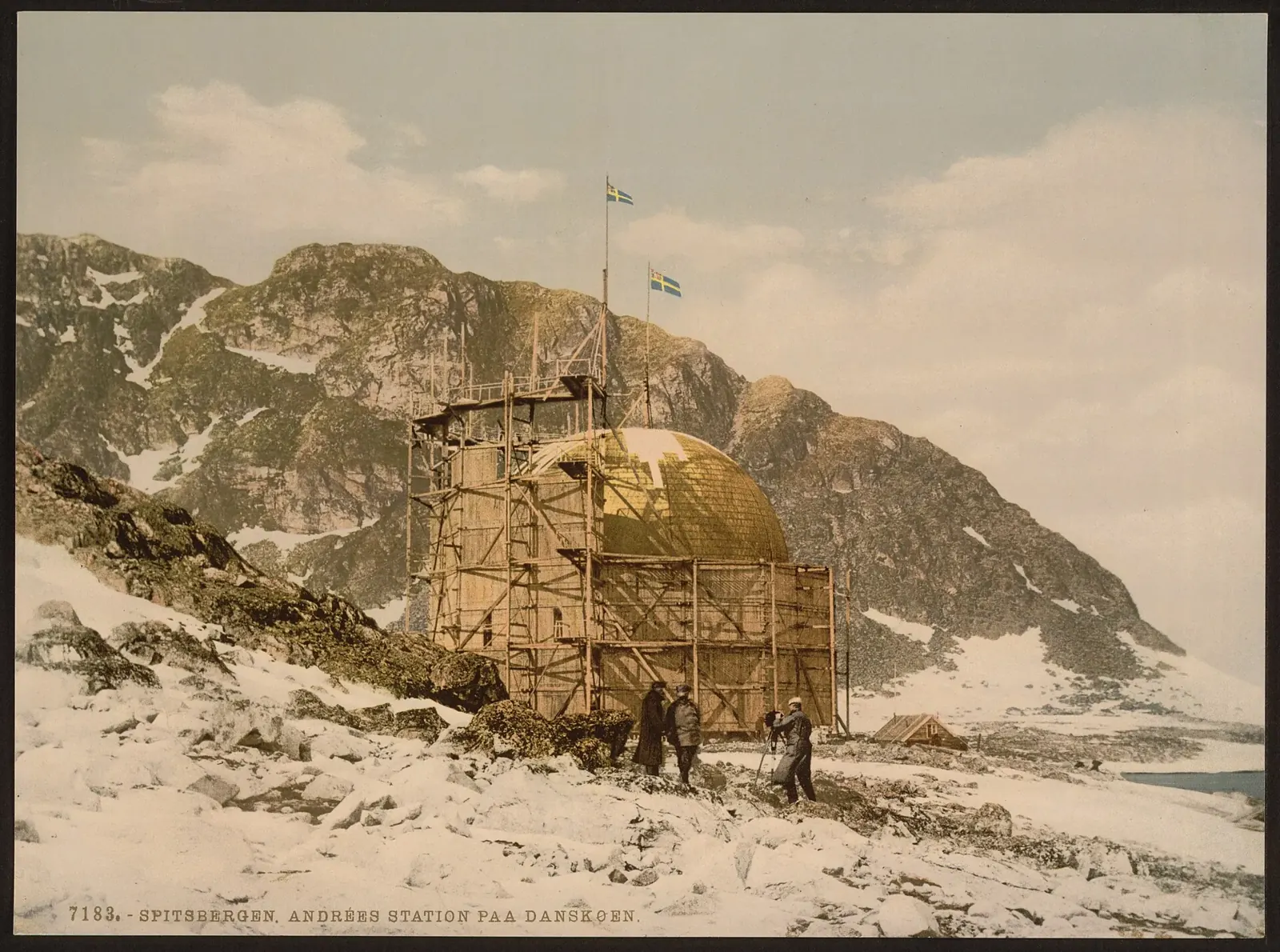

Danskøya, 11 July 1897
11 July 1897: they go, although Andrée hesitates
For the second attempt the expedition left Gothenburg on 18 May 1897 aboard the gunboat Svensksund. Over the winter the balloon had been enlarged with two bands of silk to about 4,800 cubic metres. On 11 July at three in the morning the water in the harbour, smooth until then, began to ruffle under a wind from the south-south-west.
735 kglost in the first minutes: 206 kg of sand thrown out and 529 kg of rope left on the shore
You are Andrée on the morning of 11 July. Do you go or wait?
- The wind: from the south-south-west, which is to say towards the north and the Pole.
- Its speed: 15 to 30 feet a second at the surface (5 to 9 m/s), in squalls; much stronger at 1,000 to 1,500 feet.
- In the harbour: two Norwegian sealers have just come in to shelter from a storm that, they say, will last some days.
- Last year: you waited in vain until 17 August.
Andrée asked the others: "Shall we try it or not?" Frænkel was evasive at first, then said they should go. Strindberg: "I think we ought to try it." Svedenborg agreed. Andrée told the ship's commander: "My companions insist on starting, and as I have no absolutely valid reasons against it I shall agree to it, although with some reluctance." Machuron, the maker's representative, who also wrote about that morning, describes Andrée as eager to be off.
They climbed into the basket at 1.43 p.m. Greenwich time; three minutes later the balloon rose and was named Örnen, the Eagle. Weighed down by its ropes it stayed under a hundred metres. A down-draught pushed it towards the sea, and the basket touched the water. They threw out eight bags of sand. On the shore a sailor shouted: "Look! the drag-lines are lying here on the shore!"
Each rope had a screw joint so that it could be released if it caught. Laid out on the shore, the ropes had kinked; as the balloon rose the kinks twisted and the joints unscrewed: two-thirds of every rope was left behind. Machuron thought they had caught on rocks. Andrée had once written that the joints were unnecessary and had accepted them only on others' advice. Without them the system Andrée meant to steer with was gone. The balloon now flew freely with the wind, and it soon climbed to nearly 600 metres, losing gas.
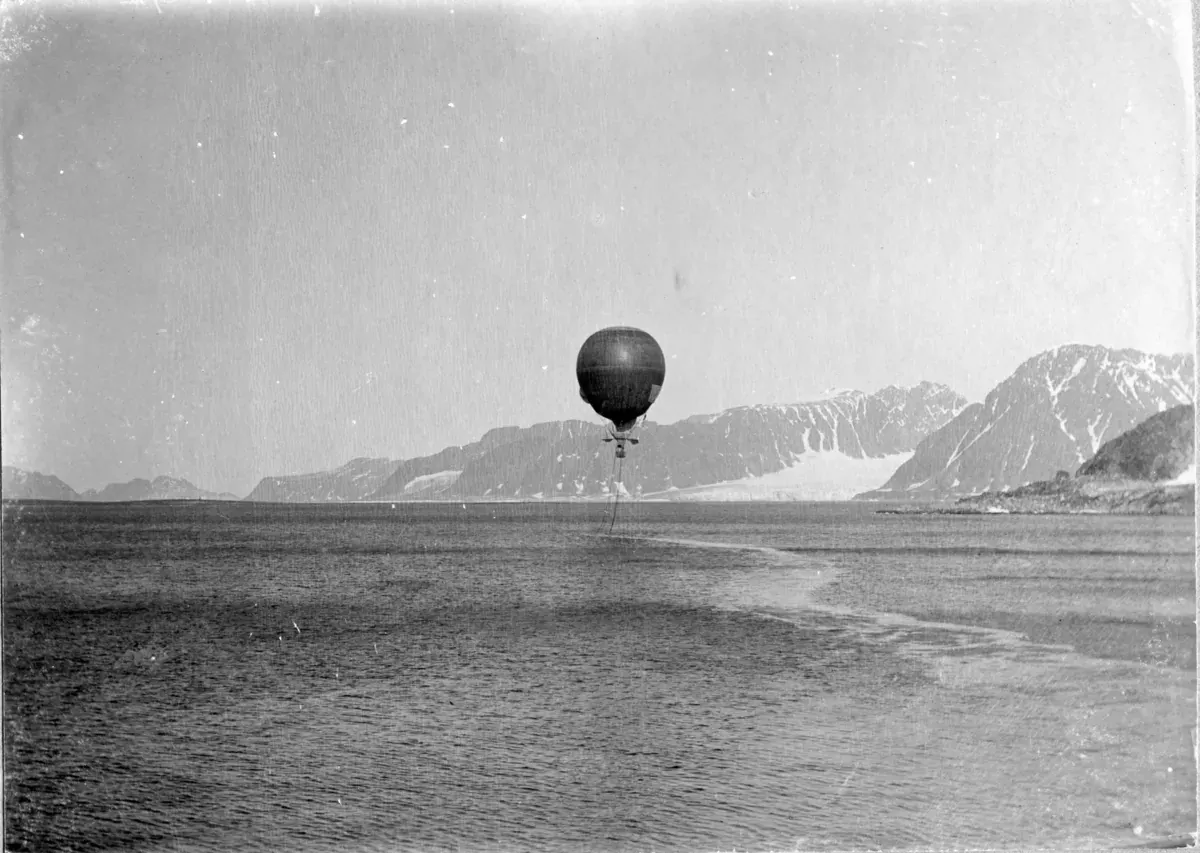

11–14 July 1897, over the ice
Sixty-five hours, ten and a half of them in free flight
The first ten hours went well. The balloon flew north-east, for a while above the clouds. At 10.55 p.m. they dropped a cork buoy with a note: "in about 82° latitude and 25° long. E. ... All well." Carried by the sea, two of the buoys with notes were found on the coasts of Iceland and Norway, in 1899 and 1900.
After midnight the balloon passed into the shadow of a cloud, cooled and sank. From 12.15 a.m. on 12 July what was left of the ropes touched the ice. The fog settled on the silk and froze; the basket struck the ice again and again. That evening a rope caught under a block of ice and held them for thirteen hours. The wind took them first west, then back east.
65 h 33 minin the air; free flight only 10 h 29 min, the rest dragging over the ice, with about 14 hours standing still
They carried dozens of carrier pigeons. How many pigeon messages reached anyone?
One. They released at least ten pigeons on three occasions. On 15 July one settled on the masthead of the Norwegian sealer Alken, and the captain shot it, taking it for a ptarmigan. The English translation of the balloon makers' book, in 1898, calls it "the fourth message"; the note itself says "the third pigeon-post".
July 13 12.30 midday. Lat. 82° 2′ Long. 15° 5′ E. good speed to E. 10° S. All well on board. This is the third pigeon-post. Andrée.
The note found in the tube on the pigeon's tail, 15 July 1897
It was the latest news of them until 1930; the buoys, dropped earlier, reached people only in 1899 and 1900. On 14 July at 7.19 in the morning the three men jumped from the basket onto the ice. The 1930 technical analysis says the balloon could no longer float because it had been covered in ice in the damp, cold air; the loss of gas mattered less.
82° 56′ N, 29° 52′ E, 14–22 July 1897
On the ice, 786 kilometres from the Pole
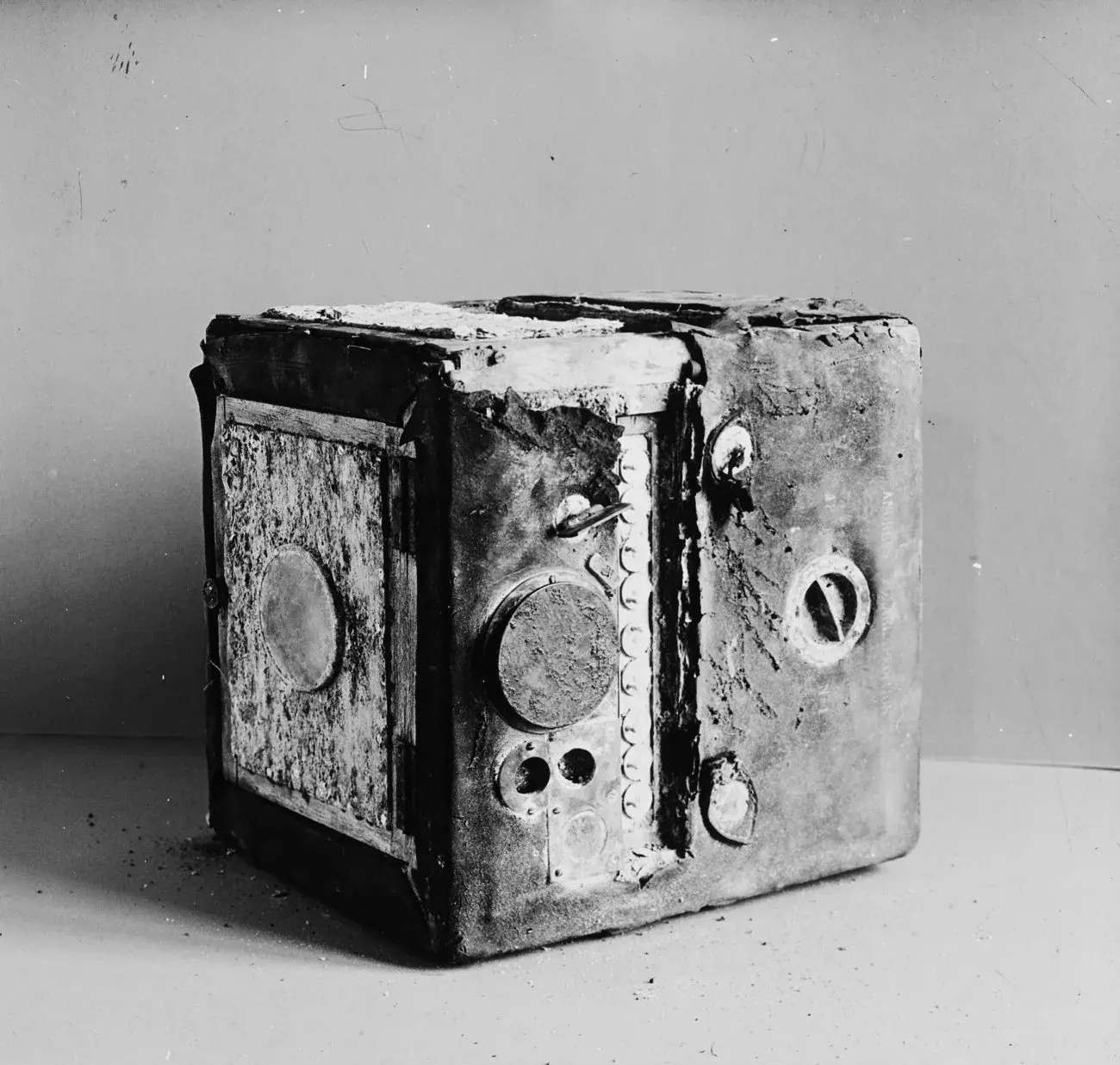
They landed with food for several months, three sledges, a canvas boat that fitted over a wooden frame, guns, and Strindberg's camera. The nearest land was about 180 miles (290 km) away. For a week they stayed by the balloon: they loaded the sledges, shot a bear, and Strindberg took photographs.
Of the food depots laid in advance, two were within reach. The larger was at Cape Flora on Franz Josef Land, the archipelago where Fridtjof Nansen had wintered, so a winter there was known to be survivable. The smaller was on Sjuøyane, the Seven Islands, north of Svalbard.
8 daysbetween the landing and setting off, on 22 July
Which way would you set off?
They chose Cape Flora and set off on 22 July at seven in the evening. After thirteen days of walking, Strindberg's position fixes showed that the ice was carrying them west faster than they were walking east. On 4 August they turned for the Seven Islands. The distances above are straight lines from the landing place; on the ice the way was much longer.
.jpg)
22 July – 13 September 1897
They walked south-west. The ice took them south-east
The sledges were heavy and the ice was full of ridges of piled-up ice and channels of open water, which they crossed in the boat. On 1 August Andrée reckoned the day's march at no less than 7 kilometres. The oceanographer Harald Sverdrup, who read the diaries in 1930, concluded that a day's march of 3.5 to 4.2 miles "was something very rare".
These values show that we have driven westwards quicker than we have walked eastwards.
Andrée, diary, 31 July 1897
130 kmsouth-south-east: how far they moved in 36 days of walking south-west
From 4 August to 9 September they walked south-west, towards the Seven Islands. Which way did they actually move, on ice that was itself moving?
South-south-east. By 9 September they were about 81 miles (130 km) south-south-east of where they had been on 4 August, though they had walked south-west: by the 1930 reckoning, "instead of an estimated equally long distance towards the south-west". The map shows the two routes.
The red dot shows where they were, from Strindberg's position fixes. The blue dot walks the course they set, south-west from 4 August, as if the ice had not moved: the 130 kilometres the 1930 reckoning took as the equivalent of their effort.
On 10 August they crossed below 82° and held a feast. On 12 and 13 September a strong north-westerly wind kept them in place. Then they decided to winter on the ice: the current and the wind, Andrée wrote, were carrying them "irresistibly" towards the strait between Svalbard and Franz Josef Land.
.jpg)
Kvitøya, 17 September – October 1897
White Island, and a note written in advance
On 17 September they saw land for the first time since the start: Kvitøya, White Island, which seemed to them "one single block of ice", at the eastern end of Svalbard. Since 12 September the ice had carried them at least 45 miles to the south-south-east.
On their floe they built a hut of ice blocks and moved into it on 28 or 29 September (the diaries give different dates). On 2 October at half past five in the morning the floe split right beside the hut. That is where Andrée's large diary ends:
No one had lost courage; with such comrades one should be able to manage under, I may say, any circumstances.
Andrée, diary, written after 2 October 1897
On 5 October they moved onto the island. Strindberg wrote in his almanac: "Moved to land." On the 6th: "Snow-storm reconnoitring." On the 7th: "Moving." Andrée wrote a few more lines, hard to read, in the first days of October. Strindberg died first, and the other two buried him. The day of death is not known for any of them.
Strindberg's almanac has one more entry, for 17 October: "Home 7.05 a.m."
24 macross: the floe left to them after 2 October
What do you think "Home 7.05 a.m.", on 17 October, means?
The 1930 editors read it as a return to camp, so all three would have been alive on 17 October. In a letter of 1938, printed by Vilhjalmur Stefansson in 1939, the geographer Hans Ahlmann, himself a member of the committee that edited the book, argued otherwise. Strindberg had written the dates into his first almanac in advance, and against 18 October, Andrée's birthday, he had put "Home". In the second almanac "Home" was entered against 17 October, with the time a train arrived in Stockholm. Stefansson added that it was the train Strindberg hoped to come back on.
If Ahlmann is right, the last dated entry is Strindberg's, of 7 October; Andrée's last lines, undated, belong to the first week of October (Stefansson puts them on the 8th).
Kvitøya, 6 August 1930
1930: a summer when the ice drew back
Kvitøya is usually locked in by ice, one of the hardest places in Svalbard to reach. In the summer of 1930 the sea around it was almost clear. The Norwegian ship Bratvaag, carrying a scientific expedition to Franz Josef Land and sealing on the way, put in at the island on 5 August. It was not looking for anyone.
The next day two sealers, Olav Salen, aged 17, and Karl Tusvik, 24, found an aluminium lid and then the canvas boat, half buried in snow. The first notebook taken from the camp had a title on its first page: "The Sledge Journey, 1897". In September a second ship, the Isbjørn, found the rest: more snow had melted, and among the objects were Strindberg's almanac, Frænkel's notebooks and metal tins of film.
On 5 October 1930, thirty-three years to the day after they had moved onto Kvitøya, the gunboat Svensksund, the ship that had carried them north, brought them home to Stockholm.
33 yearsbetween exposure and development
The film spent 33 years on the island, in metal tins partly filled with water. How many frames could be developed?
A few dozen. John Hertzberg, of the Royal Institute of Technology in Stockholm, took the rolls "with very small hopes": the Kodak film should have been developed by February 1898. He worked for weeks, bit by bit. From 192 frames on four rolls he obtained some 50 with traces of a picture, 20 of them clear enough to print. The 1930 book printed 12. Later counts speak of close to a hundred images.
.jpg)
Nils Strindberg's film, July 1897, developed in 1930
The photographs, in the order they were taken
Strindberg took onto the ice a camera built for the expedition in Stockholm, with Kodak film on rolls of 48 frames. Below are ten of the photographs Hertzberg developed in 1930, from the landing to the sledge journey. Dates follow the museum's captions where they give one; the others are inferred from the diaries.
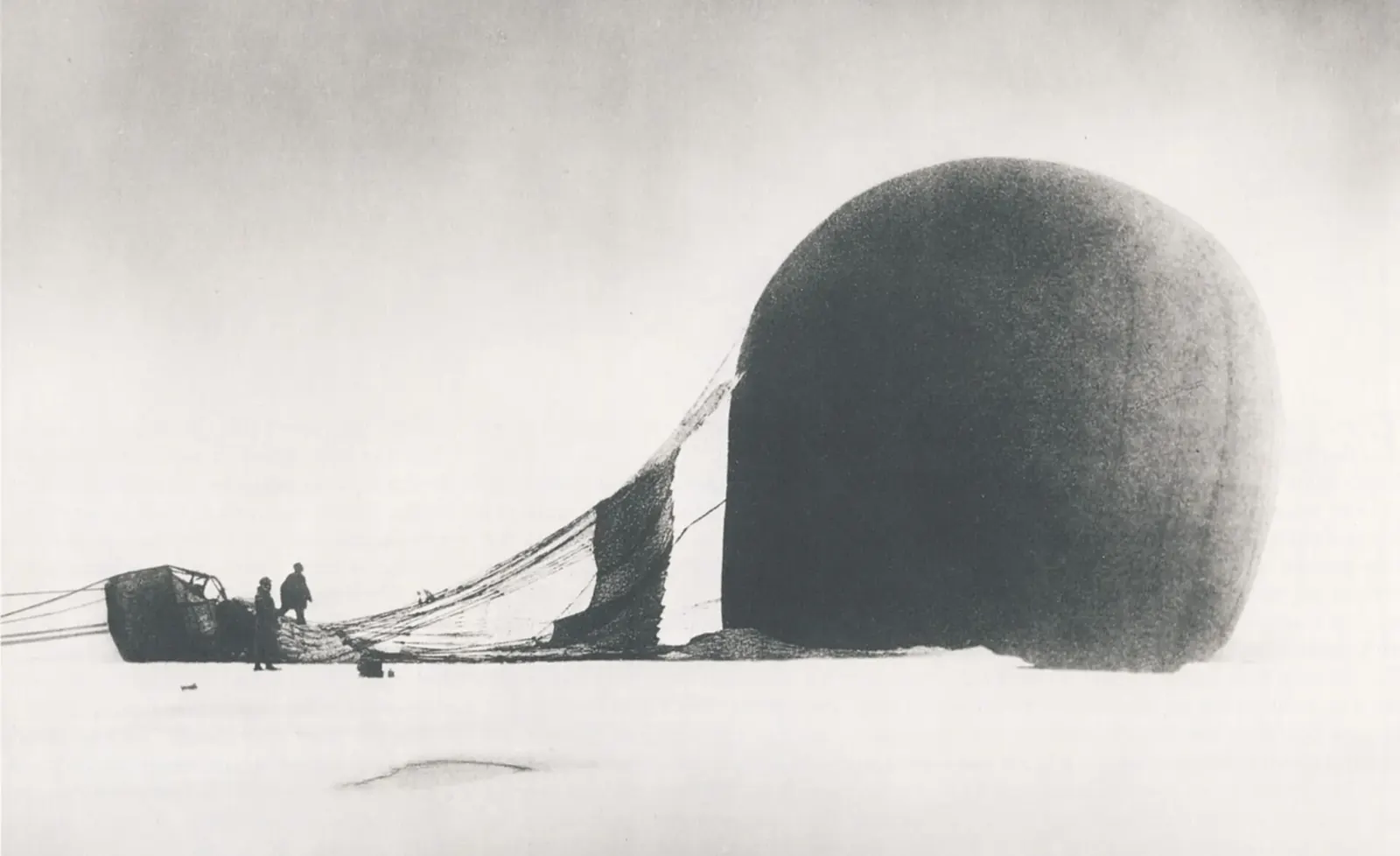
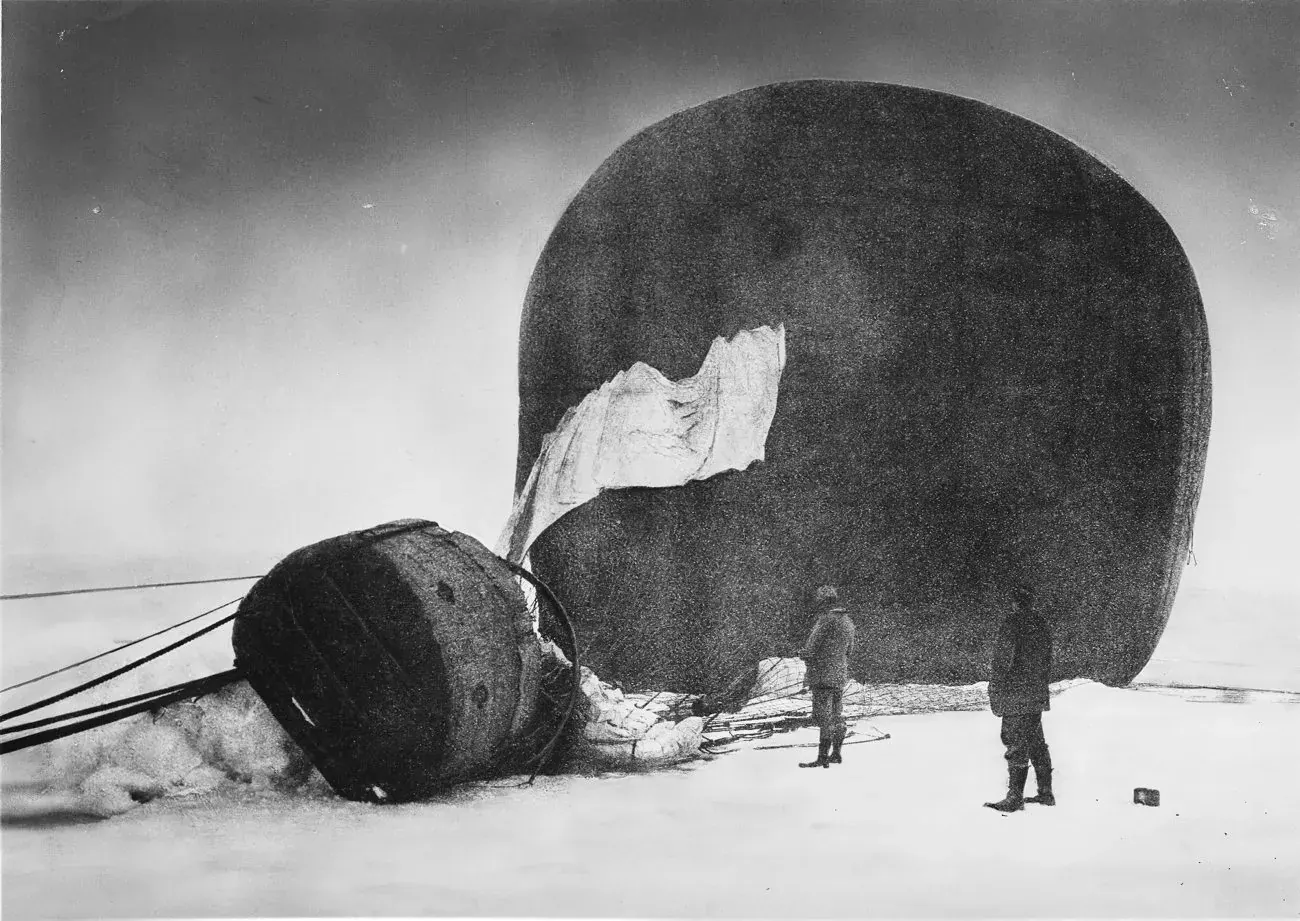
14 July. The balloon soon after landing, with two of the men by the basket.Nils Strindberg, 1897 · public domain 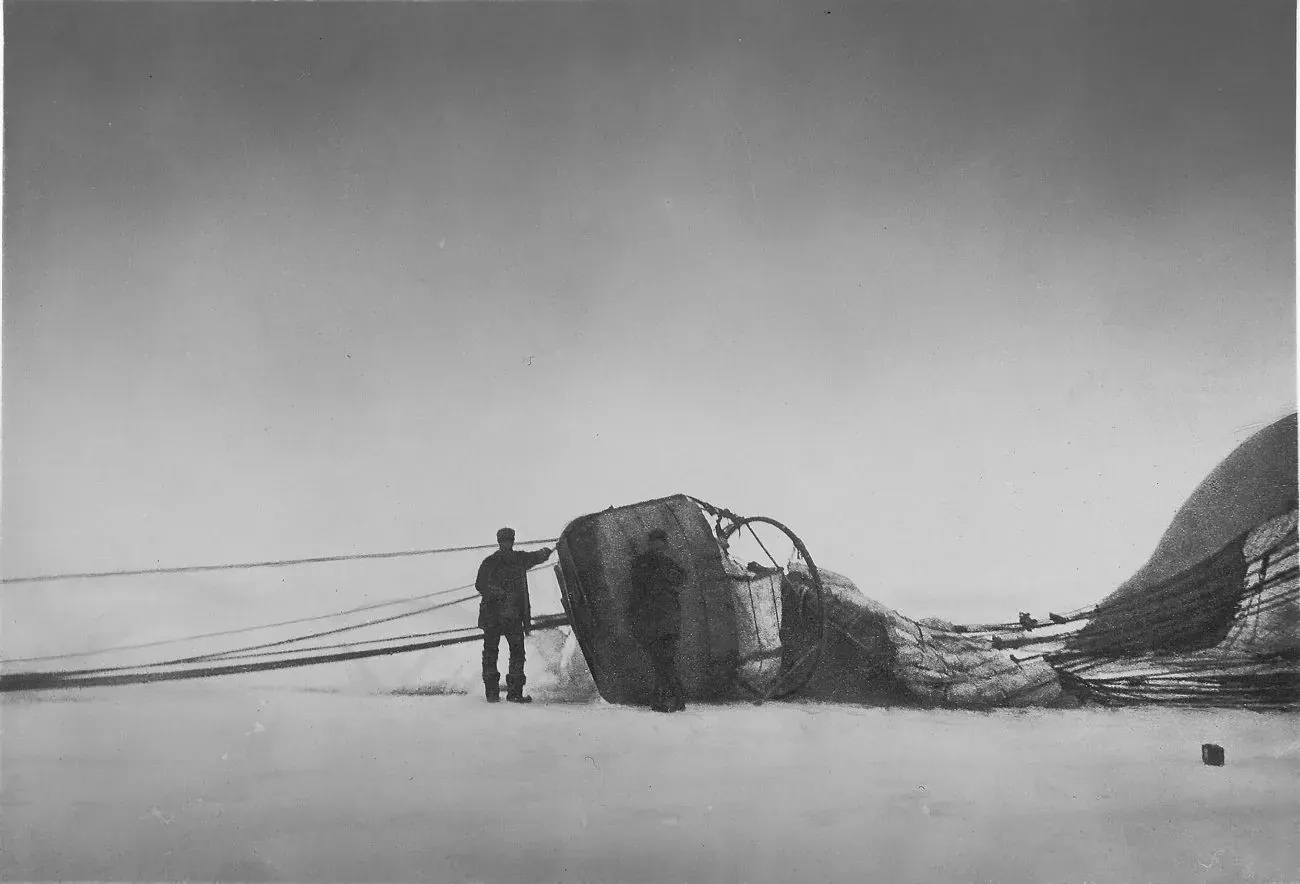
14 July. The basket and the fallen balloon, also on 14 July.Nils Strindberg, 1897; Tekniska museet · CC BY 2.0 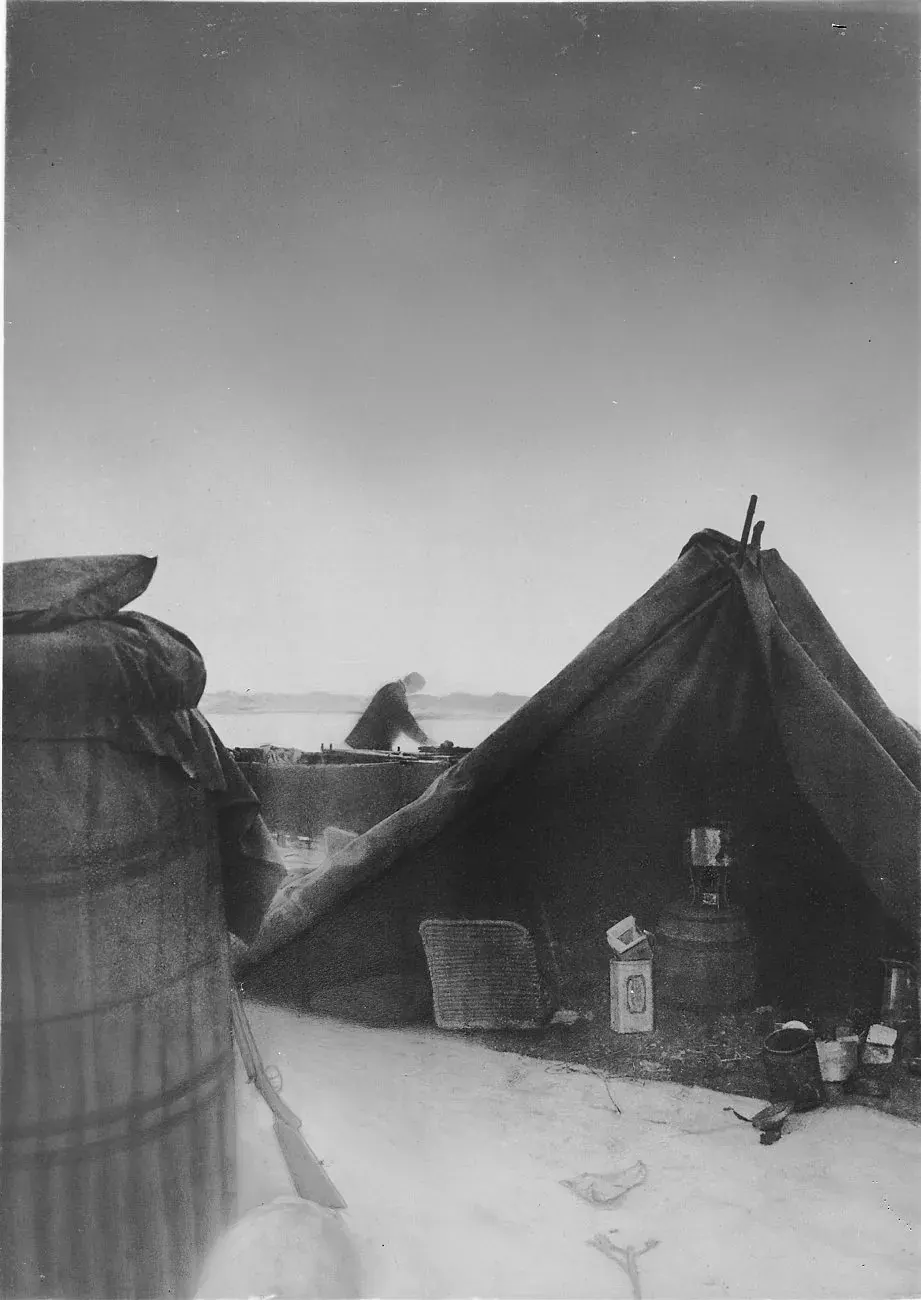
14–22 July. The camp at the landing place: the basket on the left, the tent on the right, the boat between.Nils Strindberg, 1897; Tekniska museet · CC BY 2.0 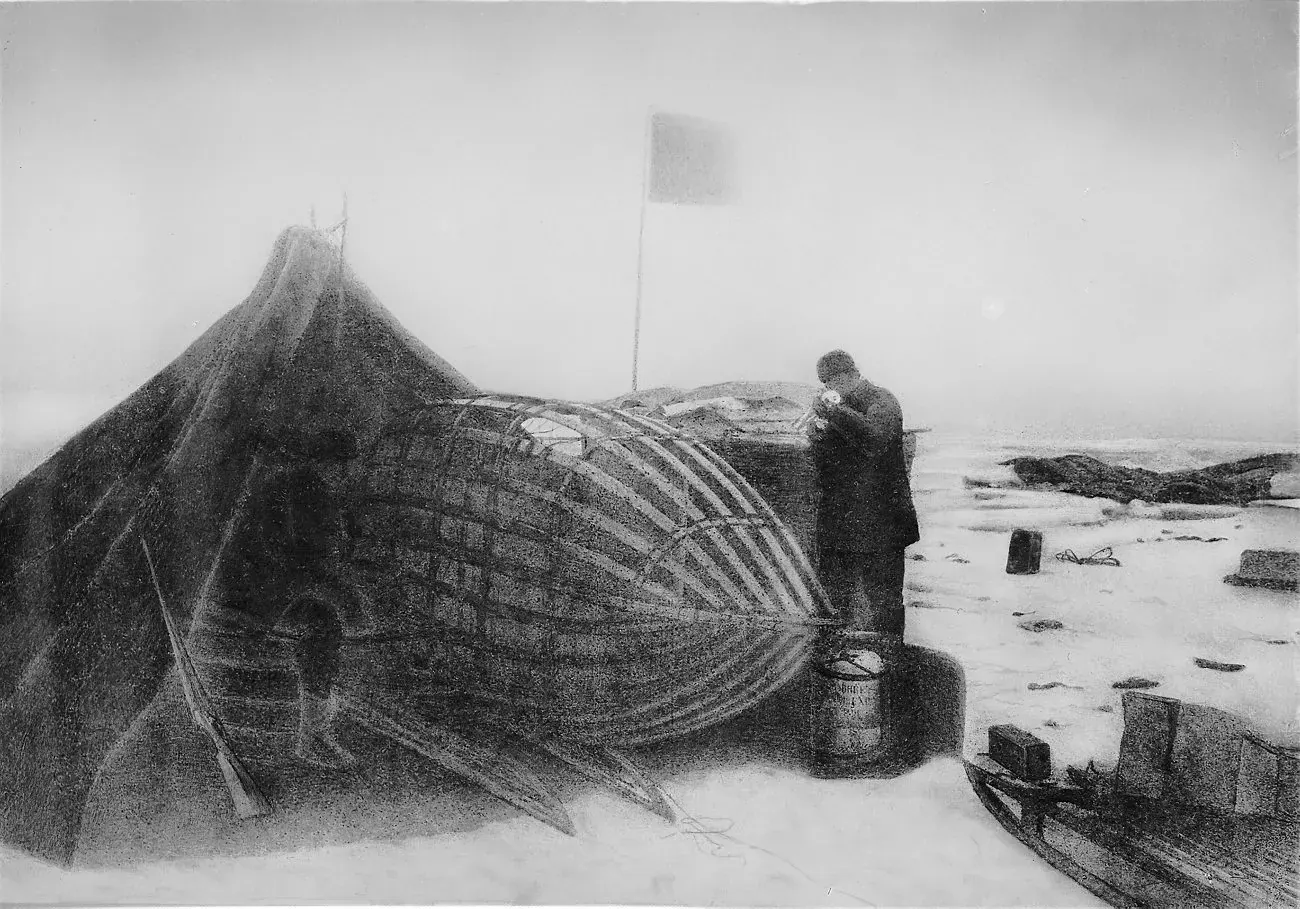
15–19 July. Fitting the boat's wooden frame.Nils Strindberg, 1897; Tekniska museet · CC BY 2.0 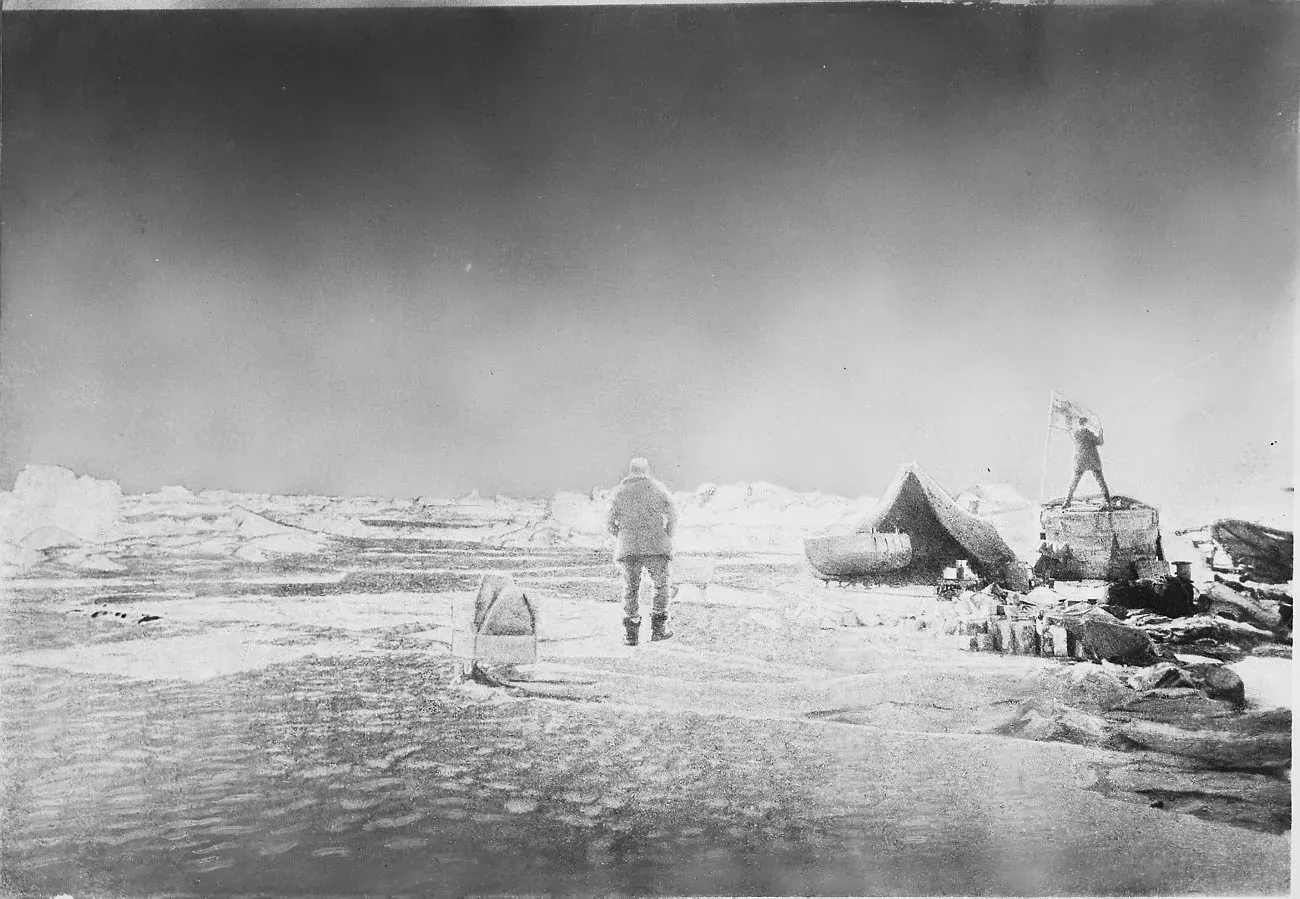
19 July. Andrée, up on the basket, searches the horizon for land. Frænkel is in the middle of the picture.Nils Strindberg, 1897; Tekniska museet · CC BY 2.0 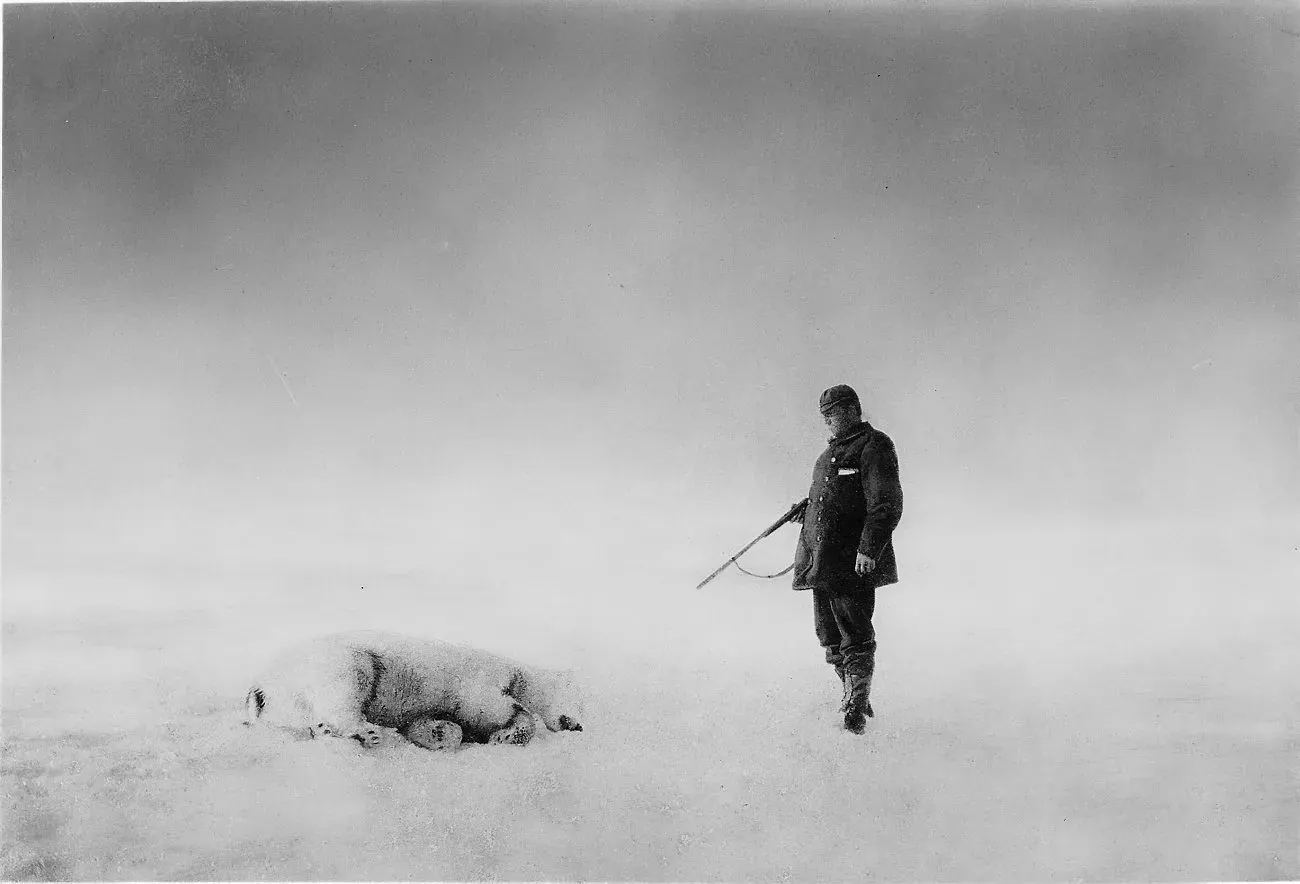
probably 19 July. Andrée beside a polar bear they had shot. Bear meat went into their daily rations.Nils Strindberg, 1897; Tekniska museet · CC BY 2.0 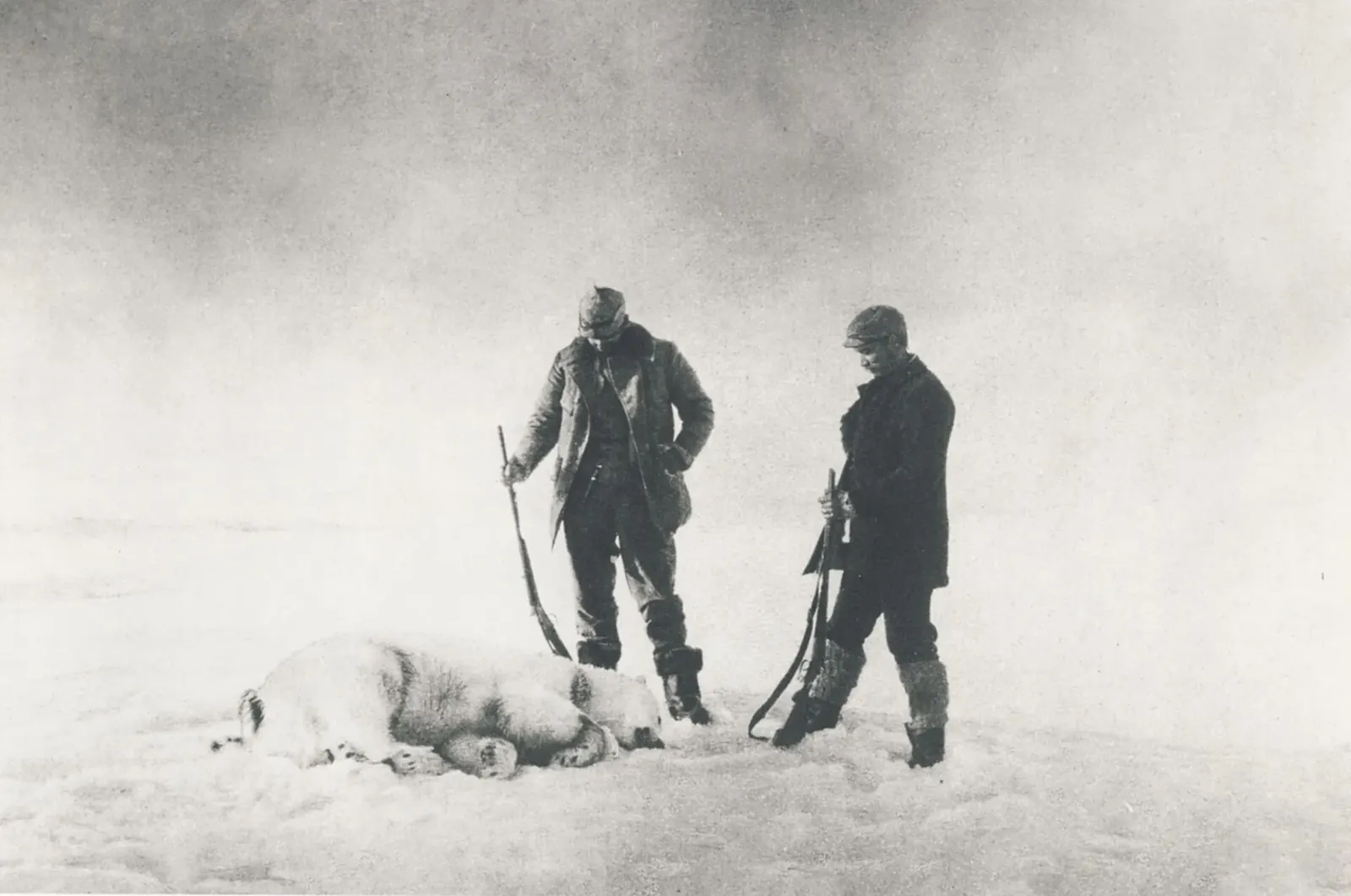
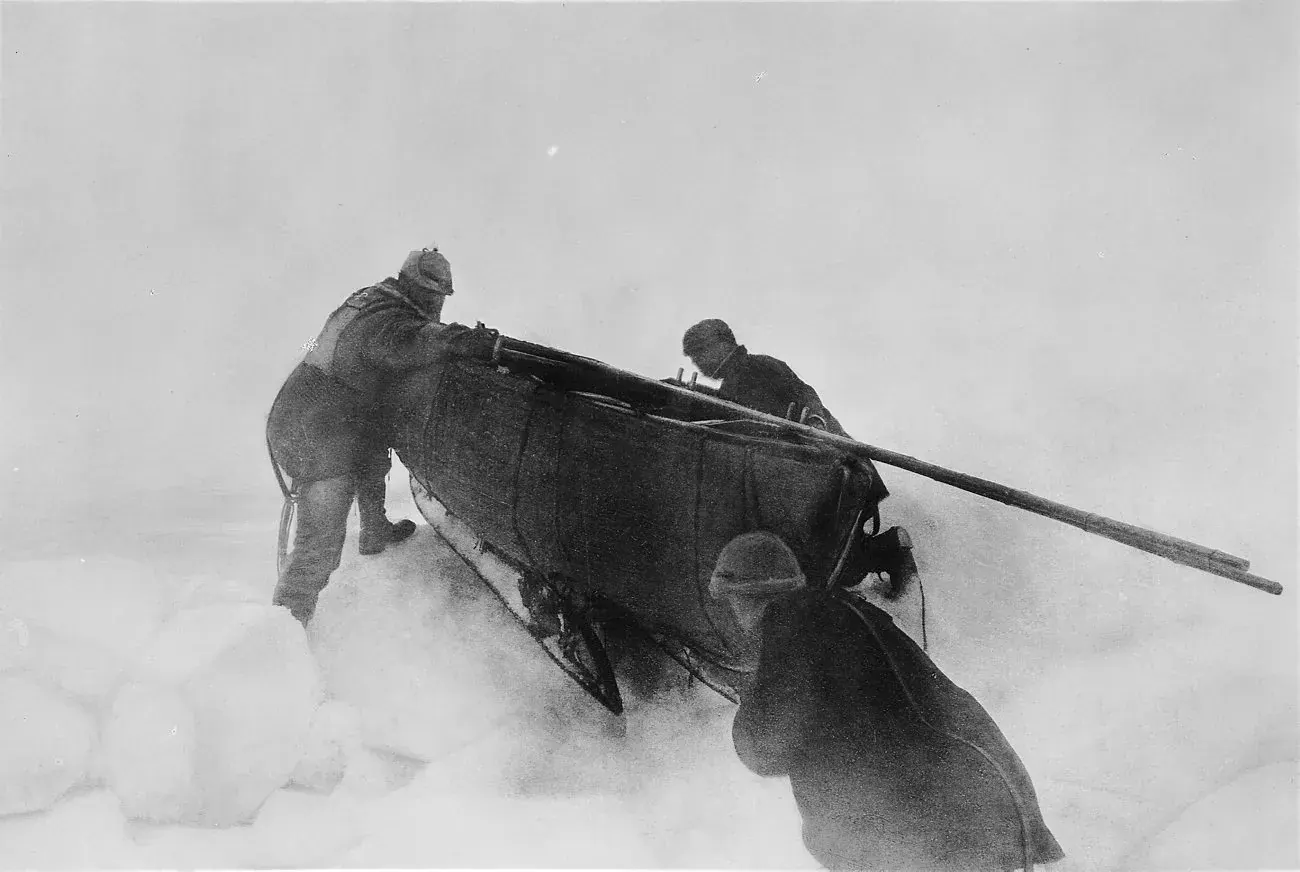
July. Two of the men with another bear. The museum names them as Frænkel and Strindberg; the 1930 book as Andrée and Frænkel.the Andrée expedition, 1897 · public domain after 22 July. All three push the sledge over a pressure ridge; the camera seems to have had a self-timer.Nils Strindberg's camera, 1897; Tekniska museet · CC BY 2.0 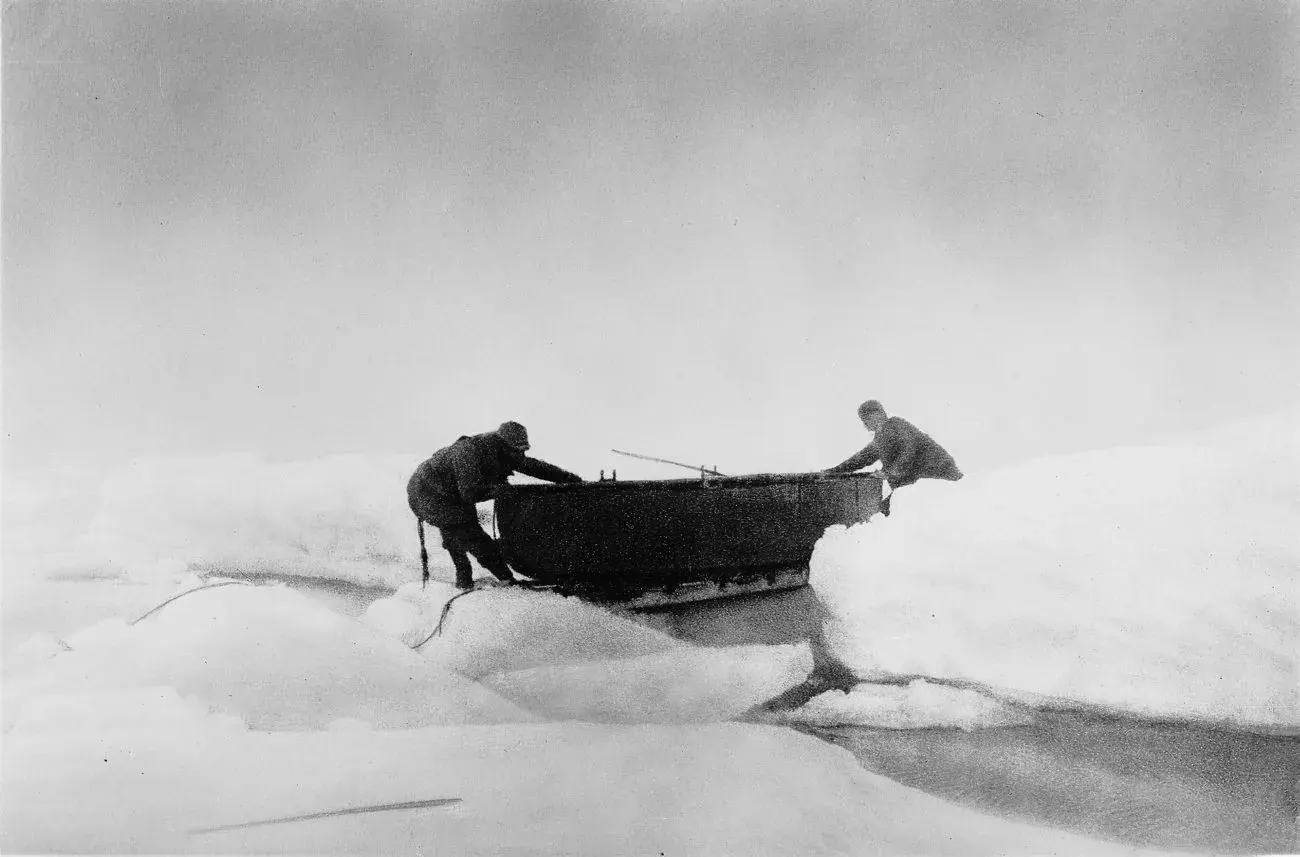
after 22 July. Frænkel's sledge, with the boat on it, hauled between blocks of ice.Nils Strindberg, 1897; Tekniska museet · CC BY 2.0 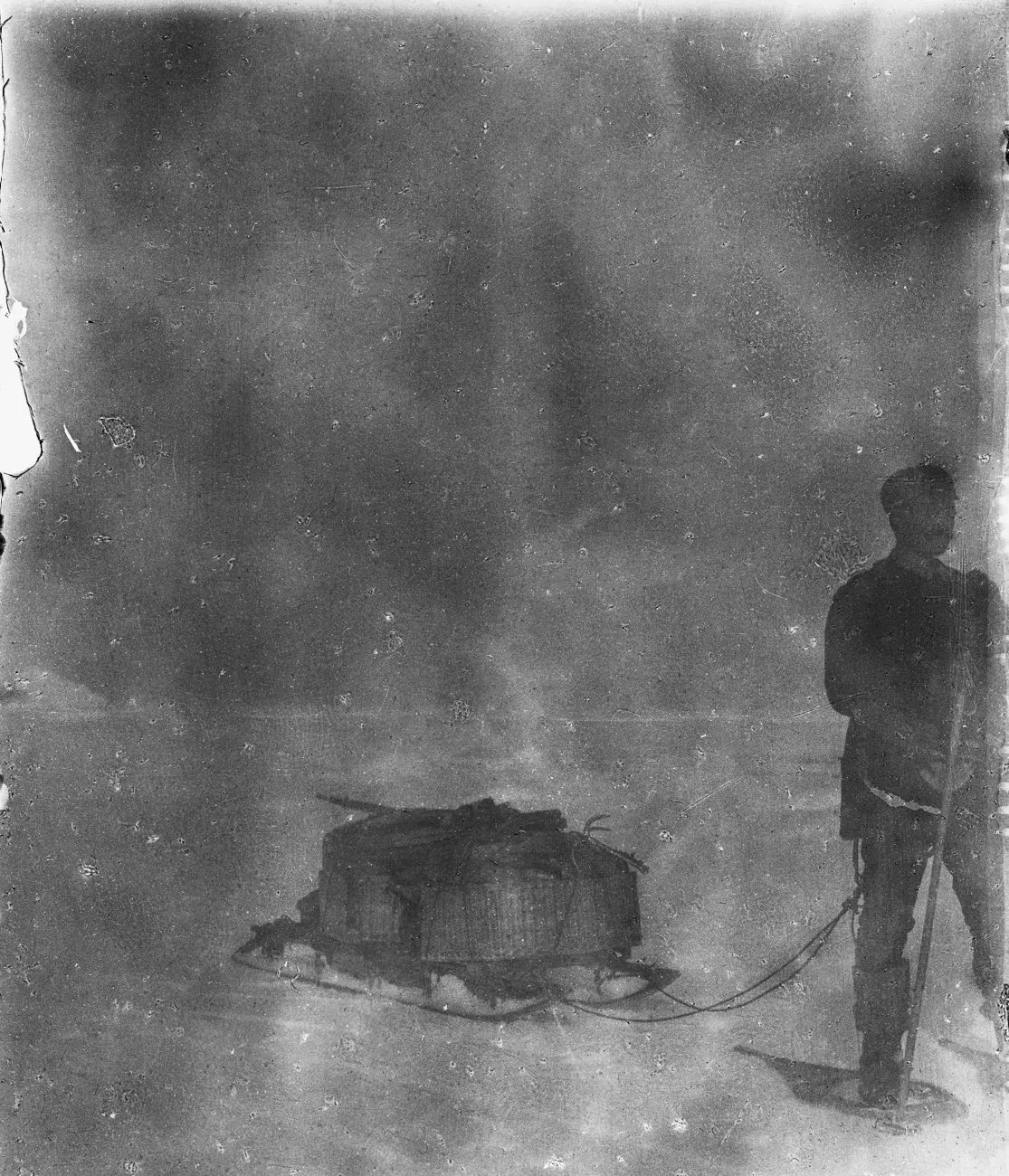
after 22 July. Strindberg hauls a loaded sledge; the only picture with snowshoes in use.S. A. Andrée, 1897; Tekniska museet · CC BY 2.0

.jpg)
.jpg)
.jpg)
.jpg)
.jpg)

.jpg)
.jpg)
Kvitøya, October 1897
Why did they die? Nobody knows
What is certain: they moved onto the island on 5 October, the certain entries stop in the first days of October, and Strindberg died first and was buried by the other two. In the camp there was bear and seal meat, at least 135 ball cartridges and 120 shot cartridges, a hundred boxes of matches and a Primus stove that still held paraffin. The 1930 report judged their clothes and tent too poor for an Arctic winter; Bea Uusma thinks they had warm clothes.
In 1930 the bodies were examined at Tromsø, but no proper autopsy was done, and they were then cremated. They can no longer be studied; only objects and clothing kept in museums can be analysed. Below are the explanations put forward and what each one requires.
Before you read the hypotheses: what had they run out of when they died?
None. The 1930 report insists on it: they had meat, cartridges, matches, paraffin and driftwood. A member of the commission quoted a sealer from the Isbjørn: "I think they died in their sleep! The cold finished them. In any case, they didn't die of hunger."
Cold and exhaustion
The 1930 report; Per-Ola Granberg and the polar researcher Rolf Kjellström, Läkartidningen, 2001
- What it rests on
- Three months of hauling, one sleeping bag for three; cold makes the body lose water, and water meant melting snow.
- What it requires
- That they reached the island severely weakened and died within days.
- What weakens it
- Personne (2000) judged it unlikely: they had plenty of food and fuel, and the first entries on the island record men still moving camp and exploring.
Trichinosis, from bear meat
The Danish physician Ernst Adam Tryde, De döda på Vitön, 1952
- What it rests on
- Tryde reported Trichinella larvae in pieces of dried meat from the bear found at the camp. The diarrhoea and pains in the diaries partly fit.
- What it requires
- An infection severe enough to kill all three, days apart.
- What weakens it
- The disease rarely kills, and death usually comes weeks after infection. The diaries record no fever or swollen eyelids. Other explorers, Nansen among them, ate bear meat in the same region and survived.
Botulism
The toxicologist Mark Personne, Läkartidningen, 2000
- What it rests on
- Seal meat carried for days and a stove that did not always work; type E toxin, common in the region, usually leaves no sign of spoilage. Personne also cites the remains of a seal shot on 19 September, found at the camp, and Frænkel's sunglasses: light hurts early in the illness.
- What it requires
- Contaminated food, and three deaths close together but not at the same moment.
- What weakens it
- It cannot be tested, and part of the argument rests on absences: entries that stop, a hurried burial. Granberg and Kjellström called it "unusually far-fetched".
A polar bear
The physician and author Bea Uusma, Expeditionen, 2013, and Vitön, 2025
- What it rests on
- Tears in Strindberg's clothes, found in museum storage; stains on Frænkel's jacket, tested at a laboratory in Rotterdam; a rifle beside Andrée that, she concludes, was unloaded.
- What it requires
- For Strindberg, that the tears were made by a bear. For Frænkel, that the stains are his blood, from 1897. For Andrée, Uusma tentatively suggests suicide with morphine.
- What weakens it
- In 2019 the test could not confirm blood in the degraded material. The newer results are set out in her 2025 book and in interviews; a scientific article was announced in 2019.
Carbon monoxide, from the stove
The explorer Vilhjalmur Stefansson, 1939, printing letters from the oceanographer Harald Sverdrup (idea from 1930) and the physiologist Yandell Henderson (1938); taken up in Läkartidningen, 1983
- What it rests on
- Similar incidents with Primus stoves on other polar expeditions; a small tent. Sverdrup read the air valve found closed, and the paraffin left, as a sign the stove was burning when they died.
- What it requires
- The stove burning in a closed tent. It concerns only Andrée and Frænkel; Strindberg had died before.
- What weakens it
- Personne (2000) and Granberg and Kjellström (2001) read the same closed valve as a sign the stove was not burning when they died. A worn tent would have let air in.
Scurvy, vitamin A or lead poisoning, suicide
Weighed by Mark Personne, 2000, as ruled out or unlikely
- What it rests on
- A diet low in vitamin C; bear liver; tins sealed with lead, and tests in 1997–98 on preserved samples showed excess lead; opium and morphine in the medicine chest.
- What it requires
- Months without vitamin C; bear liver eaten; a large dose of lead within days; a shared decision.
- What weakens it
- Personne: three months is too short for fatal scurvy. The diaries show they did not eat the bear liver. The highest lead reading dates from before the expedition, and lead acts slowly. Opium and morphine appear in the diaries as medicine, for diarrhoea and pain, and there is no farewell letter.
What the evidence supports. Trichinosis is the best-known hypothesis. Larvae found in the bear meat show where an infection could have come from, but not that the men were infected or that it killed them; a 2022 scientific review calls it unproven. Scurvy and vitamin A are treated as ruled out and lead as unlikely; Personne judged a shared suicide unlikely, while Uusma raises suicide for Andrée alone. The explanations most discussed today are cold and exhaustion, botulism and, for Strindberg at least, a bear.
The three men may have died of different causes; several authors examine each death separately. The Grenna Museum, which keeps their belongings, puts it plainly: "The cause of death still eludes us."
The story in numbers
| Time in the air, lift-off to landing | 65 hours 33 minutes |
|---|---|
| Of which free flight, with no rope on the ice | 10 hours 29 minutes |
| Straight-line distance, Danskøya to the landing place | 473 kilometres (the 1930 report: about 300 miles, 483 km) |
| Distance from the landing place to the Pole | 786 kilometres |
| Lost in the first minutes | 735 kg: 206 kg of sand and 529 kg of rope |
| Pigeon messages recovered | one; at least ten pigeons were released |
| Days on the ice, landing to Kvitøya | 83 |
| How far they moved, 4 August – 9 September, while walking south-west | 130 km south-south-east (81 miles) |
| Ages at lift-off | Andrée 42, Frænkel 27, Strindberg 24 |
| Frames on the four exposed rolls, per Hertzberg | 192; some 50 with traces, 20 clear |
| Years until the camp was found | 33 |
Quiz: 33 years of stories
Eight claims that have circulated between 1897 and today. Choose, then see what the sources say.
The balloon flew for 65 hours without touching the ice.
False. Of the 65 hours 33 minutes, free flight lasted 10 hours 29 minutes. For the rest the ropes dragged on the ice, and for about 14 hours the balloon stood still.
Four pigeon messages made it home.
False. One was recovered, from a bird shot by a sealer on 15 July 1897. The note says "the third pigeon-post".
It was known before lift-off that the balloon leaked.
True. In 1896 the seams let the gas out; in 1897, in the balloon house, the loss was dozens of times what Andrée's plan allowed.
It is certain that all three were still alive on 17 October 1897.
False. That is how the 1930 editors read the entry "Home 7.05 a.m.", as a return to camp. In 1938 Hans Ahlmann argued it was the time of a train to Stockholm, prepared in advance. The last securely dated entry is from 7 October.
Vilhjalmur Stefansson, Unsolved Mysteries of the Arctic, London, 1939
The camp was found by an expedition sent to look for them.
False. The Bratvaag was carrying a scientific expedition to Franz Josef Land and hunting seals. The sea around Kvitøya was almost clear of ice that summer, and two sealers came upon their boat.
The film was developed 33 years after it was exposed.
True. Exposed in the summer of 1897, developed by John Hertzberg in the autumn of 1930.
When they died they had run out of food.
False. The camp held bear and seal meat, ammunition, matches and paraffin. "In any case, they didn't die of hunger," a sealer said in 1930.
It is now known for certain why they died.
False. No proper autopsy was done and the bodies were cremated. Trichinosis, cold, botulism and a bear are all hypotheses.
What is not known
- What each of them died of, and on what day. It is not even known whether they died of the same cause.
- Whether they were alive on 17 October. It depends on how the entry "Home 7.05 a.m." is read: a return to camp, as the 1930 editors thought, or the time of a train, entered in advance, as Hans Ahlmann argued in 1938.
- The exact route on the ice. The line on the map joins only the positions printed in full; after 4 September there are only a few latitudes (12 and 15 September), not drawn. The 1930 book notes a mean difference of half a degree in longitude between Strindberg's own map and the recalculated one, from an error in his lunar distances.
- How many photographs there are. Hertzberg counted 192 frames, some 50 with traces and 20 that might be printed; another chapter of the same book speaks of 12 successfully developed; a present-day source of close to a hundred. The sources do not explain the difference.
- Who is in the photograph with the second bear: the museum names Frænkel and Strindberg, the 1930 book Andrée and Frænkel.
- Where each buoy was found. The 1930 book contradicts itself: one chapter puts buoy no. 4 in Norway and no. 7 in Iceland, another the other way round.
- How many pigeons they took: 36, by the 1930 report, or 32, by the balloon makers.
- Why Nils Ekholm withdrew. The 1930 book links his withdrawal to the leaks only by where it mentions it; the story that he discovered secret top-ups of gas appears only in secondary sources.
Sources
Nearly everything known about the flight and the walk on the ice comes from one book: the 1930 edition of the diaries of Andrée, Strindberg and Frænkel, with the Swedish scientists' analyses. Times are Greenwich time, as the editors converted them. Distances on the map are computed on a sphere from the printed positions; the miles in the English edition are statute miles.
- Andrée's Story: The Complete Record of His Polar Flight, 1897, New York, Viking Press, 1930 (the diaries, with the report of the Swedish Society for Anthropology and Geography). archive.org/details/andreesstory0000edwa
- Henri Lachambre and Alexis Machuron, Andrée's Balloon Expedition in Search of the North Pole, New York, 1898. archive.org/details/andreesballoone00machgoog
- Grenna Museum, The Andrée Expedition. www.grennamuseum.se/en/the-andree-expedition/
- Björn Axel Johansson, "Nils Strindberg och Andrées polarfärd 1897", Svenska Fotografers Förbund, 2022. www.sfoto.se/fotohistoria/nils-strindberg-och-andrees-polarfard-1897/
- Norwegian Polar Institute, Svalbard place names. placenames.npolar.no/
- Mark Personne, "Andrée-expeditionens män dog troligen av botulism", Läkartidningen 97 (2000): 1427–1432. pubmed.ncbi.nlm.nih.gov/10765627/
- Per-Ola Granberg and Rolf Kjellström, "Hypotermi troligaste orsaken till Andrée-männens död", Läkartidningen 98 (2001): 475–476. pubmed.ncbi.nlm.nih.gov/11229099/
- Antti Oksanen et al., "Epidemiology of Trichinella in the Arctic and subarctic: A review", Food and Waterborne Parasitology 28 (2022). pmc.ncbi.nlm.nih.gov/articles/PMC9263860/
- Vilhjalmur Stefansson, Unsolved Mysteries of the Arctic, London, 1939. archive.org/details/dli.csl.5285
- SVT Jönköping, "Fortsatt mystik kring Andréexpeditionen", 14 October 2019. www.svt.se/nyheter/lokalt/jonkoping/fortsatt-mystik-kring-andreexpeditionen
- "Mötet: Bea Uusma", interview, Läkartidningen, 2025. lakartidningen.se/kultur/motet/andree-expeditionen-har-allt-man-behover/
Photographs
- Nils Strindberg, 1897 · public domain
- Nils Strindberg, 1897; Tekniska museet · CC BY 2.0
- Nils Strindberg, 1897; Tekniska museet · CC BY 2.0
- Nils Strindberg, 1897; Tekniska museet · CC BY 2.0
- Nils Strindberg, 1897; Tekniska museet · CC BY 2.0
- Nils Strindberg, 1897; Tekniska museet · CC BY 2.0
- Nils Strindberg, 1897; Tekniska museet · CC BY 2.0
- the Andrée expedition, 1897 · public domain
- Nils Strindberg's camera, 1897; Tekniska museet · CC BY 2.0
- Nils Strindberg, 1897; Tekniska museet · CC BY 2.0
- S. A. Andrée, 1897; Tekniska museet · CC BY 2.0
- G. V. E. Svedenborg, 1897; Grenna Museum · CC BY-SA 4.0
- Detroit Publishing Co., photochrom · public domain
- Gösta Florman studio, Stockholm, 3 May 1897; Tekniska museet · CC BY 2.0
- John Hertzberg; Tekniska museet · CC BY 2.0
- Sjöfartsmuseet Akvariet, Göteborg · CC BY 4.0
.jpg)
