Dobruja, the year 992
The chalk churches whose walls no one can read
In a chalk hill near Murfatlar, monks carved churches and cells more than a thousand years ago, and the walls filled with inscriptions in several scripts: Greek, Glagolitic, Cyrillic and Turkic runes. Most were never deciphered. And the chalk is flaking.
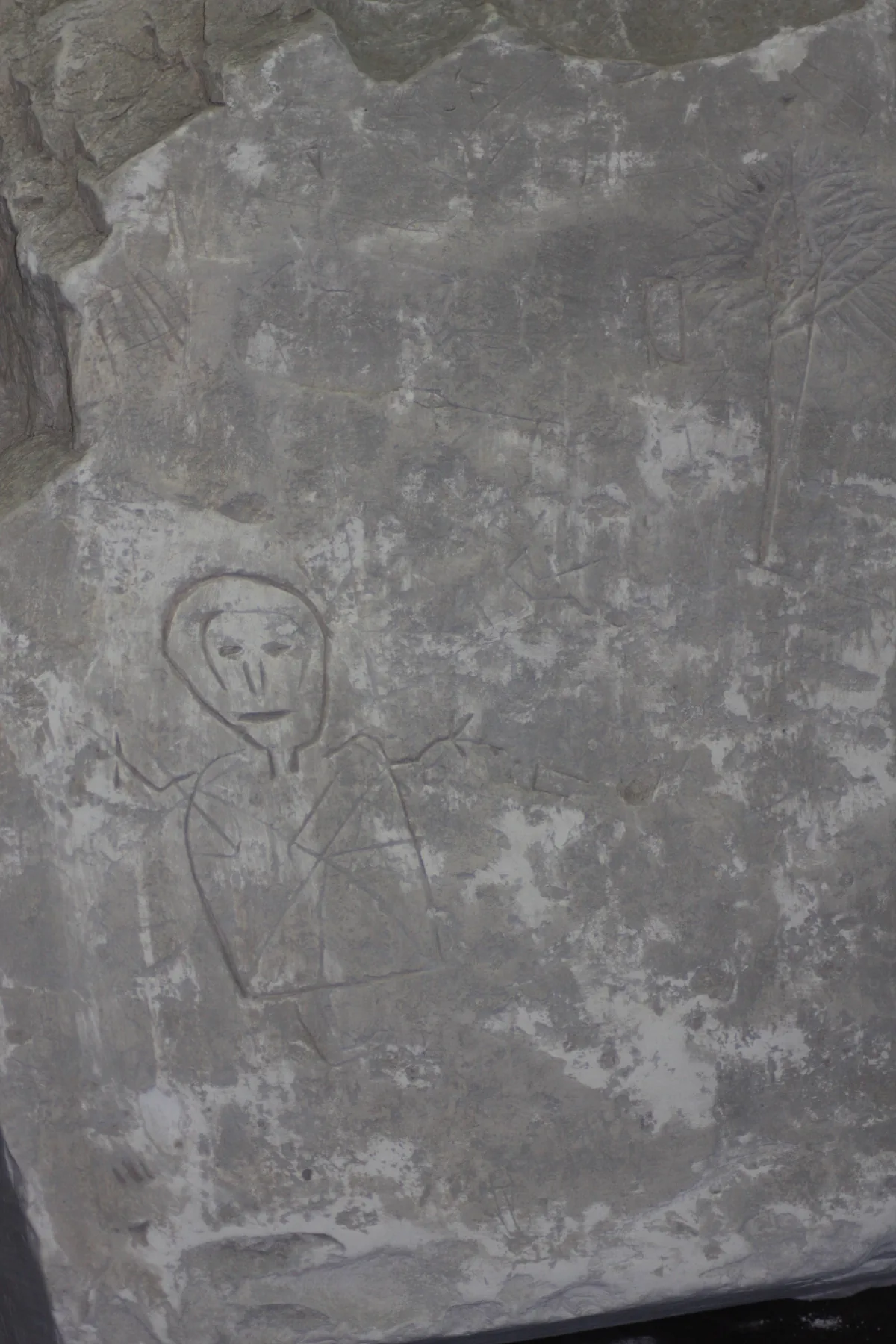

Four scripts and drawings on the same wall
Pick one below. The colour says whether we can read it. Many hands scratched them, at different times: monks, pilgrims and quarry workers.
A diagram, not a copy of the wall: it shows the four scripts and the drawings, not what they look like.
- readable
- visible, not readable
- undeciphered
132 inscriptions in four scripts, over 500 graffiti in all — the 2021–2023 count.
-
Turkic runes
About 60, in the 2009 inventory
undeciphered
Most of the markings at Basarabi are written in Turkic-type runes, the same kind of signs as on the Pliska Rosette and on the walls of the first Bulgarian capital. The language is probably Bulgar. After many attempts at decipherment, no reading is accepted by all, and the script looks mixed.
-
Cyrillic
20, in the 2009 inventory, plus new ones
readable
The 2009 inventory counted 20 texts in the Cyrillic alphabet, the largest layer among the scripts we can read. In 2024, two more newly found Cyrillic graffiti were published, from the narthex of church B4.
-
Glagolitic
One Old Slavonic text
readable
A single text in Old Slavonic, in Bulgarian recension, written in the Glagolitic alphabet, the oldest Slavic alphabet; it places the monastery in the world of the First Bulgarian Empire, in the tenth century.
-
Greek
Three, in the 2009 inventory
readable
The 2009 inventory counted three inscriptions in Greek letters, a sign that people raised in Greek, the language of the church and of administration in the south, also wrote on the chalk walls. One is a graffito on the west wall of B4 — “March, indiction 10, year 6490”, that is, 982 — in a contested reading owed to Oikonomides.
-
Drawings
Figures, crosses, ships, a carved creature
visible, not readable
Beyond letters, the walls carry incised figures, crosses and ships; one of them was called Viking by some, a contested claim explained below. A block carved with a winged creature is kept at the museum in Constanța.
What can be read is Old Slavonic of a religious-commemorative kind: a text from the Gospel of Mark, on the west wall of the narthex, memorials with names — a priest named Aian, Simeon and Jupan Gheorghe — and one of the named, Toupan, says he cut the St George chapel into the chalk.
A blast in a quarry, on a June afternoon
The complex came to light on the afternoon of 11 June 1957. The modern quarry was widening its chalk workings westward, blasting the sterile layer that covered the massif. Part of it collapsed above church B1, on the highest level, and laid bare its entrance.
That summer the digs began, run by the Institute of Archaeology in Bucharest and the Dobruja Regional Museum. The team was Ion Barnea, in charge of the site, with Virgil Bilciurescu, Petre Diaconu, Adrian Rădulescu and Radu Florescu. They cleared the sterile layer around church B1, found a dwelling or church north-east of it, rooms C1 and C2, the E galleries and a dwelling to the south-south-west, and drew the surveys of the inscriptions and drawings and the general plan. Damage began early too: tourists touched the writings on the walls, and the E galleries were badly hit by weather after an arcade collapsed.
On 1 September 1960 the site passed to the Directorate of Historical Monuments, which cut it off from the quarry and stopped the water leaks. Joint digs with the Institute of Archaeology uncovered church B2, then the mouth of gallery H, leading down to the middle level, with church B3, and the lower one, with church B4. In 1961, surface dwellings came to light, with a small cemetery, fire hearths and ten human and animal skeletons. In 1962, two more quarry basins with crosses on their walls, plus iron tools known today only from photographs: six axes or picks, a strike-a-light, a nail and three knives. Then consolidation stopped for lack of funds.
The traditional dating — the late ninth to the early eleventh century, narrowed by Romanian archaeologists to the tenth on the pottery, the markings and the link with the great stone vallum, 59 kilometres long and dated after 943, inscribed on a block in its foundation — was revised by the Bulgarian team of 2021–2023, which raised the upper limit to the twelfth century and found a last inscription from the fourteenth. Dobruja belonged then to the First Bulgarian Empire, and the complex counts as a relic of the monasticism widespread in tenth-century Bulgaria.
Two markings give years: a Slavonic inscription right of the entrance to church B1, read by Damian P. Bogdan as year 6500, that is, 992, and the Greek graffito with year 6490, that is, 982. Both readings are contested.
- Where
- The north-west slope of Tibisir hill, on the bank of what was the Carasu valley, now the Danube–Black Sea Canal, 15 kilometres from the coast
- When
- Ninth to eleventh centuries in the traditional dating, with the upper limit revised to the twelfth; contested readings give 982 and 992
- What
- Rock-cut churches, among them the four labelled B1–B4, cells, galleries, crypts and tombs, on three levels
- Status
- Listed monument, code CT-I-s-A-02585
- Getting there
- Closed to visitors; the complex is sealed and decaying

The ship that may not be Viking
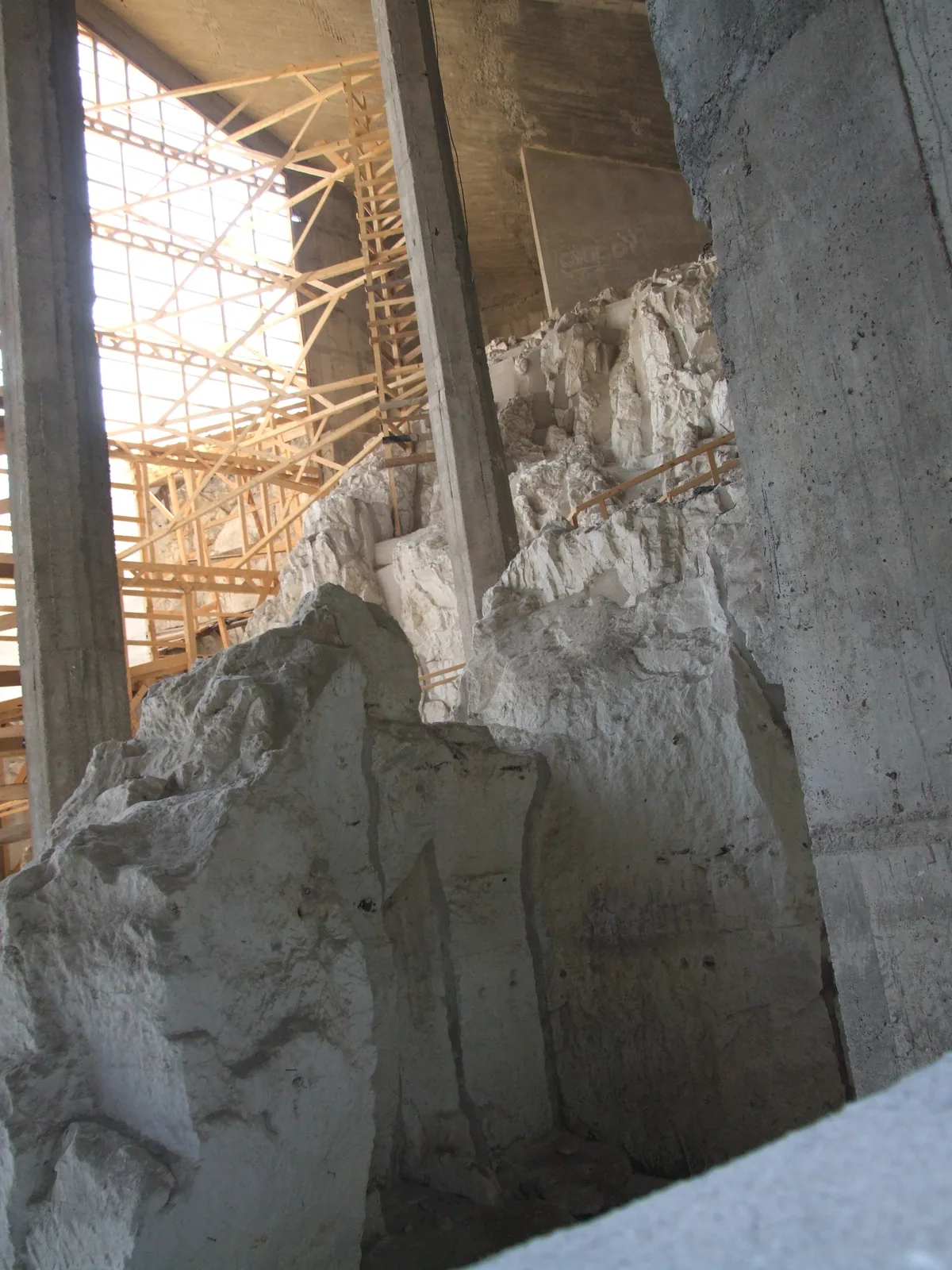
One of the drawings at Basarabi is a ship. Some Romanian scholars saw a Viking vessel in it, a sign that Northmen might have reached Dobruja. The claim travelled well: the caption of the photograph of the graffiti wall at the Constanța museum speaks of “Scandinavian-style” images.
Other scholars contested it. Vladimir Agrigoroaei first rejected the Viking claim, then re-examined it in 2008 against a similar graffito found in Sweden, with spirals at the ends and ropes tied to the mast. The question stayed open: the Basarabi ship has spirals and ropes too, but that is not proof. On another view, local monks may have scratched the drawing during the Rus' invasion of Bulgaria.
The ship remains what the rest of the complex is: a mark whose meaning is undecided. You can look at it; you cannot read it.

The chalk is flaking
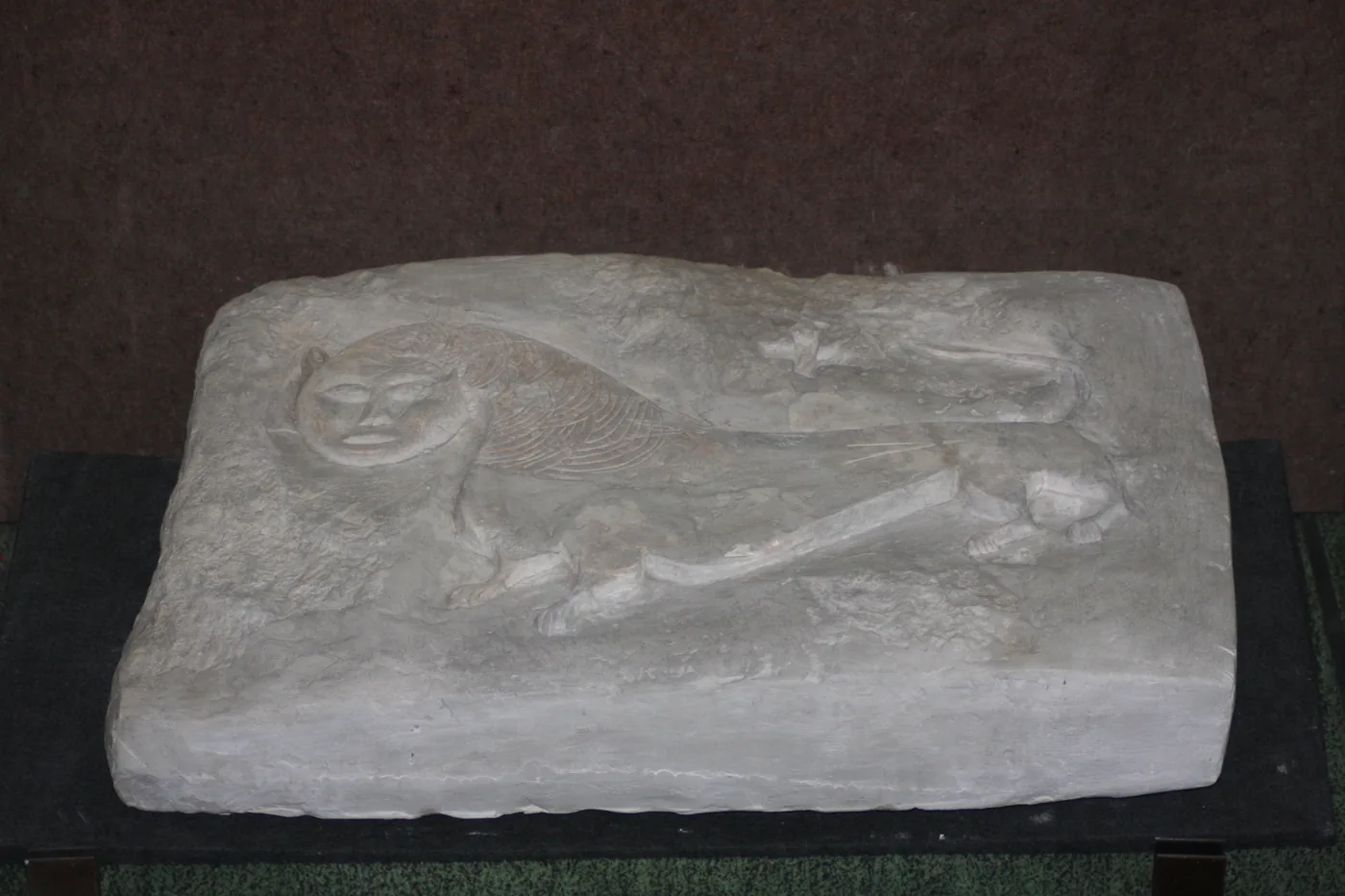
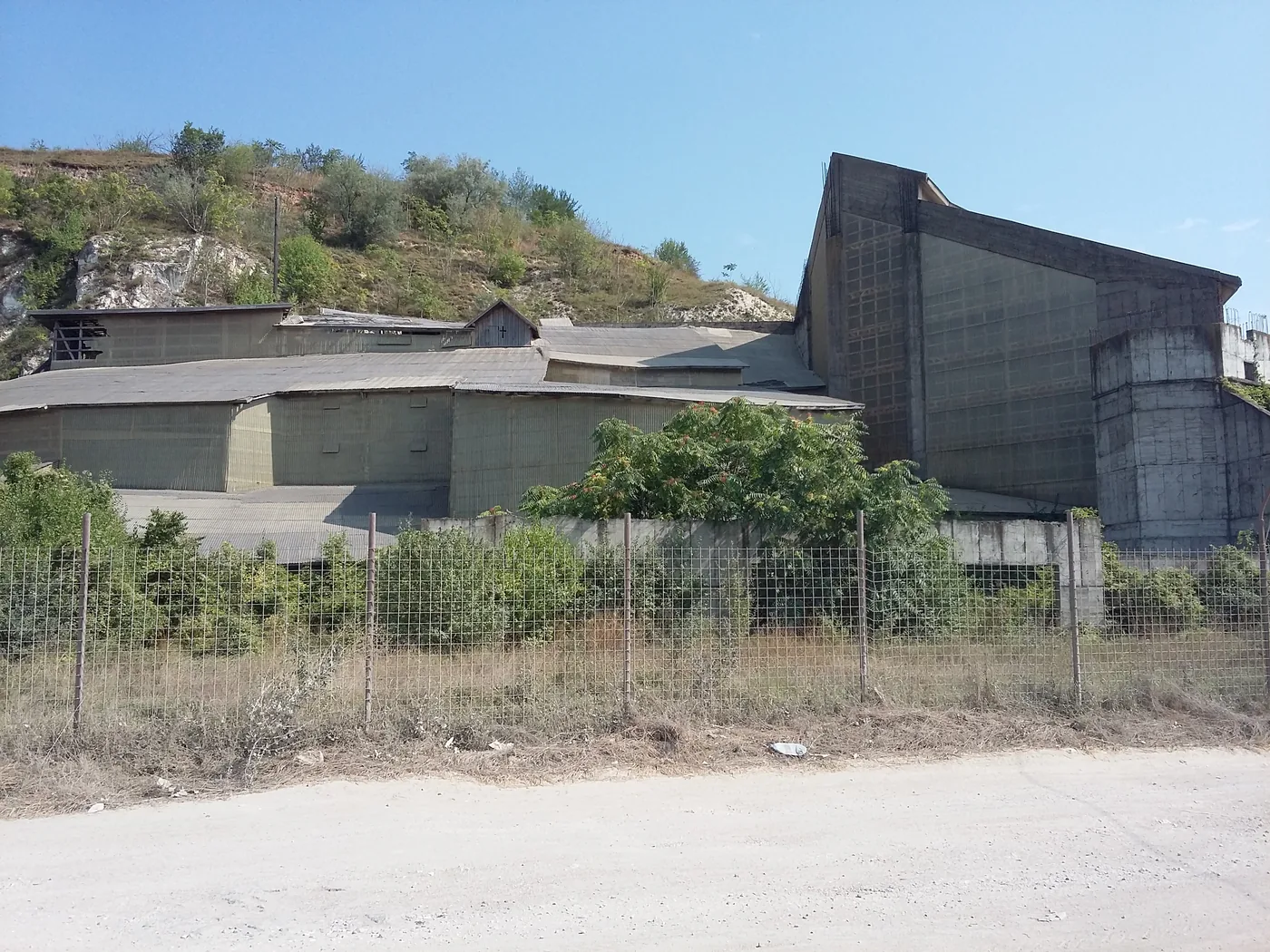
The complex is decaying fast. Of the E galleries only flaking walls remain, and in churches B1, B3 and B4 and in room C1 the walls are exfoliating. The shelter was never finished: it covers a quarter of the complex, the south-west part, and lets no air through. The town's tourism papers call the complex unvisitable, and in 2009 the archaeologists wrote that the visible graffiti grow fewer every day.
So a race against time has begun. An international team of eight researchers from Romania, Sweden and Bulgaria, including Antoaneta Granberg, Associate Professor of Slavic Languages at the University of Gothenburg, spent years documenting the complex with laser scans and 3D models. In May 2025 the team was allowed one last field expedition, at the end of May; afterwards the monastery was to close indefinitely. “I have seen for myself how a small draught makes a letter disappear,” said Granberg. “There are things we could see a few years ago that we can no longer see.” What is not read today may never be read.

Sources
The page rests on the sources below. Counts, dates and readings follow them; hypotheses are marked as such in the text.
- Ansamblul rupestru de la Murfatlar, Romanian Wikipedia: the 11 June 1957 discovery, the 1957–1962 campaigns, churches B1–B4, the CT-I-s-A-02585 listing, the decay.
- Murfatlar Cave Complex, English Wikipedia: the traditional dating, the older inscription tally, the First Bulgarian Empire setting.
- Oana Damian, Andra Samson, Mihai Vasile, Complexul rupestru de la Murfatlar-Basarabi, Materiale și Cercetări Arheologice 2009: the per-script tally — three Greek, 20 Cyrillic, one Glagolitic, about 60 undeciphered runes — the Slavonic year-6500 inscription at the B1 entrance, the Greek 982 graffito, the year 943 on the vallum, the daily loss of visible graffiti, the many different authors.
- The Murfatlar rock-cut complex, Constanța Museum of National History and Archaeology: churches B4, E3 and E5, the religious-commemorative Slavonic content, the 982 graffito.
- The Invisible Traces of Murfatlar, National Archaeological Institute with Museum, Sofia, 2024: the 2021–2023 expedition, 132 inscriptions, over 500 graffiti, the upper limit raised to the twelfth century, the last inscription from the fourteenth.
- Antoaneta Granberg, Two Newly Discovered Medieval Cyrillic Graffiti, Archaeologia Bulgarica 2024: two more newly found Cyrillic graffiti from the B4 narthex.
- Vladimir Agrigoroaei, Once again about the so-called Viking ship at Basarabi-Murfatlar, Studia Patzinaka 6, 2008: contesting and re-examining the Viking reading of the ship.
- Forskare gör en sista expedition, University of Gothenburg, May 2025: the last field expedition, the indefinite closure, the eight researchers, Antoaneta Granberg's words.
- Orașul Murfatlar, cross-border tourism strategy, 2019: the complex declared unvisitable.