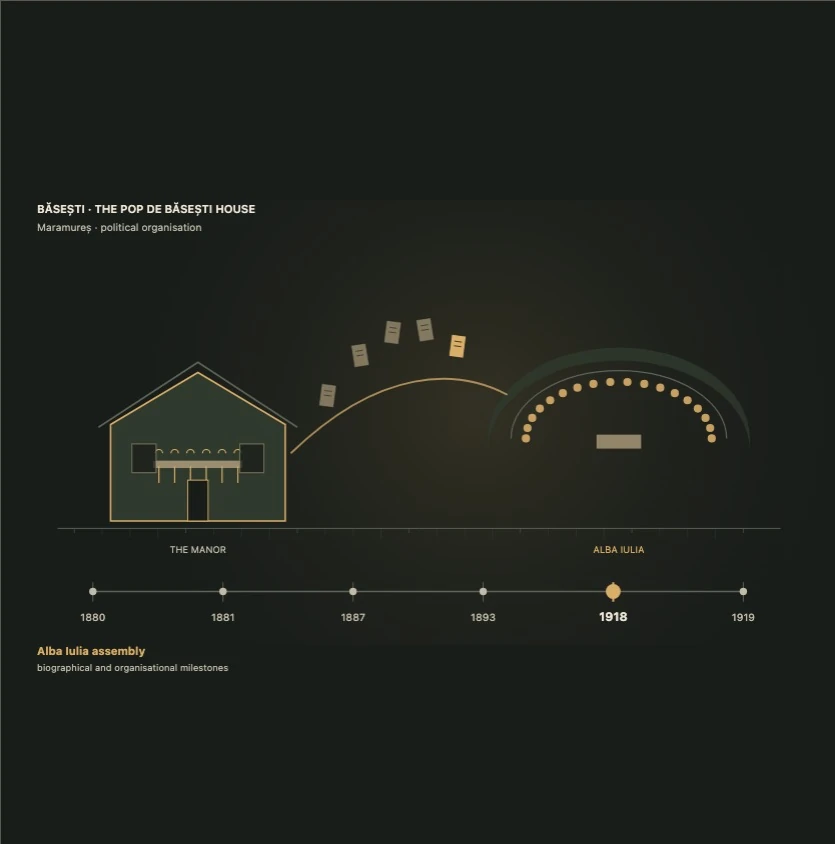
A manor in Băsești opens towards an assembly hall, linked by a sequence of letters and timeline markers.
The family manor in Băsești and the hall at Alba Iulia, linked through political time.

Băsești · Maramureș

The house before the assembly

George Pop de Băsești presided over the Great National Assembly at Alba Iulia on 1 December 1918. Years earlier, his home in the village had become a meeting place for politicians and cultural figures. [1, 2]

Choose a year and follow what changed in political organisation. The thread begins with a proposal for a national party and reaches the assembly at Alba Iulia.

Choose a milestone in his life

The milestones change the scene; they do not represent years of equal political activity.

Start the story

1880 · Turda

The proposal was to unite Romanian organisations

At a conference in Turda on 9 August 1880, George Pop de Băsești proposed uniting Romanians in Transylvania and Hungary in a single national party. 1

In October, thirty leaders decided to call a national conference in Sibiu. The effort moved from proposal to shared organisation. 1

1881 · Sibiu

The Romanian National Party took a common form

In 1881, the national conference in Sibiu declared solidarity among Romanian organisations in Hungary and united them under the name Romanian National Party of Transylvania and Hungary. 1

George Pop de Băsești had served in Hungary’s parliament as a deputy from 1872 to 1881. After that mandate, his role increasingly centred on coordinating the political movement. 1

1885–1890 · the house in the village

The manor became a meeting place

The family house was built between 1885 and 1890. For about three decades, the manor hosted meetings with figures including Vasile Lucaciu, Vasile Goldiș, Ion Rațiu and Teodor Mihali. 2

A home in a village now in Maramureș served as a link between people organising Romanian politics in Transylvania. 2

1892–1894 · petition and trial

The Memorandum brought the dispute before the empire

From 1892 to 1894, the Memorandum movement called for Transylvanian autonomy and additional rights for Romanians within Austria-Hungary. George Pop de Băsești was one of its signatories and leaders. 1

He was sentenced to prison at the 1894 Memorandum trial in Cluj. In the decade before, his home in Băsești had become a meeting place for people active in that politics. [1, 2]

1902 · 1 December 1918

The party president chaired the assembly

George Pop de Băsești was president of the Romanian National Party from 1902 to 1918. On 1 December 1918, he presided over the National Assembly at Alba Iulia. 1

The house where leaders met before that day remains in Băsești. The link between the village and the assembly lies in political work spanning nearly four decades, as well as the vote on the day itself. [1, 2]

1919–1976 · the house remembered

The house was nationalised, then became a museum

George Pop de Băsești died on 23 February 1919. His daughter, Elena Pop Longin, and her husband lived in the house until 1940. [1, 2]

Nationalised in 1948, the building became the headquarters of the local agricultural cooperative and a grain store. It was restored between 1970 and 1976; the museum preserves original objects that belonged to him. 2

Sources

Biographical milestones follow Băsești Town Hall; the manor and collection history follows the National Heritage Institute’s museum database. The hall, letters and links between people are conceptual compositions, not reproductions of documents or the house interior.

  1. George Pop de Băsești · Băsești Town Hall

    Băsești Town Hall: biographical dates, the 1880 proposal, formation of the Romanian National Party, the Memorandum movement, the 1918 assembly presidency and his cultural bequest.

  2. George Pop de Băsești Memorial House · National Heritage Institute

    The national museum database: the house built between 1885 and 1890, its role as a meeting place, nationalisation, restoration and original memorial objects.