Bektashi, between a spiritual centre and a proposed state
The Bektashi Sufi order has a headquarters in Tirana that calls itself the world headquarters. In 2024 Prime Minister Edi Rama proposed making it a sovereign state; in the sources checked up to 2 October 2026 no law, no decision and no territorial boundary appears. The page follows the order from Hacıbektaş to Tirana, Sarı Saltuk's tomb at Babadag in Romania's Dobrogea, and every step of the proposal, each with a source and a date.
Proposed · no legal act foundChecked up to 2 October 2026
Public sources use four labels for what is at stake in Tirana: religious centre, world headquarters, special diplomatic status and sovereign state. The first two describe an institution that exists. The last two are a request and a proposal, not steps of one process.
What can be said on 2 October 2026. The Bektashi headquarters in Tirana operates and receives state funding. A diplomatic status has been requested. A sovereign state was proposed by Prime Minister Edi Rama at the UN in September 2024. The sources checked show no draft law, no government decision and no published boundary, and Bektashi authorities in Turkey dispute that Tirana represents the whole order.
Two corrections to the 5 September edition. The reported area is 27 acres, almost 11 hectares, not 27 hectares. And the Vizion Plus article the page dated 3 July 2026 is from 21 September 2024. The explanations are below.
01. Religious centre Documented
The Tirana complex is a place of worship, ceremony and administration for the Bektashi order. In 2026 it hosted the Sultan Nevruz feast on 22 March, a meeting of secretaries and dervishes in July, and events with other religious communities. S08S11S07
What it does not prove. Its existence gives it neither sovereignty nor diplomatic status.
Open question. What status does the institution hold in Albanian law, beyond the legal personality the Constitution gives religious communities?
An institution in Tirana presents itself as the World Bektashi Headquarters, and the Albanian authorities treat it as such. The government marked its 95th anniversary in January 2025, and in April 2026 a Council of Ministers decision funded it among the four religious communities with agreements with the state. S17S10S55 Bektashi authorities in Turkey dispute that it represents the whole order. S24S13
What it does not prove. The title and the public funding show a recognized religious community. The Hacıbektaş declaration disputes representation of the whole order. Neither creates a state.
Open question. What new powers would the headquarters have under a different status?
On 27 March 2026 Baba Mondi, head of the World Bektashi Headquarters in Tirana, told Top Channel, an Albanian television station, that the headquarters has asked for a diplomatic status for 30 years (“it cannot be a world NGO centre”) and that the form, a state, a mini-state or an order, will be decided by the Albanian state. S09 In a 2017 letter, published by Top Channel in September 2024, the headquarters asked the Speaker of Parliament and the prime minister to recognize the Holy See of the Bektashi with the status of the Apostolic Nunciature in Tirana. S16
What it does not prove. The sources checked show no instrument granting this status.
Open question. Who would grant the status, and through which act?
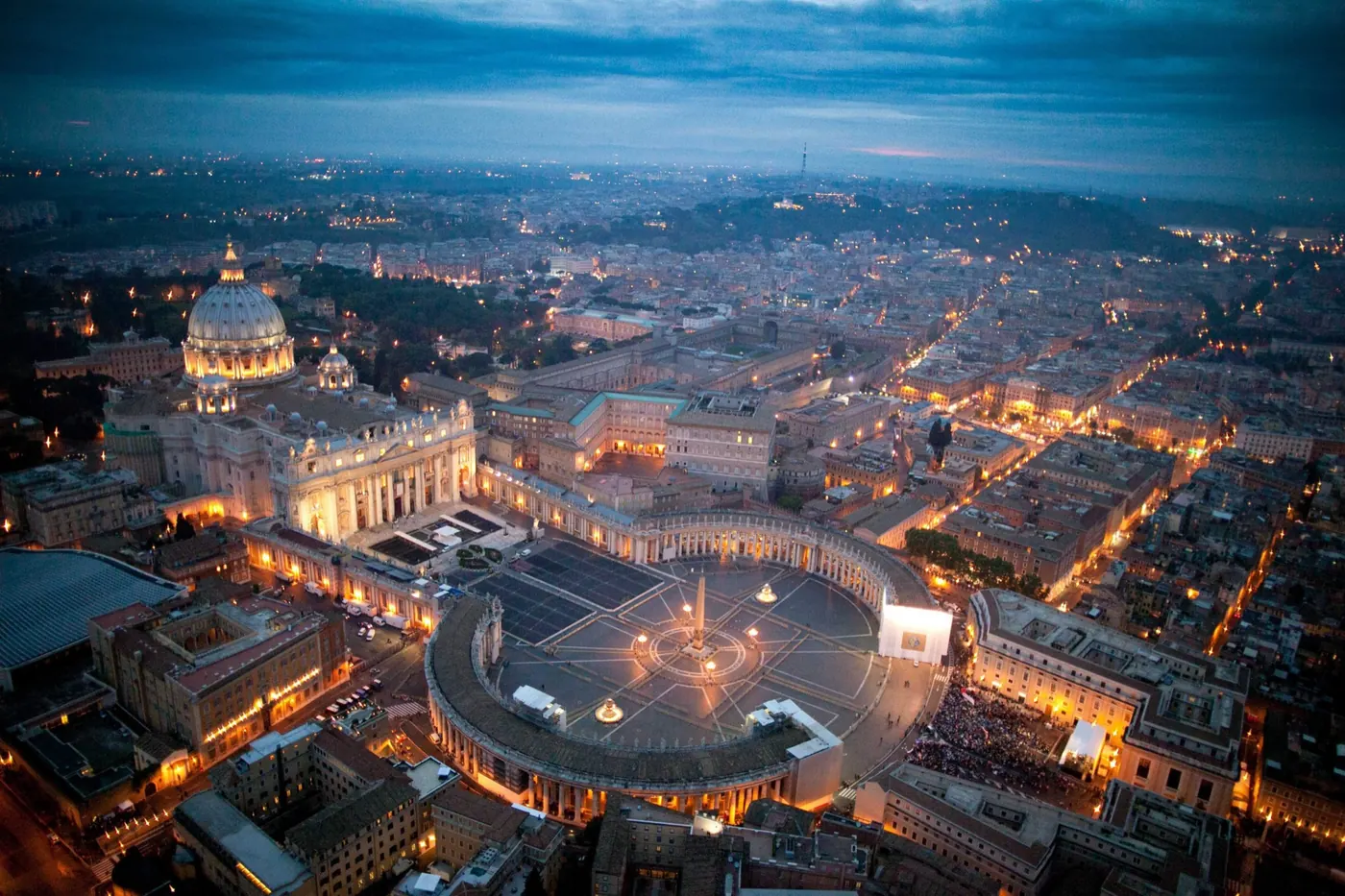
In September 2024, Edi Rama announced a plan for a sovereign Bektashi state in Tirana. S02S15 He said it to the UN General Assembly on 22 September, a day after the New York Times wrote about a Vatican-style enclave of 27 acres, almost 11 hectares. S14 The prime minister's office answered in January 2025 that no decision existed. S06 In the sources checked up to 2 October 2026 there is no draft law, no government decision and no published territorial boundary.
What it does not prove. A speech, a request or a budget allocation does not replace a founding act.
Open question. What act would create it? What territory would it have, and how would it fit within Albania's constitutional order?
The four rungs are not automatic steps. Each has its own sources and its own open question.
From Hacıbektaş to Tirana
A Sufi order born in Anatolia, with its seat in Tirana since 1930-1931
The Bektashi order is a brotherhood of dervishes in the Sufi tradition that took shape in Anatolia from the 13th century; its present form dates from the 15th and 16th. How their seat reached Tirana can be followed in dates, in places and in who says what.
Dots mark the town or OpenStreetMap feature named in the source, not the exact position of a tekke
Hacıbektaş, in the middle of Anatolia
The order is named after Hacı Bektaş Veli, a 13th-century Anatolian saint linked to some extent with the Babai revolts. S03 The year he died is not known: Ocak gives 1271, with a question mark, the text Turkey filed with UNESCO gives 1337, and the earliest deeds show only that he was dead by about 1292 to 1297. S33S35S30 No chronicle of his own time mentions him. S33
The complex around the tomb was closed on 30 November 1925 and opened as a museum in 1964. Turkey put it on UNESCO's Tentative List in 2012; it is not a World Heritage Site. S35
An order shaped in the 15th and 16th centuries
The order of today took shape later. Balım Sultan, made head of the Hacıbektaş lodge in 1501, by tradition by Sultan Bayezid II, came from Dimetoka, in Thrace, from a Christian mother. S52S03 He fixed a hierarchy of ranks headed by the celibate dervish. From then on the order has had two rival branches: the “babagan”, the celibates, and the “çelebi”, who regard themselves as descended from the saint. According to Ocak, the division has continued to our day. S03S52
The Janissaries and 15 June 1826
The Janissaries honoured Hacı Bektaş as their patron; Hasluck dates official recognition of the link between corps and order to 1591. S31S03 Algar calls “probably apocryphal” the accounts that tie the corps' founding to a Bektashi, and Birge shows that the blessing attributed to the saint cannot be taken literally, since he had died before 1295. S03S30
On 15 June 1826 the corps was destroyed. Bektashi lodges in Istanbul were razed, several babas were executed, and the older lodges passed to the Naqshbandi. By 1849 the order was strong again. S30S03
Albania before 1900
Birge wrote in 1937 that the only certain event in the order's history in Albania was that Ali Pasha of Tepelenë, who ruled Epirus between 1790 and 1822, became a Bektashi himself. S30 Ocak, following Köprülü, finds Bektashis in Albania already in the 16th century. S52 The tekke at Frashër was founded in 1825. S32
Other tekkes attested by sources: Tetovo (Harabati Baba, in North Macedonia), Gjakova (Kosovo), Gjirokastër and Krujë. S32S31S47
30 November 1925: Turkey closes the tekkes
Law No. 677 forbids the titles sheikh and dervish, dede, çelebi and baba, with at least three months in prison and a fine of 50 lira. S34 After Turkey dissolved the Sufi orders in 1925, Bektashi leadership moved to Albania, and the world seat was settled in Tirana in 1930 and 1931. S03S36S37 The dates after 1925 are those of the order's own chronology.
The Korçë congress and the king's decree
On the order's own chronology: the third congress at the Turan tekke near Korçë, 26 September 1929; Salih Niyazi Dede's arrival, 28 January 1930; the Royal Court letter of 20 March 1930 about the decree of appointment; a government decision of 2 August 1930; installation in Tirana, 1931. S36S37 The order's sources differ on details: Baba Rexheb puts the arrival in late 1930, and a page of the order places the centre at Melçan in 1930 and only then in Tirana.
Birge, who visited Salih Niyazi in 1933, writes that the head of the order was appointed by the King of Albania. S30
The building in Tirana, 1941
The new building opened in early 1941; according to Baba Rexheb the Albanian government donated 1,000 gold Napoleons towards it. S37 In November 1941 Salih Niyazi Dede and an aide were killed; Baba Rexheb writes of a plot whose origins have not been uncovered. S37
1967: religion banned by law
The communist regime banned all religions in 1967. S03 The Konrad Adenauer Foundation writes that Albania is the only country where religion was ever banned by law and that from 1967 to 1990 religious institutions were closed. S38 The order says that between 1945 and 1990, 55 dervishes and fathers were shot, jailed or exiled; the figure is the order's own and unaudited. S48
The reopening was marked on 22 March 1991, on Sultan Nevruz, with Mother Teresa present. The building had meanwhile been an old people's home. S48
Tekkes and pilgrims
In the area searched (the Balkans from 18° to 30° east and 36° to 46° north, plus a box around Hacıbektaş), OpenStreetMap contributors have tagged 90 objects as Bektashi, mostly places of worship and tombs, 73 of them in Albania. The list is partial: it shows what has been tagged, not how many tekkes exist, and the rest of Anatolia was not searched. The small green dots on the map are these objects.
The pilgrimage up Mount Tomorr, from 20 to 25 August with the main ceremony on 22 August, draws crowds; the order speaks of hundreds of thousands of people, without saying how they were counted. S49 The 2023 census recorded 115,644 people under Muslim-Bektashism (S04), below.
place named as Bektashi by a source
object tagged Bektashi in OpenStreetMap (area searched)
world headquarters in Tirana
straight lines join places, not roads
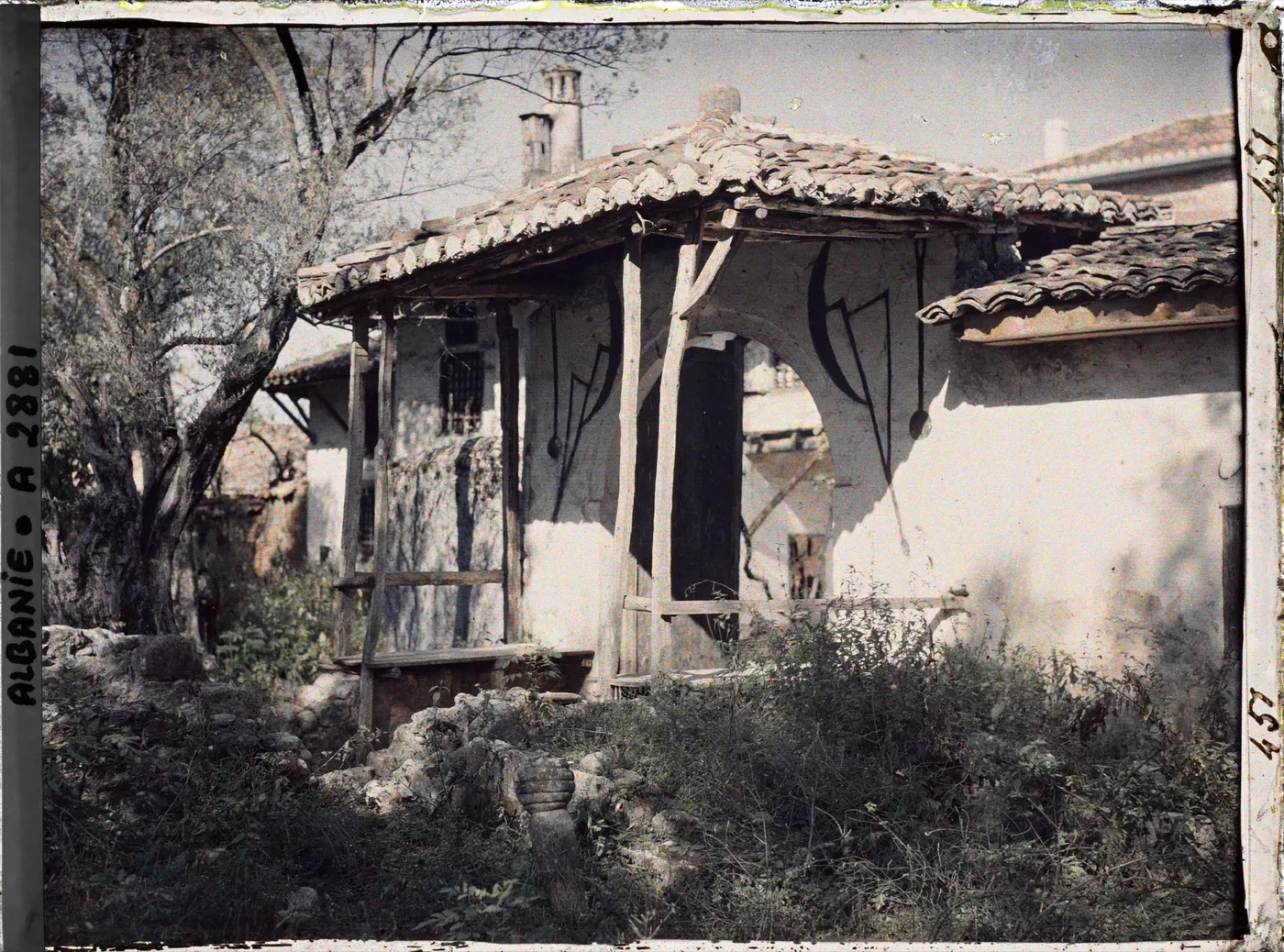
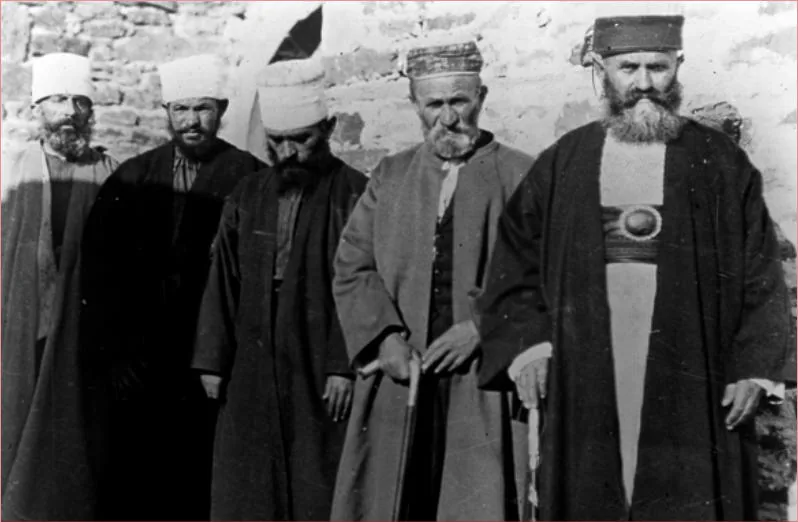
Tirana, 18 October 1913, autochrome of the Brunhes-Léon mission to the Balkans. The Albert-Kahn museum catalogues it as a Bektashi place of worship with insignia drawn on the walls; the plate's original caption says something else (“an old door of the Medersa mosque”), so the identification stays the museum's. Photo: Auguste Léon, 18 October 1913, Archives de la Planète, Musée Albert-Kahn, CC0, Wikimedia Commons.Dervishes at the Bektashi tekke of Përmet, 30 March 1904, in the Edith Durham collection. Photo: Evan MacRury, 30 March 1904, Edith Durham collection, Royal Anthropological Institute, Public domain, Wikimedia Commons.
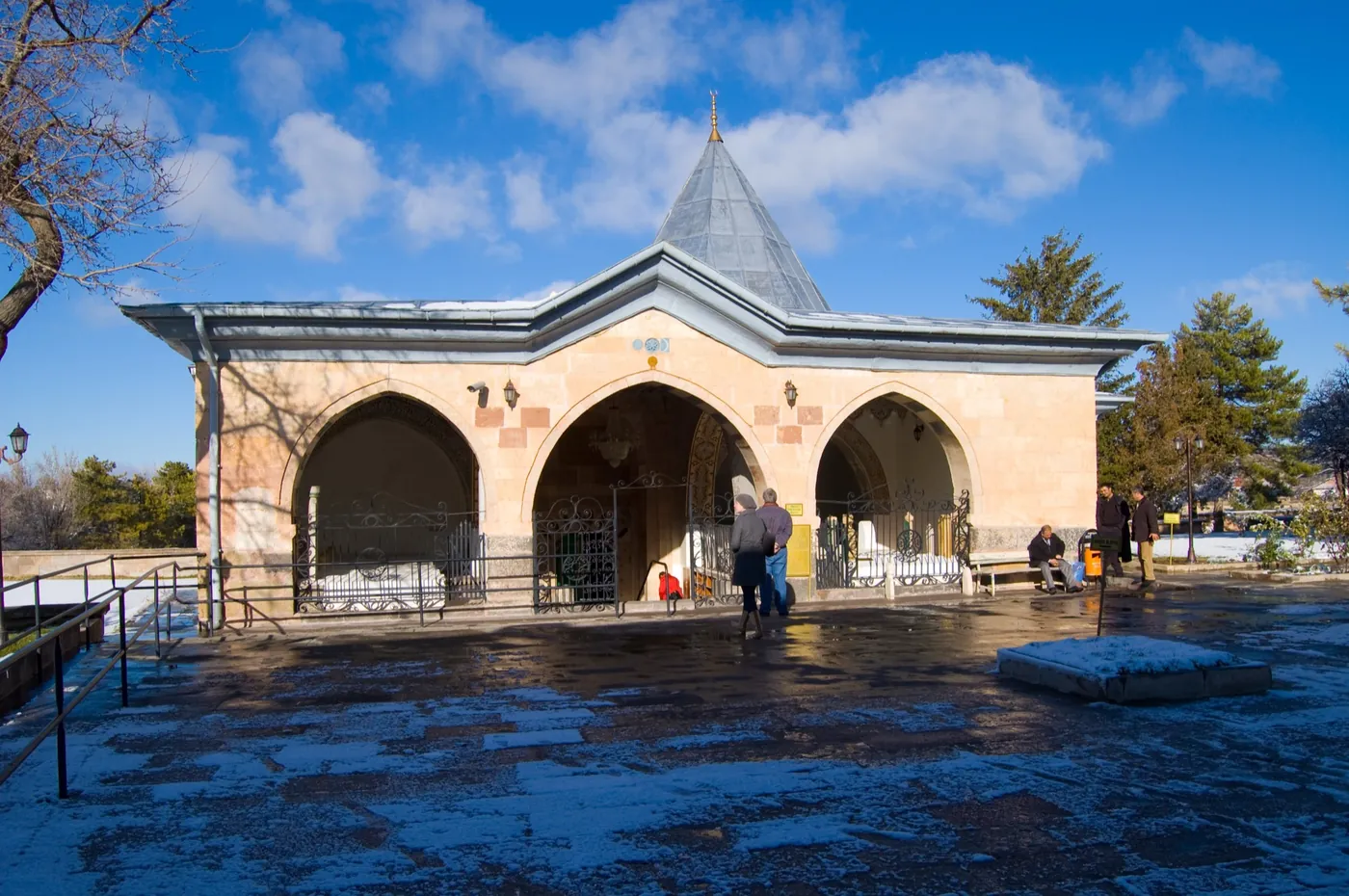
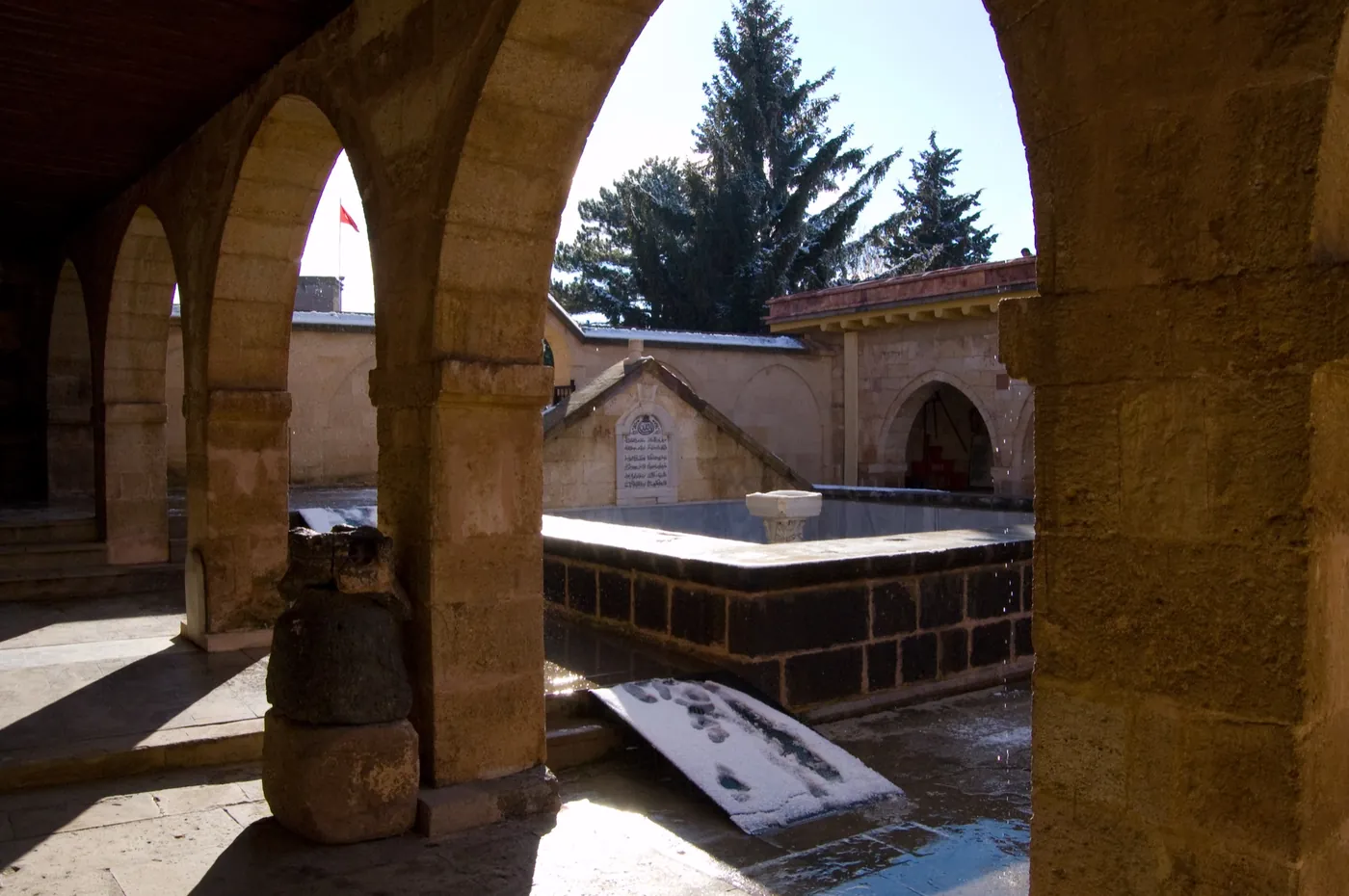
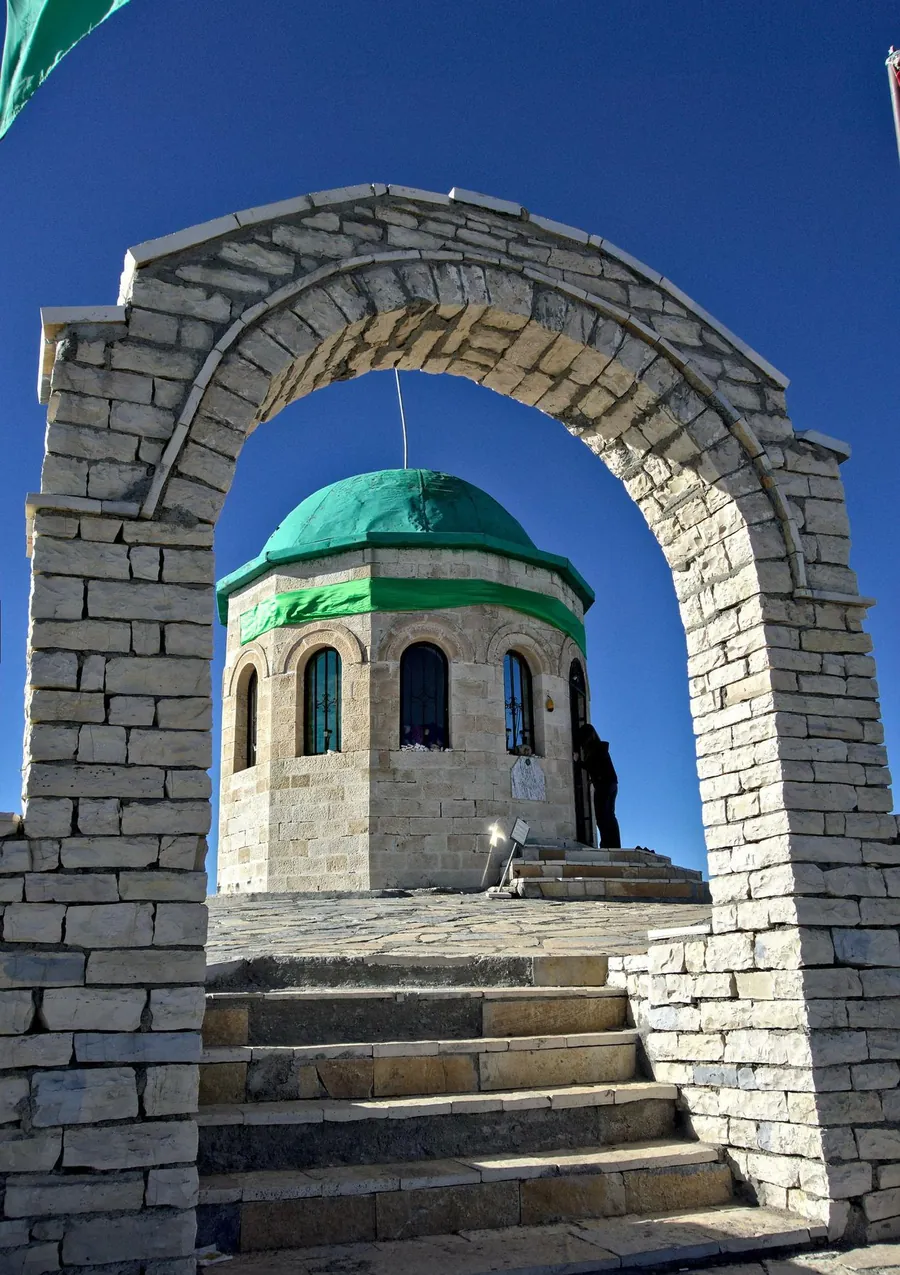
The courtyard of the complex at Hacıbektaş, 2009. Photo: Maarten from Netherlands, CC BY 2.0, Wikimedia Commons.The shrine on the summit of Mount Tomorr, where the August pilgrimages take place. Photo: malenki @ Mapillary.com, CC BY-SA 4.0, Wikimedia Commons.
Dobrogea, Romania
Sarı Saltuk: one saint, a legend of seven tombs, one in Romania
The Bektashi order counts Sarı Saltuk among its apostles in the Balkans. A tomb attributed to him is documented at Babadag, in Dobrogea, the Romanian region between the Danube and the Black Sea. The oldest sources do not call him a Bektashi, though, and the tomb at Babadag is today a place of Muslim pilgrimage.
Tombs attributed to Sarı Saltuk, after Evliya Çelebi and the Bektashi headquarters' list
Who he was, by the oldest sources
The oldest known text that mentions him, a Rifâʿî work of 1315, known from its quotation by al-Nabhani (died 1932), ties him to the Rifâʿî line, not to the Bektashi. S40 In 1332, on Gibb's chronology, Ibn Battuta passes through a town called Baba Saltuq. Of the saint he writes that he was “an ecstatic devotee, although things are told of him which are reproved by the Divine Law”, and he names no order. S39 The Saltuknâme, written for Prince Cem and completed in 1480, is an epic of a warrior hero. S40 The hagiographies of the 1480s to 1500s, of Hacı Bektaş and of Otman Baba, bring him to Rumelia by Hızır's grace, across the Black Sea on his prayer rug; according to Kiel he then returns to Anatolia to visit Hacı Bektaş's grave. S40
Hasluck saw in him the saint of a Tatar tribe from the Crimea, brought to Babadag and taken over by the Bektashi, “the Bektashi apostle par excellence of Rumeli”. S31 Sunni, Alevi and Bektashi circles each claim him in their own way. S40
Seven coffins for seven kings
Evliya Çelebi, shipwrecked near Kaliakra in the 1640s, heard from the dervishes there that the saint ordered seven coffins, because seven kings would quarrel over his body. S41S31 In von Hammer's translation the tombs are in Muscovy, at Danzig, in Bohemia, in Sweden, at Eski Baba near Edirne, at Babadag and at Kaliakra. S41 Hasluck puts the ones in Christian Europe down to confusion with Saint Nicholas. S31 Hammer also calls the dervishes at Kaliakra “all true Sunnis”, while Hasluck sees their tekke as a Bektashi one. S41S31
Other tombs, other lists
The Tirana headquarters' list adds Krujë, Blagaj, Ohrid and Corfu to Babadag and Kaliakra. S47 Blagaj, in Bosnia, is a disputed case: the Bosnian monuments commission writes that the tekke was originally the Bektashi order's, but Evliya, in 1664, describes a Khalwati lodge there. S50 Ohrid and Corfu are not on the map: the sources give only a monastery or a church, without verified coordinates.
Babadag, Tulcea County
Babadag is a small town in Tulcea County, in Dobrogea. In the list of historic monuments three entries concern the Ottoman Muslim sites there: the Ali-Gazi Pasha mosque (1618-1619), Ali-Gazi Pasha's tomb (1620) and the “Tomb of Baba-Sari-Saltuc-Dede” (code TL-IV-m-B-06042). S42 Bayezid II turned the zaviye into a complex in 1484, according to Kiel; destroyed in the Russian invasions of the 18th and 19th centuries, the tomb was rebuilt after 1828 and is a place of pilgrimage today. S40
On 26 October 2007 Recep Tayyip Erdoğan, then Turkey's prime minister, inaugurated the restored tomb, then prayed at the neighbouring mosque with worshippers from Tulcea. The works cost 65,500 euros, with the support of Turkey's Ministry of Culture and a Bucharest company, reports the news agency Rompres; Kiel writes that Turkish businessmen paid for the restoration. S43S40 The Tirana headquarters lists “Tyrbe in Babadag” among Sarı Saltuk's holy places and wrongly places it in Constanța, Romania's Black Sea port. S47
A working Bektashi tekke, a baba or a Bektashi community at Babadag does not appear in the sources read. Hasluck mentions there, in the past tense, a Bektashi convent holding one of the saint's graves. S31
Where was the town in the Rihla?
Ibn Battuta calls “Baba Saltuq” the last of the towns of the Turks, beyond which come eighteen days of wasteland. Gibb, the English translator, puts it near the lower Dnieper; Hasluck near Sudak, in the Crimea; Kiel at Babadag. S39S31S40 The text does not say which way the caravan went. The journey can be followed on the Ibn Battuta page.
How many Bektashis are there in Romania?
No source gives a number. The 2021 census recorded 58,347 residents in its single Muslim category (the “Muslim Cult”, Romania's state-recognized Muslim community), without distinguishing Bektashi or Alevi; another 2,658,165 have no religion information. S44 The list of the 18 recognized cults, republished in 2014, has no Alevi or Bektashi cult. S45
Hasluck's book, published in 1929, mentions three Bektashi tekkes “within the present frontiers of Rumania”: Babadag, Kaliakra and Balchik. Babadag and Kaliakra are reported after Evliya, in the past tense; the 1914 informant appears only for Balchik. The last two are now in Bulgaria. S31 Among the Romanian press articles found, only Dilema veche, a weekly, links the Tirana plan to Babadag, in October 2024. S46
tomb or place attributed to Sarı Saltuk by a tradition or a list
the dot is the town or OpenStreetMap feature named in the source
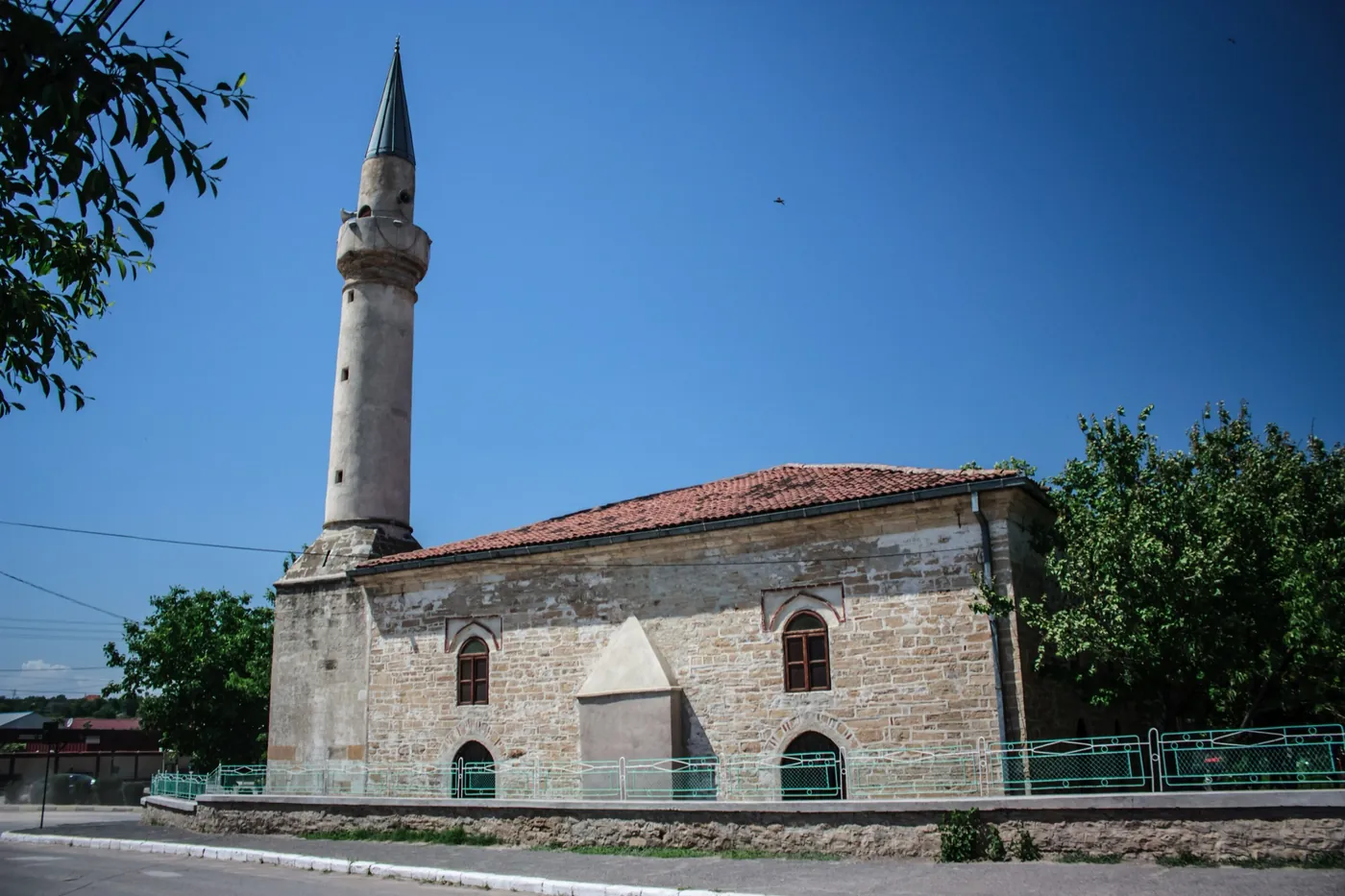
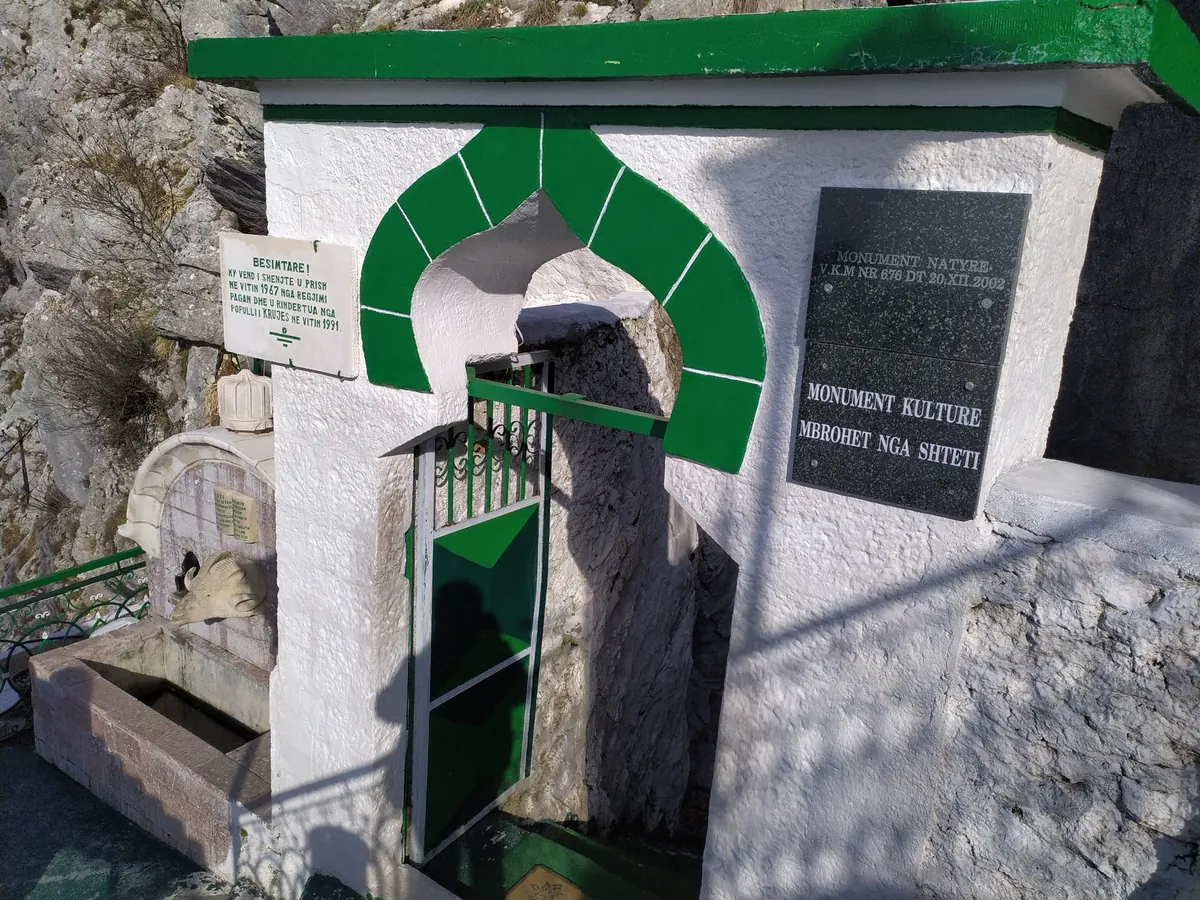
The Ali-Gazi Pasha mosque in Babadag, Romania, next to Sarı Saltuk's tomb. The list of monuments dates it 1618-1619. S42Photo: Radueduard, CC BY-SA 3.0 ro, Wikimedia Commons.The Sari Salltik monument at Krujë, Albania, 2020. Photo: Leeturtle, CC BY-SA 4.0, Wikimedia Commons.
The compound
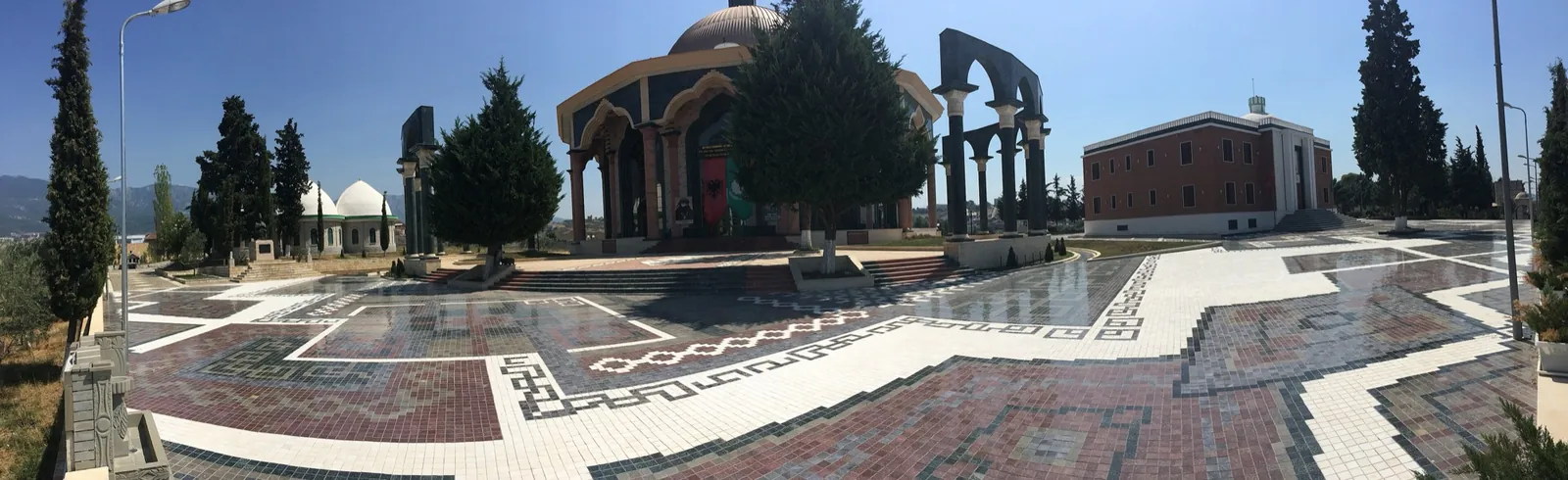
The headquarters in eastern Tirana, on the map
The Bektashi headquarters stands on the eastern edge of Albania's capital. The map below is drawn from OpenStreetMap, at true scale.
OpenStreetMap, 2 October 2026, ODbL
A district of blocks and houses
On OpenStreetMap the Bektashi headquarters' religious land is a single plot of 5.2 hectares, surrounded by streets, housing and a hospital. The press gives the address as Dhimitër Kamarda Street, but in OpenStreetMap the building carries the address Rruga Agush Gjergjevica; the plot below follows the drawing on the map, not an address.
The cultural and religious centre
OpenStreetMap names the building here “Qendra Culturore Fetare” (the cultural and religious centre), of 0.18 hectares, inside the plot. The rest of the plot is courtyards, gardens and smaller buildings.
The neighbouring hospital
Next to the plot, but outside it, OpenStreetMap maps the Continental Hospital. The US envoy Paolo Zampolli toured it on 7 September 2026; the report describes it as operating within the headquarters' precincts. S26
No published boundary
No source publishes the boundary of the proposed state. The outline on the map is a volunteer drawing, not a cadastre; the area figures are compared in the next section.
plot mapped as the headquarters' religious land
surrounding buildings and streets, from OpenStreetMap
The figure of 27 hectares that circulated in the Albanian press was two and a half times too large. The original speaks of acres.
The New York Times wrote on 21 September 2024 about “a 27-acre patch of land that Albania wants to turn into a sovereign state”, “just a quarter of the size of Vatican City”. S14 27 acres is 10.9 hectares, or 0.11 km². Vatican City is 0.44 km², 44 hectares, according to the state's own page. S29 A quarter of 44 is 11: the two statements in the NYT's sentence agree.
The same number appears correctly in the AFP article on its interview with Baba Mondi in February 2025 (“0.11 square kilometres”) S18 and in the Intelligence Online report of August 2026 (“11 hectares”) S22. Rama gave no figure in the NYT interview or in the UN speech, as far as the texts can be read.
Vatican City: 44 ha 0.44 km², the state's own page
“27 hectares”: the wrong figure a wrong conversion of “27 acres”
27 acres: 10.9 ha New York Times; “a quarter of Vatican City”
Plot in OpenStreetMap: 5.2 ha a real outline, drawn by volunteers
Equal-area circles sharing a base. Only the green outline follows a real outline.
The 27-hectare circle is the wrong figure, drawn to show how far it would have carried. The green outline is the plot that OpenStreetMap volunteers draw as the headquarters' religious land: 5.2 hectares, without the neighbouring hospital. It is not a cadastre. Nobody has published the boundary of the proposed state.
The gap between the 5.2 hectares mapped and the 10.9 reported has no explanation in the sources read. The NYT writes that the compound originally covered nearly 90 acres and shrank by two thirds after 1967, when the regime built warehouses on the order's land. S14 A shrinkage by two thirds from 90 acres leaves about 30 acres, 12 hectares, close to the reported figure.
The OpenStreetMap outline is drawn by volunteers. The area was computed geodesically from its coordinates, to within a few metres. It is not a legal boundary.
2024-2026
The proposal, step by step, up to 2 October 2026
Each entry says what kind of source stands behind it: a verifiable act or activity, a request, a proposal, a report or an analysis.
18 entries shown
State of playChecked
The sources read show no draft law, no government decision, no public consultation and no territorial boundary for the proposed state. The headquarters' most recent public event, a reception at the German embassy attended by Baba Mondi, has nothing to do with the state. S51
Paolo Zampolli, US special envoy for global partnerships, visits the headquarters. Asked about the state, he answers, in the transcript Shqiptarja made of an exchange in English, that he heard the prime minister and Baba Mondi, that the Albanian people decide or will decide, and that the international community respects its decision. In Shqiptarja's record he says the Albanians decide; the paper's headline (“We support the Bektashi state”) and its own summary go further: they call the idea excellent and say the US supports the project.
At Hacıbektaş, Bektashi leaders in Turkey reject Tirana's claim to represent the orderReported
A forum held under the patronage of a Turkish body for Alevi-Bektashi culture publishes a declaration in the name of Bektashi leaders in Turkey: “Bektashism is not a state, a political movement or a national-political project.” It maintains that Edmond Brahimaj, that is Baba Mondi, cannot be a world leader. The next day the Muslim Forum of Albania welcomes it.
The Dutch daily NRC, in its Albanian republication, writes that after almost two years few concrete steps have been taken. The order's envoys are Christopher Hyland and Hazis Vardar; Hyland says he is not paid for it. Analyst Lutfi Dervishi says that beyond rhetoric he sees nothing.
Intelligence Online: a “bek” coin and envoysReported
A paywalled Intelligence Online article, republished in Albanian, says that formalization by the Albanian authorities is expected in the coming months, that a coin called “bek” is under consideration, that passports will be issued and that the headquarters has appointed envoys abroad. The Albanian republication names no source and carries no reply from the headquarters; the original could not be read.
Administrative meeting at the headquartersDocumented
The order's secretaries and dervishes discuss administration, archiving and ceremonies. Institutional activity goes on separately from the state project.
The headquarters receives 48.5 million lekDocumented
The Council of Ministers allocates 203 million lek to the religious communities with agreements with the state. The Bektashi headquarters receives 48.5 million, 28 million of it for the tekke in Gjirokastër.
On Top Channel, Baba Mondi says the order has asked for 30 years for a diplomatic status and that the form is for the Albanian state to decide: a state, a mini-state or an order.
He says the order's representatives are working with working groups towards a verdict and a decree, and that an NGO cannot work without diplomatic status.
The AFP interview: no police, army or taxesReported
Baba Mondi describes, in Shqiptarja's republication of the AFP interview, a very small spiritual and administrative state without police, army or taxes; AFP puts it at 0.11 km², against the Vatican's 0.44 km².
The prime minister's office register: no decisionDocumented
To a freedom-of-information request of 5 January 2025 about a “sovereign Muslim microstate” in Tirana, the recorded answer is that there is no decision to create one.
Istrefi and Pasquet note that the Vatican was created by a treaty between Italy and the Holy See, not unilaterally by Italy, and that a constitutional amendment would be needed.
Top Channel publishes a 2017 letter from the headquarters to the Speaker of Parliament and the prime minister asking that the Holy See of the Bektashi be recognized with the status of the Apostolic Nunciature in Tirana. The letter surfaces three days after the UN speech.
Rama, at the UN: a sovereign state in the capitalProposed
At the Summit of the Future Rama says he supports turning the centre of the Bektashi World Order into a sovereign state in the capital, as “a new center of moderation, tolerance and peaceful coexistence” (AP). The headquarters welcomes the initiative and says citizenship would be limited to clergy and those who run the state.
Andrew Higgins writes about a “Vatican-style” enclave of 27 acres, with passports, possibly a small intelligence service, but no army, border guards or courts. A team of lawyers is drafting the legislation, which Parliament would have to endorse; NATO allies had not been consulted. Albanian outlets wrongly convert it to “27 hectares”.
Hasluck: “hopes of a Bektashi state in Albania”Analysis
In his book, published in 1929, Hasluck notes, “on good Bektashi authority”, that at the time of the Turkish revolution (presumably 1908) the Bektashi still had “hopes of a Bektashi state in Albania”. The idea is not new.
The Tirana headquarters calls itself the world headquarters. Bektashi leaders in Turkey say the centre of the order stays at Hacıbektaş.
On 4 September 2026, at Hacıbektaş, the forum “Bektashism in Anatolia and the Balkans, from the past to the present” took place, held under the patronage of a Turkish Culture Ministry body for Alevi-Bektashi culture, in cooperation with the Foreign Ministry and the Communications Directorate. S13 The final declaration, in the name of the Bektashi leader, the postnişin of the Pir Evi and the halifebabas, rejects the Tirana plan. S24
“Bektashism is not a state, a political movement or a national-political project. The spiritual authority of a path of faith cannot be created or altered by proclaiming political sovereignty, allocating territory or printing passports.”
Declaration of the Hacıbektaş forum, 4 September 2026, translated from the Turkish by Marius Comper, after the Anadolu Agency text. S24
The declaration alleges that Edmond Brahimaj, that is Baba Mondi, declared himself global leader without even holding the halifebaba licence, which it calls void under the order's rules. The sources read do not include his reply. S24
The declaration asserts that the dedebaba must be a citizen of Turkey and live in Turkey, and, as the Anadolu agency reports it, that the spiritual centre at Hacıbektaş cannot be moved to another region by political decisions. S24
The Muslim Forum of Albania welcomes the declaration, which rejects the idea that a Bektashi state in Tirana would represent the whole order. S13
“We have been asking for 30 years for a diplomatic status for the World Bektashi Headquarters. It cannot be a world NGO centre.”
Baba Mondi, Top Channel, 27 March 2026, translated from the Albanian by Marius Comper. S09
The order does not speak with one voice about the idea of a state. The Hacıbektaş declaration is by Bektashi leaders in Turkey, at a state-hosted forum; no reply from the Tirana headquarters appears in the sources read. Who is right under the order's own religious rules cannot be settled from these sources.
What an act would have to settle
The act, the territory, the people, recognition
A state does not appear from a speech. Four questions remain unanswered in the public sources.
Albania's Constitution describes the republic as a unitary and indivisible state and recognizes religious communities as legal entities. S05S28 It also says that sovereignty belongs to the people (Article 2), that the state recognizes the equality of religious communities (Article 10, paragraph 3) and that matters of territorial integrity cannot be put to a referendum (Article 151, paragraph 2). Revision needs two thirds of all members of parliament (Article 177). S28
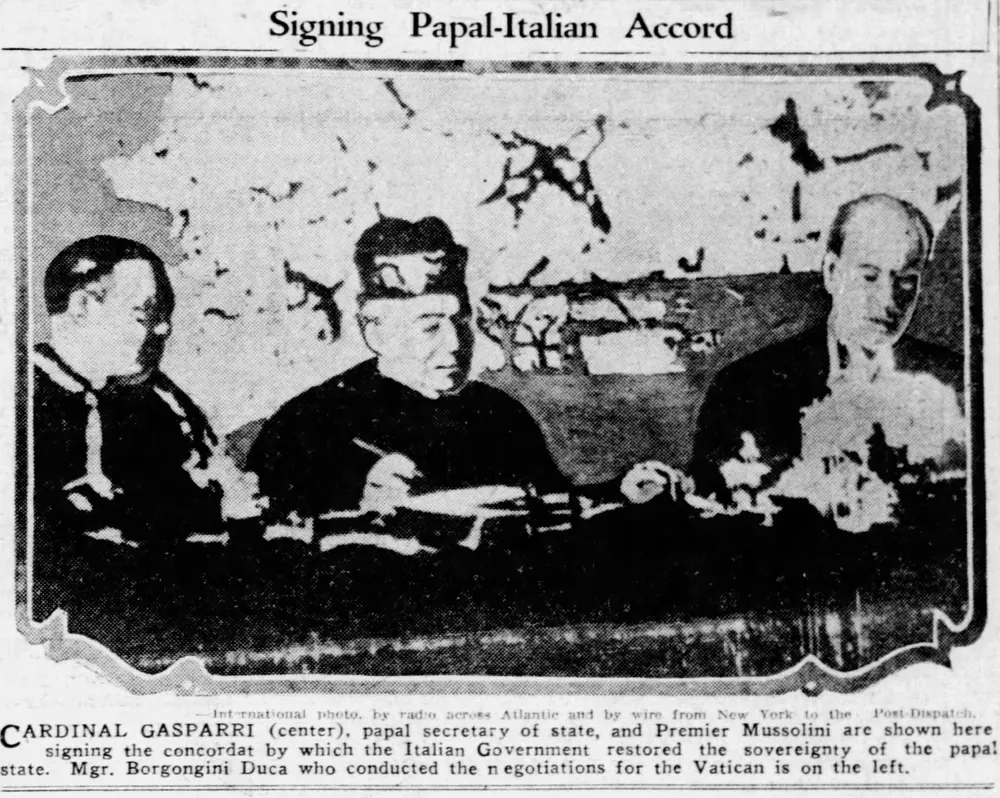
No court and no commission has ruled on the proposal, as far as I could find. The lawyers who wrote about it note that a constitutional amendment could pave the way and that the Vatican analogy is only partly convincing: it was created by a treaty between two sovereign subjects, Italy and the Holy See. S20S21
The act: what document would create the status?
The New York Times wrote in 2024 that lawyers were drafting the law and that Parliament would have to endorse it. S14 The prime minister's office answered in January 2025 that no decision existed. S06 Up to 2 October 2026 no text is public.
The reported figure is 27 acres, almost 11 hectares, while the plot mapped as religious land is 5.2 hectares. Rama said, according to the NYT, that the borders would be defined by what the order has. Nobody has published a cadastral plan. S14
AP reported that, according to the Bektashi headquarters' statement, citizenship would be limited to the top religious members and those managing the state. It is a proposal, not a rule in force. S02 The census counts residents, not citizens: 115,644 is the number who chose the category, not a list of future citizens.
An internal status and recognition by other states are different things. In 2024 NATO, the State Department and the EU did not answer Radio Free Europe's questions, and the NYT noted that the US had not been consulted. S15S14 On 7 September 2026 the US envoy said the Albanian people decide; that is not recognition. S25 Bektashi authorities in Turkey reject the plan. S24 An academic article of summer 2026 sees risks for relations with Turkey. S21
Cardinal Gasparri and Mussolini signing the 1929 accords: Vatican City was created by treaty, not by the decision of a single state. S20Photo: International Photo, 1929, Public domain, Wikimedia Commons.
Albania's census
115,644 answers in the census
It is the most solid official figure on the Bektashi, but it measures what people answered in Albania.
In the 2023 census 115,644 people chose “Muslim-Bektashism”, 4.81% of the 2,402,113 residents. S04 In 2011 the category “Bektashi” had 58,628 people, 2.09% of 2,800,138. S27
Bektashi in Albania's censuses
Year
People
Of total
No answer
2011
58,628 (2.09%)
2,800,138
13.79% “prefer not to answer”
2023
115,644 (4.81%)
2,402,113
10.2% “prefer not to answer”; 5.6% no data
The two censuses word their categories differently (“Bektashi” and “Muslim”, then “Muslim - Bektashism”), have different levels of non-response and use different methods. That is why the doubling of the count does not mean the order doubled. Baba Mondi has said the state has always undercounted the Bektashi; this is his claim, unproven. AFP wrote “about 100,000”. S18
How many Bektashis there are in the world nobody knows. The estimates run from 1.5 million (a Turkish deputy, 1924, apparently including the Kızılbaş) to 7.5 million in the old Ottoman Empire (Salih Niyazi Dede to Birge, 1933). None has a method. S30
The order's timeline
Seven centuries in one table
Timeline of the Bektashi order and the state proposal
When
What happened
Source
1271 or 1337
Hacı Bektaş Veli dies: 1271 with a question mark (Ocak) or 1337 (tradition); the earliest deeds show he was dead by about 1292 to 1297
Editorial cutoff: 2 October 2026. Each source has a type, and each claim on the page says whether it is a documented fact, a request, a report or a proposal.
How the evidence is classified. “Documented” means an act, a statistical table or verifiable institutional activity. “Requested” and “proposed” describe public statements, not legal results. “Reported” marks news I could not verify at the source. “Analysis” is academic commentary. The Intelligence Online and NRC items are republications of articles I could not read in the original.
What I could not verify, and so does not appear on the page
A statement by the Agency for Media and Information that “there is nothing concrete yet”: I found no date, outlet or text.
A reply by the Bektashi headquarters to the Intelligence Online article: no republication carries one.
The official text of Rama's UN speech: the government page and the UN portal could not be read; the words above are quoted through Radio Free Europe and AP.
The nytimes.com page of the 21 September 2024 article: the text read is the copy published by the Bektashi headquarters.
The exact coordinates of some tekkes (Hacıbektaş, Tomorr, Prishta, Gjakova, Prizren) and of the tombs at Ohrid, Corfu, Eski Baba and Kruja: the dots on the map are the towns named in the source.
Marks the 95th anniversary of the world headquarters. The government page could not be opened at the 2 October 2026 re-check (bot wall); the event and Rama's words on status are confirmed by S17.
AP reported Rama's announcement at the UN. The limit of citizenship to the top religious members and those managing the state is quoted from the Bektashi headquarters' statement, not from Rama.
Algar writes that the order was officially dissolved in Turkey in 1925, that its “official leadership” was then transferred to Albania, and that the 1967 ban covered all religions. He gives no date for the move itself: that comes from S36 and S37.
The page gives Articles 1 to 5. Article 1 describes Albania as a unitary and indivisible state. Article 10 of the consolidated text (S28) protects the independence of religious communities and recognizes them as legal entities.
For a request dated 5 January 2025, the register records that there was no decision to create a sovereign Bektashi microstate in Tirana. The register prints the answer date as “15.1.2024”, evidently a slip for 2025. The answer is dated and does not prove today's position.
The official account describes the ceremony at the Tirana headquarters, attended by clergy, believers, representatives of other religions, and officials.
In the “Flet” podcast interview, Baba Mondi says the order has asked for 30 years for a diplomatic status for the world headquarters and that the form (state, mini-state or order) is for the Albanian state to decide. The address on the 5 September page was wrong (404); this is the correct one.
The decision allocates 203 million lek to religious communities. The World Bektashi Headquarters receives 48.5 million lek, including 28 million for construction of the Shtufit tekke in Gjirokastër.
The official account shows an institution discussing administration, archiving, and ceremonies. This activity exists separately from the sovereign-state proposal.
The article is dated 21 September 2024 (modified 22 September), not 3 July 2026 as the 5 September page said. The “27 hectares” is the journalist's summary of the New York Times, an apparent wrong conversion of acres, not a quotation of Rama.
FMSH reports that the 4 September 2026 forum in Hacıbektaş, held under Turkey's structures for Alevi-Bektashi culture and in cooperation with the Turkish Ministry of Foreign Affairs and Directorate of Communications, presented Hacı Bektash Veli as the tradition's historical and spiritual centre. It publishes and endorses a declaration contesting Baba Mondi's global authority and rejecting the idea that a Bektashi state in Tirana would represent the whole order. The source establishes the existence of the dispute without settling either side's ultimate religious legitimacy.
The origin of the area figure: “a 27-acre patch of land”, “just a quarter of the size of Vatican City”. The text read is the copy published by the Bektashi headquarters; the nytimes.com page could not be opened.
Publishes the Bektashi headquarters' 2017 letter to the Speaker of Parliament and the prime minister asking for a status at least equal to that of the Apostolic Nunciature in Tirana.
At the jubilee conference for the 95th anniversary, Rama says the headquarters will have a status similar to the Vatican's and that Albania is a unitary state.
AFP article on the interview: 0.11 km², against the Vatican's 0.44 km², AFP's figures; Baba Mondi describes a small state without police, army or taxes. The AFP original was not opened; the text is Shqiptarja's republication.
Baba Mondi says the order's representatives are working with working groups towards a verdict and a decree, and that an NGO cannot work without diplomatic status.
Legal analysis: Vatican City was created by a treaty between two sovereign subjects (Italy and the Holy See), not unilaterally by Italy; the Albanian constitution would have to be amended.
Istrefi, Muharremi and Pasquet argue that the project conflicts with the constitution, lacks popular support and risks relations with Turkey. The abstract was read, not the full article.
Albanian republication of a paywalled Intelligence Online article. It says, without a named source, that formalization is expected in the coming months, that a “bek” coin and passports are under study, and that the order has appointed envoys. It carries no reply from the headquarters. The original article was not opened.
Relay of the Dutch daily NRC: after almost two years few concrete steps have been taken; envoys Christopher Hyland and Hazis Vardar speak about their roles; analyst Lutfi Dervishi sees nothing beyond rhetoric. The NRC original was not opened.
The text of the Hacıbektaş forum declaration of 4 September 2026, issued in the name of the postnişin of the Pir Evi and the halifebabas: “Bektashism is not a state, a political movement or a national-political project.” The declaration is by Bektashi leaders in Turkey; Turkish state bodies hosted and organized the forum.
Transcribes in Albanian remarks made in English by Paolo Zampolli, US special envoy for global partnerships: the Albanian people decide. The paper's headline (“We support the Bektashi state”) and its own summary are stronger than the transcript.
Confirms the date of the visit (Monday 7 September 2026), Zampolli's title and the tour of the hospital in the precinct. It quotes nothing about the state.
Articles 1 (unitary and indivisible state), 2 (sovereignty belongs to the people), 3, 10 (paragraph 3: equality of religious communities; paragraph 6: legal persons), 151(2) (territorial integrity cannot be put to a referendum) and 177 (revision).
The “Sari Saltik” chapter (vol. 2, pp. 429-439) and the list of three Bektashi tekkes within Romania's frontiers of the day, from a 1914 informant. Hasluck sees in Sarı Saltuk a Tatar saint taken over by the Bektashi.
Article 1 forbids the titles sheikh, dervish, dede, çelebi, baba, halife and others, with at least three months in prison and a fine of at least 50 lira.
Turkey's text: the complex was closed on 30 November 1925 and opened as a museum in 1964; the saint's death given as 1337. The coordinates in the entry have latitude and longitude swapped.
The Third Congress at Turan (Korçë), 26 September 1929; Salih Niyazi Dede's arrival on 28 January 1930; the Royal Court Ministry letter of 20 March 1930; the seat settled in Tirana in 1931. The chronology is the order's own and differs in details from other pages of the same site.
S37An institution's own account · Baba Rexheb, translated by Huseyin Abiva (Tirana printing 2017, on the headquarters' initiative), 2016 Islamic Mysticism and the Bektashi Path
An insider author. Salih Niyazi Dede installed in Tirana in 1931; the Albanian government donated 1,000 gold Napoleons towards the building; the new building opened in early 1941 (p. 417).
The town “Baba Saltuq”, “the last of the towns possessed by the Turks”. Gibb places it near the lower Dnieper, though Turkish tradition shows the tomb at Babadag.
S40Scholarship · Machiel Kiel, TDV Encyclopaedia of Islam 36, 2009, 2009 Sarı Saltuk
Sarı Saltuk is claimed by Sunni, Alevi and Bektashi circles; the oldest source (c. 1315) ties him to the Rifâʿî line; the Saltuknâme was completed in 1480; the Babadag tomb, rebuilt after 1828, reopened on 26 October 2007.
Ali-Gazi Pasha mosque (1618-1619), Ali-Gazi Pasha's tomb (1620) and the “Tomb of Baba-Sari-Saltuc-Dede” (1484, late 18th c.), the last a category B monument. A web-archive copy, as the ministry's address no longer answers.
Erdoğan inaugurated the Sari Saltuk Baba monument on Friday 26 October 2007; the works cost 65,500 euros, with the support of Turkey's Ministry of Culture and a Bucharest company.
A single Muslim category (“Musulmană (Cultul Musulman)”): 58,347 people; 2,658,165 with no information available. There is no Bektashi or Alevi category.
18 recognized cults, among them the “Muslim Cult”; none is called Alevi or Bektashi. The text is read on a mirror (legeaz.net), not on legislatie.just.ro.
The only Romanian press piece found that links the Tirana plan to the Babadag tomb. HotNews, Digi24, Mediafax, G4Media, Panorama and Puterea do not mention Romania.
S47An institution's own account · World Bektashi Headquarters (its own account), Page accessed 2 October 2026 The Bektashi Tariqat in Albania
Lists “Tyrbe in Babadag” among Sarı Saltuk's holy places and puts it in Constanța; Babadag is in Tulcea County.
The reopening of 22 March 1991 (Sultan Nevruz), with Mother Teresa; the building had been an old people's home; 55 dervishes and fathers shot, jailed or exiled between 1945 and 1990 (the order's own figure, unaudited).
The commission writes that the tekke was originally run by the Bektashi order and became a Khalwati centre in the 18th century; Evliya Çelebi, in 1664, describes a Khalwati lodge there. A web-archive copy.
The latest ten posts (10 September to 2 October 2026): anniversaries, academic visits and a reception at the German embassy attended by Baba Mondi; none mentions the state.
S52Scholarship · Ahmet Yaşar Ocak, TDV Encyclopaedia of Islam, 1992 Bektaşîlik
Balım Sultan, made head of the Hacıbektaş lodge in 1501 “by tradition” (rivayete göre) by Bayezid II; the split between çelebis and babagans “continued to our day”; the beginnings of the Bektashis in Albania in the 16th century, after Köprülü.
The headline says “27 hektarësh” (27 hectares), although the New York Times had written “27-acre”. The same day Telegrafi rendered the same sentence as “10 hectares”.
Reproduces the Council of Ministers decision: 203 million lek in total; 48.5 million for the Bektashi headquarters, 28 million of it for the Shtuf tekke in Gjirokastër. A mirror for S10, whose page is protected against automated access.
Editorial status. Checked up to 2 October 2026. The page is revised when an official legal act, a constitutional interpretation, a recognition decision, an official territorial proposal or an important institutional statement appears.