Marius ComperColonnade in Buziaș Park · Timiș
Română

Colonnade in Buziaș Park

Under the colonnade, water made the resort

A wooden colonnade over 500 metres long linked the springs, hotels and baths at Buziaș. Follow those connections, compare the dates of the covered passages and examine a print depicting Franz Joseph’s visit.

Follow the colonnade route ↓
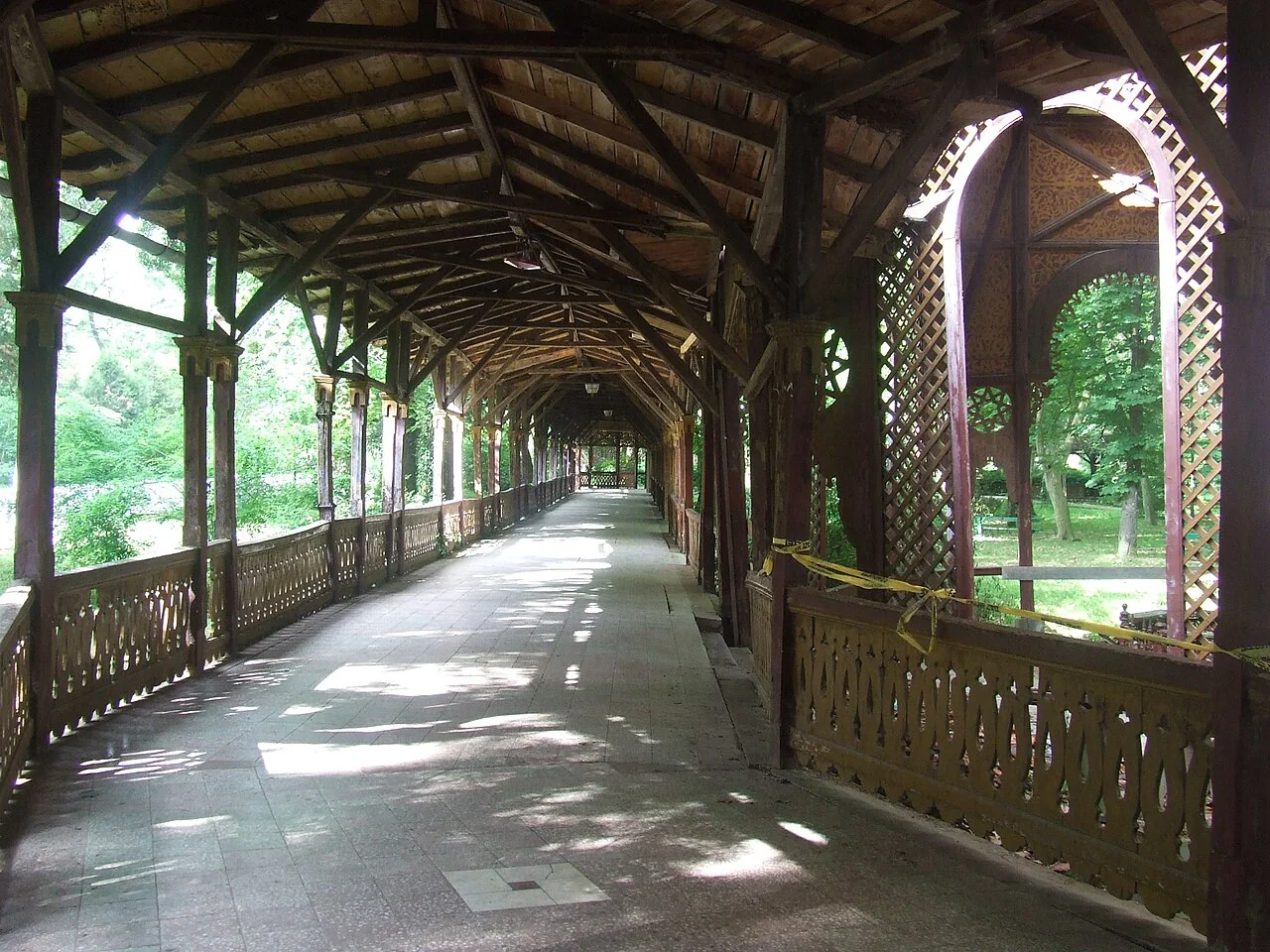
Timber colonnade with a roof and arches in the park.
A 2012 view of one section of the promenade. One frame cannot show the network connecting springs, hotels and baths. (Source · Yo6own / Wikimedia Commons · CC BY-SA 3.0 România)

Mineral water

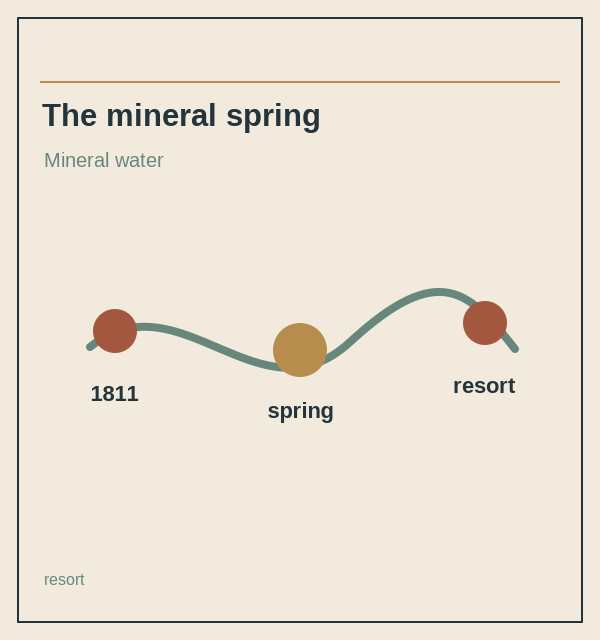
Three points linked by a curving walkway, from 1811 to spring and resort.
The diagram shows a sequence of uses, not a surveyed route. (Source · Editorial graphic based on the cited source · Original graphic; explanatory schematic, not a reconstruction to scale)

Mineral water

A spring changes the village

The first mineral spring was captured in 1811, and the resort began an organised season. Carbonated waters turned Buziaș into a treatment destination, with the park shaped around springs and walks between them. [2]

The colonnade carries that logic in timber: it links places where visitors drank the water, stayed and received treatment. A present-day photograph shows only a fragment; the full route comes from heritage descriptions. [1]

Three points linked by a curving walkway, from 1811 to spring and resort.
The diagram shows a sequence of uses, not a surveyed route. (Source · Editorial graphic based on the cited source · Original graphic; explanatory schematic, not a reconstruction to scale)

An early passage

A covered walk before the colonnade

A local tourism account places a covered walk between the upper and lower springs in 1815. The Banat Spa and Leisure Heritage project dates the construction of the familiar colonnade to 1856–1875. [3] [1]

The texts describe different episodes. The 1815 account names two springs. The colonnade inventory describes a longer route with hotels and baths. The sources here give no plan for the 1815 passage. [1] [3]
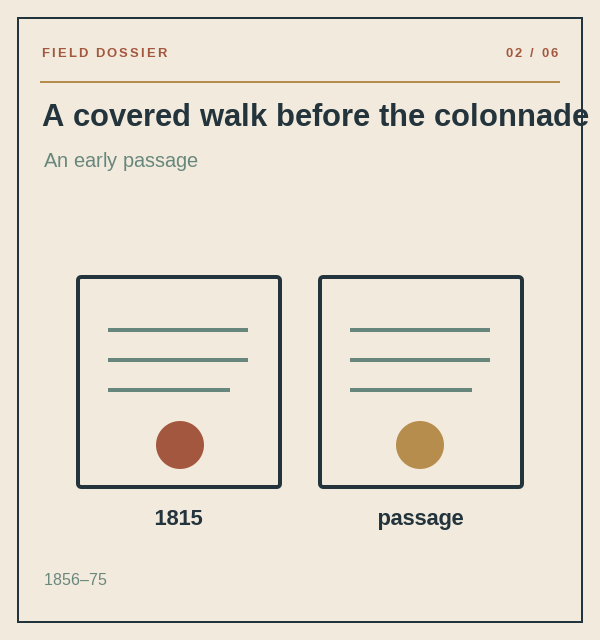
Two date panels for 1815 and 1856–75 joined by a broken line.
Two dates from different sources; they are not proven to describe the same structure. (Source · Editorial graphic based on the cited source · Original graphic; explanatory schematic, not a reconstruction to scale)

The walk between buildings

The colonnade linked the spa complex

The heritage record connects the promenade to the Grand Hotel, Bazar Hotel, Iosif and Mihai springs, the casino and Phoenix Baths. Guests had a sheltered walk between their lodgings, the springs and the baths. [1]

Follow the connection to each place. The hotels provided lodging, and the springs and baths were part of treatment. The casino served other needs of guests. The drawing groups the buildings by role. A site plan is needed to establish their order and distances. [1]
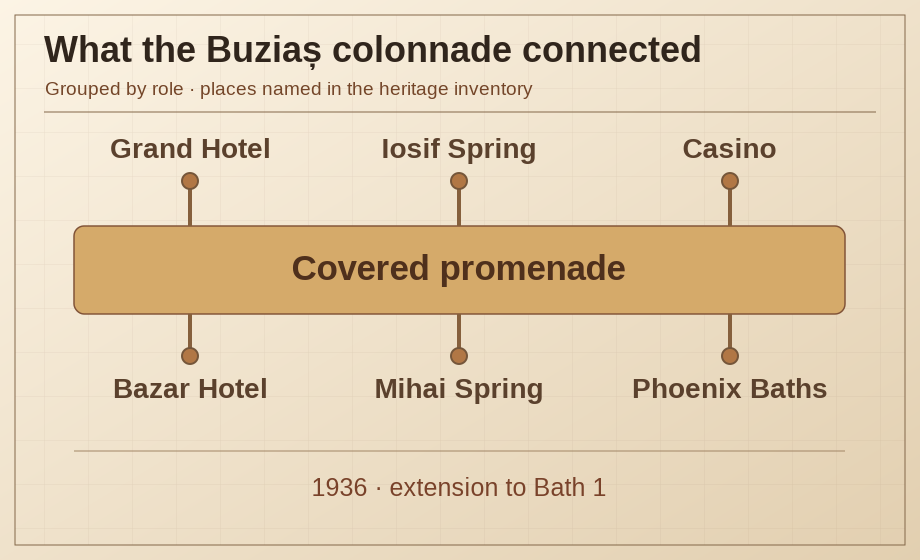
Six places connected to the covered promenade: two hotels, two springs, the casino and Phoenix Baths.
The heritage inventory names the two springs, two hotels, casino and Phoenix Baths. The diagram groups them by role. Distances and walking order are omitted. (Source · Editorial graphic based on the cited source · Original graphic; explanatory schematic, not a reconstruction to scale)

A timber structure

Decoration is also structure

The colonnade was built from timber posts and roof framing. The heritage record describes pierced, painted panels and an exposed roof structure. Those details reveal the joinery behind the promenade’s repeated rhythm. [1]

The 2012 photograph records the park colonnade before the recent restoration mentioned by the heritage source. It shows a real section, not the whole ensemble; the drawing isolates the repeated posts and arches. [5] [1]

A walkway with three repeated arches between posts, beside a colonnade photograph.
Rhythm of posts and arches interpreted from the heritage description. (Source · Editorial graphic based on the cited source · Original graphic; explanatory schematic, not a reconstruction to scale)
Timber colonnade with a roof and arches in the park.
Photograph dated 27 May 2012 by Yo6own. (Source · Yo6own / Wikimedia Commons · CC BY-SA 3.0 România)

The 1898 visit

The 1898 visit, drawn in 1908

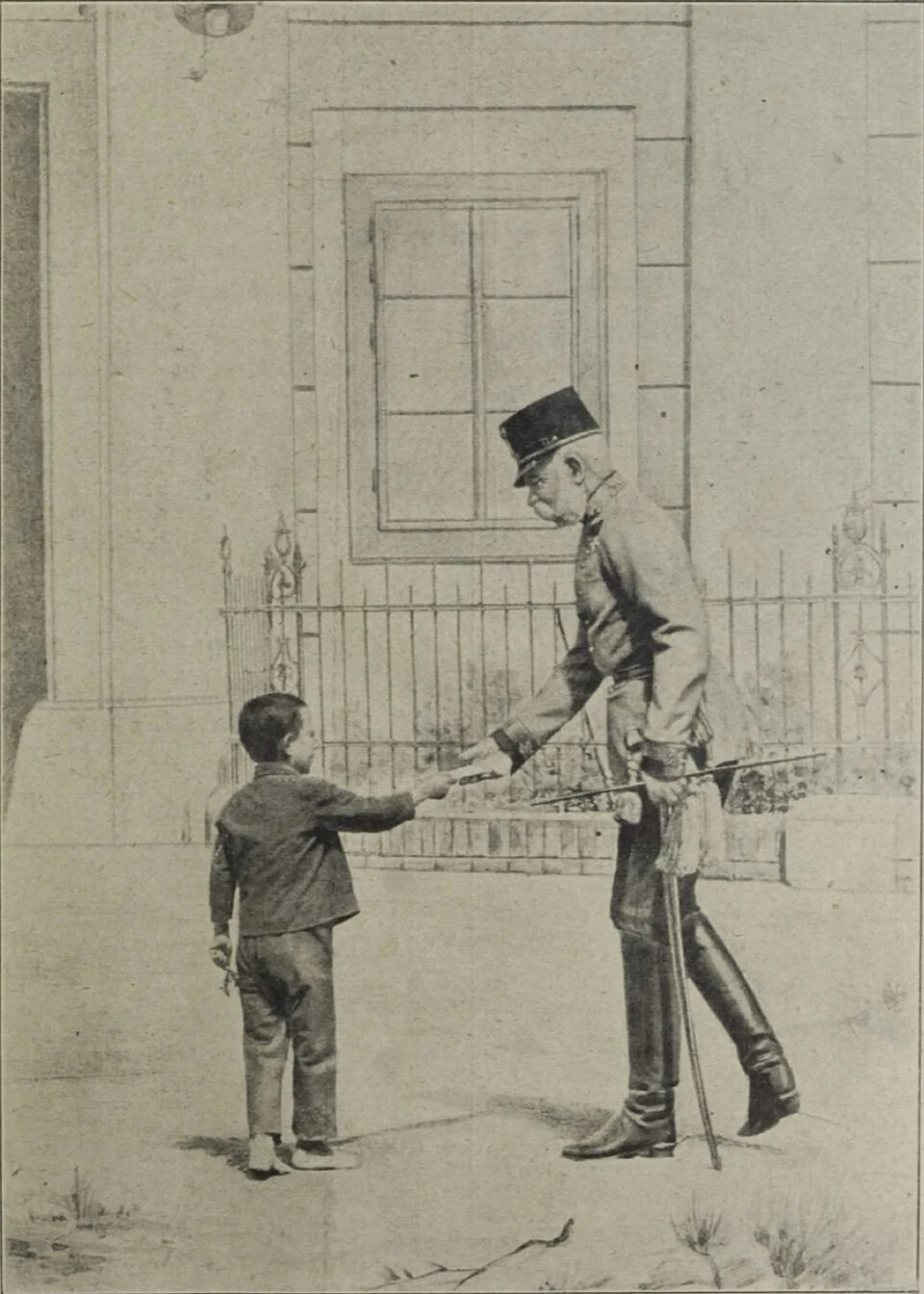
Franz Joseph reached Buziaș in 1898 during military manoeuvres. József Kossak’s image appeared in 1908 and shows him receiving a petition from a boy. It is a later visual retelling, not a contemporary photograph of the promenade. [4]

The sources consulted confirm the visit, but do not show that the emperor commissioned the colonnade for Empress Elisabeth. The Sisi story circulates in tourist descriptions; here it remains unconfirmed by a contemporary source. [4] [1]
Archival image of the emperor between two dates: 1898 and 1908.
The illustration was published in 1908 for a scene from 1898. (Source · Editorial graphic based on the cited source · Original graphic; explanatory schematic, not a reconstruction to scale)
Black-and-white press illustration showing the emperor facing a boy.
Image by József Kossak published in Das Interessante Blatt on 3 December 1908; the scene recounts the 1898 visit. (Source · József Kossak / Das Interessante Blatt / Wikimedia Commons · Domeniu public)

A later extension

In 1936 the promenade extended

The heritage record dates an extension of the colonnade to Bath 1 to 1936. It is a distinct phase, nearly six decades after completion of the main route. One date alone cannot describe every later intervention. [1]

The same record says the local authority later restored the colonnade. New photographs can show its present condition, but this drawing remains a timeline of development, not a full map of every repair. [1]
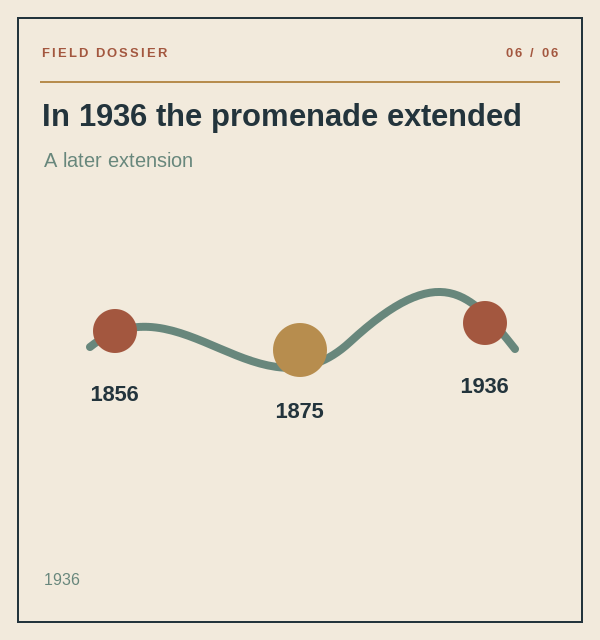
Three dates along a schematic promenade.
Three phases of the walkway; intervals are compressed. (Source · Editorial graphic based on the cited source · Original graphic; explanatory schematic, not a reconstruction to scale)

Sources

Buziaș’s colonnade was built in phases and connected places used for spa treatment and walks. The emperor’s 1898 visit is documented; a commission for Sisi does not appear in the contemporary sources consulted.

  1. Banat spa and leisure heritage, The ColonnadeThe local heritage record dates construction from 1856 to 1875; it describes the route between springs, hotels, casino and Phoenix bath, then the 1936 extension.
  2. Timiș County Council, spatial plan, vol. IIIThe county plan records the first mineral spring capture in 1811 and the early spa resort.
  3. Colonnade history, local travel accountA local travel account says a covered passage linked two springs in 1815. We treat it as a secondary claim, distinct from the 1856–75 dating of the present colonnade.
  4. József Kossak, Franz Joseph in Buziaș, Das Interessante Blatt, 1908Press image published ten years after the emperor’s 1898 visit; it depicts him receiving a petition during military manoeuvres. File marked public domain.
  5. Yo6own, Covered colonnade in Buziaș2012 photograph, licensed CC BY-SA 3.0 Romania.