Marius ComperCârniceni, Iași County
Română

Cârniceni — Holm II

Cârniceni. The house with more than 130 loom weights

A dwelling discovered near Cârniceni in Iași County contained loom weights, spindle whorls and painted pottery. The inventory offers a glimpse into working with fibres in the Cucuteni period.

Start the story ↓
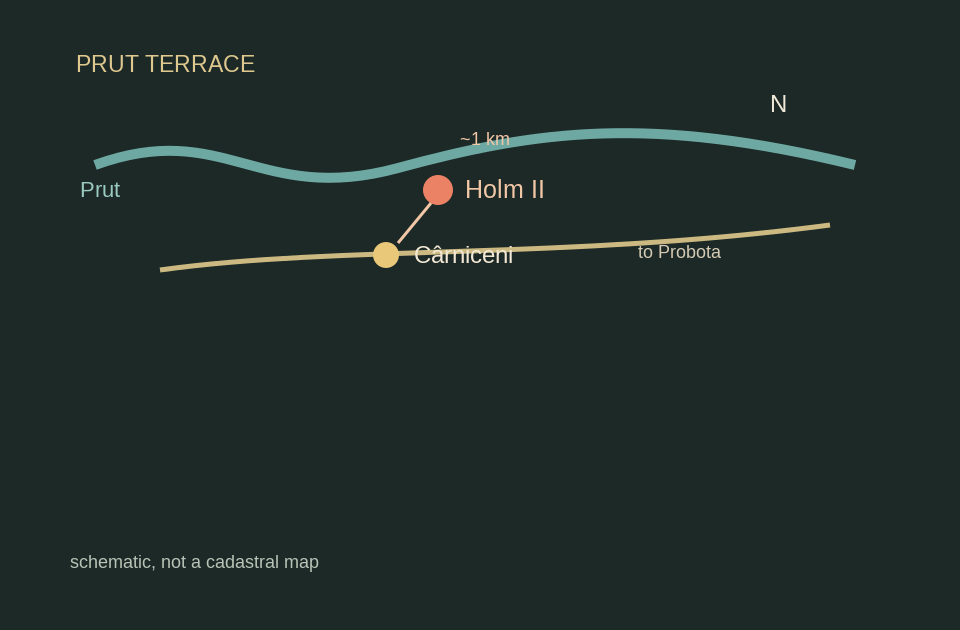
Location diagram: Holm II lies north of the village, toward the boundary with Probota.
Location diagram: Holm II lies north of the village, toward the boundary with Probota. (Source · Original drawing based on the archaeological report and RAN record)

A site by the boundary
Location diagram: Holm II lies north of the village, toward the boundary with Probota.
Location diagram: Holm II lies north of the village, toward the boundary with Probota. (Source · Original drawing based on the archaeological report and RAN record)

A site by the boundary

Holm II contains several periods

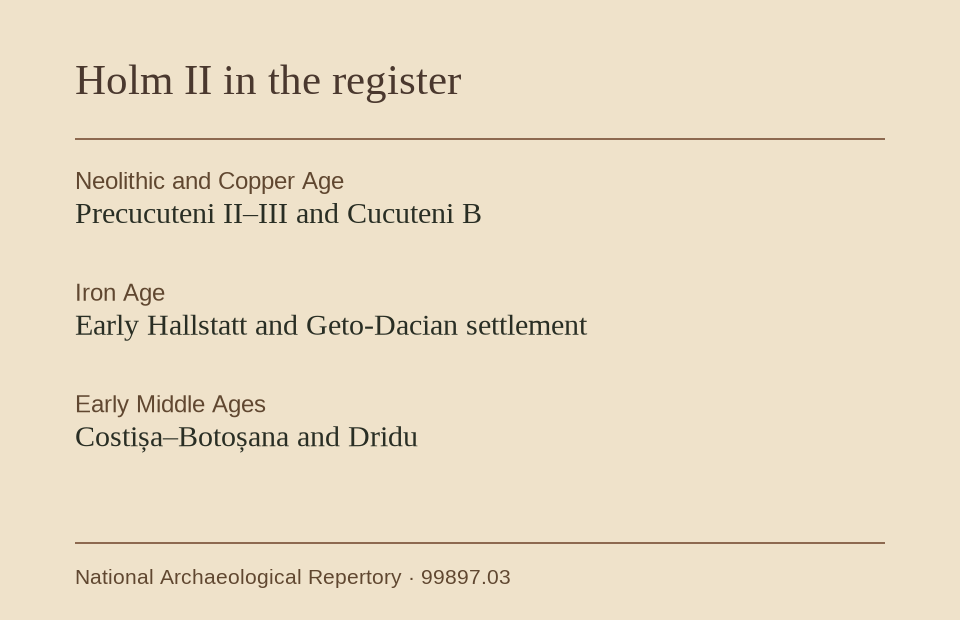
Holm II lies about one kilometre north of Cârniceni, where Țigănași commune meets Probota. On the right-bank terrace of the Prut, Romania’s National Archaeological Repertory records it as a site containing several settlements. The record lists Neolithic and Eneolithic occupation, followed by early Hallstatt traces, a Geto-Dacian settlement and others from the early medieval centuries. [1] [3]

The 2006 article follows one dwelling that archaeologists assigned to Cucuteni B2. That is one episode in a place used across different periods. The objects from this house cannot automatically be placed in every other period listed for the site. [1] [2]
Location diagram: Holm II lies north of the village, toward the boundary with Probota.
Location diagram: Holm II lies north of the village, toward the boundary with Probota. (Source · Original drawing based on the archaeological report and RAN record)
Periods in the Holm II record. The list shows repeated occupation and gives no stratigraphic order.
Periods in the Holm II record. The list shows repeated occupation and gives no stratigraphic order. (Source · Original drawing based on the archaeological report and RAN record)

An accidental discovery

What was found in the dwelling

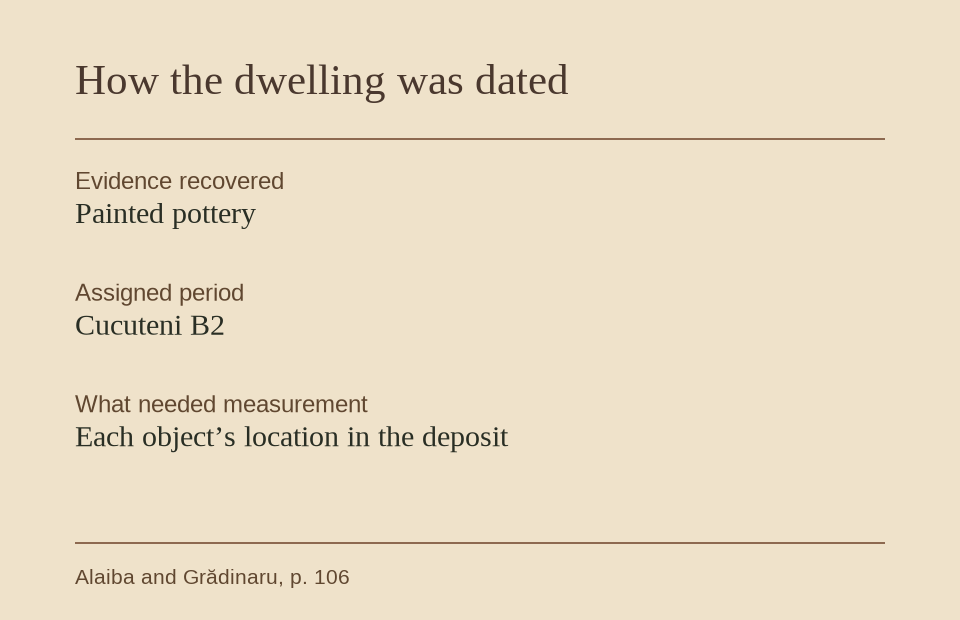
At Holm II the authors describe a dwelling discovered by chance, ahead of any systematic excavation. Painted pottery allowed them to assign it to Cucuteni B2, late in the Cucuteni period. The inventory includes objects associated with several kinds of work. [2]

The inventory gives us a starting point for understanding spinning and weaving. Establishing where people kept things in the house would require a record of each deposit and object position. The report preserves the inventory, the forms and some measurements. [2]
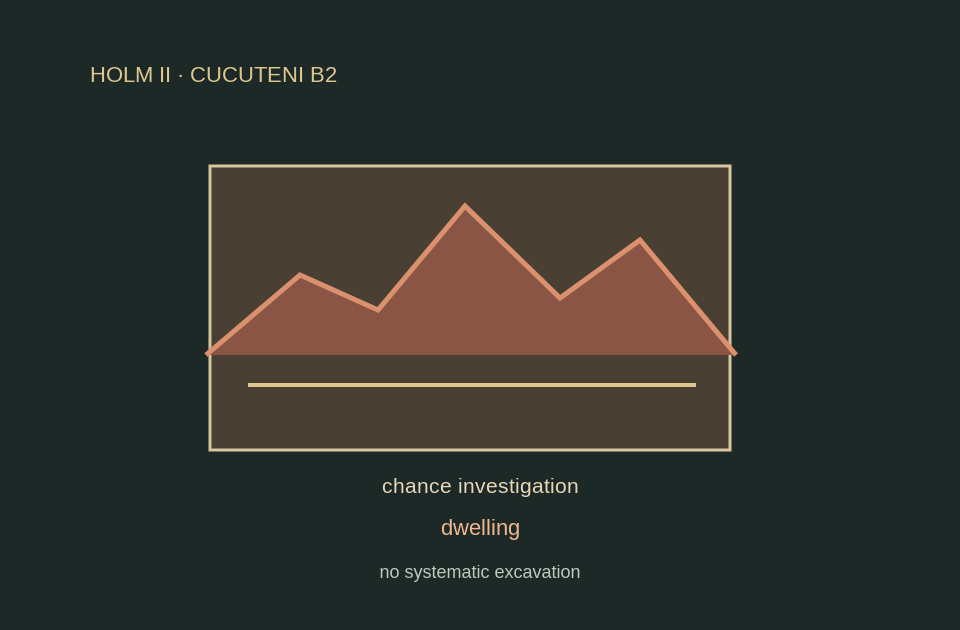
Schematic drawing based on the article; the researchers did not conduct a systematic excavation.
Schematic drawing based on the article; the researchers did not conduct a systematic excavation. (Source · Original drawing based on the archaeological report and RAN record)
The article dates the dwelling to Cucuteni B2 from painted pottery. Its observations do not establish where individual objects lay.
The article dates the dwelling to Cucuteni B2 from painted pottery. Its observations do not establish where individual objects lay. (Source · Original drawing based on the archaeological report and RAN record)

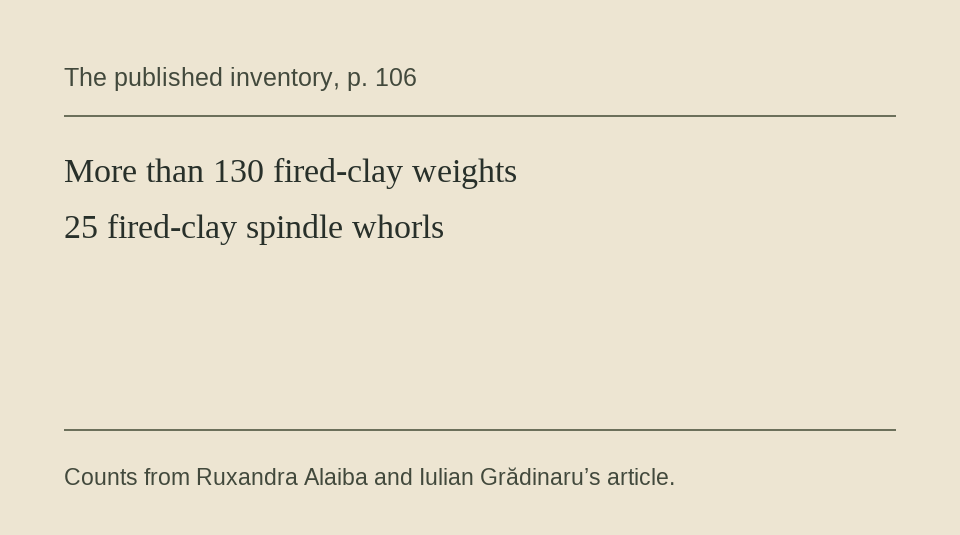
More than 130 weights

Weights to keep loom threads taut

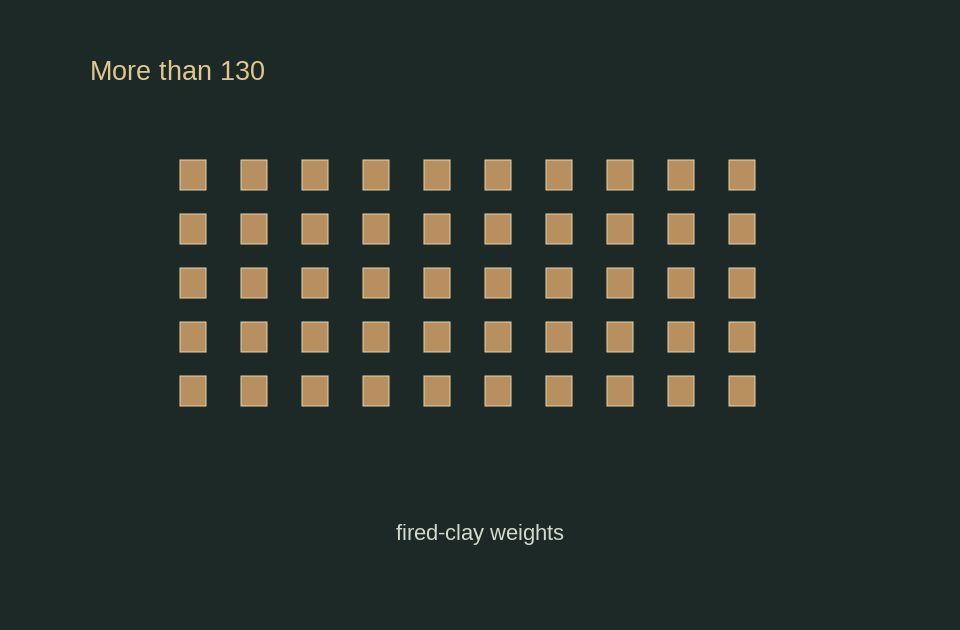
The article records more than 130 fired-clay weights. Hung from the warp threads of a loom, weights like these keep them taut while the weaver passes the horizontal thread through. The authors read the weights together with spindle whorls as evidence of a workshop for processing fibres and weaving. [2]

“Workshop” is the researchers’ interpretation; no excavation plan identifies a room by that function. The large number makes weaving in the house plausible, but the report does not tell us how many people worked there or whether the objects were all used at once. [2]
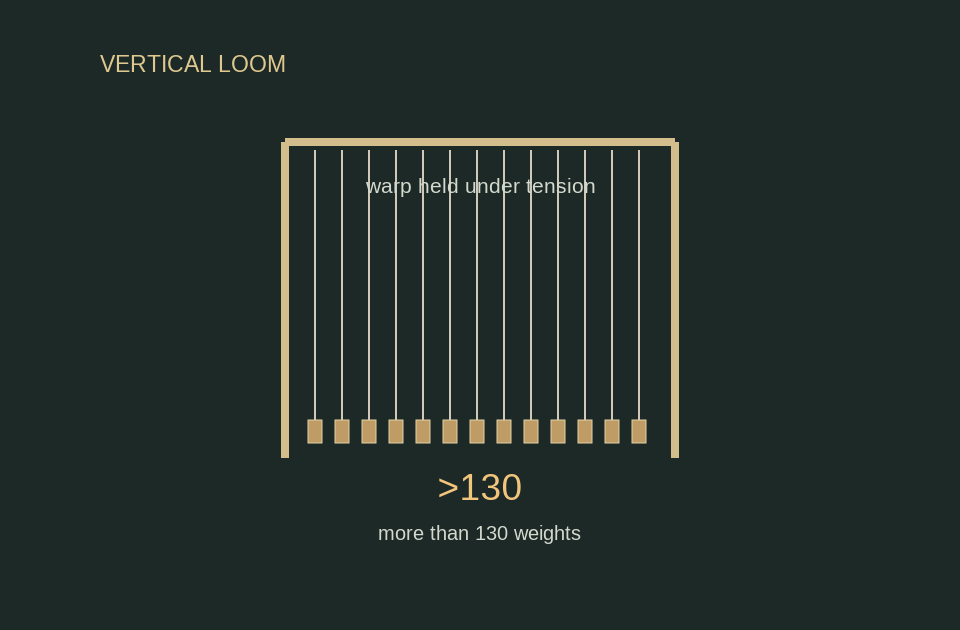
The loom is an explanatory diagram; the report says “more than 130” weights.
The loom is an explanatory diagram; the report says “more than 130” weights. (Source · Original drawing based on the archaeological report and RAN record)
The dots stand for the group of weights described in the article; they are not an item-by-item catalogue.
The dots stand for the group of weights described in the article; they are not an item-by-item catalogue. (Source · Original drawing based on the archaeological report and RAN record)
Counts from Ruxandra Alaiba and Iulian Grădinaru’s article.
Counts from Ruxandra Alaiba and Iulian Grădinaru’s article. (Source)

The spinning spindle

Weight at one end, fibre in motion

The same house yielded 25 fired-clay spindle whorls. Fitted near the base of a spindle, a whorl added weight and helped it turn and twist fibres. Alongside the loom weights, these objects point to two stages of textile work: spinning and weaving. [2]

The report does not identify the fibres or preserve a piece of cloth from this house. The diagram shows how the tool works, not the objects in their original positions. [2]
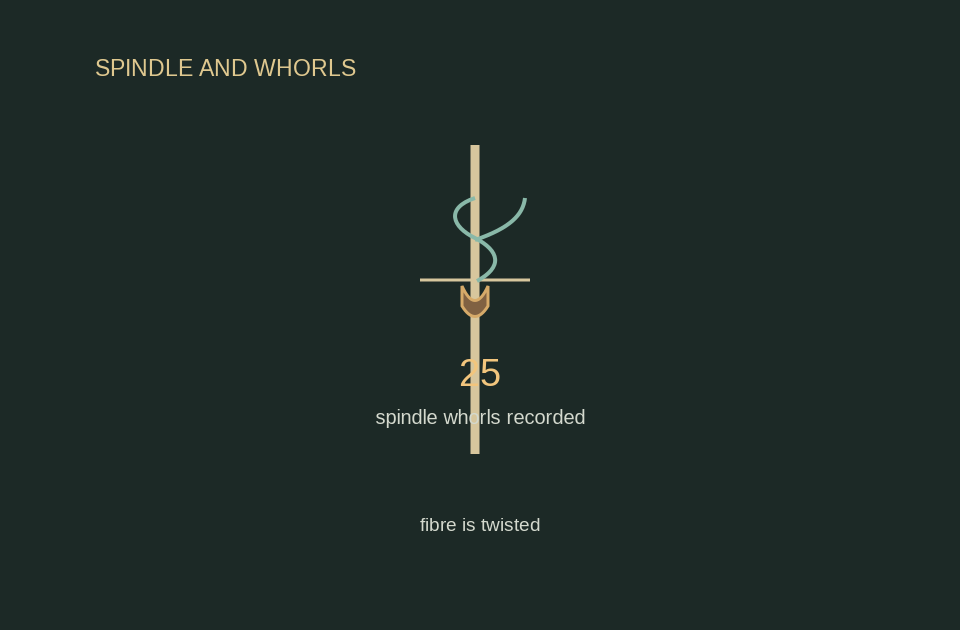
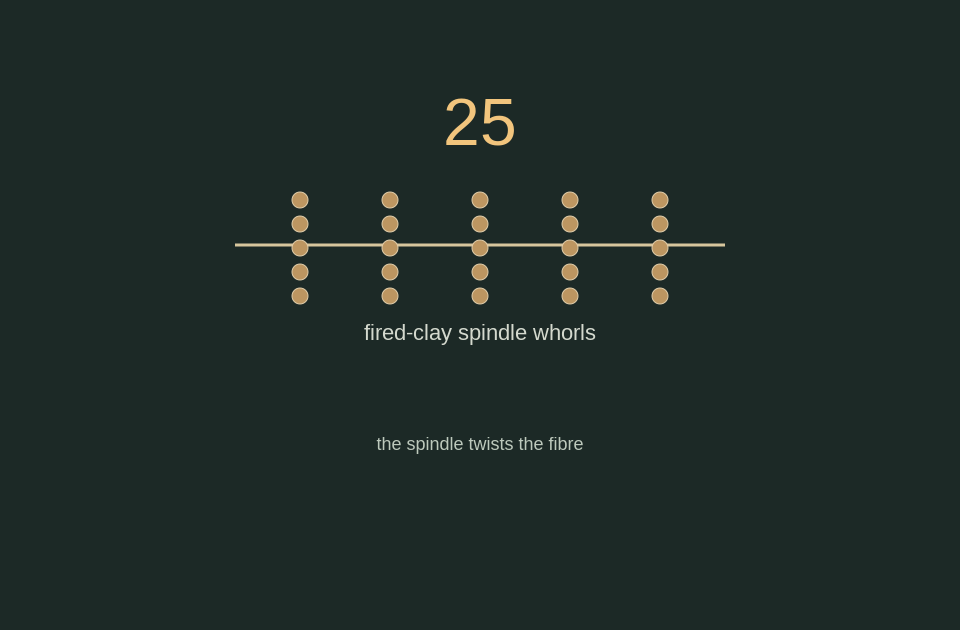
Diagram of how a spindle whorl works, not a scale reconstruction of an artefact.
Diagram of how a spindle whorl works, not a scale reconstruction of an artefact. (Source · Original drawing based on the archaeological report and RAN record)
The article counts 25 pieces used to weight the spindle and help it turn.
The article counts 25 pieces used to weight the spindle and help it turn. (Source · Original drawing based on the archaeological report and RAN record)

Painted pottery

A vessel with four lugs

The report also describes an amphora with a globular body, a tapered-convex neck, four conical lugs and red-and-black painting. Its shoulder carries elliptical motifs. The authors read a female figure in one ellipse and a grain ear or branch in another. These are their published observations, not a definitive explanation of the symbols. [2]

The vessel brings us closer to how people decorated everyday objects, but the article does not say what it held. The drawing follows the authors’ description of its shape and motifs; it is neither a photograph nor a claim about its precise use. [2]
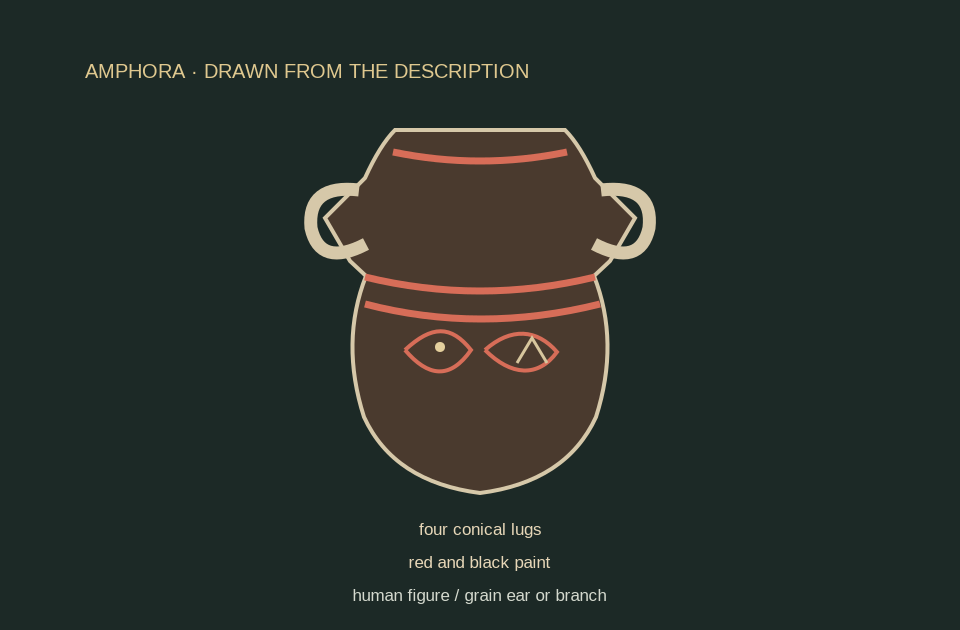
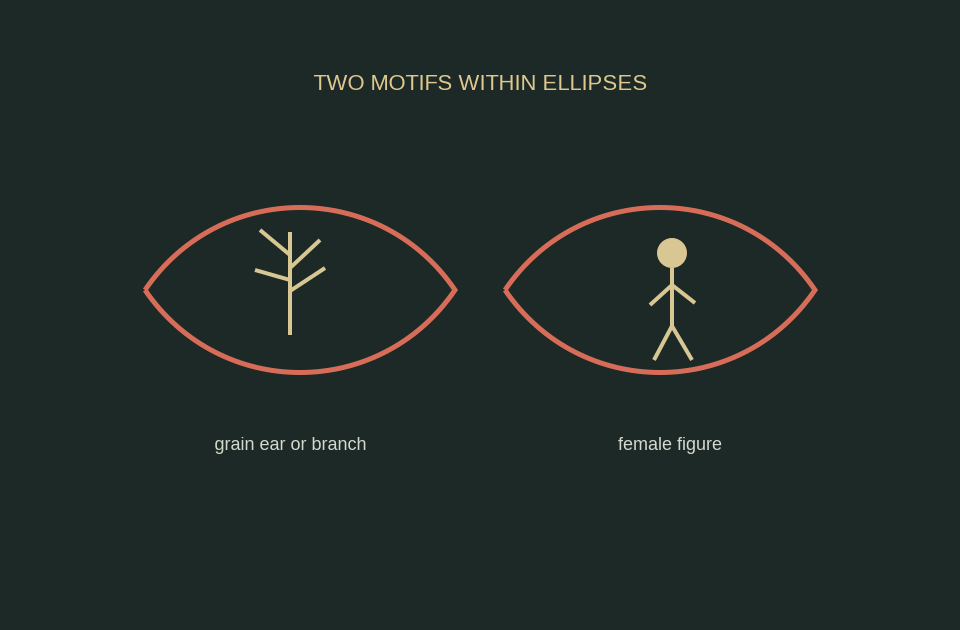
Original drawing from the description: globular body, four lugs, red and black paint.
Original drawing from the description: globular body, four lugs, red and black paint. (Source · Original drawing based on the archaeological report and RAN record)
Schematic motif: the authors describe a female figure and a grain ear or branch inside two ellipses.
Schematic motif: the authors describe a female figure and a grain ear or branch inside two ellipses. (Source · Original drawing based on the archaeological report and RAN record)

Agricultural tools?

A tool’s shape does not prove how it was used

The article presents a 19.6-centimetre dibble and a 21.4-centimetre piece worked from the main beam of a deer antler. The figure caption calls it a ploughshare, while the text is more cautious: it “may” be one. A separate drawing shows an antler hoe. [2]

The researchers connect these tools with preparing soil, but the perforated piece’s exact use is uncertain. Neither the tools nor the weaving weights alone prove what the household, fields or entire settlement looked like. We can follow the article’s proposals and stop where its evidence stops. [2]
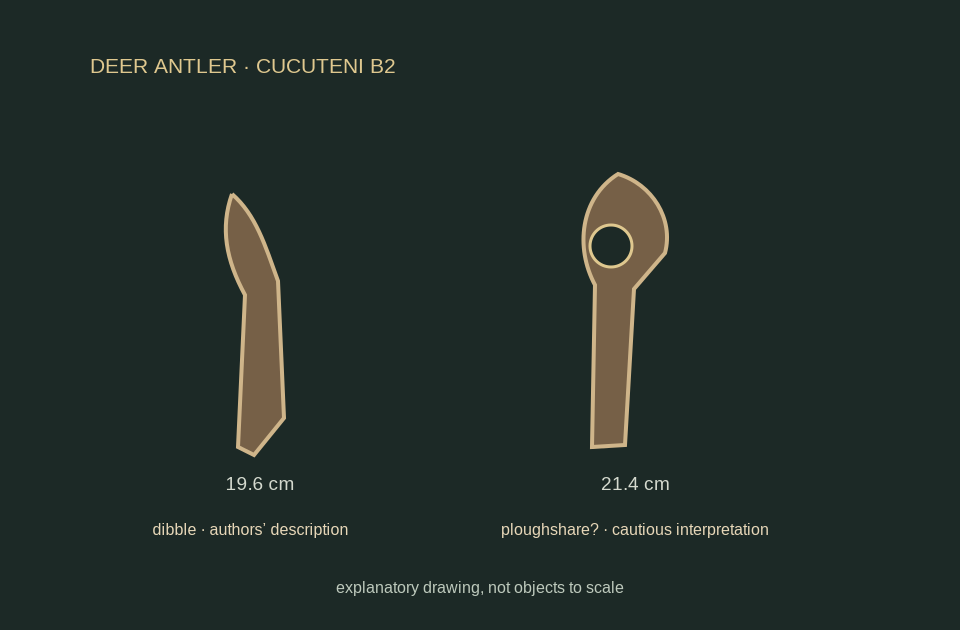
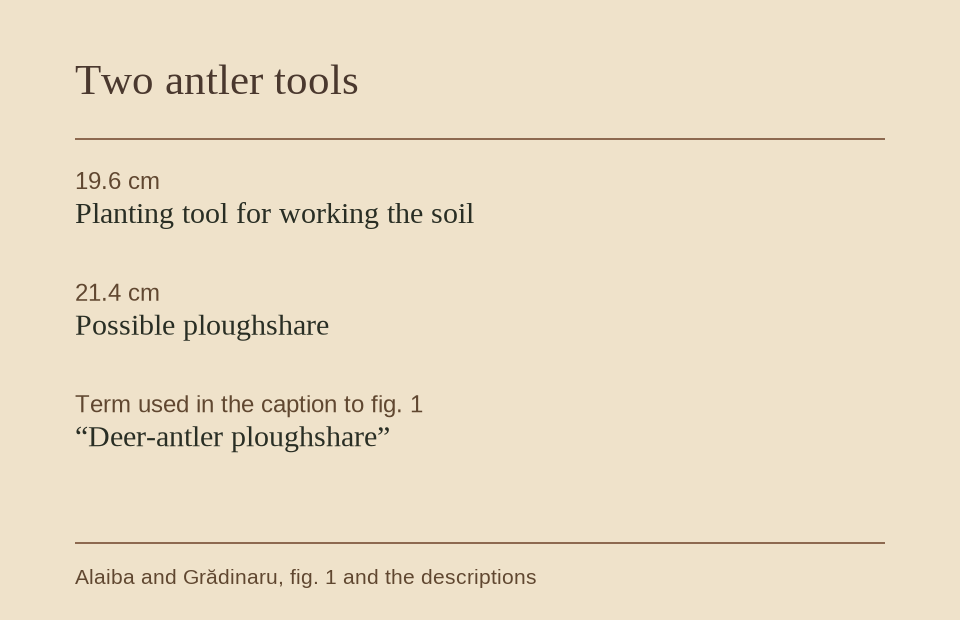
The article illustrates two deer-antler tools; the authors remain cautious about the ploughshare’s function.
The article illustrates two deer-antler tools; the authors remain cautious about the ploughshare’s function. (Source · Original drawing based on the archaeological report and RAN record)
The caption calls the 21.4 cm tool a ploughshare, and the text retains that as a possibility. The dimensions come from the article.
The caption calls the 21.4 cm tool a ploughshare, and the text retains that as a possibility. The dimensions come from the article. (Source · Original drawing based on the archaeological report and RAN record)

Sources

The weights and whorls connect the house with spinning and weaving. Painted pottery helps date the dwelling, and the antler tools raise another question about working the soil. This inventory describes one dwelling at a place people used in several periods.

  1. Romania’s National Archaeological Repertory, record 99897.03The location of Holm II and the periods of occupation listed in the record.
  2. Ruxandra Alaiba and Iulian Grădinaru, “Antler Tools from the Cârniceni-Holm II Settlement”, 2006, pp. 106–113Published archaeological report: discovery history, burned house, loom weights, spindle whorls, painted amphora and antler tools.
  3. Țigănași Commune Development Strategy, archaeological-site inventoryThe commune document places Holm II about one kilometre north of Cârniceni, by the boundary with Probota.