Cloud water, weighed
The cloud above you weighs as much as 80 elephants
An ordinary summer cloud gathers about 500 tonnes of water, as much as 80 bull elephants, and still does not fall. Weigh your own cloud and learn what holds it up.
First, a betFirst, a bet
How heavy do you think the cloud is?
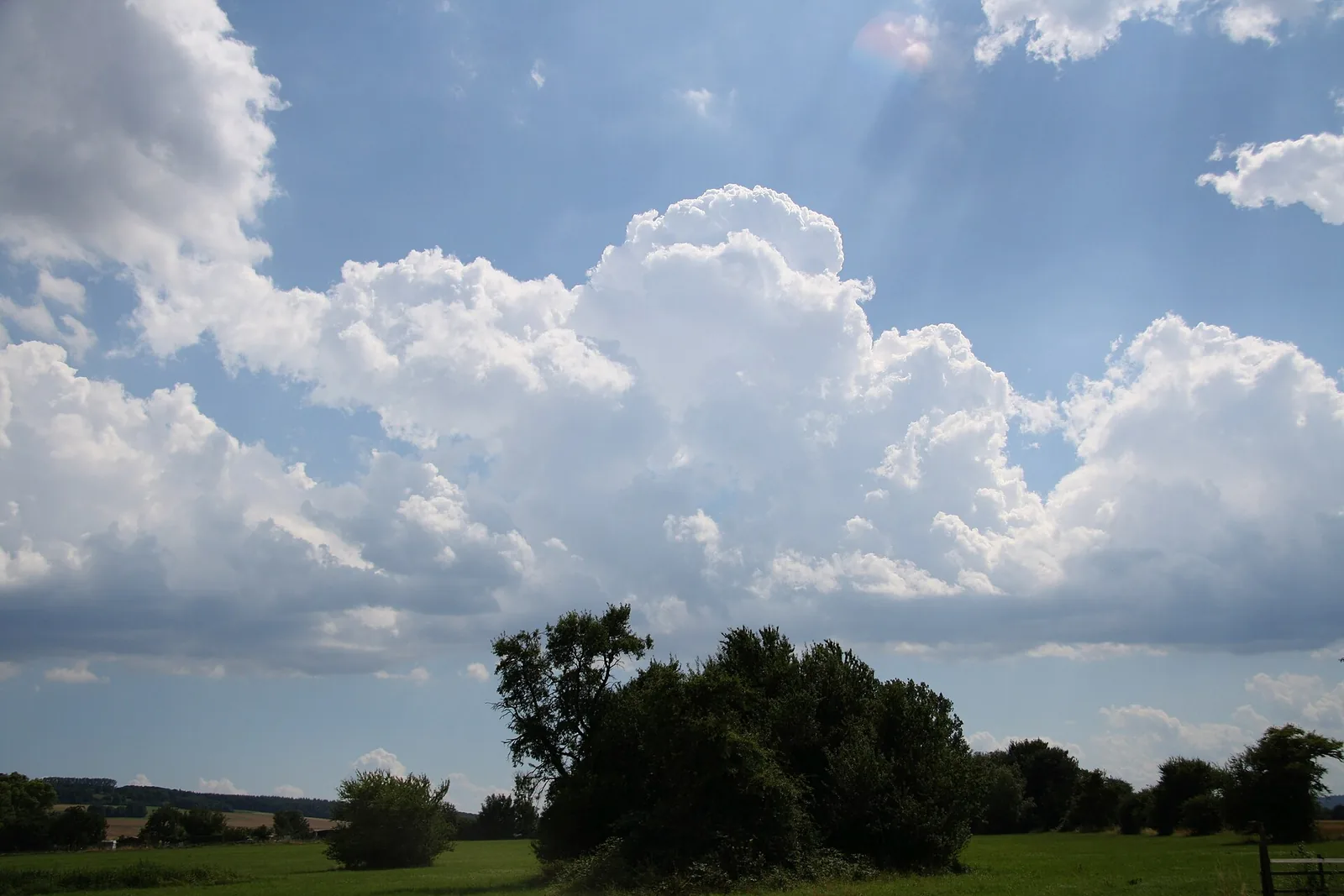
A puffy summer cloud, about a kilometre on each side. Drag the slider to where you think the weight of its water lies, then press the button. The answer only appears after you commit.
The worked answer: about 500 tonnes of water. That is what a one-kilometre cumulus gathers at half a gram of water per cubic metre. It holds as much as 80 bull elephants.
That weight counts the water only. The air of the cloud, droplets included, passes a million tonnes, and still floats. The mechanism is below, under Why does it not fall.
The shadow-and-cubic-kilometre sum belongs to the American meteorologist Peggy LeMone. She measured a cloud's width from its shadow, watching her car's odometer as she drove under it on a day with the sun high.
The cloud scales
Weigh your own cloud
Pick the kind of cloud, its width and its height. The scales reckon its water from measured water contents, and you step on with your own weight.
The water contents are averages measured in the free atmosphere: stratus 0.2, fair-weather cumulus 0.5, towering cumulus 2.5 grams per cubic metre. The cloud is reckoned on a square base: the volume is the width squared times the height.
Water in the cloud
500 tonnes
Volume
1 km³
What that means
- 83 bull elephants at 6 tonnes
- 12,500 people like you
- 500,000 litres of water
- 1.9 × 10¹⁸ cloud droplets
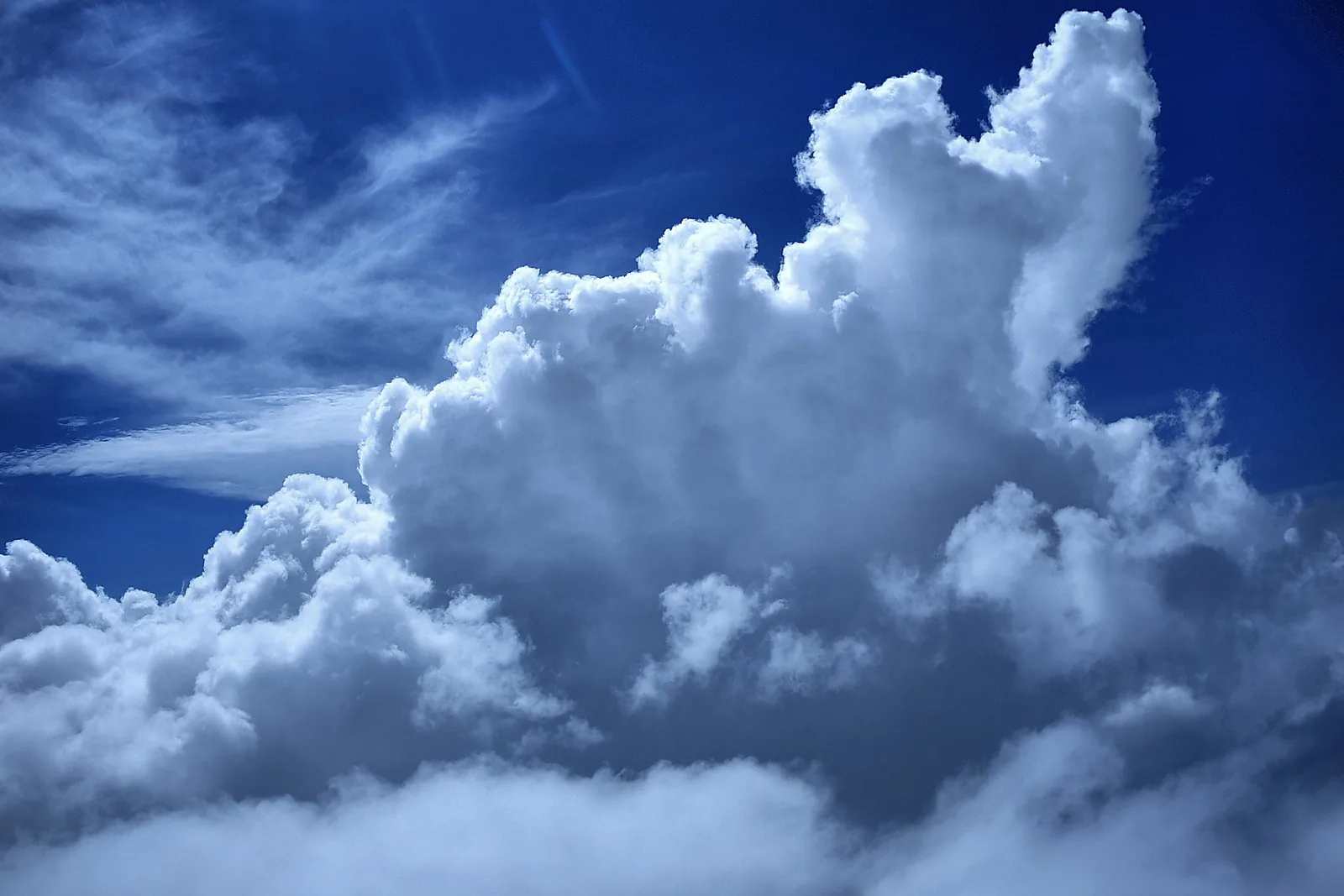
For example, a stratus sheet 10 kilometres by 10, 300 metres thick, gathers 6,000 tonnes of water, as much as 1,000 bull elephants. Put the values in the scales and see.
And a storm cloud 10 kilometres on each side, reckoned at 2.5 grams per cubic metre, would gather 2.5 million tonnes. The sum is a broad one: in a storm the water is not spread evenly, and no single measured value exists for storm clouds.
From droplet to raindrop
A million droplets in one raindrop
The water of the cloud is broken into drops so small that a million of them fit in a single 2-millimetre raindrop.
How fast the droplets fall, in still air
- Cumulus droplet, 4-micrometre radius2.0 mm/s
- Stratus droplet, 7-micrometre radius6.2 mm/s
- Towering-cumulus droplet, 10-micrometre radius12.6 mm/s
Direct measurements give fair-weather clouds droplets with a mean radius of 4 micrometres, a diameter of 8 micrometres. Against those, a 2-millimetre raindrop gathers the water of about 16 million droplets. A million comes out with the typical 20-micrometre droplet from the NASA textbooks; both sums show their inputs.
So small, the droplets fall slowly. The ordinary one sinks at 2 millimetres per second. In perfectly still air it would need almost six days to fall one kilometre, and air does not sit still.
The big question
Why does it not fall?
Three answers go around. Only one is right. Pick it before reading on.
The right answer is the second. A water molecule is lighter than the nitrogen and oxygen ones it replaces, so the moist air of the cloud is lighter than the dry air below it. The droplets fall all the time, slowly, and the rising air carries them.
First, the air. A water molecule weighs 18, against 28 for nitrogen and 32 for oxygen. When water molecules take the place of nitrogen and oxygen ones, the mixture grows lighter. At 2 kilometres up, American meteorologists reckon dry air at 1.007 kilograms per cubic metre and cloud air at 1.003.
Then, the droplets, falling at 2 millimetres per second. Air climbing in a towering cumulus passes 3,000 feet per minute, that is 15.24 metres per second: over 7,500 times faster. Even weak currents, at 5 metres per second, run about 2,500 times faster.
So the cloud does not hang still: moist air climbs all the time, and the droplets fall slowly through it. What you see in the sky is the shape the climb takes.
The cloud on the scales against the neighbouring air
3,500 tonnes lighter
For the one-cubic-kilometre cloud: 1,003,000 tonnes of moist air, plus 500 tonnes of droplets, against 1,007,000 tonnes of dry air in the same volume.
How much water, what kind of cloud
Fat clouds and thin clouds
Not all clouds hold the same amount of water. The bars show the measured averages in three kinds of cloud.
Half a gram per cubic metre is, as the scientist who weighed the cloud put it, a small marble's worth of water in a space where you could sit with a friend.
American pages write 551 tons for the same cloud. Theirs are short tons of 907 kilograms; in metric tonnes that is still 500.
What the sources cannot say
- No source gives the weight of any one cloud, with a name and a date. Every figure on this page is a sum with its volume and water content chosen openly, which you can change on the scales.
- No single measured value of water per cubic metre exists for storm clouds, and cirrus clouds are ice, with other physics. That is why the scales have only three buttons.
The game
True or false: eight lines about clouds
Eight statements, each with its proof. Answer them all, then send your score to a friend.
All the answers, with proof:
- True. A fair-weather cloud, one kilometre on each side, holds about 500 tonnes of water. One billion cubic metres at 0.5 grams per cubic metre make 500,000 kilograms. USGS
- False. The cloud floats because the water in it is lighter than air. Liquid water is heavier; what is lighter is the moist air in the cloud. USGS
- True. A 500-tonne cloud holds more droplets than you could count in a million lifetimes. About 1.9 × 10 to the 18 droplets; a million lifetimes would not finish them. NASA
- True. The sum comes to 80 elephants or 100, depending on the elephant. 500 tonnes make 100 elephants at 5 tonnes or about 83 bulls at 6 tonnes. ADW
- False. Cloud droplets hang still in the air. They fall all the time, at about 2 millimetres per second, while rising air is thousands of times faster. FAA
- True. Dry air is heavier than the moist air of the cloud. At 2 kilometres up: 1.007 against 1.003 kilograms per cubic metre. NOAA
- False. American pages say the cloud weighs 551 metric tonnes. They say 551 short tons of 907 kilograms; in metric tonnes that is still 500. USGS
- True. One raindrop gathers the water of at least a million cloud droplets. A million, with the 20-micrometre droplet; about 16 million, with the measured average diameter of 8 micrometres. LeMone
Sources and method
Where the figures come from
The sums start from Peggy LeMone's method: an ordinary cumulus cloud, about a kilometre on each side, with half a gram of water per cubic metre. The water contents by kind of cloud are averages measured in the free atmosphere, published in 1950. The fall speeds come from Stokes' law, with the measured radii and the standard viscosity of air; the page shows its inputs beside each result.
The equivalents set masses face to face: the 6-tonne bull elephant stands at the top of the published male range, the 70-kilogram person is a declared round value, the litre comes from the water itself. Where the sources fall silent, the page falls silent: it gives the weight of no one cloud in particular, and it puts neither storm nor ice clouds on the scales.
Measurements and sums
- Soniak, M., interview with Peggy LeMone (NCAR), Mental Floss: How Much Does a Cloud Weigh? the article — the shadow-and-cubic-kilometre method: 0.5 grams per cubic metre, 100 elephants
- Live Science: How much does a cloud weigh? (LeMone, Sorooshian) the article — 550 short tons, i.e. 499 metric tonnes; the 2-millimetre raindrop
- Visibility and liquid water content in clouds in the free atmosphere, 1950 (publisher abstract) the abstract — the measured averages: 0.2 / 0.5 / 2.5 grams per cubic metre; radii of 4, 7 and 10 micrometres
- USGS Water Science School: How Much Does a Cloud Weigh? the page — the 500,000-kilogram sum; the figure counts the droplets only
Why it floats
- NOAA National Weather Service: How much does a cloud weigh? (worked example) the document — dry air 1.007 against cloudy air 1.003 kilograms per cubic metre, at 2 kilometres
- FAA Aviation Weather Handbook, chapter 22: Thunderstorms the chapter — updrafts above 3,000 feet per minute
- EUMETSAT: Convective Updraft Detection Product, ATBD (Mecikalski, 2024) the document — weak updrafts, up to 5 metres per second
- NASA Glenn Research Center: Air properties the page — the standard sea-level viscosity of air
Elephants and droplets
- Animal Diversity Web: Loxodonta africana (African bush elephant) the account — males 4,500–6,100 kilograms, females 2,000–3,500
- NASA Space Math: Cloud Droplets and Rain Drops the document — the typical 20-micrometre droplet; the density of water, 1,000 kg/m³
.jpg)
