Dacia, AD 108
How long is a step?
Ask a Roman soldier and he answers with his body: five feet laid end to end, from one print of the same foot to the next. His pace measured roads from Rome to Dacia. His mile is gone; his word stayed.
One Roman pace: 1.48 m.
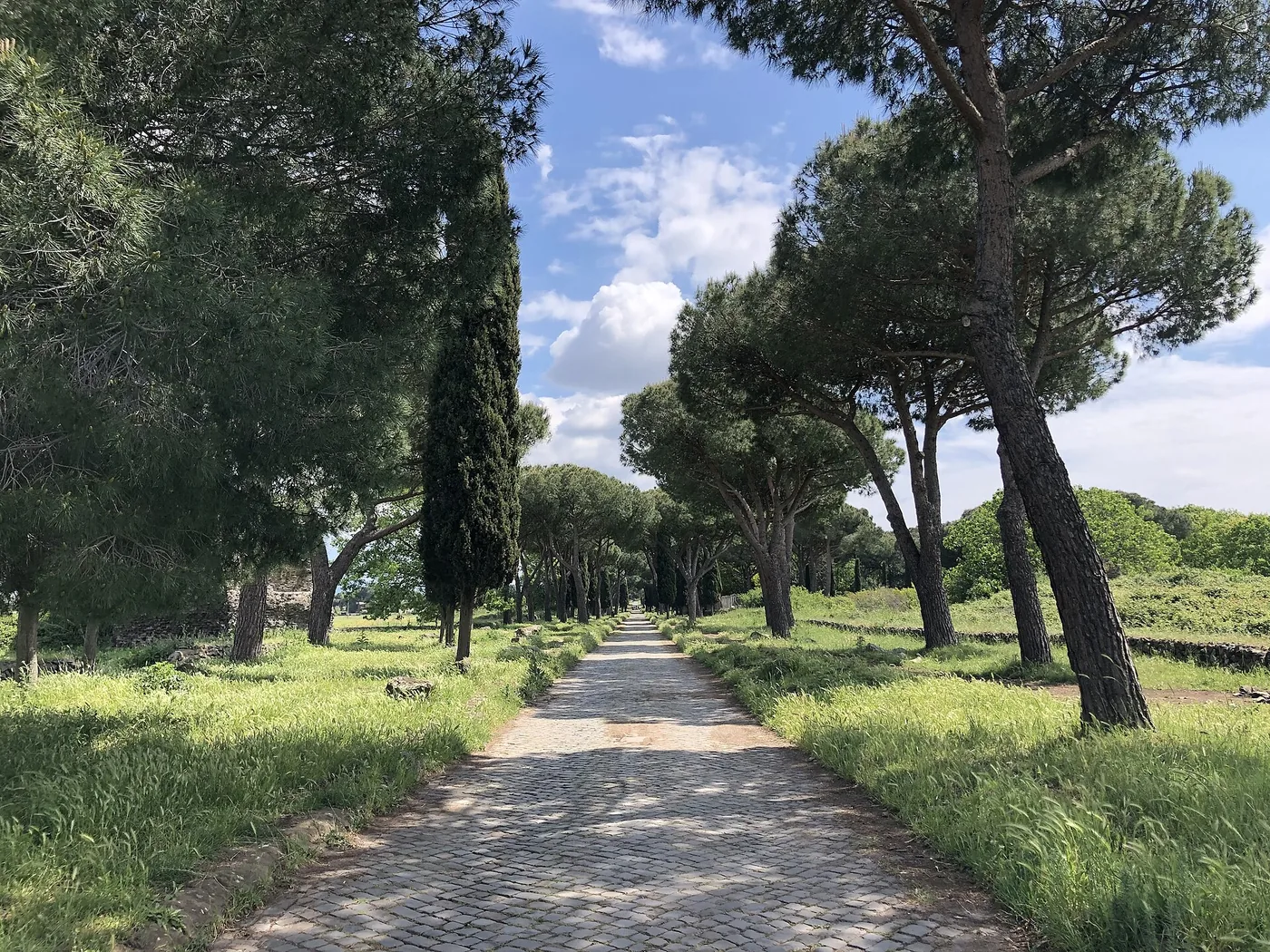
The soldier as a measuring instrument
The Romans needed no tape measure while they had soldiers. The foot, pes, ran to about 29.6 cm. Two and a half feet made the single step, gradus, of 74 cm. And the double pace, passus, counted from one heel-strike to the next print of the same foot, gathered five feet: 1.48 m.
On the march, every hundred double paces were called out loud. At a thousand paces, the road earned a stone marker: mille passuum, a thousand paces, or 1,480 m. The whole empire was divided into slices of a thousand soldier's paces each.
Pace out your mile
Set the length of your own step and see how many of your steps fit into the Roman mile.
The Roman mile is 1,480 m. At 75 cm a step, you walk it in 1,973 steps.
Ten thousand paces, set in stone
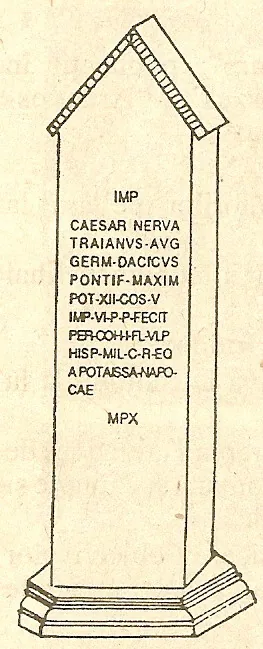
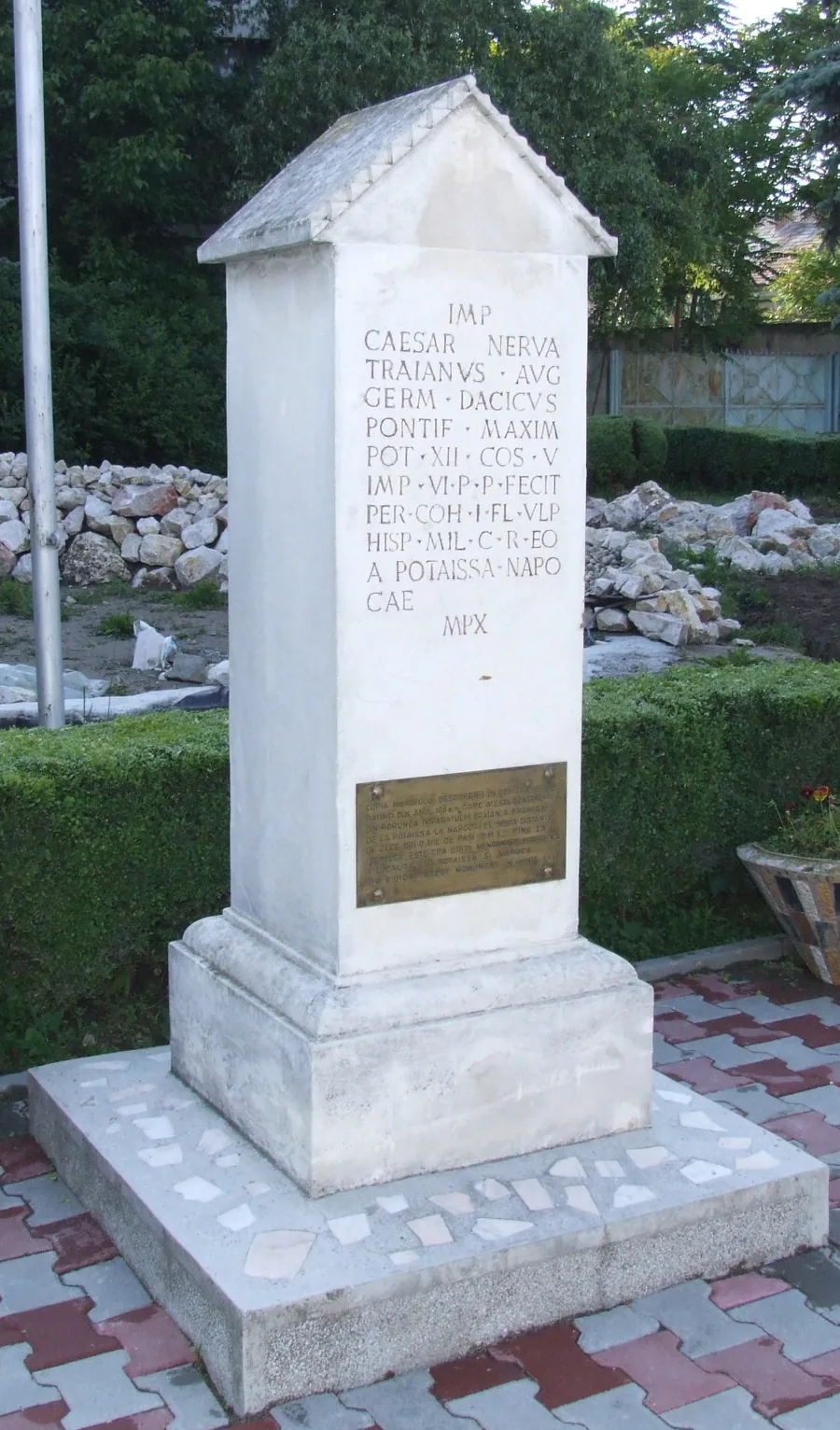
At Aiton, near Cluj, a stone pillar once counted distance in soldier's paces. The milestone, found in 1758 by the teacher Mihály Szathmári Pap, had been raised in AD 108 on Trajan's orders, on the road between Potaissa and Napoca. Its last letters say everything: M·P·X, milia passuum decem, ten thousand paces, 14.8 km.
The road had been built by the first cohort of Spaniards, cohors I Flavia Ulpia Hispanorum, a unit a thousand strong. The inscription is the first written record of the names Potaissa and Napoca, today's Turda and Cluj. Theodor Mommsen entered the text into the Corpus Inscriptionum Latinarum, volume III, as number 1627.
The original is lost; we know it from a 1758 drawing, copied in 1773 by the historian Johann Seivert into a manuscript kept at Cluj. Today, copies of the stone stand in the Aiton schoolyard and in front of the Turda post office, raised in 1993.
Imp · Caesar · Nerva · Traianus · Aug · Ger · Dacicus
fecit · per · coh · I · Fl · Ulp · Hispan · mil · c · R · eq
a · Potaissa · Napocae
M · P · X


- Where
- Aiton, Cluj county; copies at the Aiton school and at Turda
- When
- AD 108, two years after the conquest of Dacia
- Number
- CIL III 1627
- Distance
- M·P·X: ten thousand paces, 14.8 km
The mile of paces lasted two thousand years. It lost to the metre: on 15 September 1864, Alexandru Ioan Cuza signed the law adopting the metric system in Romania, defended in parliament by Mihail Kogălniceanu. The kilometre has counted distances ever since, and the Aiton stone stands as a monument to the older way of measuring.
What stayed in the language
The mile is gone, but the pace stayed. Three descendants of passus are still heard in Romanian, beside one old measure and one lost mile.
-
passuspas
survived into Romanian
Latin passus gave Romanian pas directly. Two thousand years on, the word still measures the distance between two heels, though nobody counts it in Roman feet any more.
-
pasa păși
survived into Romanian
From pas came the verb a păși, to step, to walk. The sayings a păși cu dreptul and a păși cu stângul, to start on the right or wrong foot, keep the old link between walking and luck.
-
passera pasa
returned through French
The verb a pasa, heard on the sports field, is a modern borrowing from French passer, which itself descends from late Latin passare. Same blood, another road: it left Latin and came back through Paris.
-
passuspas mare
an old measure, a new sum
The old Romanian measures knew the pas mic, of four palms, and the pas mare, of six palms. Reckoning the stânjen at about two metres, the great pace comes out at about a metre and a half: one passus. The match is approximate, because the stânjen varied from one land to another.
-
mille passuum—
lost
The mile of a thousand paces never took root in Romanian. Long distances are counted in kilometres today, inherited from the metric law of 1864. The milestones stand mute.
Sources
The Roman measures are the standard ones: the foot of 29.6 cm, the pace of five feet, the mile of a thousand paces. The etymologies follow the dictionaries on dexonline. The inscription rendering is a literal reading after the CIL text.
- Corpus Inscriptionum Latinarum III, 1627: the Aiton milestone. cil.bbaw.de
- Wikipedia: “Milliarium of Aiton” (en) and “Miliarul de la Aiton” (ro). en.wikipedia.org/wiki/Milliarium_of_Aiton
- Wikipedia: “Ancient Roman units of measurement” (en): pes, gradus, passus, mille passuum. en.wikipedia.org/wiki/Ancient_Roman_units_of_measurement
- Wikipedia: “Romanian units of measurement” (en): pas mic, pas mare, stânjen. en.wikipedia.org/wiki/Romanian_units_of_measurement
- dexonline: pas from Lat. passus; a păși from pas. dexonline.ro/definitie/pas
- Wiktionary: a pasa, borrowed from Fr. passer, from Vulgar Lat. passare. en.wiktionary.org/wiki/pasa
- The metric law of 15 September 1864, signed by Alexandru Ioan Cuza. noema.crifst.ro