Indonesia · caves · rock art
The oldest dated hand: an outline on a cave wall, at least 67,800 years old
Someone pressed a palm to the rock and blew pigment around it. The hand left; its outline stayed.
 Illustration · a different hand, undated
The outline on the island of Muna in Indonesia was dated in 2026, in a paper in Nature, from the calcite crust that grew over it: at least 67,800 years. What survives is a nearly vanished patch of pigment, 14 by 10 centimetres, about the size of a palm.
Compare your palm with the 14 × 10 cm patchHow the age is known
What a hand stencil is
A hand stencil is the place the pigment did not reach. Someone held a palm against the wall while ground ochre, mixed with water or dry, was blown around it by mouth or through a tube. When the hand pulled away, a silhouette with a fine, dusty edge stayed on the stone.
In Groenen’s experiments the soft edge of the Gargas hands was reproduced by spraying (Groenen, 1988). Newer experiments show that several methods, including blowing by mouth, give similar edges, and for hands in high or awkward places researchers think there may have been two people, one holding a hand to the wall and the other blowing the pigment (Fernández-Navarro et al., 2026).
The hand on the wall at the top is also a silhouette, of a real hand from Sulawesi: we traced its outline from a photograph. The pigment is blown by the computer.
Put your palm on the screen
The oldest dated hand survives as a patch 14 by 10 centimetres. To see how big that is, first set your screen: hold a bank card next to the rectangle below and make the rectangle as wide as the card’s short side. Then lay your palm over the patch.
1. Set your screen
2. Lay your palm on the patch
In ANSUR II, a sample of adult US military personnel, the palm averages 11.7 by 8.8 centimetres in men and 10.9 by 7.8 in women (ANSUR II; palm length from wrist to the base of the fingers, breadth across the knuckles). The Muna patch is a little bigger than a palm because it includes part of the fingers.
The Gua Mbokita patch, 24 by 17 centimetres, is bigger than a whole adult hand in the same sample, which averages 18.1 to 19.3 centimetres long. Pigment also settles around the hand, and a stencil usually comes out longer than the hand that made it, with shorter fingers (Rabazo-Rodríguez et al., 2017).
How anyone can tell how old a cave painting is
The red ochre of a stencil cannot be dated directly. But in caves, dripping water leaves a crust of calcite, like a skin of ice, over a painted wall. Calcite contains uranium, which slowly turns into thorium at a known rate. The ratio of the two says how long the layer has been growing.
The crust grows after the pigment is on the wall, never before. So the answer is a minimum age: the hand is older than the layer, but by how much, nobody can tell. Whether a hundred years or ten thousand passed between the hand and the crust, the date does not say.
The method has a safety rule too: uranium must not have leached out of the crust, or the result comes out too old. At Muna the researchers measured several zones of the crust and checked that the ages of the zones are in order or the same within error. Critics of the method say a correct order alone does not prove the ages are right (White et al., 2020).
A ranking of minimum ages is not a ranking of hands. The 2026 paper itself says that differences between minimum ages do not by themselves demonstrate that one painting is older than another (Oktaviana et al., 2026).
There is one more candidate for “oldest hand”: hand and foot traces pressed into soft travertine on the Tibetan plateau, at Quesang, on a layer 169,000 to 226,000 years old. But they are impressions in stone, not pigment stencils, and the age belongs to the layer, not to the gesture (Zhang et al., 2021). We leave them aside here.
Hands on cave walls, from the oldest to the newest
Eight places, each with what we know about the age of the hands there. Ages are minimums unless marked otherwise, and they do not say who made the hand.
- at least 67,800years
Liang Metanduno, Muna island, Indonesia
dated from the crust over it, minimum age
The 14 by 10 centimetre patch from the first section. The calcite crust that grew over it dates to 71,600 ± 3,800 years, so the hand is at least 67,800 years old. One fingertip looks deliberately narrowed. Sulawesi was also home to archaic hominins before our species arrived, and the authors say they have no method to tell who made the hand; they attribute it to our species from the narrowed finger and from when our species is known to have reached the region (Oktaviana et al., 2026).
No free photograph of this hand exists. The Nature article cannot be reproduced; the drawing shows only the size of the patch, not its shape. - at least 66,700years
Maltravieso cave, Cáceres, Spain
disputed
A red hand almost completely covered in calcite: 70,080 years (+3,820/−3,410), so at least 66,700 years. The authors attribute it to Neanderthals. Other researchers dispute both the date and the attribution: uranium can leach out of a crust and make the result look too old (Hoffmann et al., 2018; White et al., 2020). The minimum ages at Muna and Maltravieso overlap within their errors; which hand is older remains unknown.
No free photograph of the dated hand.
- at least 44,700years
Gua Mbokita, Muna island, Indonesia
dated from the crust over it, minimum age
On the same island, a red hand 24 by 17 centimetres: 50,800 ± 6,100 years, so at least 44,700 years. The error is large (Oktaviana et al., 2026).
No free photograph. - at least 39,900years
Leang Timpuseng, Maros, Sulawesi
dated from the crust over it, minimum age
In 2014 this hand became the oldest hand stencil then known: 40,700 years (+870/−840), so at least 39,900 years (Aubert et al., 2014). The same method caused a dispute in Spain; for the thin crusts in Sulawesi the critics themselves write that the system stayed closed, meaning the uranium did not leach out (White et al., 2020).
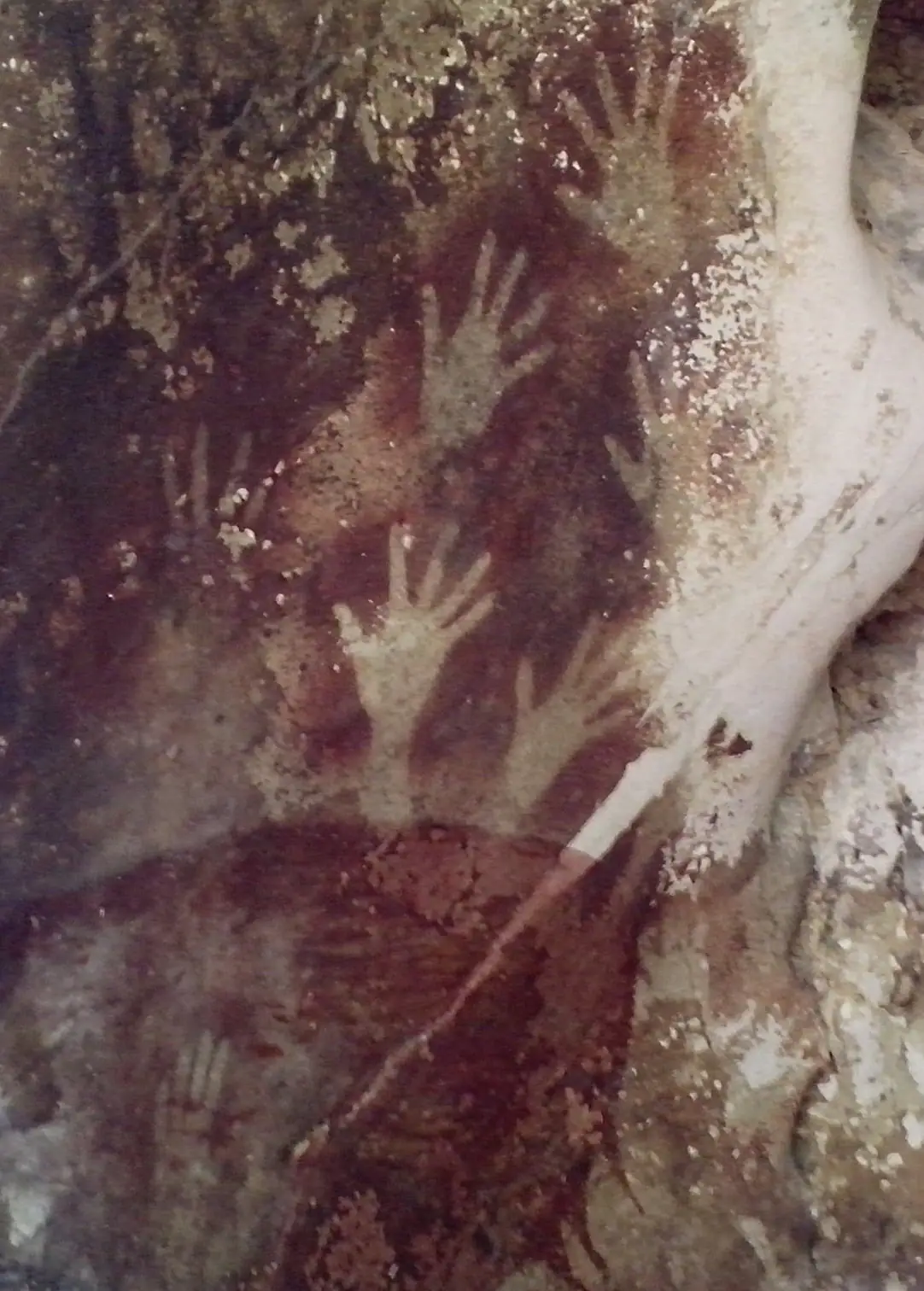
Hands in Leang Pettakere, in the same Maros karst. We found no date for this panel. - at least 37,300years
El Castillo, Cantabria, Spain
dated from the crust over it, minimum age
The Panel of Hands holds about 40 hands. The oldest date for a hand from here comes from a red hand lying under a yellow bison: 37,630 ± 340 years, so at least 37,300 years (Pike et al., 2012).
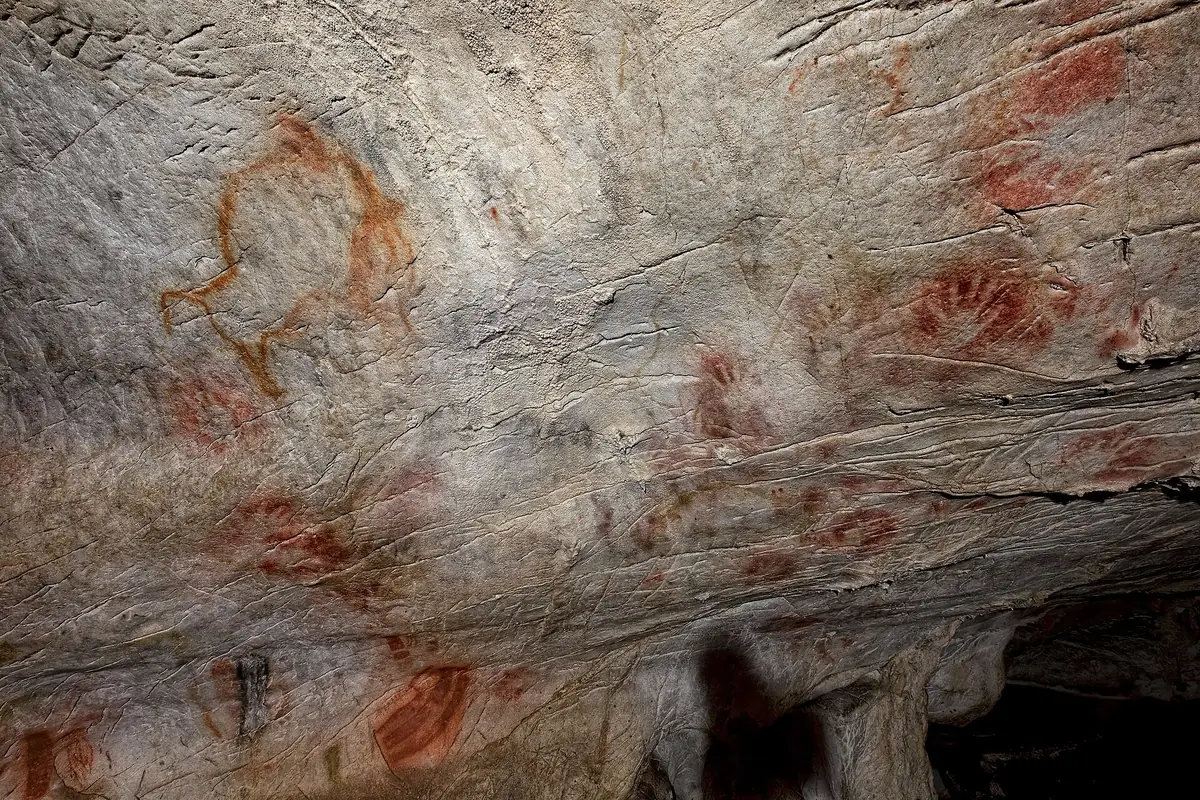
The Panel of Hands in El Castillo. Photo: Gabinete de Prensa del Gobierno de Cantabria. - at least 37,200years
Lubang Jeriji Saléh, Borneo, Indonesia
dated from the crust over them, minimum age
Two orange hands are each at least 37,200 years old. A third of the same colour has a maximum age of 51,800 years. The dark purple hands are younger: roughly 20,000 to 21,000 years (Aubert et al., 2018).
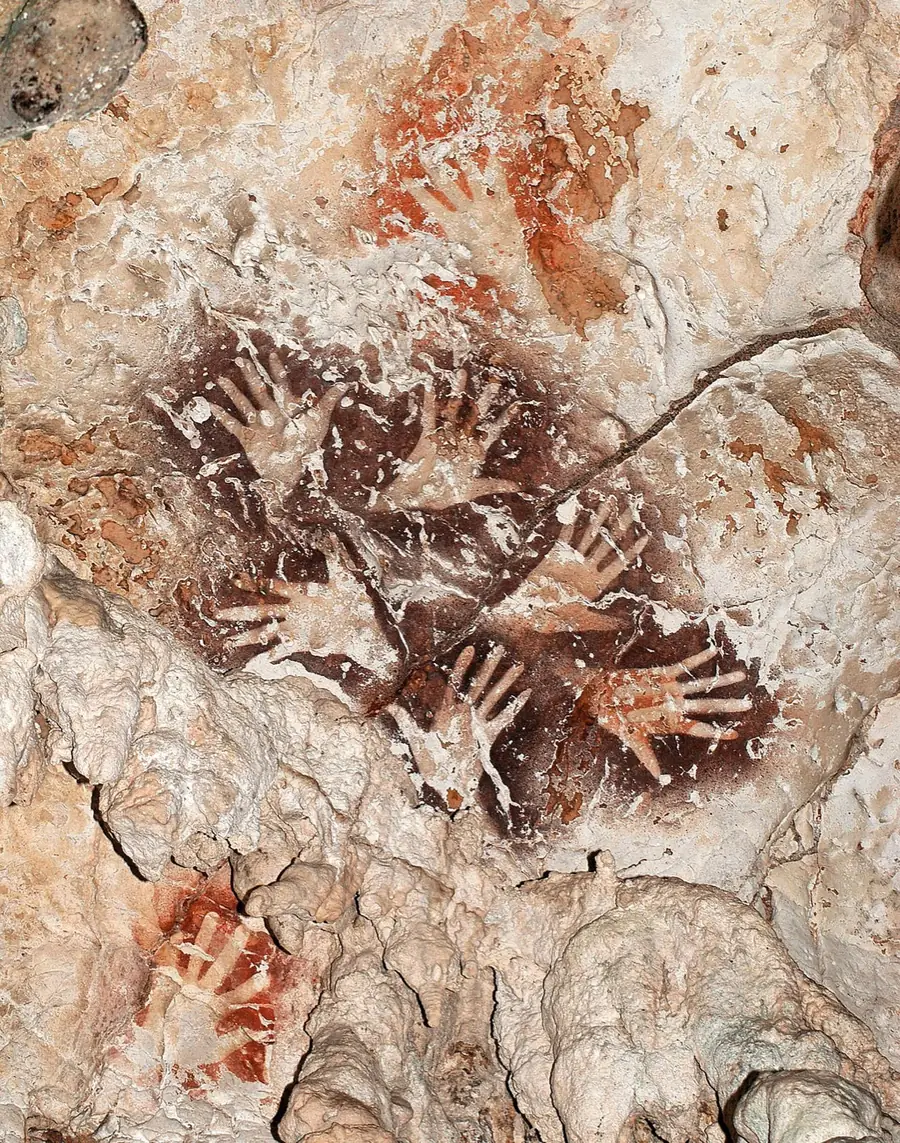
The “Bouquet of Hands” in Lubang Jeriji Saléh. We do not know which of these hands was dated. - no date of its own
Gargas cave, Pyrenees, France
no date of their own
The largest collection in Europe: 231 hands, in negative and in positive. No hand has a date of its own. A bone found in a crack beside hand number 4 is 26,860 ± 460 radiocarbon years, uncalibrated, but no link to the painting can be shown (García-Diez et al., 2015). Why many of them lack fingers is explained further down.
No free photograph from inside the cave.
- no date of its own
Cueva de las Manos, Santa Cruz, Argentina
no date of their own; not from the Ice Age
More than 800 hands, mostly left hands, on a wall like a corridor. The oldest occupation layers in the cave are about 9,300 radiocarbon years old, and the last style of painting about 1,300 years. The hands themselves were not dated directly (Gradin et al., 1987; UNESCO dossier no. 936).
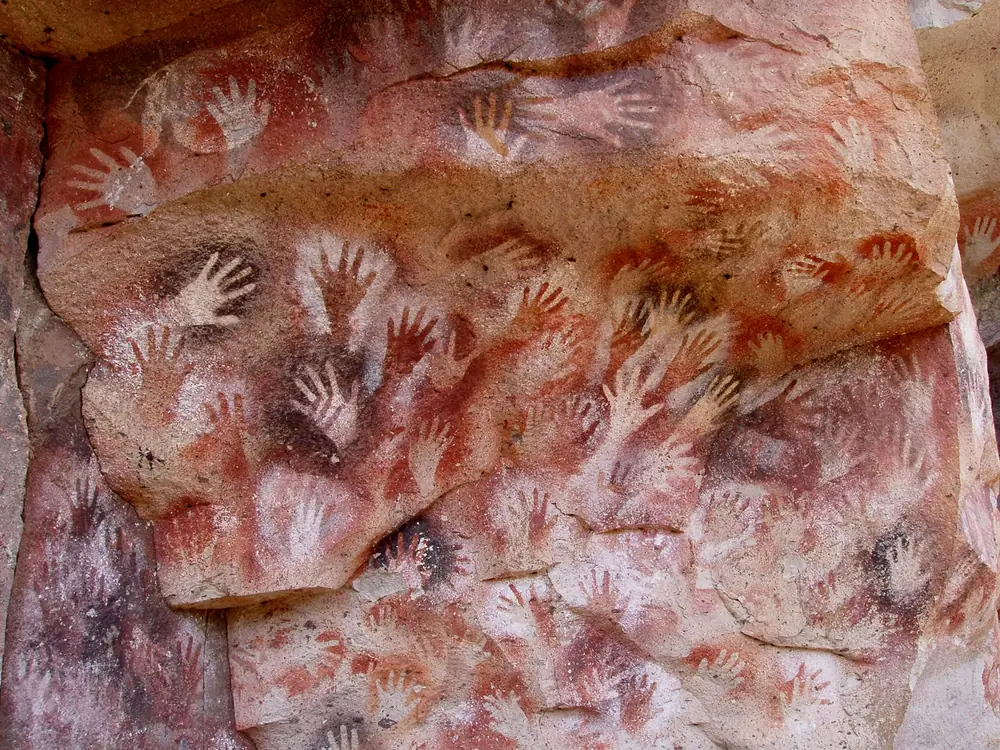
Cueva de las Manos, Argentina. Photo: Mariano, public domain. - Now
You
If we count 25 years to a generation, there are at least 2,712 generations between your hand and the one at Muna.
Who put their hand on the wall: women, men, children?
Four studies measured hands in caves in France and Spain, some in the very same cave, and reached results that contradict one another.
- Guthrie 2005 201 stencils, Europemale 169female 32of 201
- Snow 2013 32 stencils, eight cavesmale 9female 23of 32
- Rabazo-Rodríguez et al. 2017 21 stencils, El Castillomale 10female 11of 21
Why they do not agree: the methods rest on the size of the hand and the length of the fingers, and men’s and women’s hands overlap. An adolescent boy’s hand can look like a woman’s. Snow’s formulas got the sex right in 79% of modern hands using hand and finger measurements, and only 59% by finger ratio, and the reference sample was made of present-day northern Europeans (Nelson et al., 2017). No hand on a cave wall has a known owner, so there is no way to check.
Who most of them were stays an open question. It has not been shown that most were women, and it has not been shown that most were men.
What looks more solid: at Gargas, Groenen found hands of children, adolescents and adults, plus two babies’ hands, too faint to be measured (Groenen, 1988). A 2026 review finds considerable participation by children and adolescents, as well as by men and women (Fernández-Navarro et al., 2026).
One more detail: at El Castillo, most hands are left hands (Ripoll et al., 2021). The authors assume the right hand held the pigment or the tube.
Why do so many hands at Gargas lack fingers?
At Gargas, in the Pyrenees, an inventory from 1976 counts 231 hands. On 124 the outline is clearly visible. Of those, 114 have shortened or missing fingers, and only 10 are whole. The other 107 are too faded to say anything (Hooper, 1980; Groenen, 1988).
Three explanations were proposed: disease or frostbite, ritual or punitive amputation, or fingers simply folded while the pigment was blown. In experiments Groenen remade the same shapes by folding fingers, and found it possible and even easy. Most recent authors we read now think the fingers were folded rather than cut. The debate is not over, though: Hooper argued in 1980 that the hands were mutilated.
Some think folding the fingers was a sign, like a hunters’ language. That is a hypothesis: the finger positions can be made in the air, but nobody knows what they would have meant (Etxepare & Irurtzun, 2021).
Try it: press your palm to a sheet of white paper, fold four fingers down and leave only the thumb out. It is the most frequent shape in Leroi-Gourhan’s table, 44 appearances among the 92 hands charted in it.
And in Romania?
We found no hand stencil published from any cave in Romania. At Coliboaia, in Bihor, there are charcoal drawings: a bison, a horse, bear and rhinoceros heads. Two radiocarbon dates: 27,870 ± 250 years on the drawing of an undetermined animal and 31,640 ± 390 on charcoal found beneath it. Calibrated, they come out at roughly 31,000 to 33,000 and 35,000 to 37,000 years (our own calculation with the IntCal20 curve, not a published range) (Clottes et al., 2013).
The oldest modern humans found in Romania, those of Peștera cu Oase in the Banat region, lived about 40,440 years ago (Oase 1: 40,440 ± 1,030 calibrated years, Rougier et al., 2007). The minimum age of the Timpuseng hand, 39,900 years, falls in the same range of time, and the Muna hand is more than 25,000 years older than these people. More about them: Peștera cu Oase.
What is measured, what is traced and what is imagined
- Measured by others The ages, the sizes of the patches (14 by 10 and 24 by 17 centimetres), the number of hands at Gargas, the study results above, the average adult hand.
- Traced from a photograph The outline of the hand on the wall at the top, from a photograph in Leang Pettakere (Cahyo, CC BY-SA 4.0). The photograph has no scale, so the outline has no real size.
- Imagined by us The wall (a computer-generated texture), the blowing of pigment, the look of the patch on screen, where only the extent is drawn.
- Not known Who made the Muna hand. What the hands meant. Whether they can be called a signature: in northern Australia, people who made hand stencils in the twentieth century said they marked a person and a place (May et al., 2020); for Ice Age hands there is no such testimony.
- What stays with you Nothing you do on the page leaves your device and no hand is saved. The only things kept, in your browser, are your screen size after you set the card and your theme choice.
Sources
- Oktaviana et al., 2026. Rock art from at least 67,800 years ago in Sulawesi. Nature 650:652–656.
- Hoffmann et al., 2018. U-Th dating of carbonate crusts reveals Neandertal origin of Iberian cave art. Science 359:912–915.
- White et al., 2020. Still no archaeological evidence that Neanderthals created Iberian cave art. Journal of Human Evolution 144:102640.
- Aubert et al., 2014. Pleistocene cave art from Sulawesi, Indonesia. Nature 514:223–227.
- Aubert et al., 2018. Palaeolithic cave art in Borneo. Nature 564:254–257.
- Pike et al., 2012. U-series dating of Paleolithic art in 11 caves in Spain. Science 336:1409–1413.
- García-Diez et al., 2015. The chronology of hand stencils in European Palaeolithic rock art: implications of new U-series results from El Castillo Cave. Journal of Anthropological Sciences 93:135–152.
- Groenen, 1988. Les représentations de mains négatives dans les grottes de Gargas et de Tibiran. Bulletin de la Société royale belge d’Anthropologie et de Préhistoire 99:81–113.
- Hooper, 1980. Further information on the prehistoric representations of human hands in the cave of Gargas. Medical History 24:214–216.
- Etxepare & Irurtzun, 2021. Gravettian hand stencils as sign language formatives. Philosophical Transactions of the Royal Society B 376:20200205.
- Nelson et al., 2017. Beyond size: the potential of a geometric morphometric analysis of shape and form for the assessment of sex in hand stencils in rock art. Journal of Archaeological Science 78:202–213.
- Snow, 2013. Sexual dimorphism in European Upper Paleolithic cave art. American Antiquity 78:746–761.
- Ripoll et al., 2021. Hands stencils in El Castillo Cave (Puente Viesgo, Cantabria, Spain): an interdisciplinary study. Proceedings of the Prehistoric Society 87:51–71.
- Rabazo-Rodríguez et al., 2017. New data on the sexual dimorphism of the hand stencils in El Castillo Cave (Cantabria, Spain). Journal of Archaeological Science: Reports 14:374–381.
- Fernández-Navarro et al., 2026. Reevaluating hand stencil phenomena in cave art. Cambridge Archaeological Journal 36:272–292.
- Clottes et al., 2013. The discovery of a new Paleolithic decorated cave in Romania (Bihor department; Coliboaia). Palethnologie 5.
- Rougier et al., 2007. Peștera cu Oase 2 and the cranial morphology of early modern Europeans. Proceedings of the National Academy of Sciences 104.
- May et al., 2020. Survival, social cohesion and rock art: the painted hands of western Arnhem Land, Australia. Cambridge Archaeological Journal 30(3).
- Zhang et al., 2021. Earliest parietal art: hominin hand and foot traces from the middle Pleistocene of Tibet. Science Bulletin.
Photographs and licences
- Hands in Pettakere Cave detail.jpg, Cahyo, CC BY-SA 4.0. Resized and compressed (WebP).
- Bouquet de Mains, Gua Jeriji Saleh, Lhfage, CC BY-SA 4.0. Resized and compressed (WebP).
- Panel de manos de la cueva del Castillo.jpg, Gabinete de Prensa del Gobierno de Cantabria, CC BY 3.0 ES. Resized and compressed (WebP).
- SantaCruz-CuevaManos-P2210651b.jpg, Mariano, public domain. Resized and compressed (WebP).


The outline of the hand at the top is derived from the first photograph and shared under the same licence, CC BY-SA 4.0. The Nature paper (Oktaviana et al. 2026) is CC BY-NC-ND and we reproduced none of its figures.