Bucharest, Romania · height records
The tallest building in Bucharest, 1933 to today: the four that held the record
Since 1933, the title of tallest building in Bucharest, Romania’s capital, has passed through four buildings. The longest reign, some fifty years, went to Casa Scînteii, the communist-era house of the newspapers. Climb the ruler and see each record at true scale, from a bell tower of 1714 to a 250-metre chimney.
Read on: the ruler climbs from street level
The starting point · 0 m
The plain: almost 42 metres between its lowest and highest point
Bucharest stands on a plain. The city’s risk plan puts Bucharest itself at 60–90 m, and the surrounding plain between 54.5 m, in the Dâmbovița valley at Popești-Leordeni, and 96.3 m, at Chiajna, both just outside the city. The plain’s relief is 41.8 m, under a third of Sky Tower’s height.
On the ruler, heights are read from the building’s base, not from sea level. The silhouettes are schematic; the heights, and the Parliament’s width, come from sources.
Risk analysis and coverage plan, Municipality of Bucharest (2008)
1714 · nearly 50 m
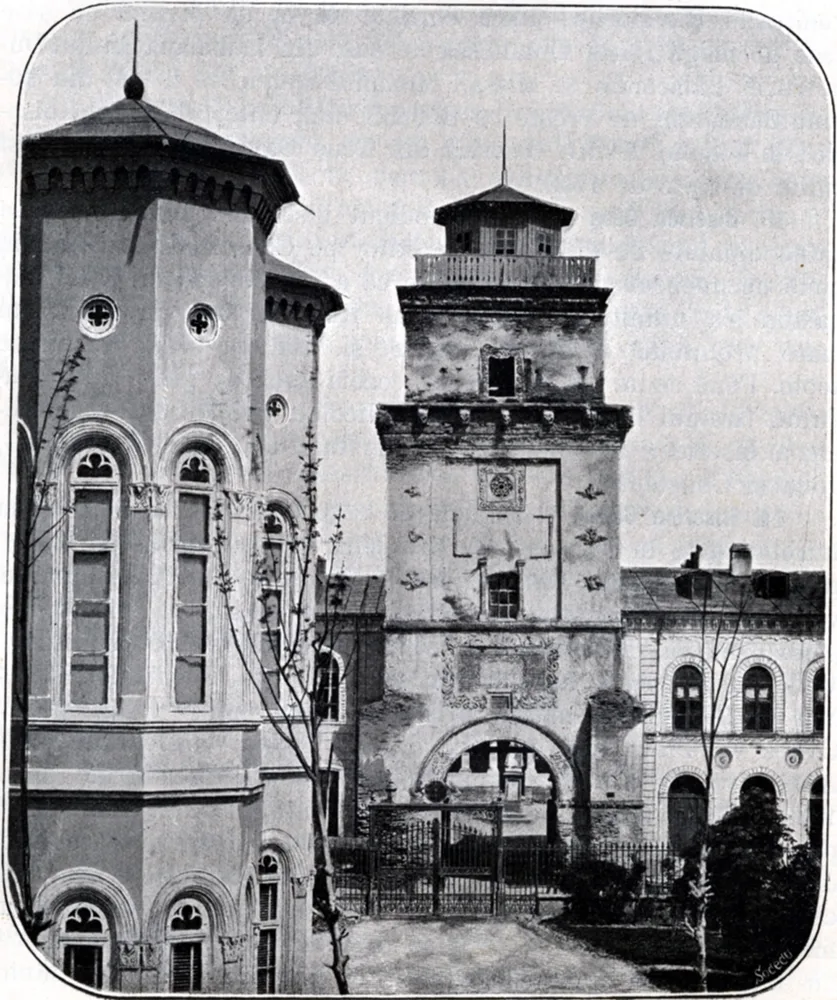
The Colței Tower, 1714: nearly 50 metres
The tower with a bell and a clock at Colței was finished in 1714 and measured nearly 50 metres. The 1802 earthquake brought half of it down, and in 1888 it was demolished to widen the street.
Between 1714 and 1933 there are 219 years, and in all that time I found no structure with a documented height above 50 m. For church towers there are no published heights, so “tallest” here means tallest with a proven height.
1933 · 52.5 m
The Telephone Palace, 1933: 52.5 metres of steel
Inaugurated on 24 April 1933 with King Carol II present, the Telephone Palace on Calea Victoriei was Romania’s first tall steel-frame building. The plans are by the American architect Louis S. Weeks; Edmond van Saanen Algi led the execution and the details.
At 52 m on opening day according to Agerpres (Infocons gives 52.5 m), it passed the tower of 1714 and stayed the capital’s tallest building for 23 or 24 years, until Casa Scînteii. Orange reopened it in 2024.
1936 · 47 m
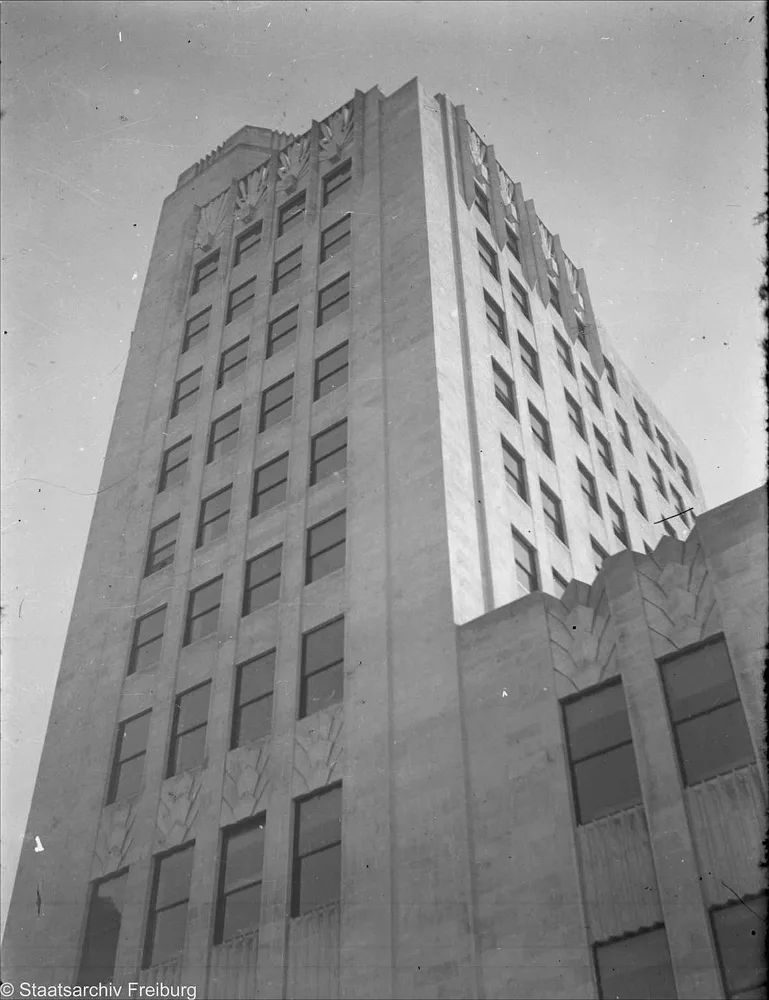
The Carlton Block: the tallest apartment block, never the tallest building
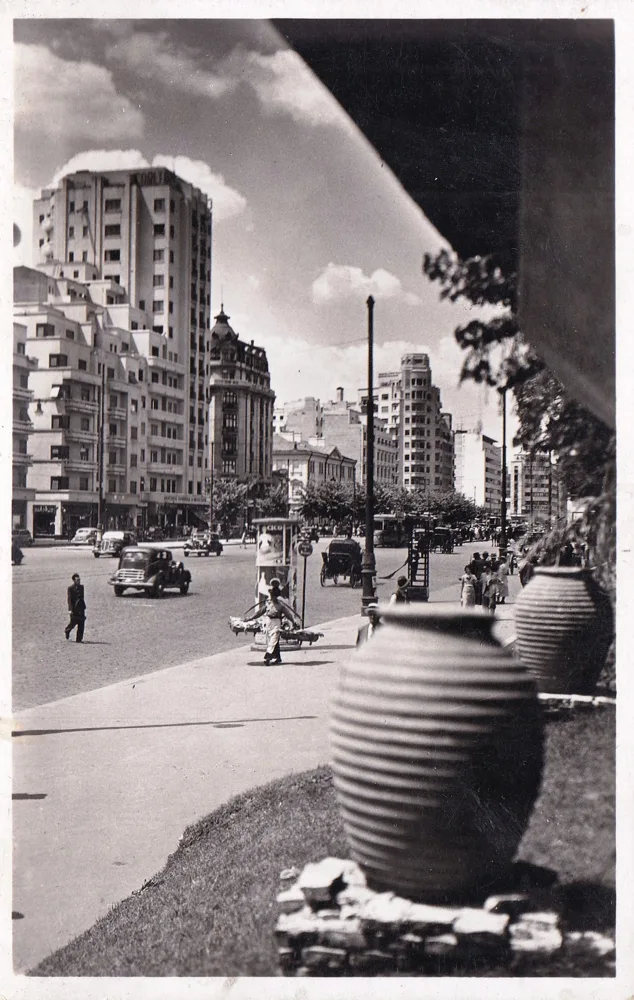
The Carlton Block, on Brătianu Boulevard (today Nicolae Bălcescu), opened in 1936 and stood 47 m on 14 levels. It was the tallest apartment block of interwar Bucharest. Wikipedia’s timeline shows it as the city’s tallest building in 1932–1934, and Agerpres gives it 52.5 m, but from the foundation; Playtech and Architectuul give 47 m. The Telephone Palace, 5.5 m taller, had been inaugurated three years earlier.
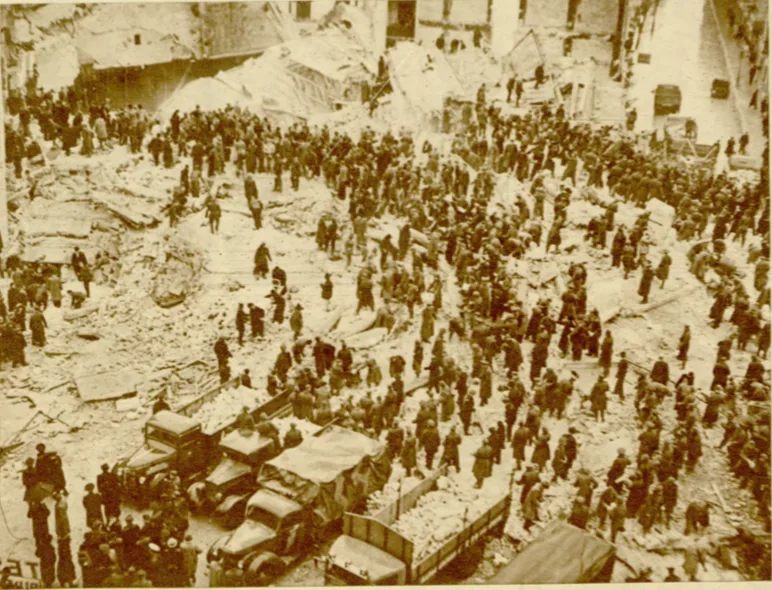
In the night of 10 November 1940, at about 3:40, the earthquake brought it down. Agerpres counts 140 dead from the Carlton alone, and Playtech writes that 226 people lived in its 96 flats.
1956–57 · 91.6 m
Casa Scînteii, 91.6 metres: the record that lasted fifty years
From 1956 or 1957 (sources differ) the title went to Casa Scînteii, today Casa Presei Libere, “Free Press House”, where newspapers such as Scînteia, Flacăra and România Liberă were produced under Romania’s communist regime. It is 91.6 m to the roof and 104 m with its 12.4 m television mast. The jump over the Telephone Palace was 39.1 m, or 74%, the biggest in the whole series.
Its design drew on Lomonosov University in Moscow: the team led by the architect Horia Maicu was sent to Moscow and came back with a design adapted to Stalinist ideology, Adevărul reports. Playtech adds the Hotel Ukraina in Moscow and the Palace of Culture in Warsaw. The title stayed with Casa Scînteii until 2007, which is 50 or 51 years, longer than its two successors together: 19 years so far.
1971–1988 · 77–104 m
Buildings that stay outside the ranking
The Intercontinental Hotel, opened in 1971, is given as 77 or 87 m in sources. On any of them it stays below Casa Scînteii; when it opened it was the second tallest building in the city.
The Palace of the Parliament, begun in the 1980s, is 270 m long, 245 m wide and 84 m above ground, according to the Chamber of Deputies’ own website. That is 7.6 m below Casa Scînteii; underground it officially goes down 16 m.
A taller structure than Casa Scînteii did exist: the Basarab tower, with 23 floors, raised in 1986–1988 to test the lifts for the Parliament. It was 104 m to the roof, according to Wikipedia, and demolition began in 2020. It was an industrial test rig, not a building made to be lived or worked in, so it is left out: like Wikipedia’s timeline and the CTBUH database, the ranking counts buildings by type and completion year, not masts, chimneys or test towers.
Playtech · Chamber of Deputies · CTBUH · Wikipedia: the hotel · Wikipedia: Basarab tower
2007 · 106 m
Tower Center International, 2007: the record moves to an office tower
In 2007 the office tower on Piața Victoriei passed Casa Scînteii. Its owner, Globalworth, gives 106 m, while the international Skyscraper Center database (CTBUH) gives 120 m, its architectural height. On either height it also passes Casa Scînteii with its mast (104 m). It stood empty for years over lawsuits (Profit.ro), and Globalworth dates its completion to 2012; the record counts it from 2007, the completion year in the CTBUH database.
It held the record for five years.
2012 · 137 m
Sky Tower, since 2012: 137 metres and 37 floors
Sky Tower, in the Floreasca district, passed every building in Bucharest in 2012: 137 m and 37 floors. Sky Tower has held the record since 2012; in 2026 that is 14 years.
The People’s Salvation Cathedral is, in the official chronology, 120 m plus a 7 m cross, about 127 m, and stays below Sky Tower. At 137 m, Sky Tower is 3.3 times the plain’s relief (41.8 m).
Today · 250 m
Bucharest’s tallest structure is a chimney
Chimney no. 1 at the CET Progresu power plant is 250 m, says its operator Elcen; Wikipedia gives 240 m. It is 113 m taller than Sky Tower, or 1.8 times its height.
Units 1 and 2 of the plant date from 1987; I found no source for the year the chimney was raised.
Your scale · from 3 m to 180 m
Your block, at the city’s scale
Choose how many floors your block has. You see it drawn beside Tower Center and Sky Tower, and below it, which record it would have broken.
The estimate assumes 3 m per floor.