Bucharest, the 1980s
The church that walked away on rails
In Constitution Square, the People's House does not fit inside one photograph. Underneath it there was once a neighbourhood — sloping streets, villas, churches — and one of the churches did not die: it walked away on rails and is waiting behind the blocks. Pull it yourself, metre by metre.
Sound starts as you scroll; you can stop it any time.
The hill under the palace
Constitution Square
If you stop in Constitution Square and try to fit the People's House into a single photograph, you run into a problem: the building does not fit. Too wide, too tall, too deep for any ordinary lens. So are its numbers: the bucharest.ro account “Beyond the Numbers” takes them one by one.
4 March 1977
On 4 March 1977 an earthquake badly damaged Bucharest, and the reconstruction became the pretext for a new civic centre. Arsenal Hill — the old Spirea Hill — was also chosen for having the lowest seismic risk in the city. But the hill held the Uranus neighbourhood: sloping streets, boyar villas, modest houses.
The demolitions began in the early 1980s and ran on, in successive waves, until close to the end of the decade. Early plans would reportedly have let the Mihai Vodă complex stay near the future House of the Republic; the option fell away, and in January 1985 the authorities ordered the evacuation and demolition of the complex.
What followed is hard to measure: how many houses, how many people — the figures agree to this day on nothing. But one church did not die. It walked away on rails.
The streets that were
The press of the time and since speaks of 40,000 PEOPLE (Mara Popescu's TU Delft thesis, after Light & Young, 2013) or of over 57,000 FAMILIES (Irina Dragomir's Groningen thesis, after Panaitescu, 2012) — people or families, depending on the source — while the COURAGE registry counts over 60,000 FAMILIES moved for the WHOLE rearrangement of the centre, not Uranus alone. No single toll is printed here: it keeps all three, unit and source beside each.
Demolished buildings run between 9,000 and 40,000, depending on the source. Why nothing exact survives: the demolitions never followed one plan set from the start, but expanded gradually as the People's House project itself kept changing — which makes a centralised, exact record unlikely to have ever existed (the Uranus Acum researchers, via bucharest.ro).
Three Uranus places of worship were demolished: Alba-Postăvari, Spirea Veche and Izvorul Tămăduirii. Two others — Schitul Maicilor and Mihai Vodă — were physically relocated and hidden behind the new blocks, to keep them as inconspicuous as possible. The 22 churches razed between 1977 and 1987, per the Associated Press, cover the Bucharest of those years, not the neighbourhood. For the whole rearrangement, COURAGE counts 5.86 km² demolished, some 20,000 properties destroyed and 19 streets blocked or erased.
Uranus Street ran, as the Uranus Acum project maps it, right through today's stretch of the People's House where the contemporary-art museum sits. Under the floor you walk as a visitor today there was once a street.
The rails
Autumn 1985
In the autumn of 1985, the church of Mihai Vodă and its belfry set off downhill on rails, in tandem, with six spatial movements (Bejan). By the most frequently cited figures (bucharest.ro, after the historical sources), the church travelled 289 metres and came down 6.2 metres from the former hill level; the COURAGE registry gives the same figures. The church weighed 3,100 tonnes on engineer Bejan's count, within 3,100–3,700 cited; the belfry, 289 tonnes. Put your finger on the church and pull it yourself: 289 steps, one metre each.
Pull the church
Put your finger on the church and pull it downhill, towards Sapienței Street. The arrow keys work too.
metre 0 of 289
Under the church a concrete tray had been built — the engineer had thought of the waiter carrying full glasses without spilling a drop (AFP, 2017) — and the tray slid along railway rails. After the move the church stayed closed for almost ten years; it reopened for worship in 1994.
In 1986 the photographer Cristian Zaharia caught the complex among the rubble: the church and its belfry standing, the excavator at work.
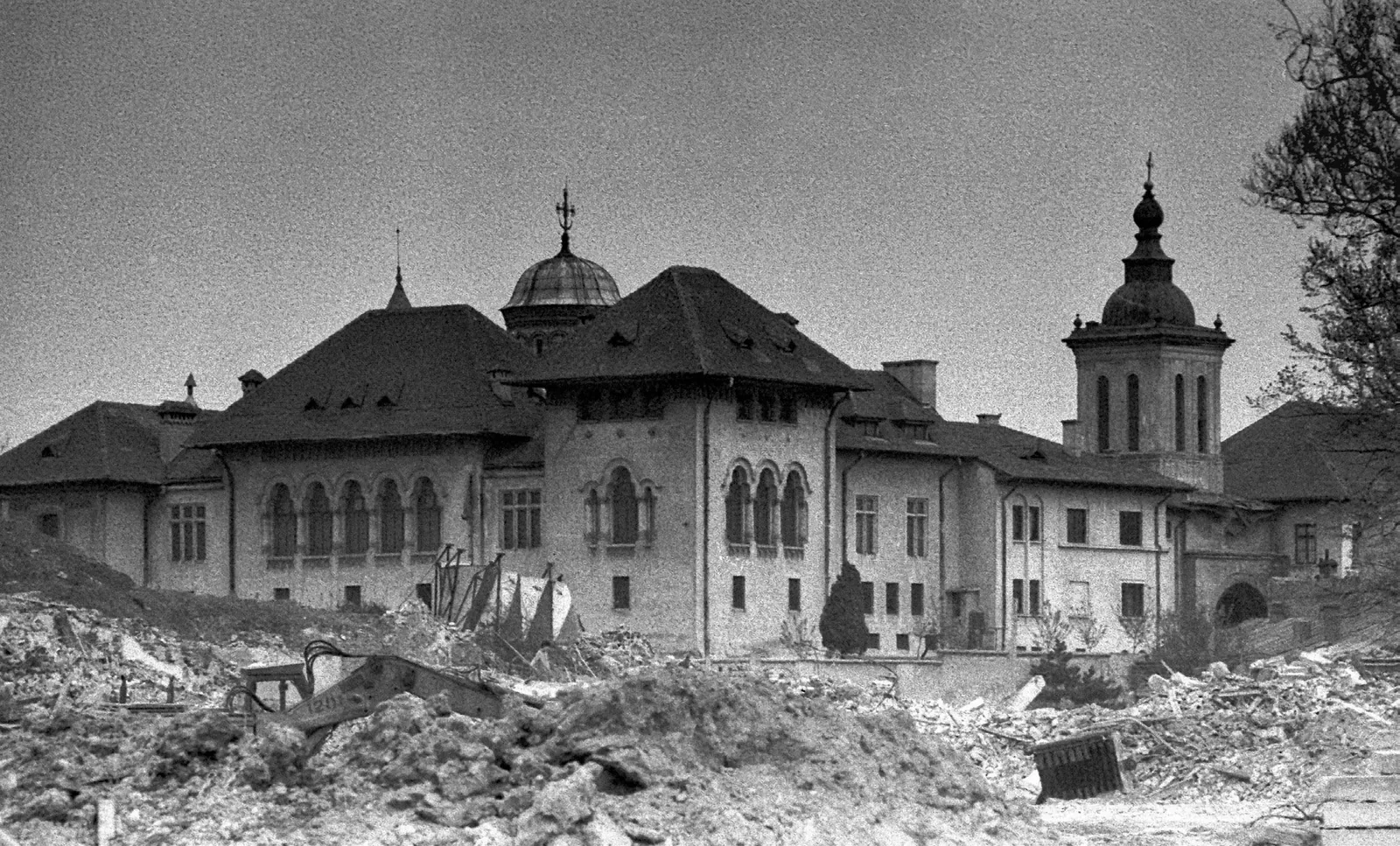

Today you can walk along Splaiul Independenței and pass very close to the church without noticing it. Access is from Sapienței Street, through a passage between the blocks, near Izvor Park.
The younger sister
June 1982
Three years earlier the first one had walked: Schitul Maicilor, the 1726 post-Brâncoveanu jewel. Engineers Eugeniu Iordăchescu and Inocențiu Filimon, of the Bucharest Project Institute, moved it in 72 hours — the first translated church in Bucharest (Răfailă, 2019).
745 tonnes, lifted 1.67 metres on 22 hydraulic presses at 11 working points; a 13°49′ rotation after 19.26 metres, 245 metres in a straight line, a second rotation of 36°30′ so the altar would face east, and 25 centimetres down onto the new socle. Beforehand: injections into the wounds of the 1977 quake, vault shoring, the paintings protected.
In 1980 the parish priest, Mihai Ionescu, had vehemently opposed the demolition. Two years later the surrounding buildings were removed — although moving them with the church had been proposed, the authorities would not agree. Of the old complex nothing remains but the tiny church, tucked away today behind a massive building, at 49 Antim Ivireanul Street.
The palace without numbers
The People's House is famous for its numbers. Guides recite them indoors: the second administrative building in the world, thousands of rooms, tonnes of marble. But the numbers shift from one guide to the next, from one site to the next, from one newspaper to the next (bucharest.ro). Touch each number: it melts into variants. And the church nobody counted was measured to the metre.
Touch a number and watch it melt
Each note restates the figures, the source and the ambiguity, because you may open only one.
The people: 40,000 PEOPLE (Mara Popescu's TU Delft thesis, after Light & Young, 2013) or over 57,000 FAMILIES (Irina Dragomir's Groningen thesis, 2019, after Panaitescu, 2012) — the unit itself differs by source. The third figure, over 60,000 FAMILIES moved, is the COURAGE registry's for the WHOLE rearrangement of the centre, not Uranus alone. Why nothing exact survives: the demolitions never followed one plan from the start, and the project itself kept changing (the Uranus Acum researchers, via bucharest.ro).
Not even the author stands inside one number: Anca Petrescu was 28 or 31 at the selection, depending on the source, and led some 700 architects; the Chamber of Deputies answers a public-information request by saying it holds no documentation to confirm or deny the exact authorship. The accurate form: chief architect and public face of the project.
On the site stood some 20,000 people at any hour — a figure confirmed by Anca Petrescu herself — and underground worked between 5,000 and 12,000 soldiers, depending on the source. That much can be said plainly; the rest are variants.
Go and find it
Mihai Vodă Monastery stands at 4 Sapienței Street, District 5, behind the blocks along Splaiul Independenței. The nearest landmark is Izvor Park, and the metro station is Izvor. Its former site is today in the eastern part of Izvor Park, by the palace.
Go and find the church that walked away on rails. It is on Sapienței Street, behind the blocks — and it is waiting.
The mechanism, in brief
The Uranus neighbourhood of Bucharest — sloping streets, boyar villas, churches — was demolished in waves through the 1980s to raise the People's House on Arsenal Hill, the old Spirea Hill. How many people and buildings went is disputed to this day: 40,000 people or over 57,000 families, 9,000 to 40,000 buildings, depending on the source — because the demolitions never followed one fixed plan.
In the autumn of 1985, the church of Mihai Vodă and its belfry travelled downhill on rails, in tandem: 289 metres and 6.2 metres down from the former hill level, by the most frequently cited figures. The church weighed 3,100 tonnes on the engineer's count, within 3,100–3,700 cited; the belfry, 289 tonnes. Six spatial movements brought them to Sapienței Street, where the church reopened for worship in 1994.
Three years earlier, in June 1982, the first church had walked: Schitul Maicilor, 745 tonnes over 245 metres in 72 hours. Three Uranus places of worship were demolished — Alba-Postăvari, Spirea Veche, Izvorul Tămăduirii — and the two that walked were hidden behind the new blocks.
The palace famous for its numbers has no reliable ones: rooms at 1,100, 3,100 or nearly 5,000, floor area between 330,000 and 360,000 m², a record listing held by the World Records Academy, a private listing constantly confused with Guinness. Guinness holds no entry for the palace. Touch any figure on this page and it dissolves into its variants — while the church nobody counted was measured to the metre. It stands at 4 Sapienței Street, behind the blocks by Izvor Park.
Sources and method
Every number on this page carries its unit, its geography and its source: Uranus-area figures are never merged with whole-rearrangement ones, and displacement is always counted in the source's own unit — people or families. The 289 metres are the most frequently cited figures; the paper that also writes a second figure and the page that writes a third stay one tap away in the notes, never hidden.
The hill, the streets and the church on the rails are drawn for illustration: archive stills from the Fototeca were not used, their reuse terms unconfirmed, and no other period photograph carries the scene. The single 1986 photograph — the church standing among the rubble — is public domain (Cristian Zaharia, via Wikimedia Commons) and is credited beside it. House silhouettes drifting past the pull are schematic, not surveyed plots.
All sound is synthesised in place and illustrative: a muffled city bed at -33 dB, a rails rumble that answers only while the church moves, at -14 dB, and a soft tick when a note answers, at -18 dB. The honest level is the default; Boost adds about 12 dB so small speakers carry it. There are no period recordings on this page.
The side-profile drawing exaggerates the 6.2 m drop twenty times to make it visible, and says so on the drawing. The Bangkok comparison is shown only as the guides' own arithmetic, with the category mismatch named beside it. No completion year and no construction cost appear anywhere: the sources refuse them, and so does this page.
What was not read is never cited: the expropriation and demolition decrees, Iordăchescu's own 1983 paper on the Maicilor translation, and the primaries behind the thesis footnotes (Light & Young, Marinescu, Panaitescu) — every load-bearing number is carried by the sources above instead.
- I. Tronaru, “Casa Poporului, Beyond the Numbers”, bucharest.ro, 16 June 2026 — the palace numbers, the Uranus demolitions, the records (full text) bucharest.ro
- R. Ogaru, “Mihai Viteazul Monastery, saved from demolition on railway tracks”, bucharest.ro, 31 July 2026 — the 1985 move, today's address (full text) bucharest.ro
- M. Bejan, “Performanță tehnică deosebită – translarea monumentelor și clădirilor prin metoda Iordăchescu”, Știință și inginerie (full text, PDF, in Romanian) stiintasiinginerie.ro
- M. Răfailă, “Schitul Hagi Dina – Schitul Maicilor, București”, MNLR Iași Yearbook XII, 2019, pp. 7–20 — the June 1982 move, the 72 hours (full text, PDF, in Romanian) anuarmnlri.ro
- The COURAGE registry, “Pandele Andrei, Translation of Mihai Vodă Church, 1986” — 289 metres, 6.2 metres, the photograph on the rails (collection entry) cultural-opposition.eu
- The World Records Academy, “Largest administrative building” — the record listing: 360,000 m², civilian use (live listing) worldrecordacademy.com
- M. Popescu, “Uranus neighborhood: erased from the city, remembered by its inhabitants”, TU Delft thesis — the 40,000 people (full text, PDF) repository.tudelft.nl
- AFP, “How churches were lifted to safety in communist Bucharest”, 11 November 2017, via Basilica.ro — the Iordăchescu interview, the waiter's tray (full text) basilica.ro
- I. S. Dragomir, “The building at the outskirts of history”, master's thesis, Groningen, June 2019 — the 57,000 families (full text, PDF) frw.studenttheses.ub.rug.nl
- S. Lascu, “Professor Ioan Scurtu at octoginta quinque annis”, Annals of the Academy of Romanian Scientists 18(1), 2026, pp. 203–213 — the witness on the rails (full text, PDF) aos.ro
- Thai PBS World, “Eight years and billions of baht later, world's largest Parliament opens in Thailand amid controversy”, 29 April 2021 — 424,000 m², official opening scheduled 1 May 2021 (archived; English Wikipedia “Sappaya-Sapasathan” for corroboration only) web.archive.org
- Associated Press, “Romanian engineer who saved churches during communist era dies”, 17 August 2024, via Pulse — the Iordăchescu obituary (full text) pulse.co.ke
- C. Zaharia, “Mihai Vodă Monastery … during its demolition in 1986” — the church among the rubble (photograph, public domain, Wikimedia Commons) commons.wikimedia.org