Marius ComperCernica, Ilfov
Română

Ilfov · manuscripts, printed books and two islands

What Cernica’s manuscripts tell us

In 1902, Nicolae Iorga found at least 250 manuscripts at Cernica. Sixty-eight years earlier, a monk named Casian had copied a liturgy in Romanian and Greek, using Cyrillic for both. Inscriptions and inventories show who used the books and how some reached the Romanian Academy.

Enter the story ↓
Two handwritten pages with dark lines of text and red initials.
The liturgy book copied by Casian in 1834, Ms. rom. 5789. The volume contains Romanian and Greek, both written in Cyrillic. (Source · Library of the Romanian Academy · Tezaur, December 2023 · Public domain)

The place

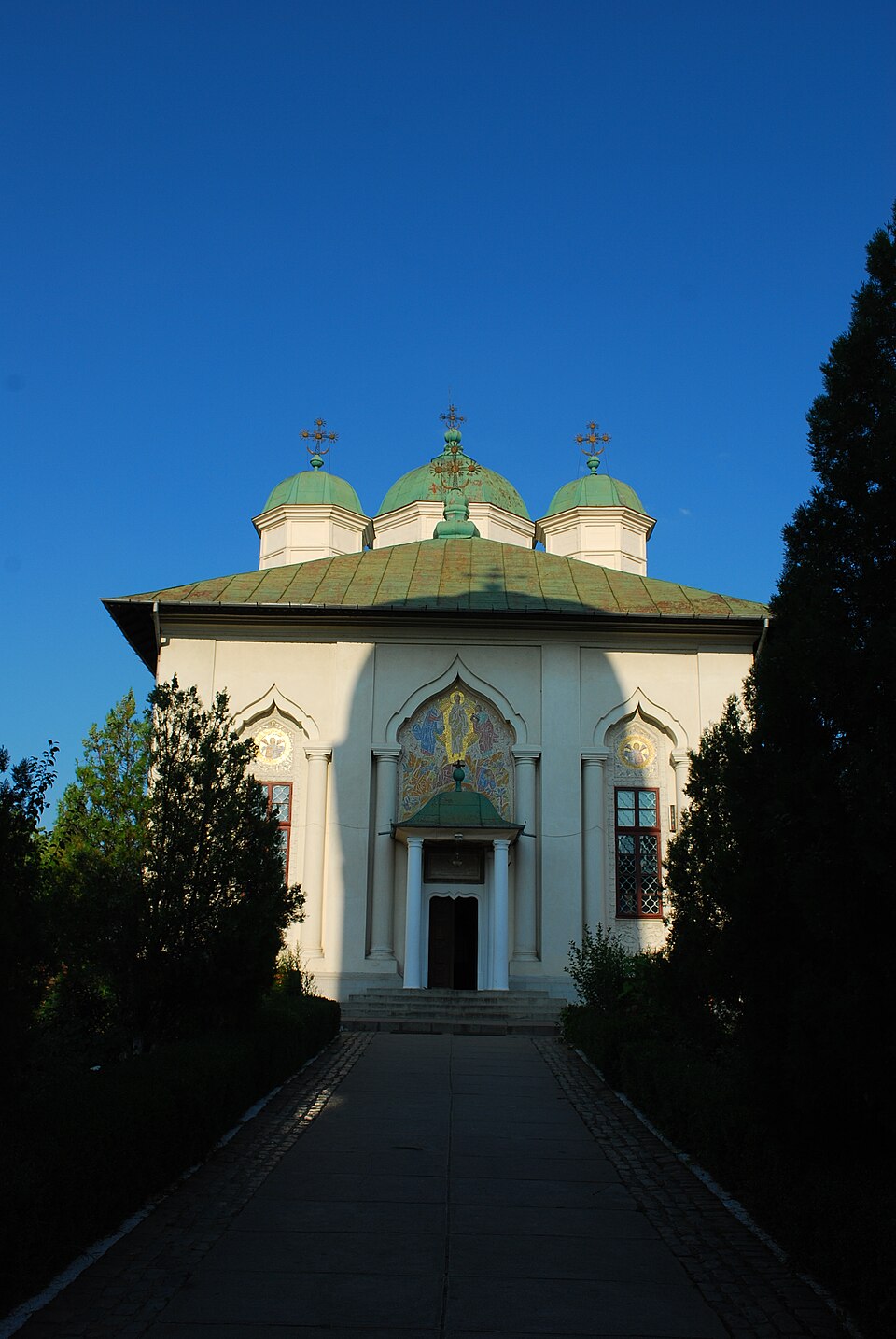
White church with domes and tiled roofs framed by trees.
Saint George Church on the smaller island, photographed on 30 July 2011. (Source · Andrei Stroe, Wikimedia Commons · CC BY-SA 3.0)

The place

A monastery on two islands

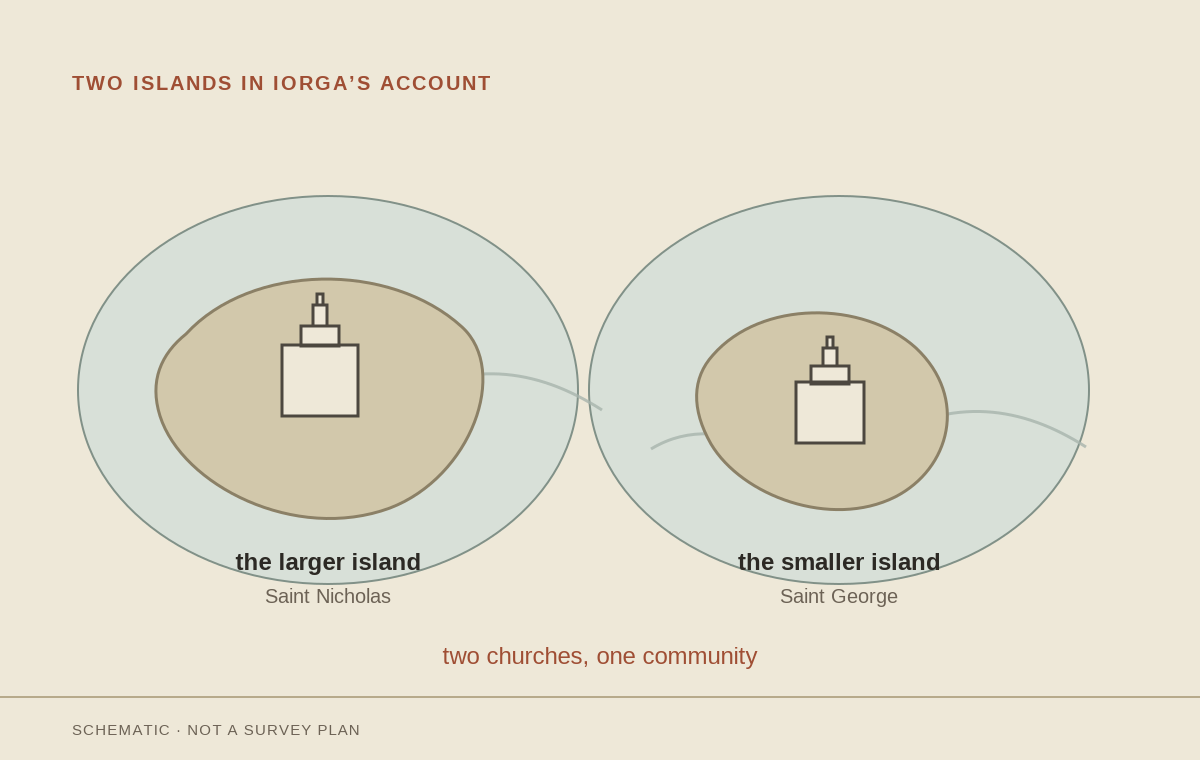
In 1902, Iorga described Cernica through its water: the monastery spread across two islands, with cells and churches, and the lake also served as a fishpond. He does not say which island held the library. The older church, dedicated to Saint Nicholas, stood on the larger island; the church of Saint George was built later on the smaller one. CIMEC records the monastery’s documented beginning in 1608, with a wooden church on Saint Nicholas Island. [1] [2]

Saint George Church on the smaller island appears in the 2011 photograph. The monastery housed the library Iorga studied in 1902. In his account he simply calls it the little library room. [6] [1]
White church with domes and tiled roofs framed by trees.
Saint George Church on the smaller island, photographed on 30 July 2011. (Source · Andrei Stroe, Wikimedia Commons · CC BY-SA 3.0)
Schematic view of two islands, each marked with the church named by Iorga.
Iorga distinguishes the larger Saint Nicholas island from the smaller Saint George island. The drawing does not show measured island shapes or positions. (Source · Explanatory diagram based on Iorga and the CIMEC record)

Book work

How books were translated at Cernica

Iorga wrote that Macarie translated Greek manuscripts into Romanian and that Abbot Gheorghe later encouraged other scholars. He placed their work in a wider network: Greek and Slavonic texts were gathered, translated and then printed. This is a historian’s account from 1902, not a copyist’s diary or the proven route of one particular volume. [1]

The library’s purpose comes into view: keeping books was tied to reading, translation and their use within the community. The Library of the Romanian Academy describes Cernica’s holdings as including monastic teachings, saints’ lives and service books. [3]
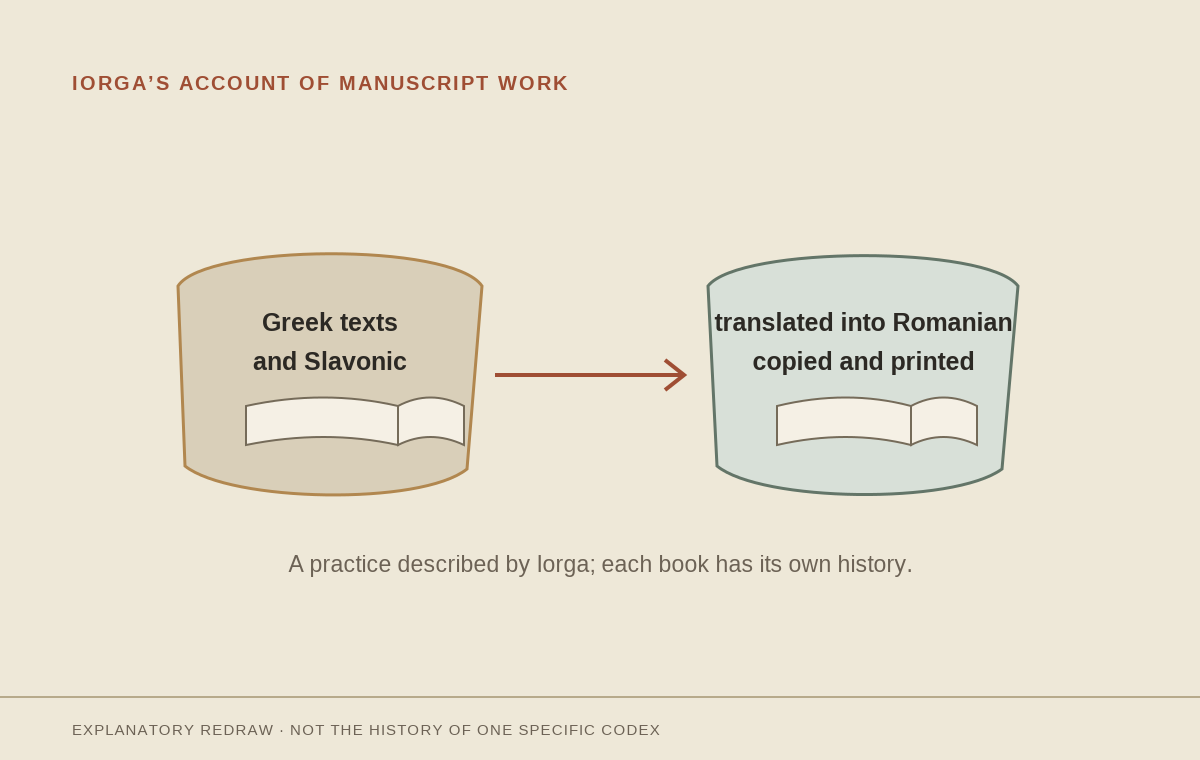
Greek and Slavonic texts pass through Romanian translation, then copying and print.
A diagram of the general practice described by Iorga. It does not trace one manuscript from source to print. (Source · Explanatory redraw after Iorga, 1902)
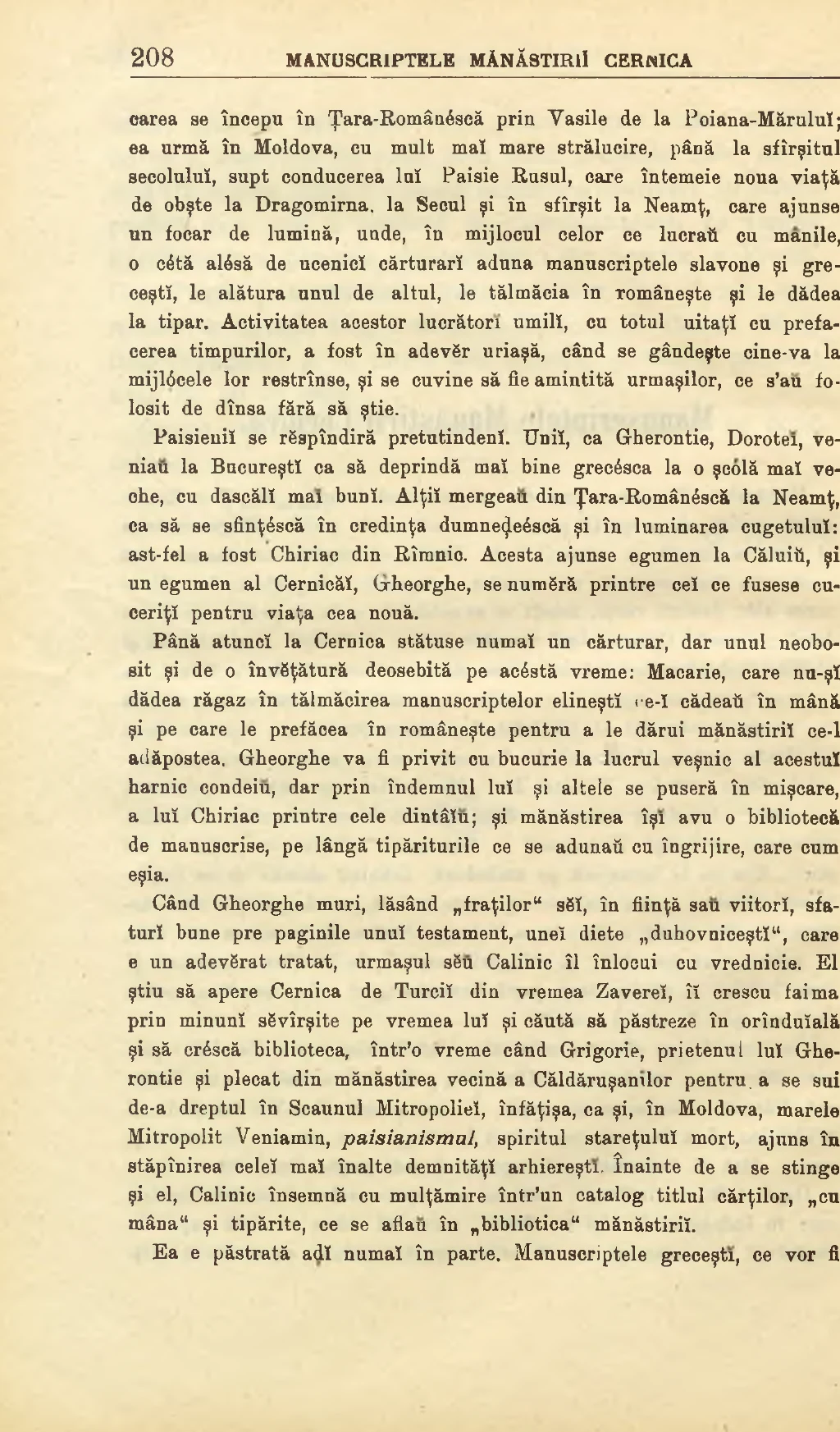
Page 208 of the journal Biserica Ortodoxă Română, printed in columns.
On page 208, Iorga describes how Macarie translated Greek manuscripts into Romanian and gave them to the monastery. (Source · Biserica Ortodoxă Română, vol. XXVI, 1902, p. 208; digitized copy from G. T. Kirileanu Neamț County Library · Public domain)

A book’s trace

A Pentecostarion preserves two names

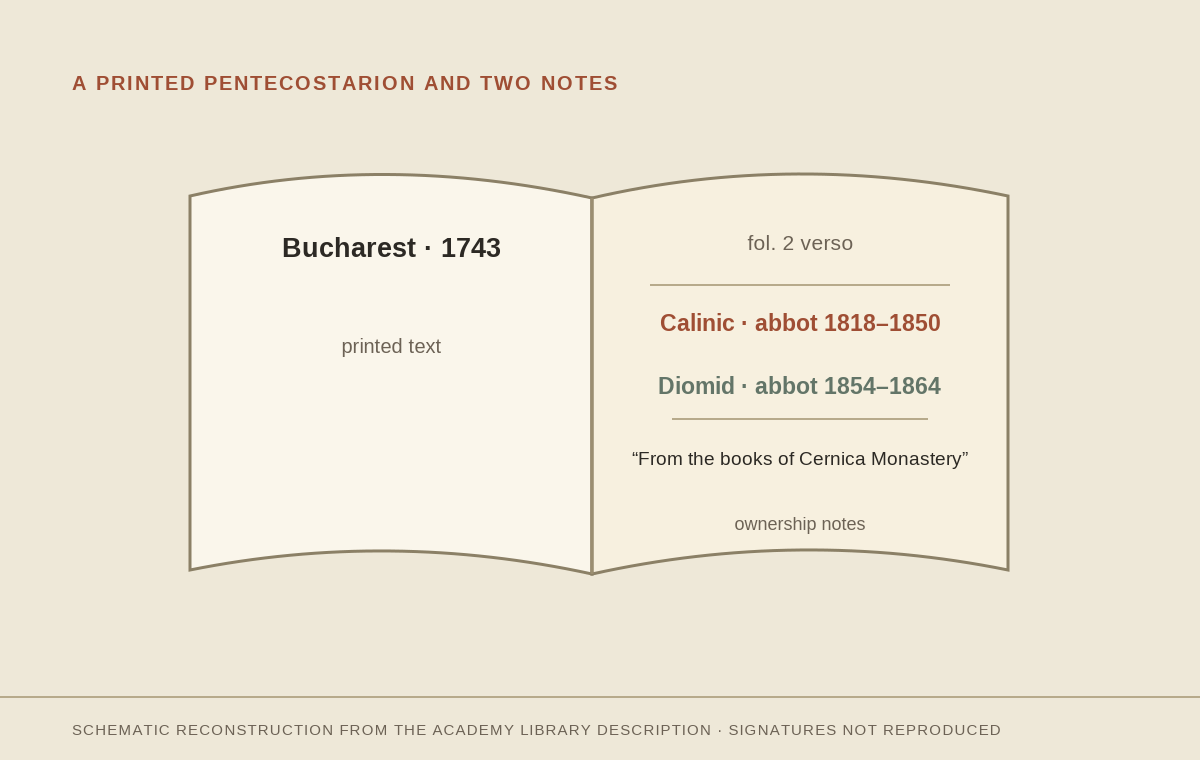
Printed in Bucharest in 1743, the Pentecostarion contains hymns and services for the period after Easter. On the back of its second leaf are the signatures of two abbots, Calinic and Diomid, and a note identifying it as one of the monastery’s books. The Library of the Romanian Academy holds it under shelfmark CRV 232. [3]

The signatures place the book at Cernica in the time of two nineteenth-century abbots. The publication date establishes when it was printed. The notes establish who later held it, and its arrival date at Cernica remains unknown. [3]
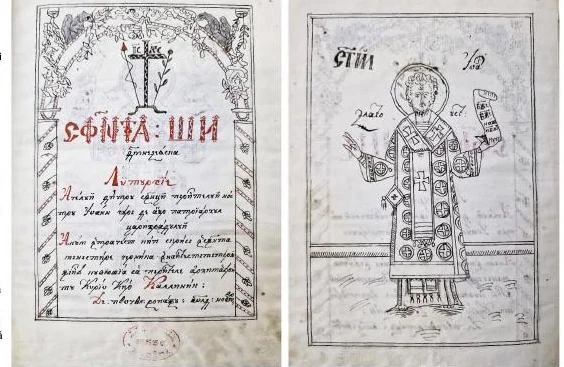
Two pages of the printed Pentecostarion from Cernica.
Pages from the Pentecostarion held at the Library of the Romanian Academy under shelfmark CRV 232. (Source · Library of the Romanian Academy · Tezaur, December 2023 · Public domain)
Schematic open book showing a 1743 Pentecostarion and later notes by abbots Calinic and Diomid, including its Cernica ownership note.
The diagram separates the print date from the later ownership notes. It does not reproduce the original page or imitate the signatures. (Source · Diagram based on the Library of the Romanian Academy’s description in Tezaur, 2023)

The inventory

What Iorga found in one day

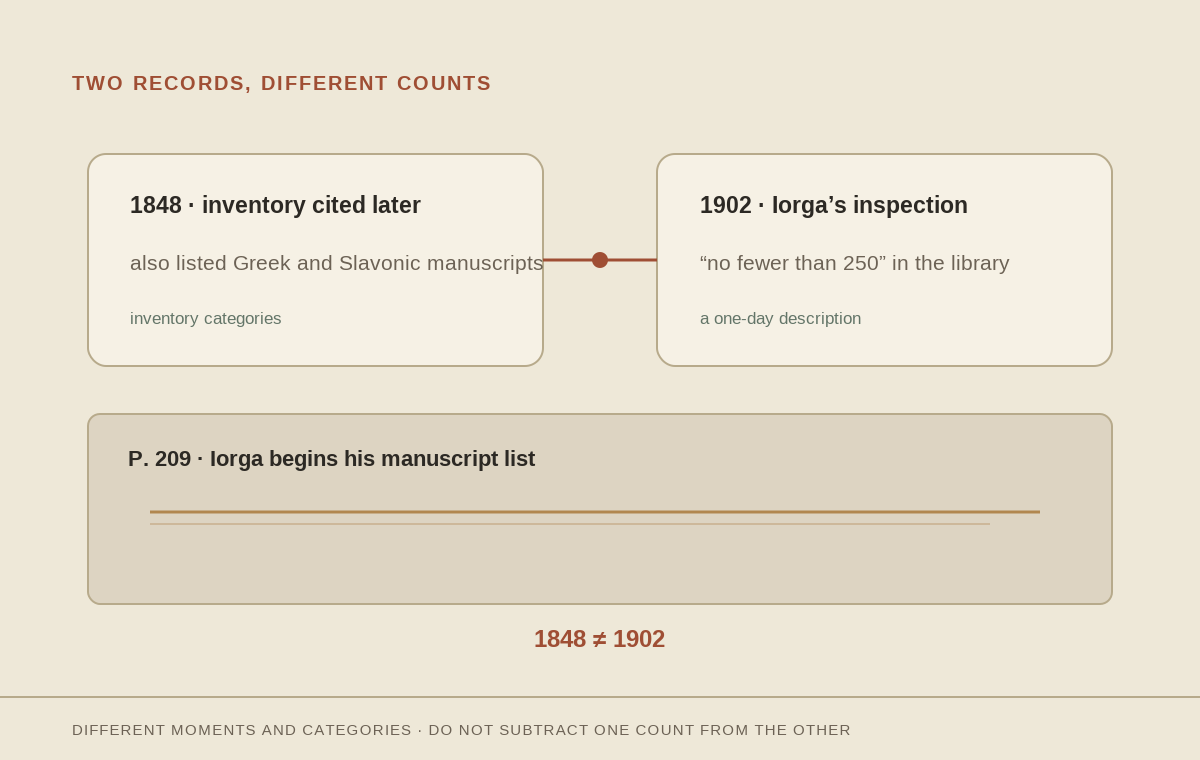
An 1848 inventory cited by researcher Oana-Mădălina Popescu listed Greek and Slavonic manuscripts among the holdings. In 1902, Iorga wrote that the small room still held “no fewer than 250” manuscripts. With G. Bogdan-Duică and a student named Băjan, he put together the list in a single day. [3] [1]

The second book in the list contained a service for the dead, an ink recipe and the start of a model letter. In his introduction, Iorga writes that the Slavonic manuscripts had disappeared. His entry 252, however, records Greek glosses. The catalogue describes what he could examine that day. [1]
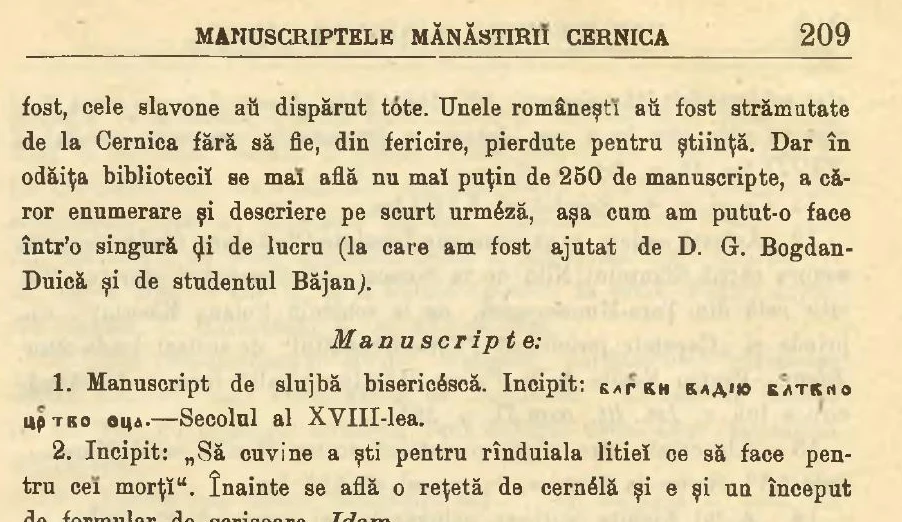
Facsimile of page 209, where Iorga says he found at least 250 manuscripts and begins describing them.
At the top of page 209, Iorga writes that at least 250 manuscripts remained and names the people who helped describe them. The second entry records an ink recipe. (Source · Biserica Ortodoxă Română, vol. XXVI, 1902, p. 209; digitized copy from G. T. Kirileanu Neamț County Library · Public domain)
Two dated records: an 1848 inventory including Greek and Slavonic manuscripts; in 1902 Iorga describes at least 250 manuscripts.
The inventory cited for 1848 and Iorga’s 1902 account concern different moments and lists. “250” is Iorga’s lower estimate for manuscripts he saw then. (Source · Redrawn from Iorga, 1902, and Popescu, 2023)

A manuscript

Two languages written in the same script

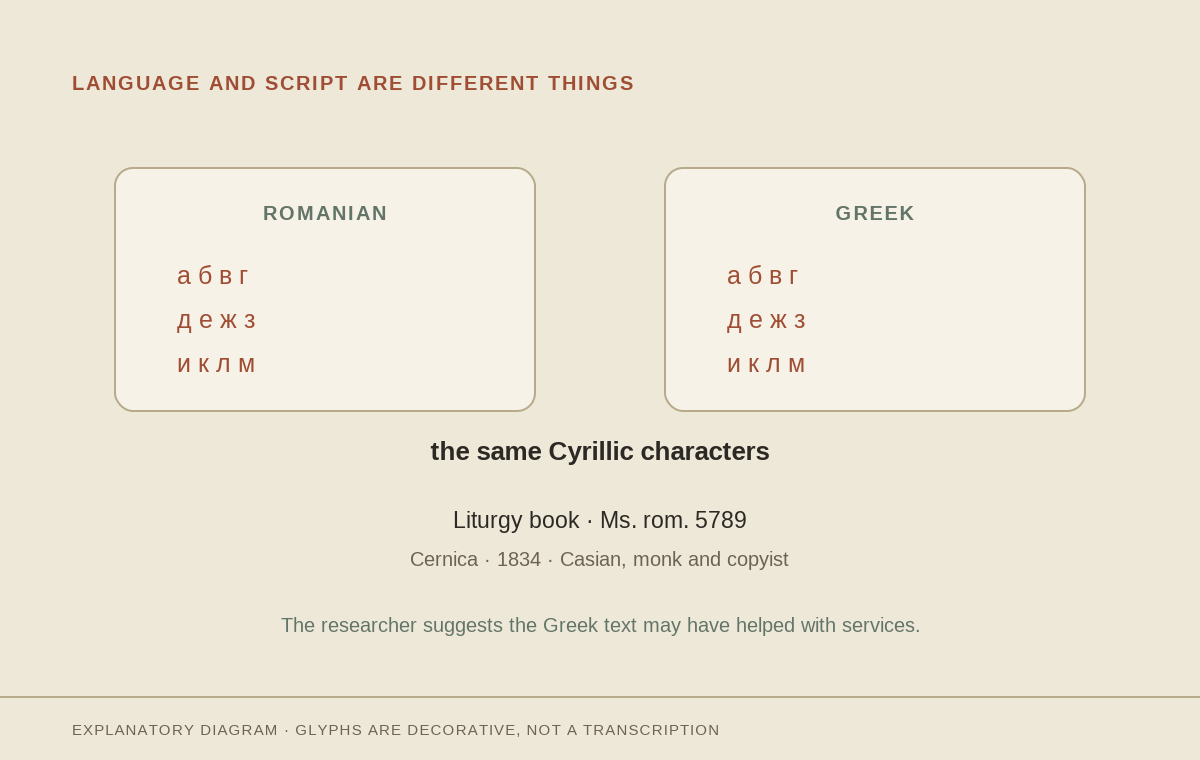
In 1834, the monk Casian copied a liturgy for the service of Saint John Chrysostom at Cernica. Now held by the Library of the Romanian Academy as Ms. rom. 5789, the book is bilingual: Romanian and Greek. Both languages are written in Cyrillic characters. [3]

The copyist’s name appears in a cipher on the title page, deciphered by Oana-Mădălina Popescu. She suggests that Cyrillic may have helped monks with limited Greek read the text during worship. The book survives, and the reason for Casian’s choice remains open. [3]
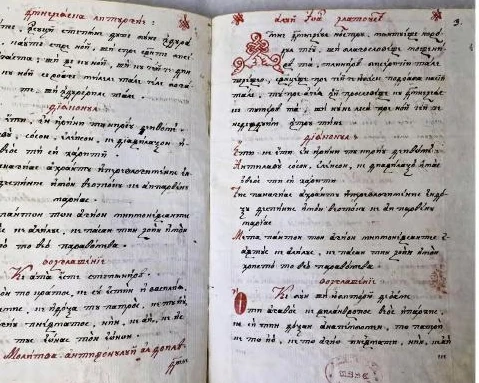
Two handwritten pages with dark lines of text and red initials.
The liturgy book copied by Casian in 1834, Ms. rom. 5789. The volume contains Romanian and Greek, both written in Cyrillic. (Source · Library of the Romanian Academy · Tezaur, December 2023 · Public domain)
Two text fields labelled Romanian and Greek; both use Cyrillic characters in a manuscript copied by Casian in 1834.
An explanatory diagram showing that both languages use Cyrillic characters. The decorative marks do not transcribe the original pages. (Source · Explanatory diagram based on Oana-Mădălina Popescu’s description of Ms. rom. 5789)

After the library

What the Academy received in May 1902

In May 1902, the Ministry of Religious Affairs donated 244 Romanian manuscripts from Cernica to the Library of the Romanian Academy. Iorga had examined them before they were taken from the monastery. The Academy also received other books from Cernica at different times. [3]

Iorga describes what he found in the library. The Academy records the books it received in May. These records trace part of the collection, while the route of each volume calls for separate evidence. [1] [3]
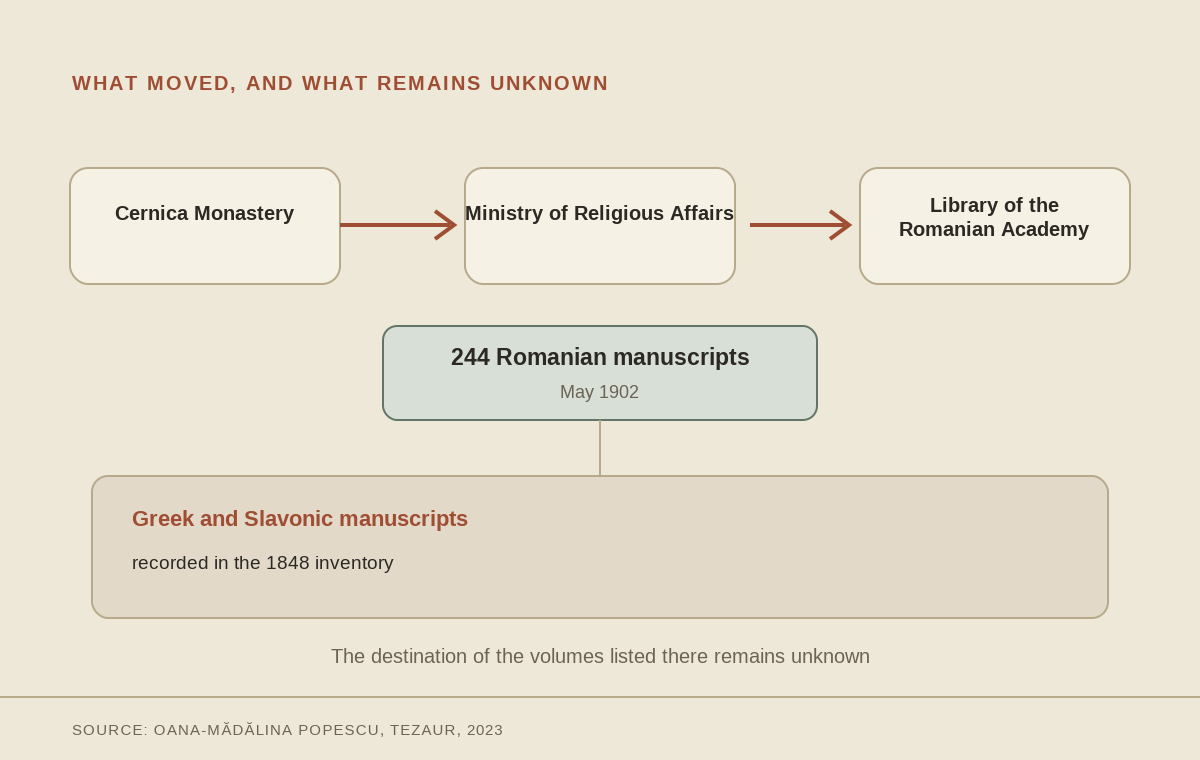
A 1902 transfer diagram from Cernica Monastery through the Ministry to the Romanian Academy Library; a separate branch marks the unknown destination of Greek and Slavonic manuscripts.
The May 1902 donation has a recorded recipient and manuscript count. The routes of other books have to be traced one volume at a time. (Source · Redrawn from the Library of the Romanian Academy’s 2023 Tezaur article and Iorga, 1902)

Sources

At Cernica, Casian copied a book, abbots signed their volumes and Iorga made a list in a single day. Each record takes you a different distance. Shelfmark Ms. rom. 5789 leads to one book. The number 244 leads to a donation.

  1. Nicolae Iorga, “Manuscripts of Cernica Monastery”, 1902A contemporary account and catalogue following a visit to Cernica. Scans of printed pages 208–209 from the 1902 issue appear here; accompanying transcriptions and diagrams are not manuscript facsimiles.
  2. CIMEC, Cernica Monastery recordThe record documents the monastery’s 1608 foundation, the wooden church on Saint Nicholas Island and its later expansion onto Saint George Island.
  3. Oana-Mădălina Popescu, manuscripts and printed books from Cernica’s library, Tezaur, 2023Oana-Mădălina Popescu describes the 1848 inventory, the 1902 donation, and volumes CRV 232 and Ms. rom. 5789. The reproductions appear on pp. 10–11 of the December 2023 issue.
  4. Oana-Mădălina Popescu, Cernica manuscripts, Martyria, 2024A study citing the 1848 inventory and placing Cernica’s library, translations and copying activity in context.
  5. Pantelimon City Hall, Cernica MonasteryMunicipal source for the map point and visitor orientation.
  6. Andrei Stroe, Cernica Monastery Church, 2011Photograph by the author, CC BY-SA 3.0; it shows Saint George Church in 2011, not a nineteenth-century building.