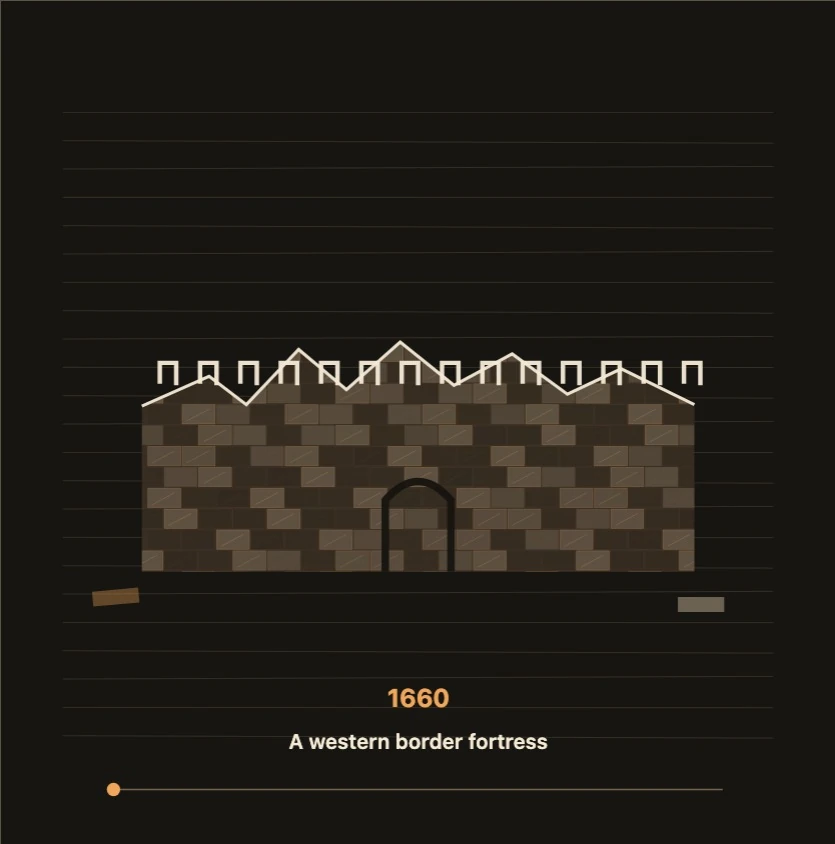
An engraved outline of a fortress comes apart into stones and printed lines on paper.
After Oradea fell in 1660, Săcueni Fortress remained a defensive point on the western edge of the Principality of Transylvania. The town’s history calls it the principality’s western bastion. [1]

Bihor · 1660

The fortress they dismantled

After Oradea fell in 1660, Săcueni Fortress remained a defensive point on the western edge of the Principality of Transylvania. The town’s history calls it the principality’s western bastion. 1

Here, treaties, commissioners and armies converge. A local fortress becomes part of a wider diplomatic conflict.

Follow the fortress’s final years

The image is a visual interpretation, not a measured plan of the fortress.

Start the story

A border fortress

After 1660, Săcueni guards the western frontier

The fall of Oradea changes the fortress’s role. Săcueni becomes a key defensive position for the principality. The town’s history says repeated Ottoman attempts to capture it failed. 1

Vasvár · 1664

Peace also decides the fate of the walls

The Peace of Vasvár changes the region’s political situation. In October 1664, the Diet of Sighișoara decides to demolish Săcueni Fortress. 2

In January 1665, Transylvanian commissioner Sigismund Bánffy arrives at the fortress alongside representatives of the Ottoman court and the Habsburgs. 2

January 1665

A military engineer takes charge of the demolition

Military engineer Lucas Georg Sicha was assigned the demolition. He also made an image of the fortress before and after it was dismantled, later preserved in volume IX of *Theatrum Europaeum*. 2

Early February 1665

In a few weeks, the fortress is taken apart

The demolition was completed by early February 1665, according to a study in the journal *Crisia*. A later decision exempted Martin Boldvai and his heirs from responsibility for the loss of the fortress, which had been imposed by treaty. 2

After the fortress

Șimleu Silvaniei gradually takes over its garrison role

The study describes the fortresses at Șimleu Silvaniei, Valcău and Cehu Silvaniei remaining as garrison posts in the principality. Săcueni’s walls did not survive the political change. 2

The illustration follows the transition from fortress to the gap it left in the chronology. It does not represent the fortification’s actual geometry.

Sources

The chronology follows the historical study in Crisia and the town’s history page. The drawing is an interpretation of the demolition, not an architectural reconstruction or site plan. The abstract shapes do not imply the exact state of the walls before 1665.

  1. History of Săcueni

    The town’s account of Oradea’s fall and the later role of Săcueni Fortress.

  2. Săcueni Fortress in the run-up to the Peace of Vasvár (1664–1665)

    A Muzeul Țării Crișurilor study on the demolition order, commissioners, military engineer and completion of the work in early 1665.

  3. Theatrum Europaeum, vol. IX

    The 1672 volume cited by the historical study for an image of the fortress before and after demolition.