The place
The place
A castle with changing uses
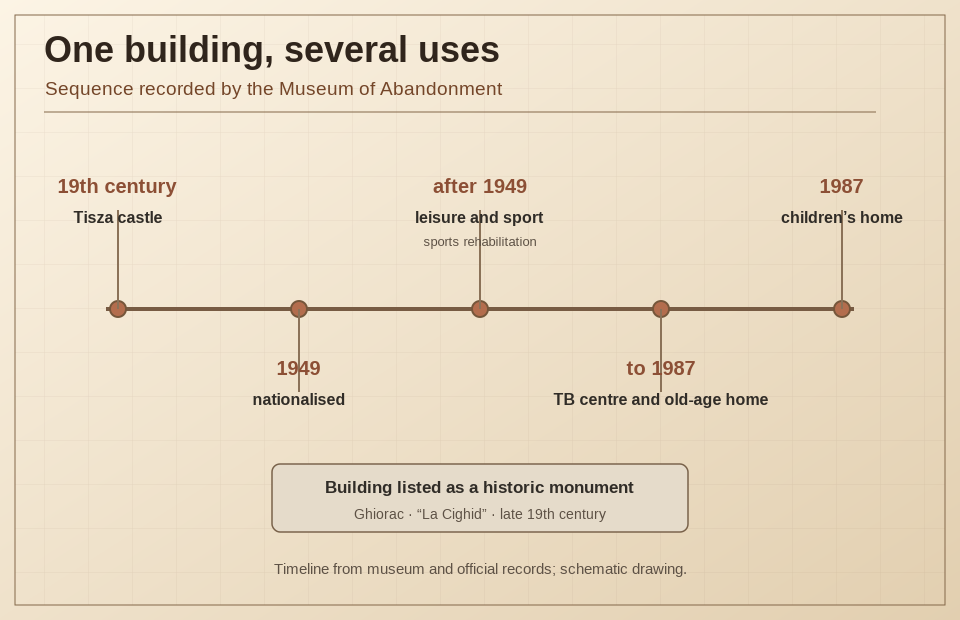
At Ghiorac, in Ciumeghiu commune in Bihor County, Tisza family castle dates from the second half of the nineteenth century. After the building was nationalised in 1949, it housed a leisure and hunting centre, a sports rehabilitation centre, a children’s tuberculosis centre, then an old-age home. [1] [2]
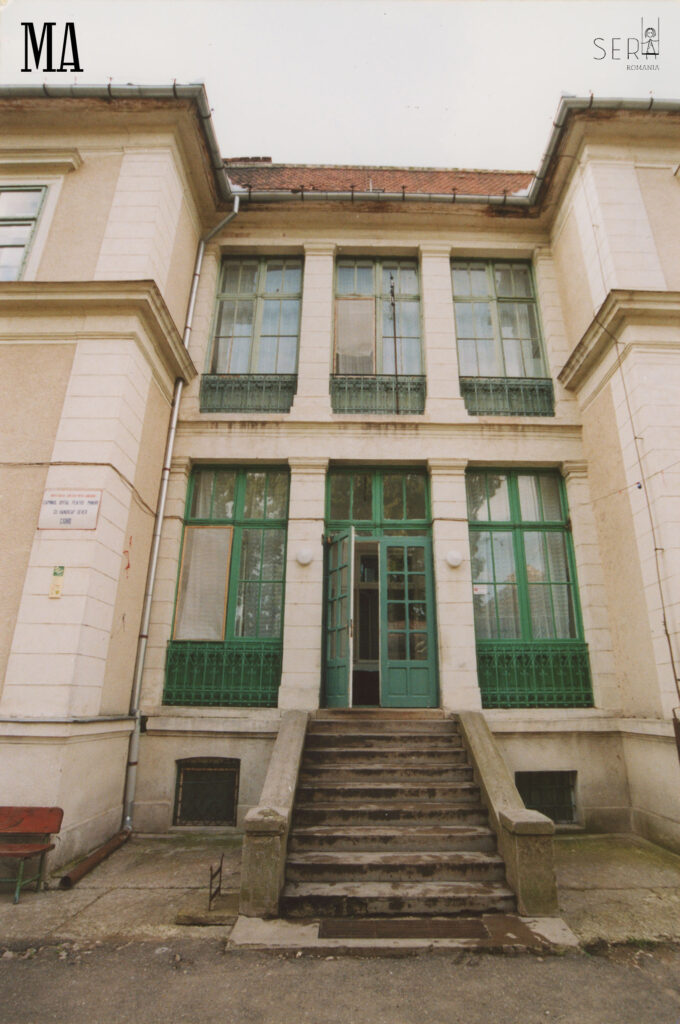
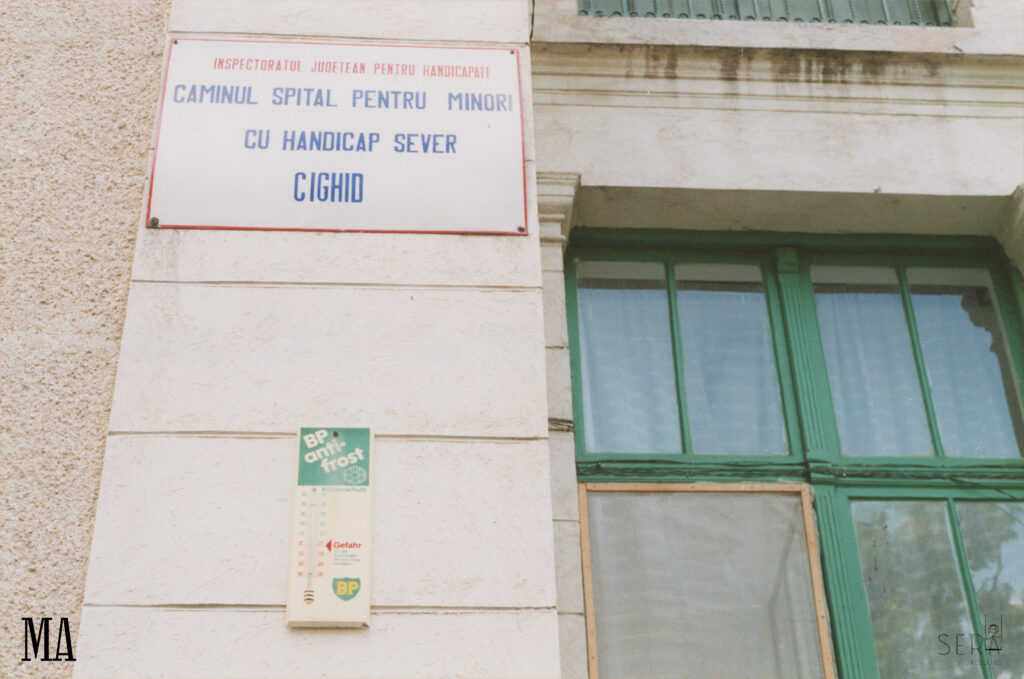
In October 2004 Doru Ștefan photographed a building entrance on the grounds of the Cighid centre for the SERA Foundation. Fekete says she had been transferred out of Cighid three years earlier. The register of historic monuments lists Tisza Castle at the address “La Cighid”. [8] [7] [2]
The decision
Three days from decision to opening
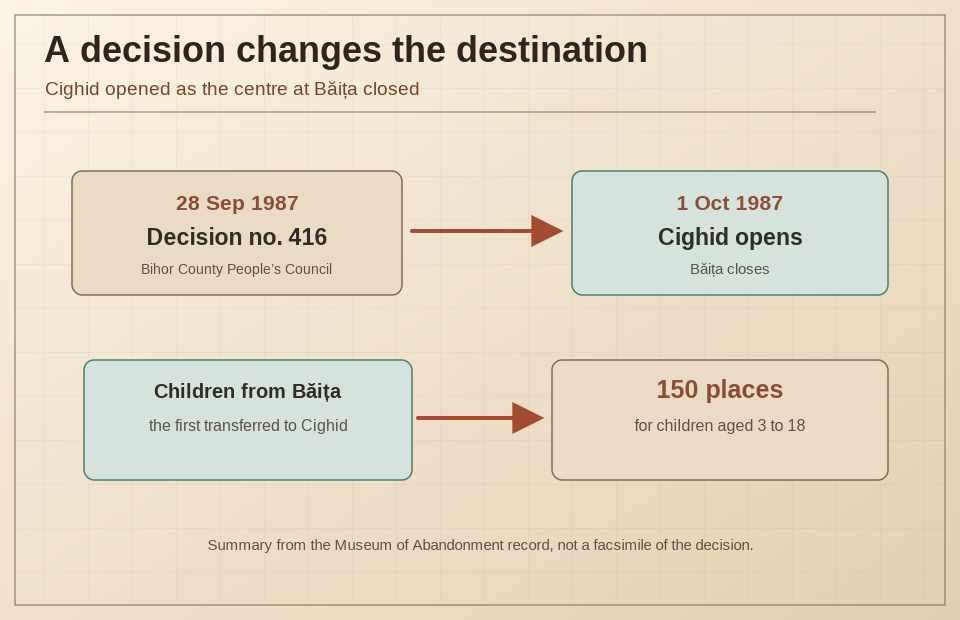
The residential institution at Cighid was established on 1 October 1987 under decision no. 416, dated 28 September. The Băița home, also in Bihor County, closed at the same time. The first children brought to Cighid were transferred from there; others were assigned by the county committee for child protection. [1]
The home had capacity for 150 residents aged three to eighteen, with permanent placement. It was subordinate to the Executive Committee of the Bihor County People’s Council, which provided funding. The Museum of Abandonment lists 29 staff, including a physician-director and employees in several roles; the record does not separately date this roster. [1]
State categories
An administrative label does not describe a child
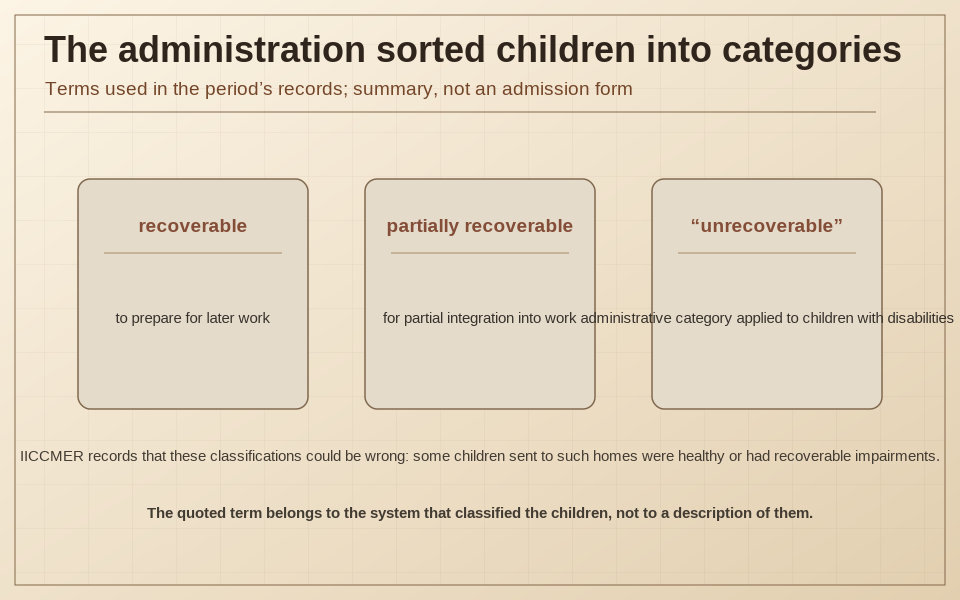
In state records, children under state care were divided into “recoverable”, “partially recoverable” and “unrecoverable”. IICCMER explains that the first distinction linked rehabilitation to later participation in work. Children placed in the administrative category “unrecoverable” were sent to Cighid. [3] [4]
These words belong to the institutions that classified the children. IICCMER says its investigations of hospital homes found cases of healthy children or children with recoverable impairments being sent there. This describes the wider system; without individual files, it cannot be assigned to every child at Cighid. The sign photographed in 2004 gives the institution’s later name, “Hospital home for minors with severe disabilities”. [4] [8]
The 2017 count
138 deaths across a stated period
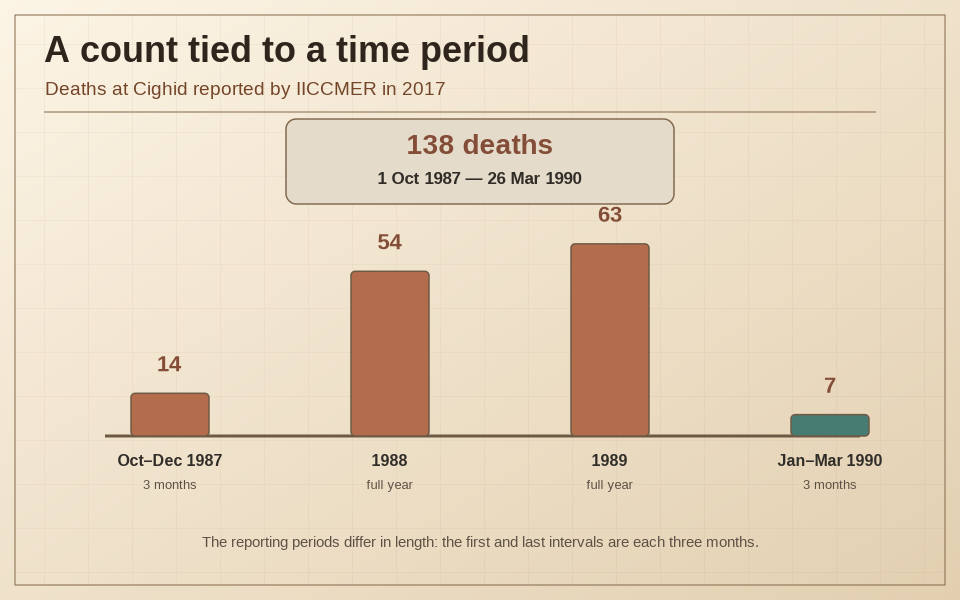
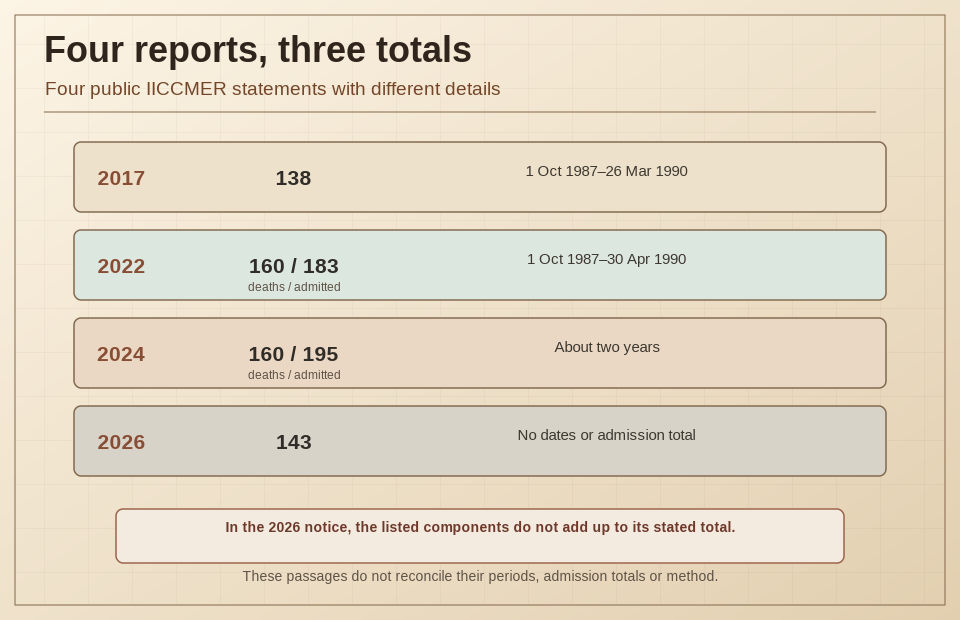
In the criminal complaint announced on 1 June 2017, IICCMER reported 138 deaths at Cighid between 1 October 1987 and 26 March 1990. The institute called the combined figure for three homes “provisional”, while giving this precise interval for Cighid. [3]
The Museum of Abandonment record breaks the count into periods: 14 deaths in the first three months, 54 in 1988, 63 in 1989 and seven in the first three months of 1990. The two three-month intervals cannot be compared directly with full years. These periods add to 138. [1]
Later counts
One story, different published series
In 2022, IICCMER reported 160 deaths among 183 children admitted through 30 April 1990. Its final report published in 2025 repeats 160 deaths but says 195 children had been admitted; that passage describes the period only as about two years. These sources do not give the same admission total or the same precision about the period. [4] [5]
A January 2026 IICCMER statement prints 143 deaths for Cighid in a list about several homes, without a time window or admission total. Its aggregate does not match the entries: the first four figures add to 2,307, although the statement gives 2,207; all five add to 2,743. The public document leaves this discrepancy unexplained. [6]
Medical records
What the death certificates record
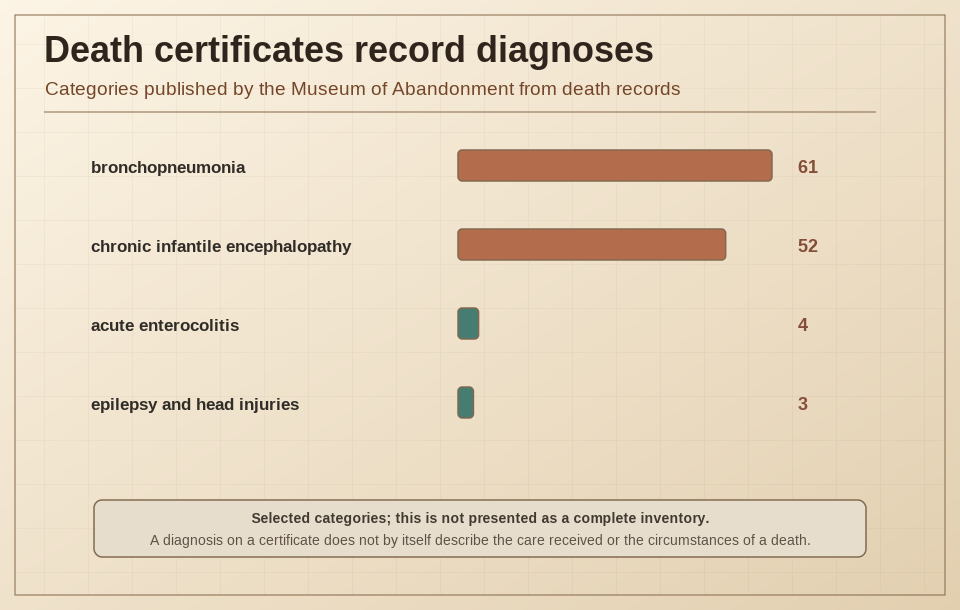
From the death certificates, the Museum of Abandonment publishes 61 cases of bronchopneumonia and 52 of chronic infantile encephalopathy. Its list also includes four cases of acute enterocolitis and three grouped under epilepsy and cranio-cerebral injuries. These are diagnoses as reported in the cited record, not a complete list. [1]
A certificate records the medical cause entered in the document. By itself, it does not describe room conditions, food, access to treatment or transfer decisions. IICCMER’s complaints allege failures in care and living conditions; for each child, the link between a diagnosis and the circumstances of death requires the individual file. [3] [4]
Testimony and memory
A former resident’s testimony
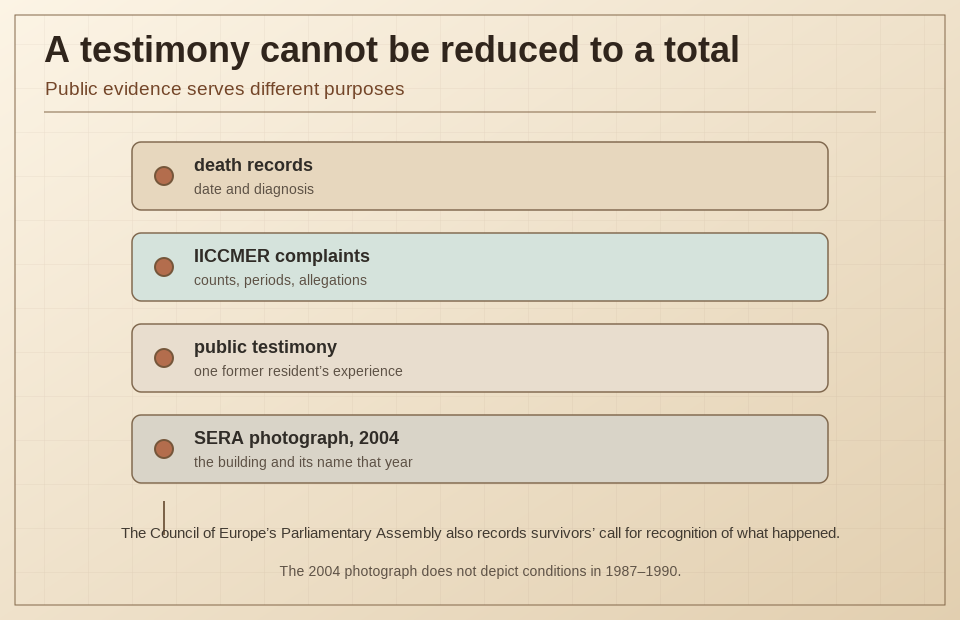
In an interview published by IICCMER on 20 October 2022, Sârmanca Fekete says she was sent to Cighid after being abandoned at a maternity hospital and lived there until 2001. She says food, heating, outdoor play and access to kindergarten improved after a foundation arrived in the 1990s, although some staff continued to hit her. The interview records her testimony; the institute says it does not present the findings of an investigation. [7] A report by the Parliamentary Assembly of the Council of Europe later discussed the Cighid case. [10]
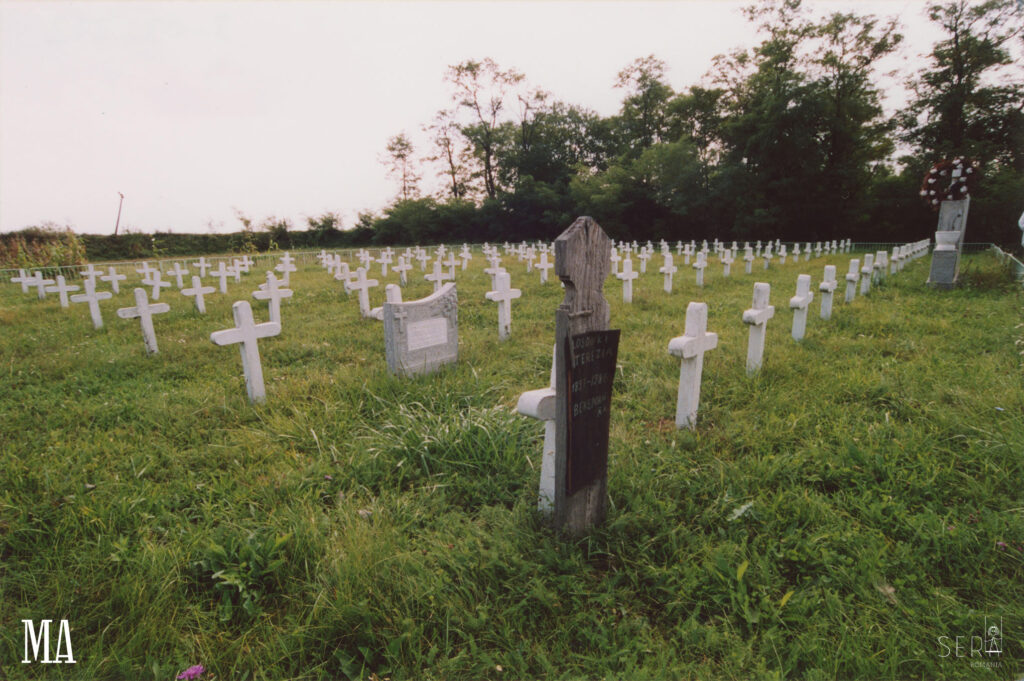
A second SERA photograph from 2004 shows crosses and gravestones in Cighid’s cemetery, with no legible names. The image does not identify those buried or connect any grave to the published counts. It belongs to the place’s archive, alongside a testimony that follows the institution’s life beyond the periods covered by the reports. [8] [7]