Marius ComperSuceava
Română

Suceava · craft and settlement

Ciocănești: how a motif reached the wall

Ciocănești’s houses carry motifs linked to embroidery, decorated eggs and local craft. Sources preserve more than one date for the tradition’s beginning. Follow Leontina Țăran’s story, the making of the first band and the way a household choice became the image of a whole valley.

Start the story ↓
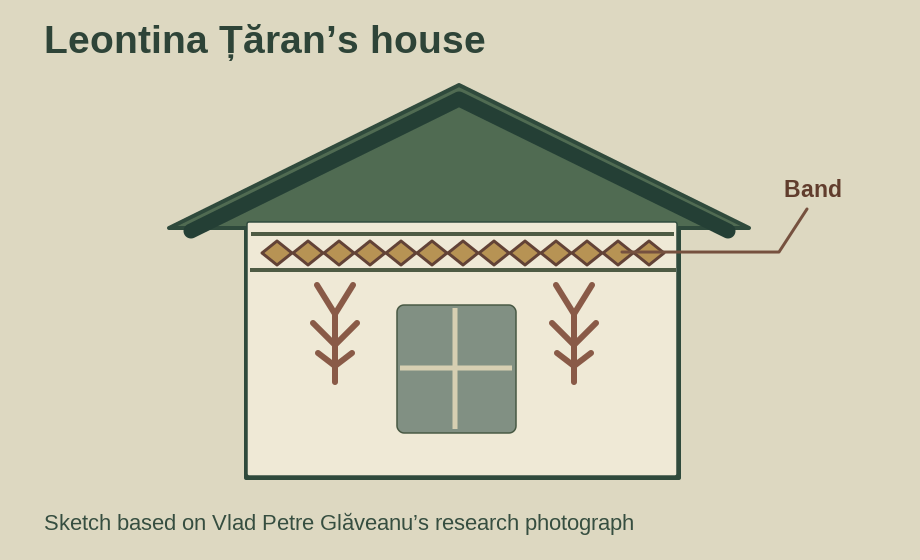
Sketch of the house with a row of diamonds below the eaves and two motifs beside the window.
The band follows the edge below the eaves. Two motifs descend along the wall beside the window. Sketch based on Vlad Petre Glăveanu’s published photograph. (Research photograph)

The place

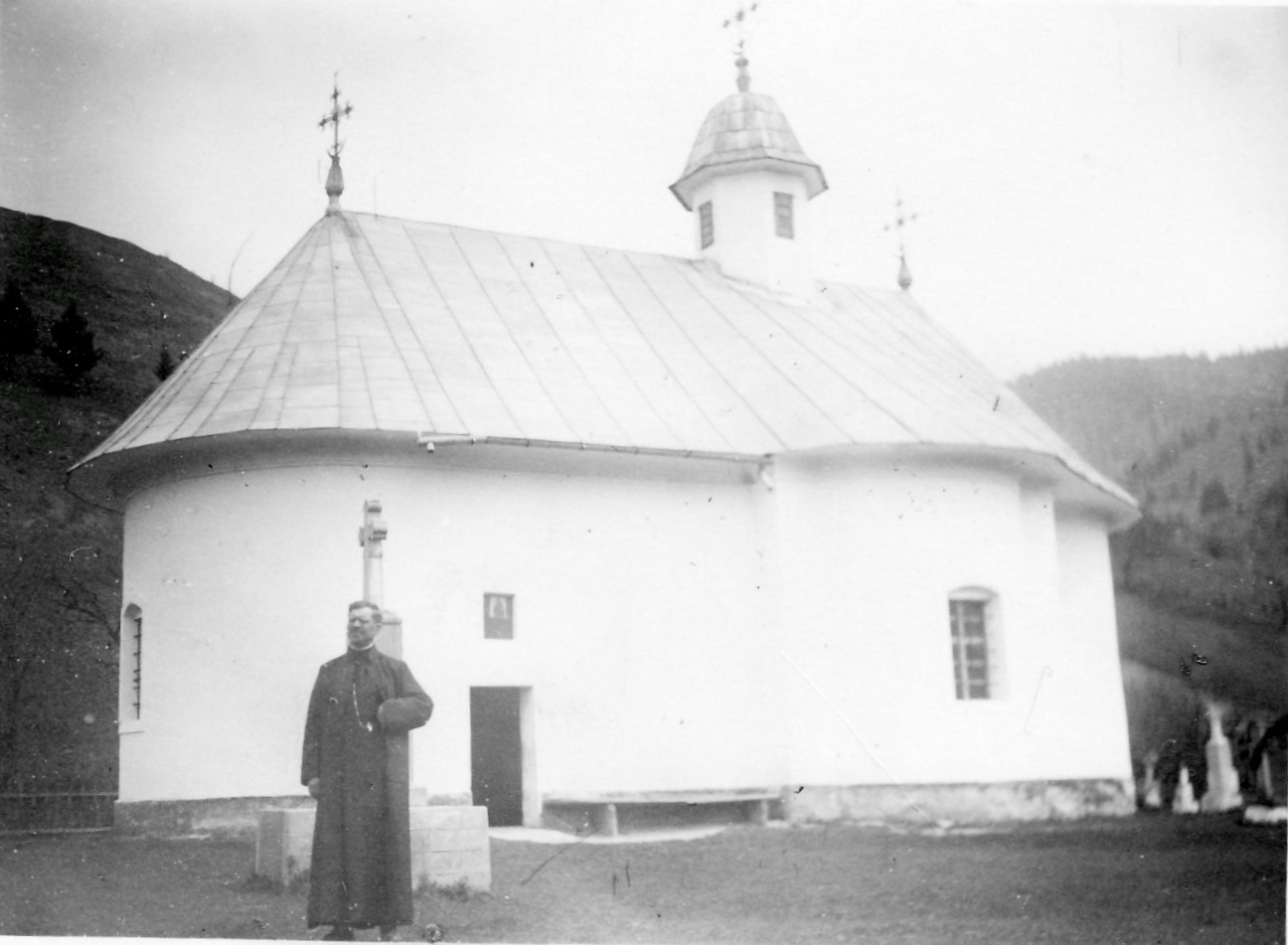
Black-and-white archive photograph of Ciocănești church and a priest, dated 1936.
The church and priest of Ciocănești in a photograph from 1936. (Source · Țetcu Mircea Rareș · Arhiva Mitropoliei Moldovei · Wikimedia Commons · CC BY-SA 4.0)

The place

First, a lived-in valley

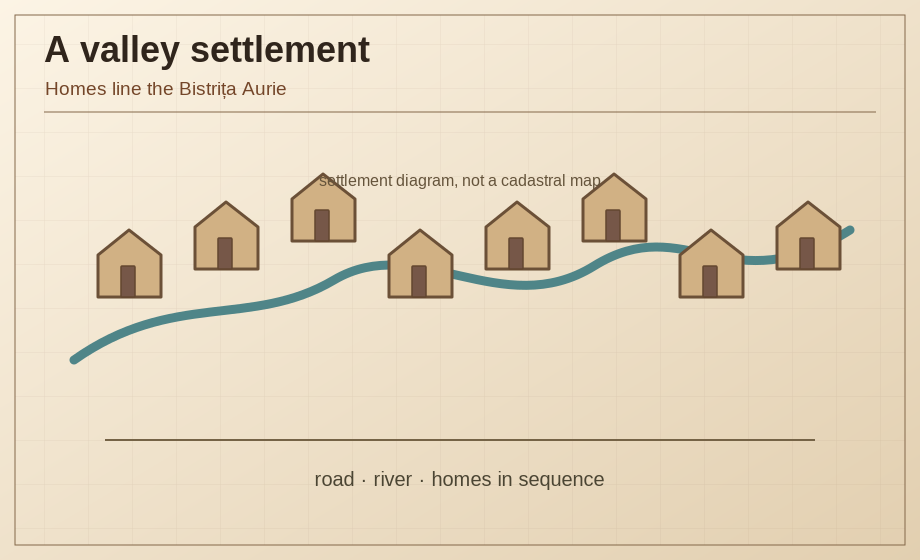
Ciocănești follows the Bistrița Aurie through a valley of homes, gardens, water and nearby forest. In 1996, Vera Tătaru described it as groups of houses along the river, often with façades facing south, built by local craftspeople who prepared their own timber. [1]

The 1936 photograph records the priest and village church. Leontina Țăran’s house appears in a much later study. The photograph of that house shows a band below the eaves and patterns beside the window. [7] [9]
Black-and-white archive photograph of Ciocănești church and a priest, dated 1936.
The church and priest of Ciocănești in a photograph from 1936. (Source · Țetcu Mircea Rareș · Arhiva Mitropoliei Moldovei · Wikimedia Commons · CC BY-SA 4.0)
A winding river through a valley, with houses along its banks and a parallel road.
Diagram based on the ethnographic description of a linear settlement along the Bistrița Aurie. Individual houses are not plotted at measured coordinates. (Source · Original diagram drawn from the cited source. · CC0 1.0)

The beginning

When was the first house decorated?

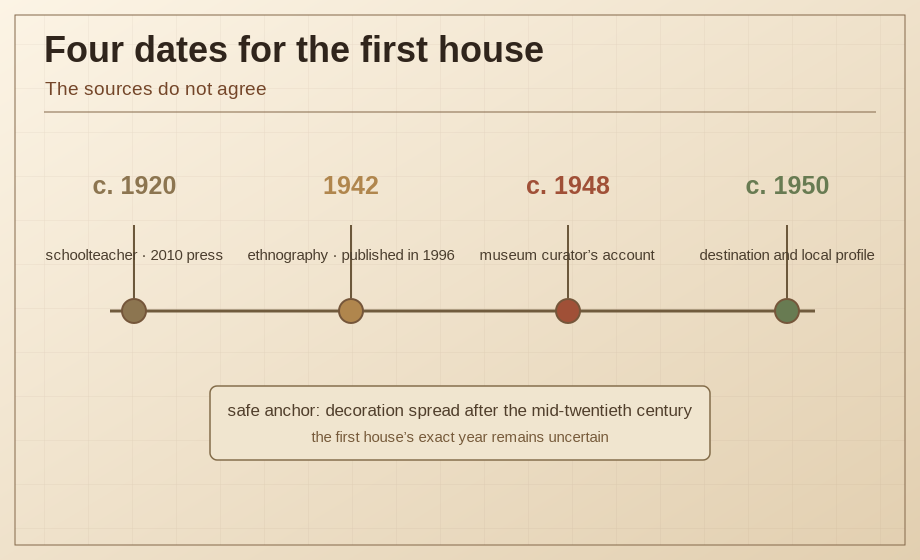
There is no single agreed date here. An ethnographic study published in 1996 says Leontina Țăran and mason Dumitru Tomoagă began in 1942. Museum curator Marilena Niculiță says “around” 1948 in a 2025 interview; the House Museum page and a local profile give about 1950. [1] [3] [2] [4]

A 2010 feature attributed the first pattern to a schoolteacher around 1920. These accounts were recorded long after the event and draw on different sources; no dated building record or photograph here resolves the disagreement. The robust marker is the spread through the 1950s and 1960s, not one definitive starting day. [5] [4]
Four proposed beginnings—c. 1920, 1942, c. 1948 and c. 1950—each attached to a different source.
The timeline shows dates reported by separate sources, not a chronology verified by contemporary records. (Source · Original diagram drawn from the cited source. · CC0 1.0)

The motif

What moved from blouse to house?

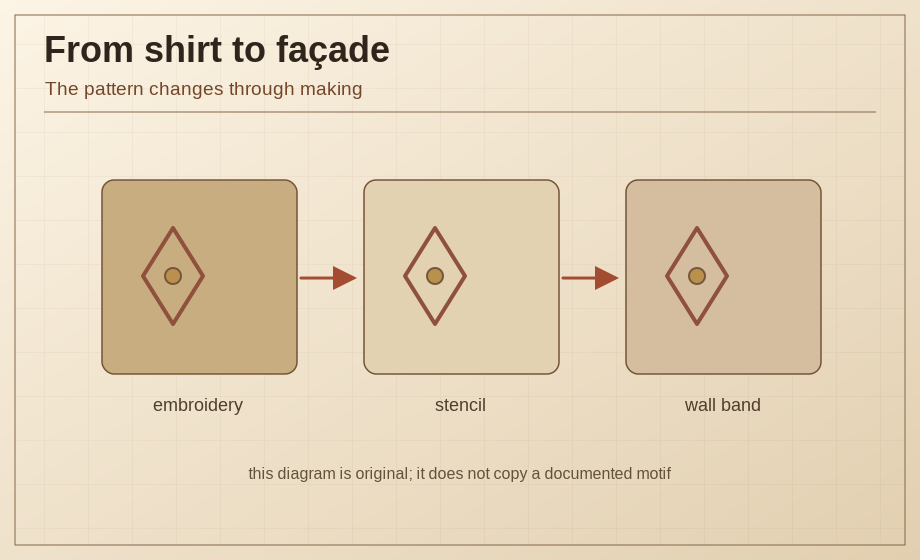
Vera Tătaru describes Leontina Țăran’s requested pattern as resembling motifs stitched on blouses. The museum curator says these marks moved among costumes, textiles and decorated eggs before appearing on façades. The pattern carried the shape of embroidery, while its material and scale changed. [1] [3]

A wall motif does not automatically have one fixed verbal translation. Sources describe how a shape travels and how owners choose patterns, not a universal dictionary of symbols. This is an original geometric composition showing the transfer between surfaces; it does not reproduce a specific village motif. [3] [1]

In Vlad Petre Glăveanu’s photograph of Leontina Țăran’s house, a row of diamonds runs below the eaves and two long motifs flank the window. On a wall, the pattern spans the face of the house and stops at its edges. [9]
The same geometric motif appears on embroidery, a stencil and a façade band; the shapes are illustrative, not copied.
Original explanatory drawing. Sources connect house ornaments to patterns used on clothing and eggs, but this diagram does not copy a specific local design. (Source · Original diagram drawn from the cited source. · CC0 1.0)
Sketch of the house with a row of diamonds below the eaves and two motifs beside the window.
The band follows the edge below the eaves. Two motifs descend along the wall beside the window. Sketch based on Vlad Petre Glăveanu’s published photograph. (Research photograph)

The technique

How was a raised band made?

The curator describes a wooden stencil, a layer of cement, sand and lime, work with a chisel, then drying and painting. The House Museum page describes the same sequence and says the marks can be felt by touch. The ornament was more than an image on a wall: it rose from the plaster. [3] [2]

Materials and recipes may have varied over time and from house to house. The 1996 ethnography mentions mortar and cement, while newer accounts specify lime and sand too. This is a process diagram, not a building instruction; it orders the steps described by the sources. [1] [3]
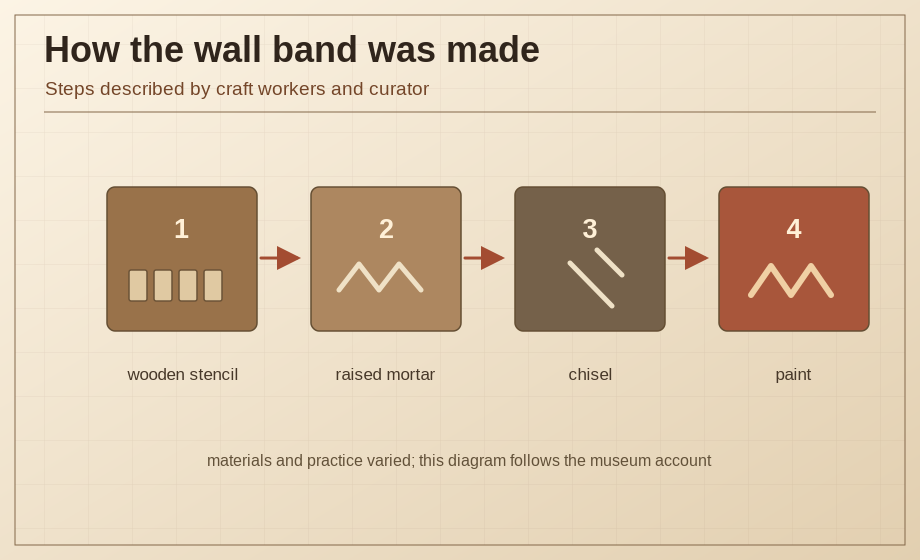
Four steps show the stencil, raised mortar, carving with a chisel and painting.
Materials come from the curator’s account and the House Museum page. This illustration shows the work sequence, not actual layer thickness. (Source · Original diagram drawn from the cited source. · CC0 1.0)

The spread

How did one design become a tradition?

The 1996 study says Dumitru Tomoagă created more than 30 base designs and decorated almost every house in the village. The Association of Communes profile places the spread in the 1960s, as households renewed their plaster. A repeatable technique and each family’s choices carried the motif beyond the first home. [1] [4]

That did not make every façade identical. The curator says owners choose their designs and few houses share the same decoration. The tradition grew through variation: one craft worker offered patterns, and households adapted them to their walls and preferences. [3]
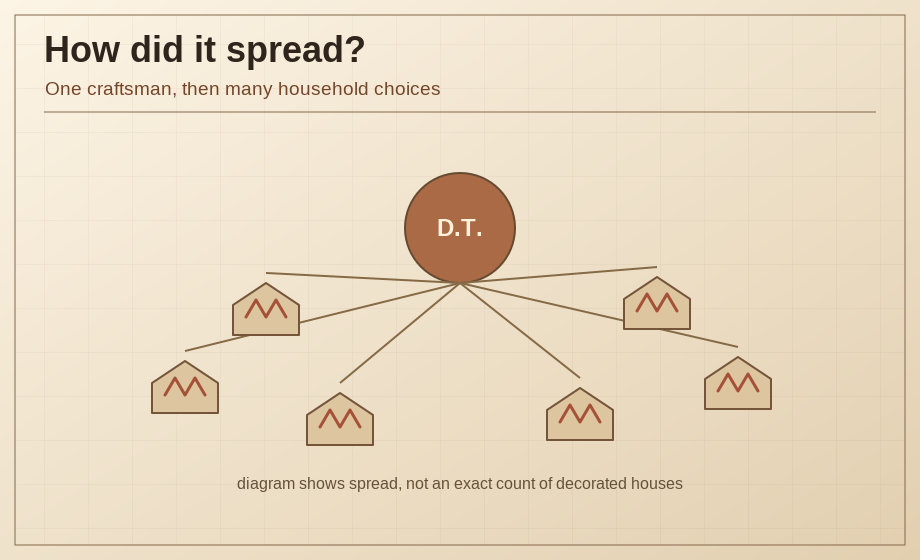
One craft worker connects to six houses with different bands, illustrating spread and variation.
Diagram of a craft spreading to several households; the number of houses drawn is not a statistic. (Source · Original diagram drawn from the cited source. · CC0 1.0)

The public name

What did “museum commune” mean?

A local newspaper reports that in 2004 the council declared Ciocănești a “museum commune” through decision no. 39 of 22 December. The designation gave public shape to a tradition already spreading along the valley and made decorated homes a marker for visitors. [6]

The full decision is not reproduced in the source available here, so we do not infer that every resident was legally required to paint a house. The tourism page offers practical visitor guidance: Leontina Țăran’s home is a museum, and access can be arranged by asking at the town hall or Ethnographic Museum. [6] [2]
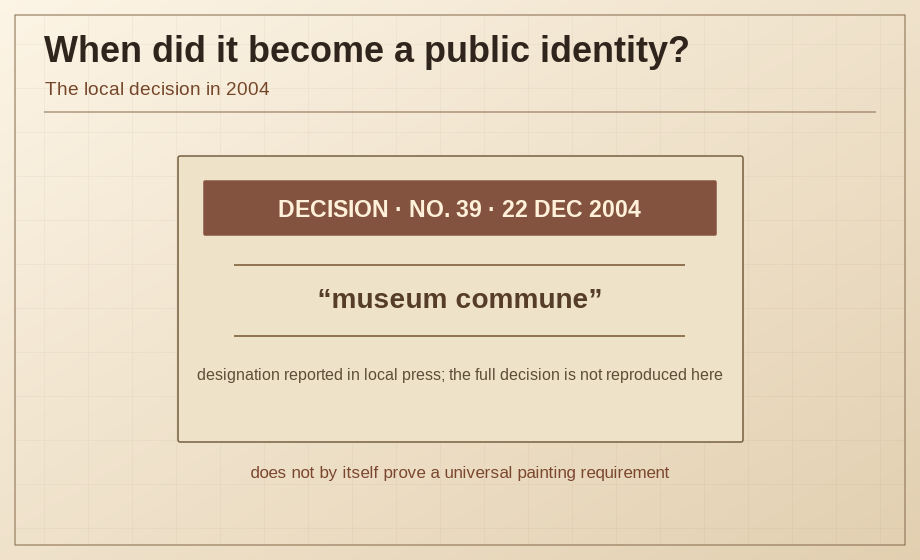
Panel shows local decision no. 39 dated 22 December 2004 and the phrase “museum commune”.
Explanatory panel based on local press reporting, which gives the decision number and date. This is not a facsimile and does not summarise clauses unavailable here. (Source · Original diagram drawn from the cited source. · CC0 1.0)

Sources

Ciocănești’s painted houses have a clear story and a beginning that is hard to date precisely. Leontina Țăran, Dumitru Tomoioagă and valley households carried embroidered motifs from clothing to walls, making raised patterns that vary from house to house.

  1. Vera Tătaru, “The houses of Ciocănești village (Bukovina)”, in Etudes roumaines et aroumaines, vol. III, 1996, pp. 133–139Ethnographic study of households, house construction, embroidered motifs transferred in relief to façades, and the spread of the decoration. The author dates Leontina Țăran’s initiative to 1942; the article does not cite a contemporary document for that date.
  2. Dorna Land Destination Management Organisation, Leontina Țăran House MuseumLocal tourism page says Leontina Țăran married in 1942, entered her mother-in-law’s home, and worked with Dumitru Tomoioagă on the first pattern around 1950. It describes a wood stencil, chisel, cement, lime, sand and paint, and gives current visitor guidance.
  3. Alina Mitran, interview with museum curator Marilena Niculiță, “An authentic Ciocănești egg has a black background”, Adevărul, 20 April 2025The curator dates the first decorated home to around 1948 and connects it to Leontina Țăran and craft worker Dumitru Tomoioagă. She describes motifs used on costumes, textiles and eggs and then transferred to houses, and explains the craft process.
  4. Association of Romanian Communes, Suceava branch, Ciocănești profileLocal profile dates the first painted house to 1950 and says the practice spread in the 1960s as residents renewed plaster.
  5. Cristina S. Carp, “The museum commune”, Viața Liberă, 16 April 2010, p. 8The 2010 feature says a schoolteacher first painted a house around 1920. This is a press account decades after the event, different from later testimony about Leontina Țăran; we preserve the discrepancy rather than treating it as a certain date.
  6. Viața Liberă, “The commune with decorated houses in Bukovina”, 20 May 2016, p. 10; cites Local Council Decision no. 39 of 22 December 2004The article reports that Ciocănești was designated a “museum commune” through local council decision no. 39 in 2004. That establishes a reported designation; it does not by itself show a general requirement to decorate every house.
  7. Metropolitanate of Moldavia archive, “Church and priest in Ciocănești”, 1936; photograph by Țetcu Mircea Rareș, Wikimedia CommonsThe church and priest of Ciocănești in a photograph from 1936.
  8. OpenStreetMap, Ciocănești, Suceava CountyThe pin marks the village on the Bistrița Aurie valley; it does not locate the house museum or the decorated homes precisely.
  9. Vlad Petre Glăveanu, LSE thesis, 2012, image 7, p. 91The photograph of Leontina Țăran’s house shows the band beneath the eaves and motifs around the window. Page 90 discusses interviews about house decoration.