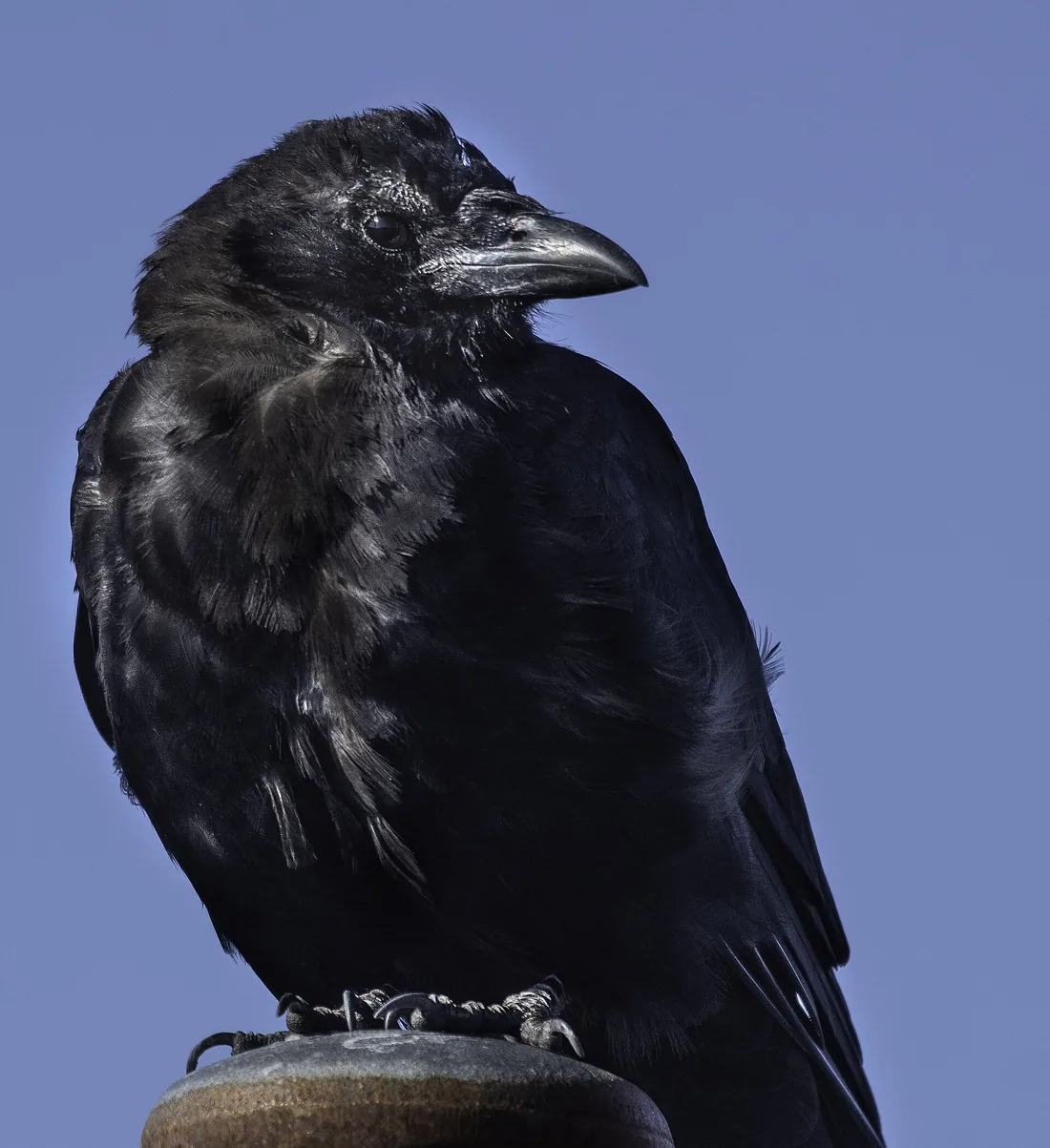
American crow (Corvus brachyrhynchos). Photo: TRinaud, CC BY 4.0.
A real experiment · Seattle · American crows
Crows remember the people who scared them
In Seattle, people in masks caught crows. After 2.7 years, two thirds of the crows met on the same route scolded the mask, and at the study’s five sites nearly nine in ten of the scolding crows had not been caught by the masked people. We found no test of Romania’s crows.
The mask experiment, in an imagined town square
29 crows sit in the square. You walk a person in a mask across it. How each crow behaves is our drawing; how many of them scold the mask at each stage comes from the Seattle study. Pick a mask, then drag the person across the square. “Scolding the mask” means a harsh alarm call, repeated, with wings and tail flicking, aimed at the mask.
Before the catch
On the University of Washington campus in Seattle, only 3% of 167 crows scolded this mask before anyone used it. Here: one crow in 29.
The catch
Two people wearing the same mask caught crows with a net, banded them and released them after 10–30 minutes. The mask came off only inside a building. At the University of Washington seven crows were caught, according to the press; the paper gives between 7 and 15 per site.
Around them, 15 to 40 crows circle overhead and scream, at each of the five sites except one. They are not caught, but they see what happens.
Two weeks later
Of the crows met on the route, 26% scold the mask. Some had been caught; others probably learned from the mob that formed.
One year and three months
The share barely moved: 30.4%. The researchers walk the same route in the same mask, at most once a day.
2.7 years
In autumn 2008, 66% of the crows met scold the mask. Two thirds.
The researchers also look beyond the route: 4 of 65 crows scold the mask there too, 541, 667 and 1,248 metres from where the catching happened; at the 3% rate from before the catch, 2 would be expected.
Who scolds?
Of 160 scolding crows that were classified, 86.9% had not been caught by the masked people (the five sites taken together).
The circled crow was never caught. At four other sites near Seattle: where a mob had formed, 27.8% of the lone crows that came later scolded the mask; where none had, 3.3%. The authors read this as social learning.
Young crows learn from their parents: fledglings whose parents had scolded the mask, left on their own, scolded it on 7 of 11 territories, against 1 of 9 for the same person without the mask.
Same square, another mask
With a mask that was not the catch mask at that site, crows not caught by the masked people scolded in 11.8% of encounters (the five sites taken together). Here: 3 of 29 crows.
Crows that had been caught scolded the catch mask in 91.3% of encounters (21 of 23) and other masks in 11.1% (2 of 18). Crows not caught by the masked people scolded the catch mask in 33% of encounters (137 of 421).
The percentages at each stage (3.0%, 26%, 30.4%, 66% for the catch mask; 11.8% for another mask) come from the study and are rounded to whole crows here. The study was done on the American crow (Corvus brachyrhynchos) on a Seattle campus. We found no repeat of it with the hooded crow of a Romanian town.
How long do crows hold a grudge? The 17-year story
It is said that Seattle’s crows held a grudge for 17 years. Here is what was measured and what was said.
- 2005, before the catch: 3.0%
- 2006, two weeks after: 26%
- 2007, 1.25 years after: 30.4%
- 2008, 2.7 years after: 66%
- Around 2013, reported: around half
- September 2024, reported: 0 of 16 crows
Published and measured
The paper published in 2012 followed the campus for 5 years. Two weeks after the catch, 26% of the crows met scolded the catch mask; after 1.25 years, 30.4%; after 2.7 years, 66%. The number of scolding crows kept growing up to five years.
Said by the author, unpublished
In October 2024 The New York Times reported that John Marzluff, the University of Washington researcher who led the experiment, estimates that the crows held the grudge for “around 17 years”, based on the experiment he began in 2006. According to the report, about seven years after the catch around half of the crows met scolded, and on a September 2024 walk none of the 16 crows met scolded the mask. The data are unpublished.
What can be said: on that Seattle campus, crows scolded a mask year after year; according to the newspaper, on a September 2024 walk none of the 16 crows met did so any more. What cannot be said: that a single crow remembers a face for 17 years. Nobody has shown that. It is not known whether any of the crows caught in 2006 is still alive.
What happens in a crow’s brain when it sees a person
In another study, 12 adult crows (likely male), freshly caught by researchers in a mask, were held for four weeks and fed by people in another mask. Each was then shown a person in the catch mask, a person in the feeding mask or an empty room, and its brain was scanned with PET (not MRI).
At the catcher’s mask (five crows), the amygdala, a brain region linked to fear, was 11% more active than in the empty-room crows; the thalamus and brainstem lit up too. At the feeder’s mask (four crows), other areas, linked to motivation, lit up. Empty room: three crows.
The crows behaved differently too: facing the catcher they flashed the white membrane over the eye 29 times a minute, and facing the feeder 41 times. The groups are small, and the scanned crows are not the ones of the mask experiment.
Why do crows gather around a dead crow?
Researchers placed, two metres from a pile of food, a masked person holding a stuffed crow, or with a stuffed hawk two metres away, or with the hawk and a stuffed crow together two metres away. The crows of the territory scolded in 96% of 102 tests. When the person wore only the mask, with no danger in sight, they scolded in 17% of 12 tests; with food only, in none of 17.
Facing a person holding a dead crow on outstretched palms, they scolded in 94% of 34 tests. Facing one with a dead pigeon, in 2 of 5.
One such event was enough for the crows to learn the masked person, and in 38% of cases the lesson held after 6 weeks.
Crows are said to hold “funerals”. The study’s authors read the gathering as a lesson about danger. Whether crows grieve has not been tested.
Do crows bring gifts? Do magpies steal shiny things? Do crows see faces like we do?
Crows bring gifts
The story of a Seattle girl who received small objects from the crows she fed went round the world in 2015. John Marzluff, the crow specialist, said he cannot say crows always do it, but that he has seen a great many things crows have brought people. We found no controlled test. It remains a lovely, unproven story.
Magpies steal shiny things
A 2015 study tested wild and captive magpies. Its conclusion: no evidence that the birds are attracted to shiny objects; the wild ones were wary of any new object.
Crows see faces like we do
In the mask experiments, crows tell apart masks worn by people. It has not been shown that they perceive a face the way we do. Two laboratory crows in Germany did not show the face-inversion effect, the one that makes an upside-down face hard for humans to recognise.
And the crows of Romania?
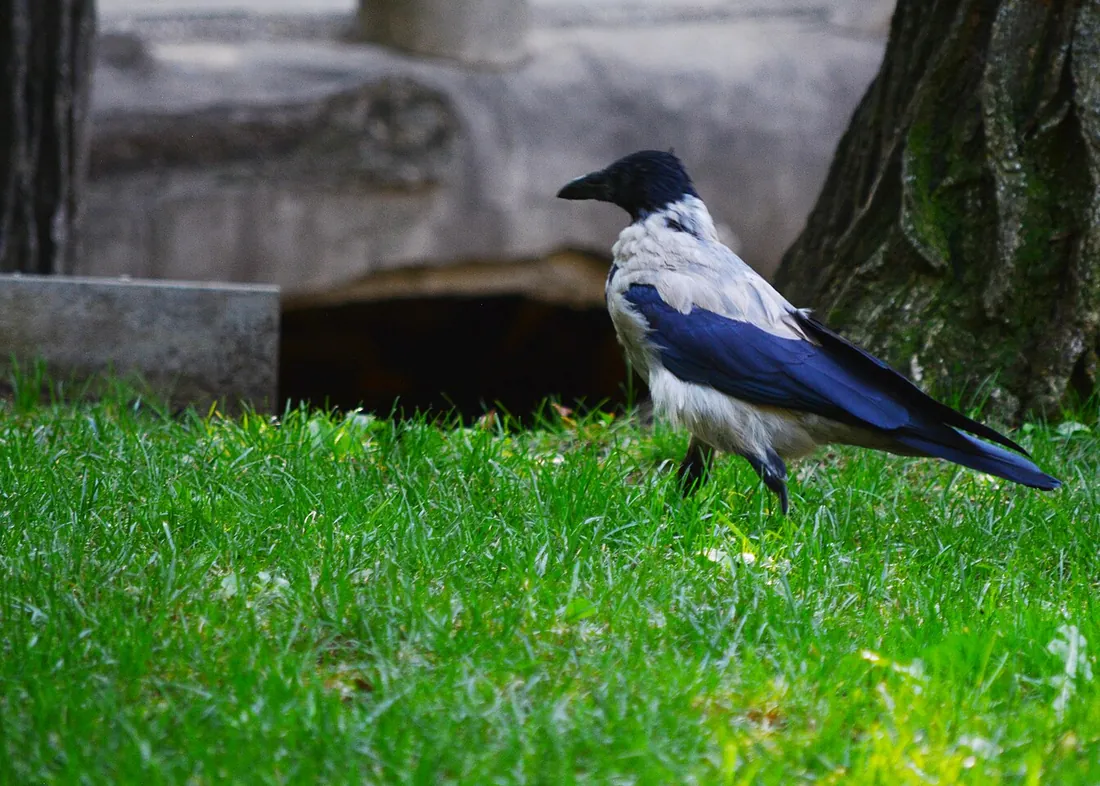
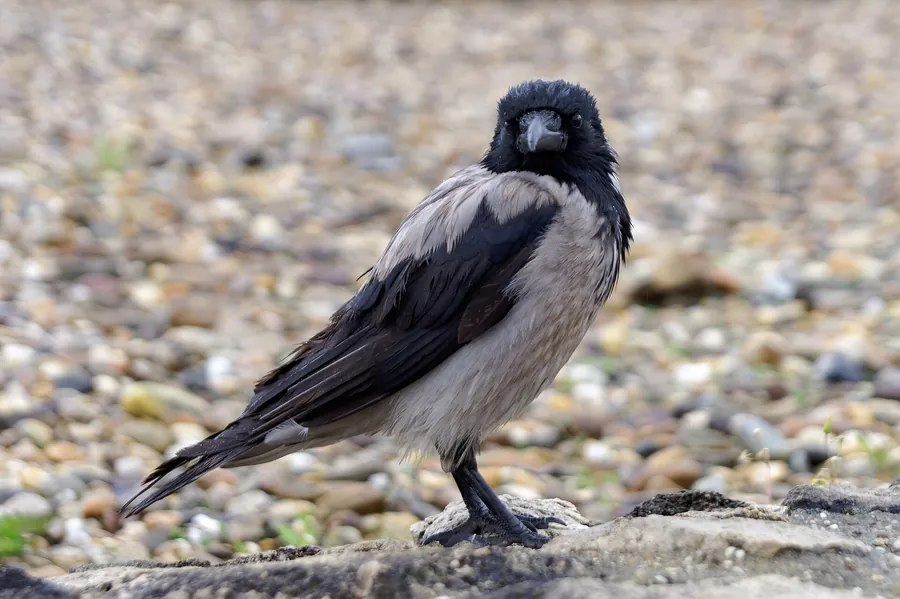
The crow in the photo below, taken in a park in Bucharest, Romania’s capital, is a hooded crow (Corvus cornix): black head and wings, grey back and chest. Its close relatives are the carrion crow (Corvus corone), the rook (Corvus frugilegus), the jackdaw and the magpie.
We found no study in which the hooded crow, in Romania or anywhere else, was tested with masks. The Seattle experiment used the American crow. We do not know whether hooded crows in a Romanian town do the same.
What has been shown for its relatives in Europe and Asia
- Wild magpies in Seoul told apart people who had climbed to their nest from people who had not (Lee and colleagues, 2011).
- Wild jackdaws in England reacted differently to the mask worn by the person who had handled their chicks and to another mask (Davidson and colleagues, 2015; 36 trials at 8 nest-boxes).
- Jackdaws in Cornwall learned that a stranger was dangerous just from hearing other jackdaws’ alarm calls (Lee and colleagues, 2019).
- In four Serbian cities (Belgrade, Novi Sad, Šabac, Čačak), nearly 30,000 people passed 15 hooded crow nests in 130 hours of observation, before the young had left the nests, and the crows attacked no one. It was not a recognition test (Novčić and colleagues, 2024).
How Romanians saw them
In 1883 the ethnographer Simion Florea Marian noted that, in some circumstances, the cawing of crows is taken as a bad sign: old women are frightened, believing it foretells death. The proverb “Corb la corb nu scoate ochii” (a raven does not pick out another raven’s eyes) is in Iuliu Zanne’s collection of Romanian proverbs (1895), glossed (after Golescu) as “those who are alike do not harm those like them…”. The proverb is about the raven.
Hooded crow call, southern Finland (Oona Räisänen, public domain).

What nobody has shown
- Whether a single crow remembers a face for life.
- Whether hooded crows in Romanian towns do what American crows did in Seattle.
- Whether the lesson passes through many generations of crows: one step has been shown, from parents to young.
- Whether crows grieve a dead crow.
- What the crows on that Seattle campus do today: the data of recent years are unpublished.
Crows also learn who feeds them: in the PET scans, the mask of the person who had fed them for four weeks lit up different parts of the brain than the mask of the person who had caught them.
Sources and credits
What is measured and what is drawn
Measured (American crows, Seattle): the percentages at each stage, the size of the mobs, the 86.9% not caught, learning from mobs and from parents (Cornell and colleagues, 2012), the PET scans and the gatherings around a dead crow. Drawn by us: the square, the crows as individuals, who flies and when, the masks, the sounds chosen from recordings of American crows in Minneapolis. The figure of seven crows caught at the University of Washington comes from the press (The New York Times, 2008 and 2024); the scientific paper says between 7 and 15 crows were caught at each of the five sites.
- Cornell, Marzluff and Pecoraro (2012), Social learning spreads knowledge about dangerous humans among American crows, Proceedings of the Royal Society B 279:499–508
- Marzluff, Walls, Cornell, Withey and Craig (2010), Lasting recognition of threatening people by wild American crows, Animal Behaviour 79:699–707
- Marzluff, Miyaoka, Minoshima and Cross (2012), Brain imaging reveals neuronal circuitry underlying the crow’s perception of human faces, PNAS 109:15912–15917
- Cross and colleagues (2013), Distinct neural circuits underlie assessment of a diversity of natural dangers by American crows, Proceedings of the Royal Society B 280:20131046
- Swift and Marzluff (2015), Wild American crows gather around their dead to learn about danger, Animal Behaviour 109:187–197
- Lee, Lee, Choe and Jablonski (2011), Wild birds recognize individual humans: experiments on magpies, Animal Cognition 14:817–825
- Davidson, Clayton and Thornton (2015), Wild jackdaws, Corvus monedula, recognize individual humans and may respond to gaze direction with defensive behaviour, Animal Behaviour 108:17–24
- Lee, Régli, McIvor and Thornton (2019), Social learning about dangerous people by wild jackdaws, Royal Society Open Science 6:191031
- Shephard, Lea and Hempel de Ibarra (2015), ‘The thieving magpie’? No evidence for attraction to shiny objects, Animal Cognition 18:393–397
- Brecht and colleagues (2017), Comparing the face inversion effect in crows and humans, Journal of Comparative Physiology A 203:1017–1027
- Novčić and colleagues (2024), Low probability of attacks by hooded crows Corvus cornix during the nest-attendance period: a pilot study, Acta Zoologica Bulgarica 76(4):499–505
- Thomas Fuller, If You Think You Can Hold a Grudge, Consider the Crow, The New York Times, October 2024 (copy on West Hawaii Today)
- Katy Sewall, The girl who gets gifts from birds, BBC News, 25 February 2015
- Iuliu A. Zanne, Proverbele românilor, vol. I, 1895 (p. 435)
- Simion Florea Marian, Ornitologia poporană română, 1883, chapter Cioara
Image and sound credits
- Opening portrait: TRinaud, CC BY 4.0, Wikimedia Commons. The silhouette used in the square is cut from this photograph.
- Hooded crow in Bucharest: Joe Mabel, CC BY-SA 4.0.
- Council Square, Brașov: Whitepixels, CC0.
- Hooded crow in Budapest: Jakub Hałun, CC BY-SA 4.0.
- The flying crows in the drawing: Ryan Kissinger, NIAID (NIH BioArt, public domain).
- The crow calls in the square: recording XC121396 by Jonathon Jongsma, Minneapolis, American crows, CC BY-SA 3.0; cut into eight calls. The hooded crow call: Oona Räisänen, public domain.