Marius ComperCleja • a record’s history
Română

St Francis of Assisi Church • current building, dating to 1906

A song from Cleja, written down in 1843, published in 1956

In 1843, priest Inocențiu Petrás wrote down a Hungarian-language version of the song now called Miorița in Cleja. The text did not appear in print until 1956. Parish registers and maps show what we can learn about the place—and what remains uncertain.

Read the song’s story ↓
Sepia topographic map with Cleja and Faraoani on hills beside a valley.
The map shows the settlement; registers preserve names, dates and communities. (Source)

The place on the map
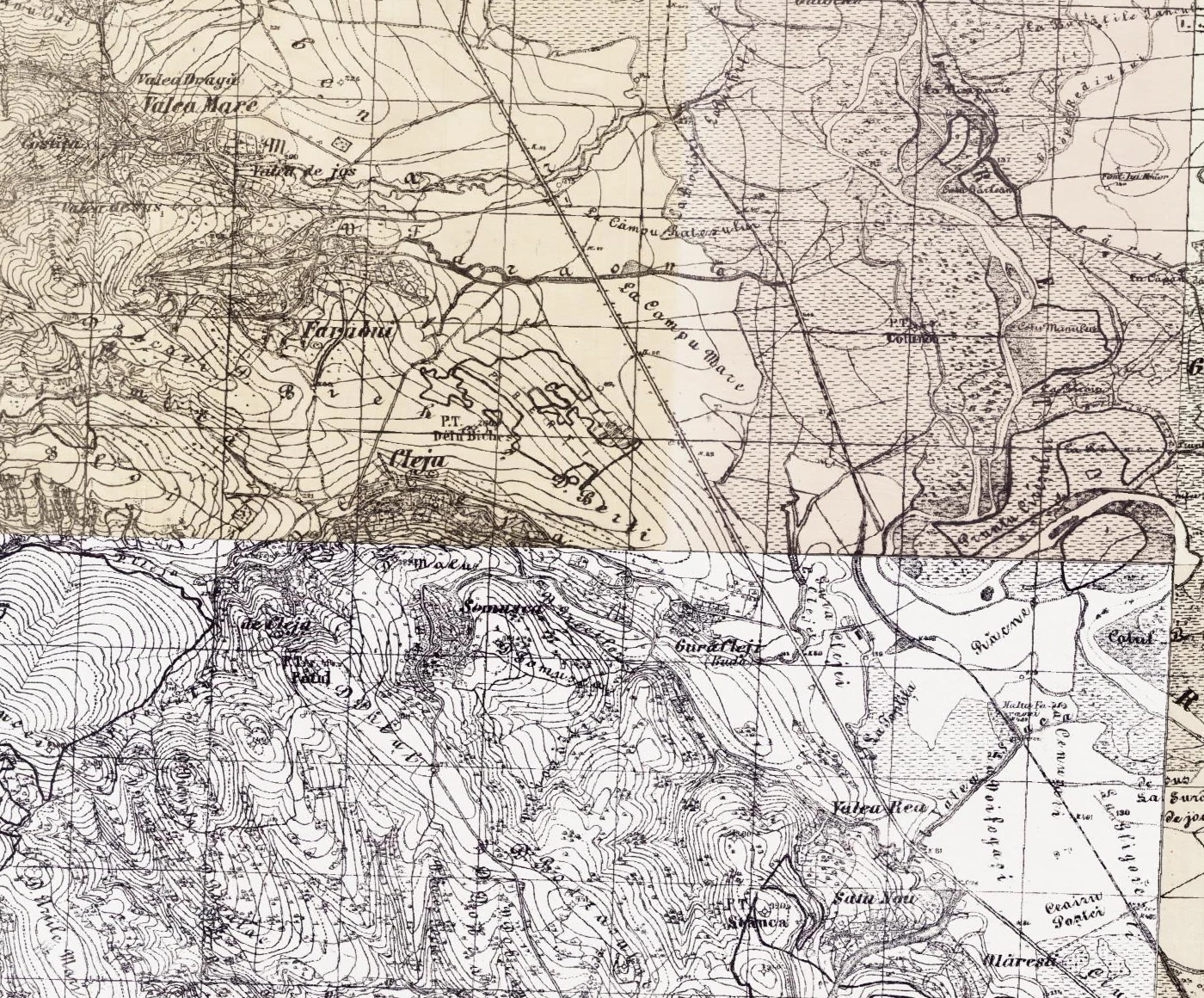
Sepia map with hills, valleys and Cleja printed at left, Faraoani farther north.
Historical 1:20,000 crop; Cleja and Faraoani appear on the same map. The sheet date is not visible. (Source · Serviciul Geografic al Armatei · eHarta / geo-spatial.org · decupaj / crop · CC BY-SA 4.0)

The place on the map

The church you see today

The point in this story is St Francis of Assisi parish church, built in brick in 1906. It marks Cleja today, not the site of the wooden church from 1811 or the exact place where priest Inocențiu Petrás wrote down a song in 1843. The parish history distinguishes those stages. [3] [8]

The historical military map shows Cleja, Faraoani and the valley between them. It provides geographic context, not a map of successive churches or the household where the song was collected. The map is useful when we do not ask it to locate more than it shows. [7]
Sepia map with hills, valleys and Cleja printed at left, Faraoani farther north.
Historical 1:20,000 crop; Cleja and Faraoani appear on the same map. The sheet date is not visible. (Source · Serviciul Geografic al Armatei · eHarta / geo-spatial.org · decupaj / crop · CC BY-SA 4.0)
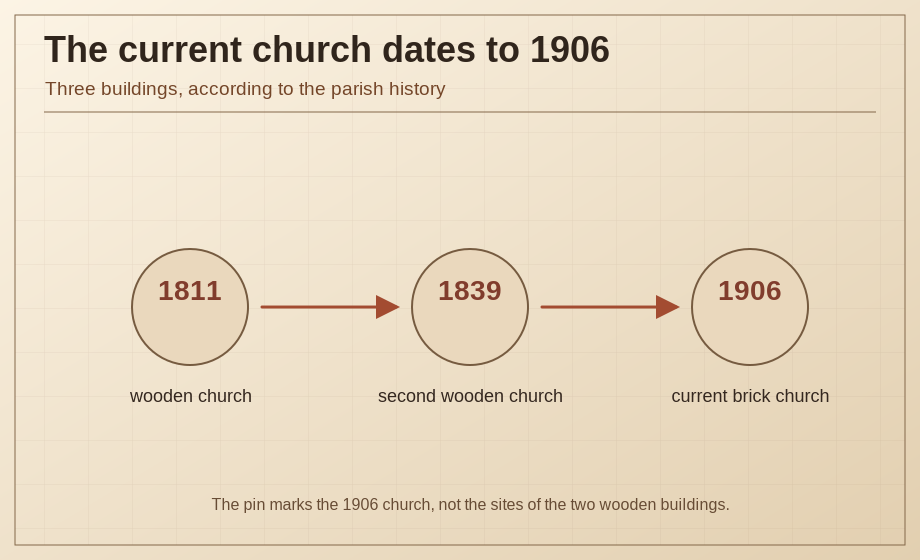
Three dates for successive parish churches.
The pin marks the 1906 church; the old map shows the settlement, not the historic chapel. (Source)

An absence in the report

What Codex Bandinus cannot prove

Marco Bandini visited Catholic communities in Moldova in 1646–1648. Anton Coșa’s study notes that the report’s edition names Faraoani but not Cleja. Yet the document is not a complete census of every village in Moldova; Cleja’s absence from its pages does not prove that the settlement did not exist. [2] [1]

The village name appears earlier, in a document dated 3 May 1588 that mentions Ștefan of Cleja, according to the same study. That attests to the place-name and one person, not a full community description. Each document answers a narrower question than the complete history of the place. [1]
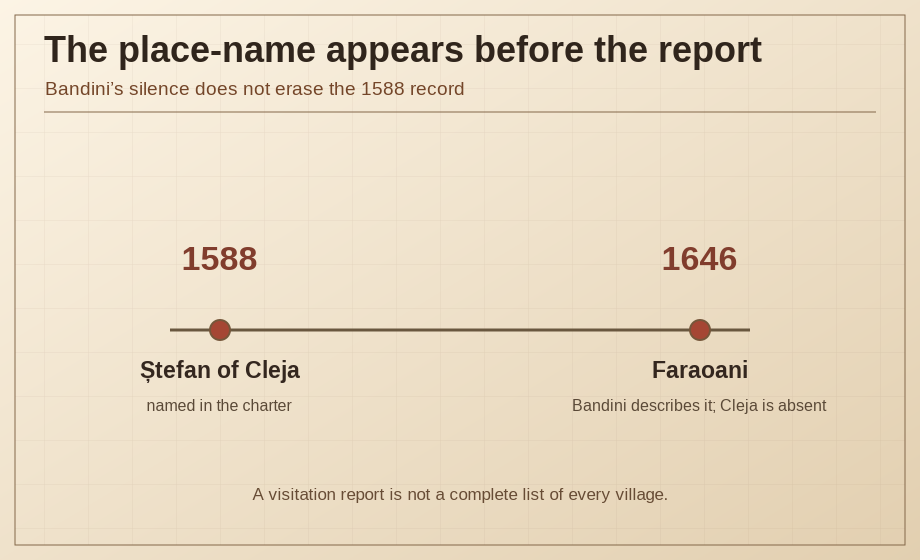
A document page with Faraoani marked as named and Cleja as not named; a note says the report is not a complete census.
Faraoani appears in the edition; silence about Cleja does not prove the village was absent. (Source)
Sepia map with hills, valleys and Cleja printed at left, Faraoani farther north.
Historical 1:20,000 crop; Cleja and Faraoani appear on the same map. The sheet date is not visible. (Source · Serviciul Geografic al Armatei · eHarta / geo-spatial.org · decupaj / crop · CC BY-SA 4.0)

A mission list

“Clesa”: 76 Catholics recorded

A supplement to missionary Bernardino Silvestri’s report, dated between February and November 1696, names the settlement “Clesa”. Anton Coșa says the list records names and relatives and notes who had received confirmation. Cleja has 76 Catholic people recorded; this is not the village’s total population. [1] [3]

The missionary’s report was dated 28 June 1697, after his return to Rome, the study says. So the supplement’s year and the report’s date are not the same. This is a religious inventory of visited Catholic communities, not a civil register or a count of the entire population. [1]
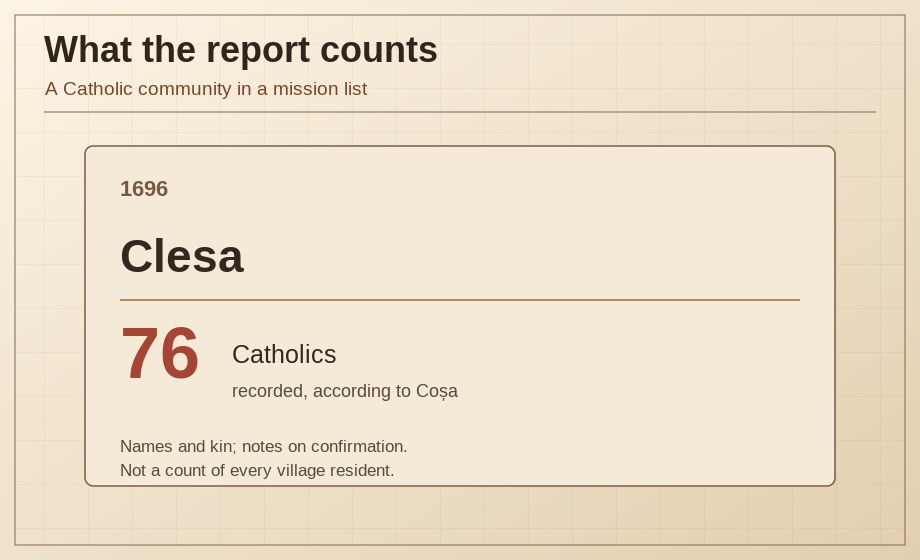
A document card with the name Clesa, 76 Catholic people and a note that it is not a count of all residents.
As transcribed by Coșa, with the unit of counting made explicit. (Source)
Sepia map with hills, valleys and Cleja printed at left, Faraoani farther north.
Historical 1:20,000 crop; Cleja and Faraoani appear on the same map. The sheet date is not visible. (Source · Serviciul Geografic al Armatei · eHarta / geo-spatial.org · decupaj / crop · CC BY-SA 4.0)

The name in a register

Clesia in the Faraoani list

In 1781, priest Aloysius Maffei compiled a Status animarum at Faraoani, a list of parish families and members. Radu Cucuteanu and Valentin Piftor identify households from the settlement written as “Clesia” in this list. It did not necessarily count every resident and was not a modern census. [4]

Cleja’s parish history separately says a count of believers there was made in 1784. The sources do not say whether this was another list or a different date for the same record, so we keep the years separate. In either case, this is a record of a religious community, not every resident. [3] [4]
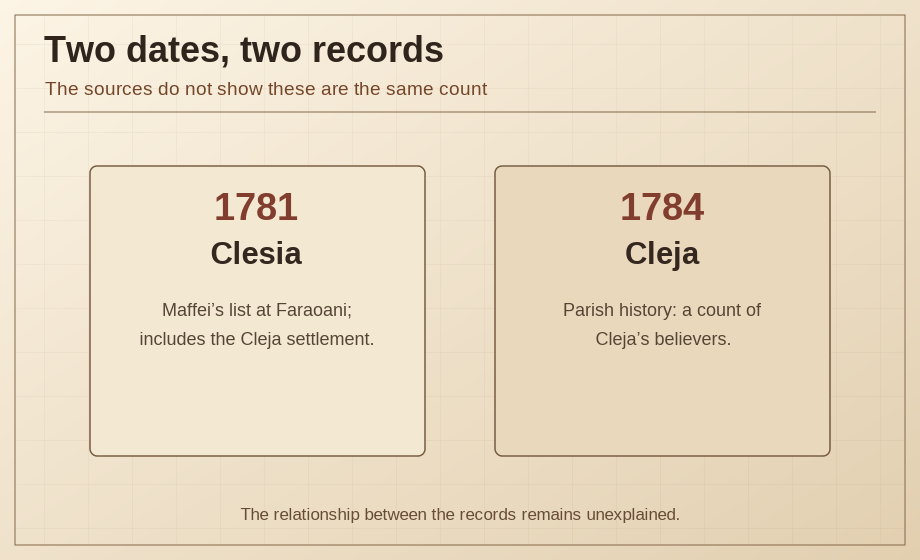
Comparison: Maffei’s 1781 list at Faraoani records Clesia; the parish history mentions a count of Cleja’s believers in 1784.
We cannot combine them without the original records. (Source)
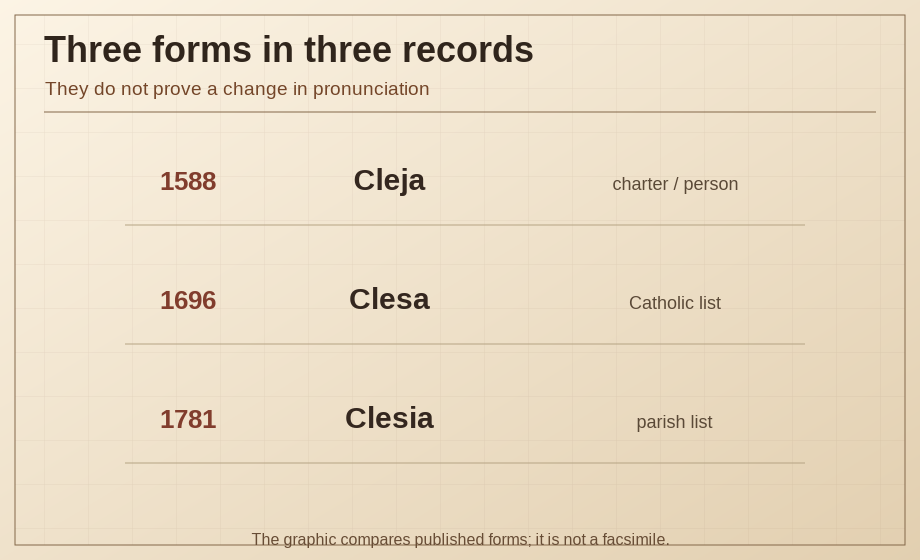
Two cards: the Cleja place-name in a 1588 document and the form Clesia in the 1781 Status animarum.
The written form depends on the language and record. (Source)

The parish and its buildings

From 1793 to the current church

The parish registers begin in 1793, the year Anton Coșa’s study treats as the start of Cleja parish. In 1811, the community built a wooden church. A second wooden church followed in 1839 on the earlier foundation; the current brick building was built in 1906. [1] [3]

Today’s church remains a place marker, but it should not be confused with the spaces where people lived and gathered in earlier centuries. The parish history gives dates and building materials; it does not map the early chapel or the two wooden churches. [3]
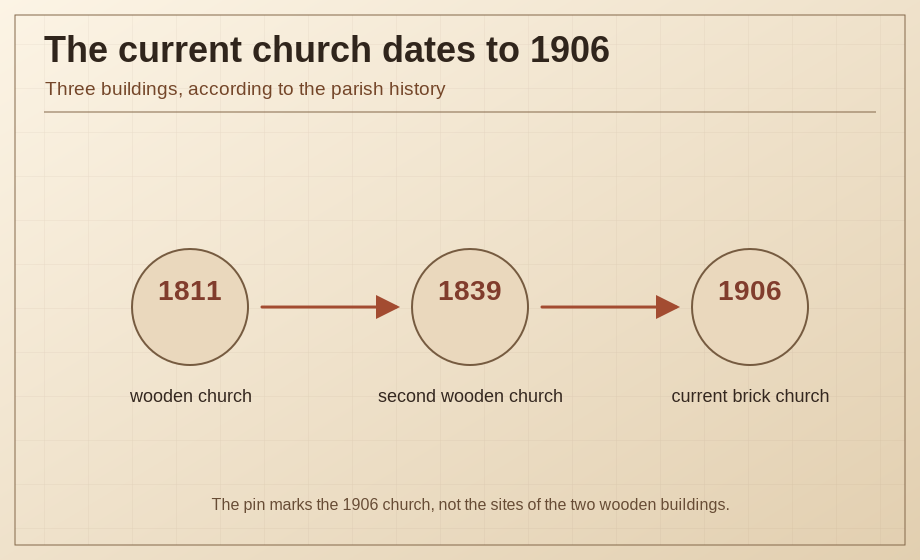
Three linked circles: wooden church in 1811, another in 1839, current brick building in 1906.
The timeline comes from the parish history and Coșa’s study. (Source)
Sepia map with hills, valleys and Cleja printed at left, Faraoani farther north.
Historical 1:20,000 crop; Cleja and Faraoani appear on the same map. The sheet date is not visible. (Source · Serviciul Geografic al Armatei · eHarta / geo-spatial.org · decupaj / crop · CC BY-SA 4.0)

One family in two registers

What Petrás’s registers can tell us

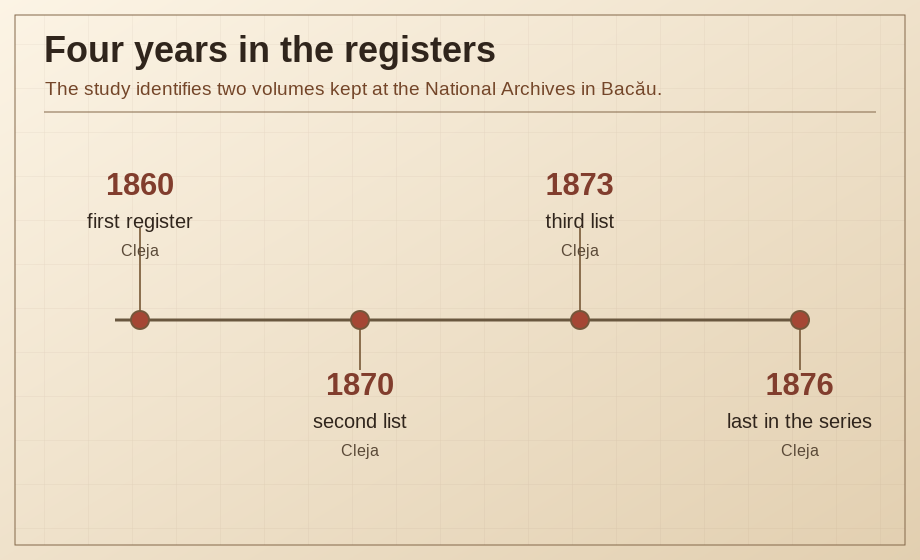
Inocențiu Petrás served at Cleja from 1843 to 1886. The Status animarum registers he compiled in 1860, 1870, 1873 and 1876 are kept in two volumes at the National Archives of Bacău County, according to Vilmos Tánczos’s study. The article publishes photographs and transcriptions from these registers; here we use only the transcription, not a facsimile. [5] [1]

In one family, the 1860 register lists a couple and their children, including Rosa; in 1870, new children’s names appear and Rosa is absent. Tánczos suggests she may have died in the meantime, but a name disappearing from a register does not prove why she is gone. The entry allows a comparison, not a complete family story. [5]
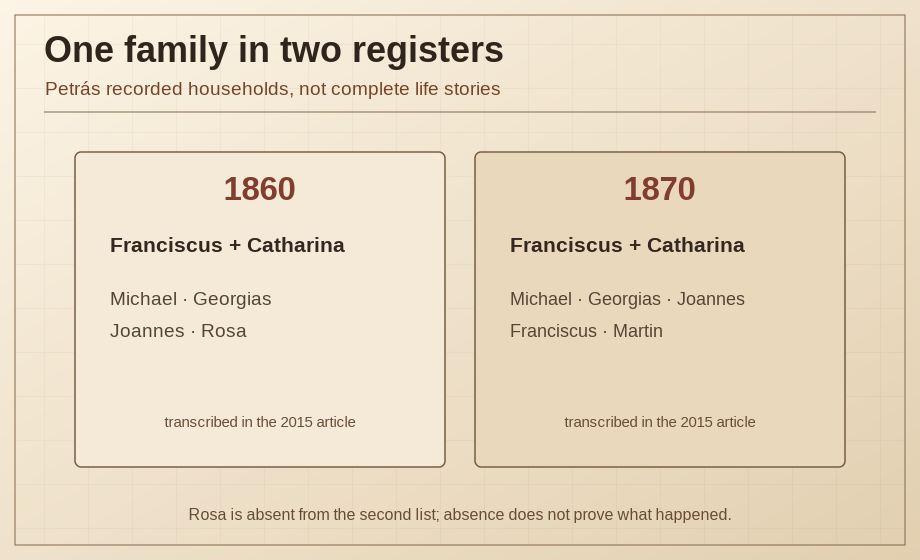
Two columns show the same family in 1860 and 1870; Rosa appears in the first list but not the second. A note says absence does not prove why.
Diagram based on Tánczos’s published transcription; not an archival facsimile. (Source)
Diagram with four register years: 1860, 1870, 1873, 1876; arrow to two volumes held at the National Archives of Bacău County.
The study identifies two volumes at the National Archives in Bacău. (Source)

The song written down in 1843

A pastoral ballad written down in Hungarian

Miorița is a well-known pastoral ballad with many variants. In the Romanian version published by Vasile Alecsandri, a ewe warns a shepherd that the others mean to kill him. Folklorists trace how episodes such as the warning and the shepherd’s burial wishes vary from one account to another. The scholar Éva Jeney places the Hungarian text Petrás wrote down at Cleja among the related versions. [6]

Petrás wrote the text down in 1843. That date tells us when he recorded the words. The ballad circulated in several forms, and the name by which it is known today comes from its publication history. At Cleja, 113 years passed between the manuscript and the printed volume. [6]
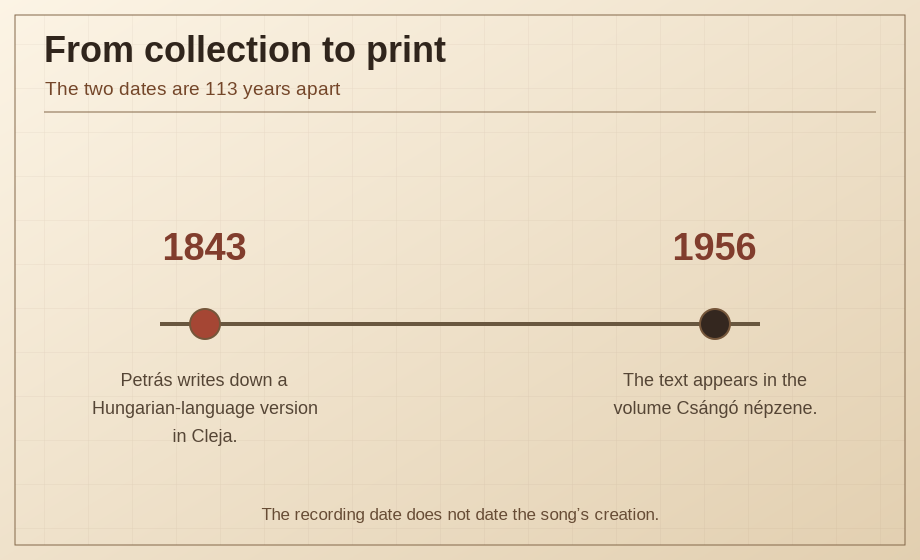
Timeline from 1843, when Petrás records the song in Cleja, to 1956, when it appears in Csángó népzene.
Dates documented by Jeney Éva; the image does not reproduce the song text. (Source)
Sepia map with hills, valleys and Cleja printed at left, Faraoani farther north.
Historical 1:20,000 crop; Cleja and Faraoani appear on the same map. The sheet date is not visible. (Source · Serviciul Geografic al Armatei · eHarta / geo-spatial.org · decupaj / crop · CC BY-SA 4.0)

The manuscript rediscovered

How did the text reach print?

In the summer of 1953, the researcher Pál Péter Domokos found Petrás’s collection in the manuscript department of the Hungarian Academy of Sciences. He and Benjámin Rajeczky published it in full in the first volume of Csángó népzene, in 1956. The Cleja text is on pages 63–65. [9] [6]

The volume made the words Petrás had written down available to readers. The other records in the story answer different questions. The 1696 list counts Catholics, and the registers of 1860 and 1870 follow households. The text from 1843 shows that a Hungarian-language version was in circulation in the village then. [9] [6]
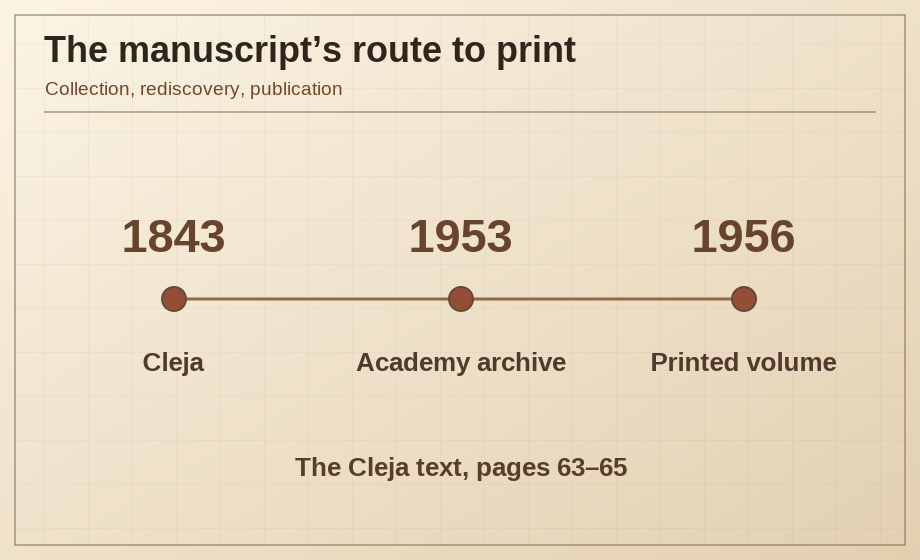
A timeline of the three events in the history of the text.
Petrás wrote the text down in 1843. Domokos found his collection in 1953 and published it with Rajeczky in 1956. (Source)

Sources

Cleja’s records tell us when the village, the parish, a household and a song were recorded. The year 1843 marks a moment in the life of the ballad, when somebody heard it in Hungarian and wrote it down.

  1. Anton Coșa, “Roman Catholic communities in Moldova: Cleja”, Carpica, XXIX, 2000, pp. 123–137The study draws on church records and publishes information on the place-name, the 1696 Catholic count, the 1781 Status animarum, parish records and successive churches. Some of the author’s conclusions about population origins are interpretations; this story uses only what the dated records establish and preserves their limits.
  2. V. A. Urechia, Codex Bandinus, digitised edition from “Mihai Eminescu” Central University Library Iași, 1895This is the 1895 published edition and transcription of Marco Bandini’s 1646–1648 visitation report, not the autograph manuscript inspected directly. Coșa notes that the work names Faraoani but not Cleja. An absence from this account does not prove the village did not exist.
  3. Roman Catholic Diocese of Iași, “Cleja Parish – St Francis of Assisi”, parish history, revised and updated in 2026The parish history says a 1696 document recorded 76 Catholics in Cleja; it dates the parish’s organisation to 1793, a first wooden church to 1811, another wooden church to 1839 and the current brick church to 1906. It separately says a Status animarum for Cleja’s believers was made in 1784; the page does not explain how this relates to the 1781 list compiled at Faraoani.
  4. Radu Cucuteanu and Valentin Piftor, “Demographic contributions on the Catholic population of Moldova: an analysis of the 1781 Status animarum in Faraoani parish”, Anuarul Institutului de Istorie “A. D. Xenopol”, LIV–LV, 2008–2009, pp. 83–95The study analyses the list made by priest Aloysius Maffei at Faraoani in 1781. It includes households in the settlement written as Clesia, but does not fully explain omissions in the register. The authors say a *status animarum* recorded parishioners and families; it is not a modern census of every resident.
  5. Vilmos Tánczos, “Pozsony Franciscus et Catharina ux…: János Petrás Ince’s registers from nineteenth-century Moldavian Csángó villages”, in Aranykapu, 2015, pp. 341–345The study identifies two volumes of Status animarum registers from 1860, 1870, 1873 and 1876, kept at the National Archives of Bacău County, and reproduces photographs and transcriptions of some pages. We use only data from one published example and do not reproduce the photographs. A family traced in 1860 and 1870 shows what a register can and cannot tell us.
  6. Jeney Éva, “The history of the Hungarian Miorița”, in A megosztó és a megosztható múlt: tanulmányok, Kriterion, Cluj-Napoca, 2023, pp. 85–94The author describes the text Petrás wrote down in Cleja in 1843 as a Hungarian-language version corresponding to the Miorița, while noting that the label is approximate for lack of a better one. According to the study, the text was not published until 1956 in Csángó népzene. We do not use the song to assign an ethnic origin to all Cleja residents.
  7. Army Geographic Service, Direct Firing Plans; eHarta / geo-spatial.org crop, scale 1:20,000The crop shows Cleja, Faraoani and the surrounding valley on a historical military map. The sheet date and marginalia are outside the crop; the image does not locate the 1811 church or the place where Petrás wrote down the song. geo-spatial.org releases these maps under CC BY-SA 4.0.
  8. Biserici.org, St Francis of Assisi church in Cleja; HARTA G coordinates, corroborated by OpenStreetMap way 1075846216The pin marks the current parish church at 46.412872, 26.910654. The parish history dates this building to 1906. It is not the location of the 1811 or 1839 wooden churches, or the place where the song was recorded in 1843.
  9. Mária Domokos on rediscovering the manuscriptsThe article records that Pál Péter Domokos found the collection at the Hungarian Academy in summer 1953 and published it with Benjámin Rajeczky in 1956.