COFFEEHOUSES · LONDON · 1652‑1860
Work the morning.
For two centuries the London coffeehouse was the trading floor, the newsroom, and the auction mart — until each trade took its price list and left. Work one merchant’s morning across three tapes, then judge what emptied the houses.
Twelve slips, three houses: stockjobbers’ talk at Jonathan’s, ship news at Lloyd’s, the hammer at Garraway’s. Every line dated, every line sourced — and a verdict on why the Alley fell silent.
Lloyd’s tape: ship news
Start where the news landed. A youth read the ships aloud to Edward Lloyd’s customers from a pulpit — arrivals, winds, and losses. Four slips, 1696 to 1753: place each on its house.
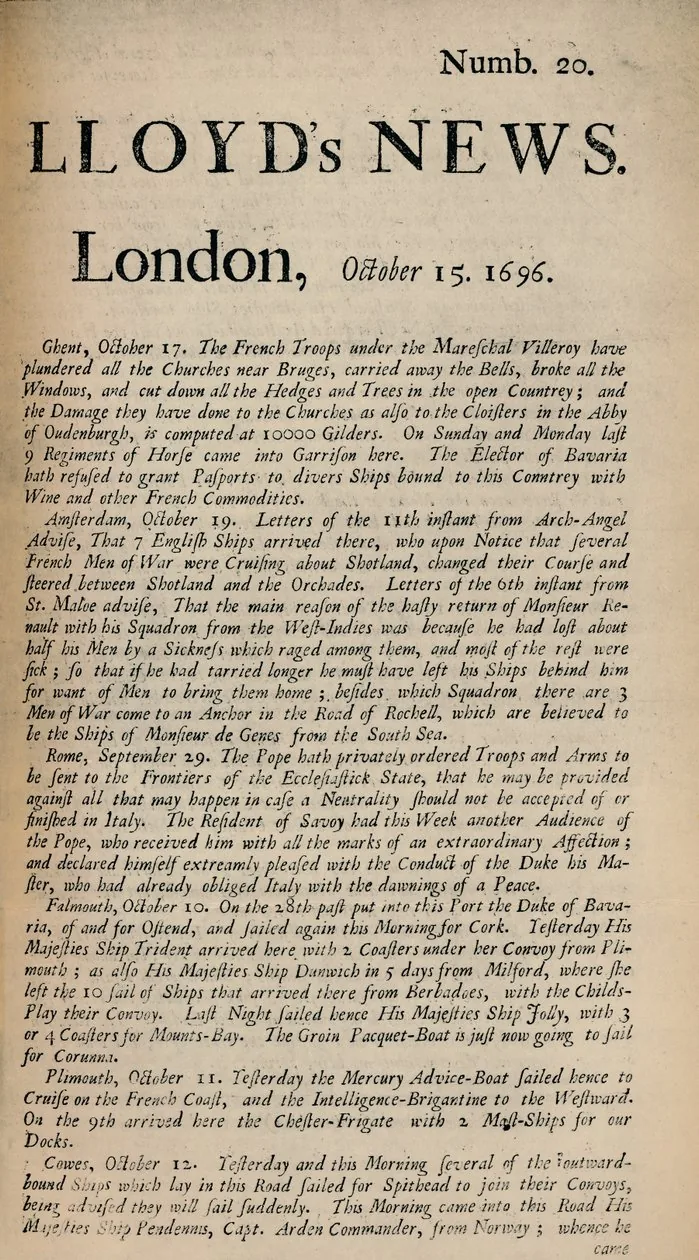
Figure receipt
1696 · Facsimile via Commons PD · Public domain
Tick Lloyd’s tape
Place each slip on its house — Jonathan’s, Lloyd’s, or Garraway’s — in order from the top. The lists judge every placement, and a wrong house sends the slip back with the list that placed it.
Prefer the plain list? All twelve slips, with answers, are below, in Three tapes, in brief.
Jonathan’s tape: stockjobbers
Cross to Change Alley, where the money-dealers went in 1698 and Castaing posted the prices. Four slips, 1694 to 1709: brokers’ talk, refuse, brokerage, and the general mart itself.
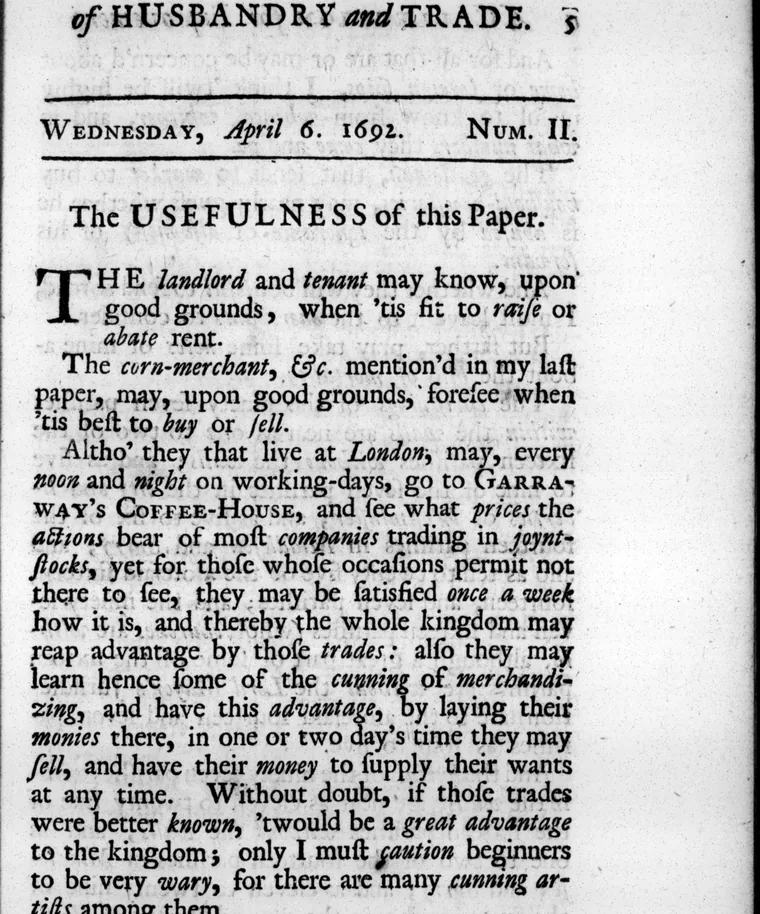
Figure receipt
1690s text · 1727 reprint via IA scan · Public domain
Tick Jonathan’s tape
Place each slip on its house — Jonathan’s, Lloyd’s, or Garraway’s — in order from the top. The lists judge every placement, and a wrong house sends the slip back with the list that placed it.
Prefer the plain list? All twelve slips, with answers, are below, in Three tapes, in brief.
Garraway’s tape: the hammer
End under the auctioneer’s inch of candle — and the Course of the Exchange, printed here in 1711. At first Houghton sent his readers here for prices (1692); two years on the brokers stood at Jonathan’s. Four slips, 1676 to 1771, from candle sales to catalogue lots.
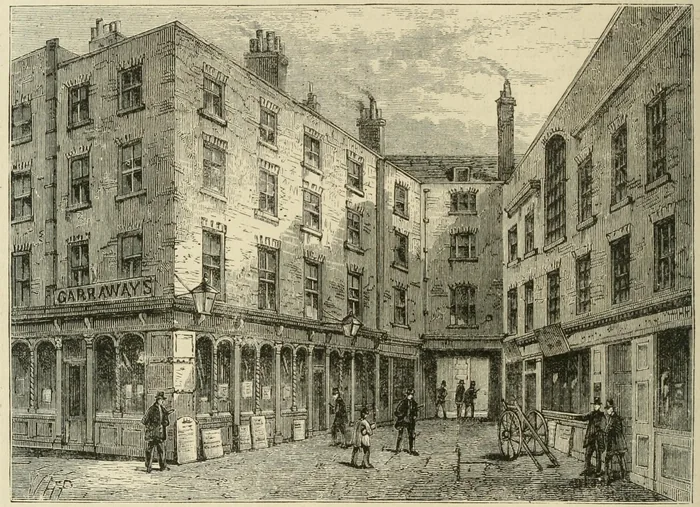
Figure receipt
Pre-1878 sketch · Old and New London via Commons PD · Public domain
Tick Garraway’s tape
Place each slip on its house — Jonathan’s, Lloyd’s, or Garraway’s — in order from the top. The lists judge every placement, and a wrong house sends the slip back with the list that placed it.
Prefer the plain list? All twelve slips, with answers, are below, in Three tapes, in brief.
Two rails, one Alley
The houses rail runs from Bowman’s shed to the 1774 successions; the lists rail from Houghton’s first number to the Course that shed its coffee-house. Every row dated, every row sourced.
The morning set
Every placed slip, in tape order.
L1 — Lloyd’s → Ship news from Archangel — Lloyd’s News, No. 20, 15 October 1696.
Lloyd’s · L1
L2 — Lloyd’s → A King’s ship in the roads — Lloyd’s News, No. 20, 15 October 1696.
Lloyd’s · L2
L3 — Lloyd’s → A loss at sea — Lloyd’s List, No. 1783, 2 January 1753.
Lloyd’s · L3
L4 — Lloyd’s → Subscriptions at the bar — Lloyd’s List, No. 1784, 5 January 1753.
Lloyd’s · L4
J1 — Jonathan’s → Brokers asking how stocks go — Houghton’s Collection, No. XCIX, 22 May 1694.
Jonathan’s · J1
J2 — Jonathan’s → Refuse on India shares — Houghton’s Collection, No. XCIX, 22 May 1694.
Jonathan’s · J2
J3 — Jonathan’s → Brokerage prices — Houghton’s Collection, No. CII, 13 July 1694.
Jonathan’s · J3
J4 — Jonathan’s → The general mart of stockjobbers — the Tatler, No. 38, July 1709.
Jonathan’s · J4
G1 — Garraway’s → Sold by inch of candle — City Mercury, No. 20, March 1676, via Martin 1876.
Garraway’s · G1
G2 — Garraway’s → Prices of actions — Houghton’s Collection, No. II, 6 April 1692.
Garraway’s · G2
G3 — Garraway’s → The Course, printed at Garraway’s — 31 December 1711.
Garraway’s · G3
G4 — Garraway’s → Three lots at noon — Ridgeway’s catalogue, 1 August 1771.
Garraway’s · G4
The houses rail
Eight dated rows carry the houses from shed to institution.
in or about the yeare 1652: Bowman sets up the first house in St Michael’s Alley
1652 · Aubrey MS, via Robinson (traditional, with reservations) source
the Rainbow at Fleet Street: Farr presented for the evil smells of coffee-making
21 December 1657 · Temple Bar presentment, via Robinson source
a standing lottery of books at Garway’s; wine by the candle
1673 · Timbs + Robinson source
Garraway’s and Jonathan’s near the Exchange, attested by 1680
c.1680 · Dangerfield’s narrative, via Robinson source
Lloyd’s Coffee House first referred to in the London Gazette
1688 · Gazette reference, via Lloyd’s/RMG source
the money-dealers betake themselves to Change Alley
1698 · Thornbury source
Garraway’s, Jonathan’s, Jerusalem and the Swan burn in the Alley fire
March 1748 · Timbs + Thornbury source
New Jonathan’s resolves to be the Stock Exchange; New Lloyd’s opens on the Exchange
1773–1774 · Thornbury + Martin source
The lists rail
Eight dated rows carry the lists from first number to last imprint.
Houghton’s Collection begins: prices for the provinces
30 March 1692 · Houghton No. 1 source
stock-market prices replace the Bills in Houghton’s paper
11 May 1694 · Barry on Houghton source
Lloyd’s News prints the ships, three times a week
15 October 1696 · Lloyd’s News No. 20 source
Castaing begins posting the Course of the Exchange
1697/98 · BoE Museum + Dale (contested year) source
the Course is printed at Garaway’s Coffee-House
31 December 1711 · Bonhams lot photos source
Lloyd’s List starts as a weekly journal of commercial news
1734 · RMG + Lloyd’s (no facsimile) source
the List absorbs the stocks and the Course of Exchange
5 January 1753 · Lloyd’s List No. 1784 source
the Course sheds its coffee-house: Shergold and Castaing’s sister
10 November 1758 · Yale photo source

Your morning, your verdict
One question, three answers: why did the houses empty? Pick the verdict the rails support — then ask what room your own trade meets in.
Give your verdict
Three answers. The rails support exactly one.
Correct. Jonathan’s became the Stock Exchange by resolution on 14 July 1773 and a subscription room in 1801; Lloyd’s subscribers moved over the Royal Exchange in March 1774; the Course of the Exchange stopped naming any coffee-house by 1758. Specialization emptied the houses.
Refused. The coffee duty dates to 1660 — fourpence a gallon — and the houses thrived for another century on top of it. The successions of 1773–74 answer to no duty change; the lists moved because the trades did.
Refused — as the general cause. Clubs took the wits’ houses: Button’s faded after Addison died in 1719. But the Alley market houses left no forwarding address to clubland; they left as institutions, with dated resolutions and new premises.
Three tapes, in brief
The same twelve slips, stated plainly. Ship news ticks to Lloyd’s, brokers’ talk to Jonathan’s, the hammer to Garraway’s — with the Course of the Exchange printed at Garraway’s in 1711 as the trap. The verdict the rails support: each trade took its price list and left.
| Slip | House | What the list says |
|---|---|---|
| L1 | Jonathan’s (had you picked this) | Jonathan’s refuses this slip — it is ship news, and ship news lived in Lloyd’s News (No. 20, 15 October 1696). Try Lombard Street. |
| L1 | Lloyd’s | Ship news from Archangel — Lloyd’s News, No. 20, 15 October 1696. |
| L1 | Garraway’s (had you picked this) | Garraway’s refuses this slip — no hammer falls here; it is ship news, and ship news lived in Lloyd’s News (No. 20, 15 October 1696). Try Lombard Street. |
| L2 | Jonathan’s (had you picked this) | Jonathan’s refuses this slip — it is ship news, and ship news lived in Lloyd’s News (No. 20, 15 October 1696). Try Lombard Street. |
| L2 | Lloyd’s | A King’s ship in the roads — Lloyd’s News, No. 20, 15 October 1696. |
| L2 | Garraway’s (had you picked this) | Garraway’s refuses this slip — no hammer falls here; it is ship news, and ship news lived in Lloyd’s News (No. 20, 15 October 1696). Try Lombard Street. |
| L3 | Jonathan’s (had you picked this) | Jonathan’s refuses this slip — it is ship news, and ship news lived in Lloyd’s List (No. 1783, 2 January 1753). Try Lombard Street. |
| L3 | Lloyd’s | A loss at sea — Lloyd’s List, No. 1783, 2 January 1753. |
| L3 | Garraway’s (had you picked this) | Garraway’s refuses this slip — no hammer falls here; it is ship news, and ship news lived in Lloyd’s List (No. 1783, 2 January 1753). Try Lombard Street. |
| L4 | Jonathan’s (had you picked this) | Jonathan’s refuses this slip — it is ship news sold at the bar, and the bar was Lloyd’s (Lloyd’s List, No. 1784, 5 January 1753). Try Lombard Street. |
| L4 | Lloyd’s | Subscriptions at the bar — Lloyd’s List, No. 1784, 5 January 1753. |
| L4 | Garraway’s (had you picked this) | Garraway’s refuses this slip — no hammer falls here; it is ship news sold at the bar, and the bar was Lloyd’s (Lloyd’s List, No. 1784, 5 January 1753). Try Lombard Street. |
| Slip | House | What the list says |
|---|---|---|
| J1 | Jonathan’s | Brokers asking how stocks go — Houghton’s Collection, No. XCIX, 22 May 1694. |
| J1 | Lloyd’s (had you picked this) | Lloyd’s refuses this slip — no ships here; it is brokers’ talk, and brokers asking how stocks go stood at Jonathan’s (Houghton’s Collection, No. XCIX, 22 May 1694). Try Change Alley. |
| J1 | Garraway’s (had you picked this) | Garraway’s refuses this slip — the hammer is idle; it is brokers’ talk, and brokers asking how stocks go stood at Jonathan’s (Houghton’s Collection, No. XCIX, 22 May 1694). Try Change Alley. |
| J2 | Jonathan’s | Refuse on India shares — Houghton’s Collection, No. XCIX, 22 May 1694. |
| J2 | Lloyd’s (had you picked this) | Lloyd’s refuses this slip — no ships here; it is brokers’ talk, and the brokers’ paper was Houghton’s (Collection, No. XCIX, 22 May 1694). Try Change Alley. |
| J2 | Garraway’s (had you picked this) | Garraway’s refuses this slip — the hammer is idle; it is brokers’ talk, and the brokers’ paper was Houghton’s (Collection, No. XCIX, 22 May 1694). Try Change Alley. |
| J3 | Jonathan’s | Brokerage prices — Houghton’s Collection, No. CII, 13 July 1694. |
| J3 | Lloyd’s (had you picked this) | Lloyd’s refuses this slip — no ships here; it is brokers’ talk, and brokerage prices were taken at Jonathan’s (Houghton’s Collection, No. CII, 13 July 1694). Try Change Alley. |
| J3 | Garraway’s (had you picked this) | Garraway’s refuses this slip — the hammer is idle; it is brokers’ talk, and brokerage prices were taken at Jonathan’s (Houghton’s Collection, No. CII, 13 July 1694). Try Change Alley. |
| J4 | Jonathan’s | The general mart of stockjobbers — the Tatler, No. 38, July 1709. |
| J4 | Lloyd’s (had you picked this) | Lloyd’s refuses this slip — no ships here; it is the general mart itself, and the general mart of stockjobbers was Jonathan’s (the Tatler, No. 38, July 1709). Try Change Alley. |
| J4 | Garraway’s (had you picked this) | Garraway’s refuses this slip — the hammer is idle; it is the general mart itself, and the general mart of stockjobbers was Jonathan’s (the Tatler, No. 38, July 1709). Try Change Alley. |
| Slip | House | What the list says |
|---|---|---|
| G1 | Jonathan’s (had you picked this) | Jonathan’s refuses this slip — no stocks here; it is the auction hammer, and the hammer fell at Garraway’s (City Mercury, No. 20, March 1676, via Martin 1876). Try Exchange Alley. |
| G1 | Lloyd’s (had you picked this) | Lloyd’s refuses this slip — no ships here; it is the auction hammer, and the hammer fell at Garraway’s (City Mercury, No. 20, March 1676, via Martin 1876). Try Exchange Alley. |
| G1 | Garraway’s | Sold by inch of candle — City Mercury, No. 20, March 1676, via Martin 1876. |
| G2 | Jonathan’s (had you picked this) | Jonathan’s refuses this slip — these prices were taken at Garraway’s (Houghton’s Collection, No. II, 6 April 1692). Try Exchange Alley. |
| G2 | Lloyd’s (had you picked this) | Lloyd’s refuses this slip — no ships here; these prices were taken at Garraway’s (Houghton’s Collection, No. II, 6 April 1692). Try Exchange Alley. |
| G2 | Garraway’s | Prices of actions — Houghton’s Collection, No. II, 6 April 1692. |
| G3 | Jonathan’s (had you picked this) | Jonathan’s refuses this slip — the Course moved; this Course was printed at Garraway’s (Course of the Exchange, 31 December 1711). Try Exchange Alley. |
| G3 | Lloyd’s (had you picked this) | Lloyd’s refuses this slip — no ships here; this Course was printed at Garraway’s (Course of the Exchange, 31 December 1711). Try Exchange Alley. |
| G3 | Garraway’s | The Course, printed at Garraway’s — 31 December 1711. |
| G4 | Jonathan’s (had you picked this) | Jonathan’s refuses this slip — no stocks here; it is the auction hammer, and the hammer fell at Garraway’s (Ridgeway’s catalogue, 1 August 1771). Try Exchange Alley. |
| G4 | Lloyd’s (had you picked this) | Lloyd’s refuses this slip — no ships here; it is the auction hammer, and the hammer fell at Garraway’s (Ridgeway’s catalogue, 1 August 1771). Try Exchange Alley. |
| G4 | Garraway’s | Three lots at noon — Ridgeway’s catalogue, 1 August 1771. |
The houses
Shed, ban, Alley, lists, silence
Five beats, two centuries. The shed first, then the ban that never was, then the Alley, then the lists leaving, then the silence.
The shed on a thousand sixpences
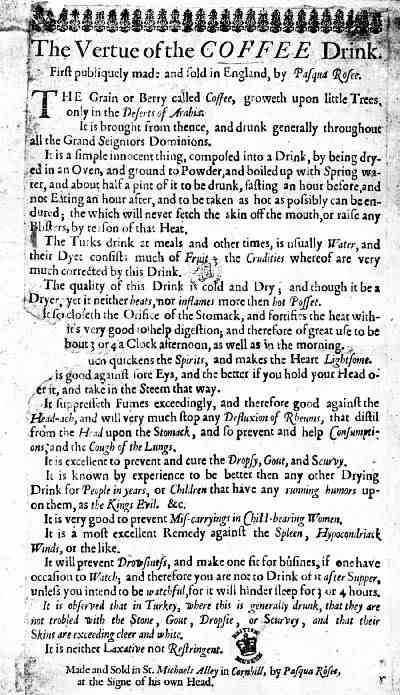
In or about 1652, Bowman’s shed in St Michael’s Alley becomes London’s first coffee-house — a coachman’s venture on a Turkey merchant’s backing, a thousand sixpences turning shed to house. Eight years on, the 1660 duty puts fourpence on every gallon of coffee — and the houses fill anyway. Pasqua Rosee’s handbill survives in a 1922 photo, captioned from the British Museum original: the first coffee publicly made and sold in England, at the sign of his own head. But the sheet bears no date — 1652 is tradition, carried as tradition.
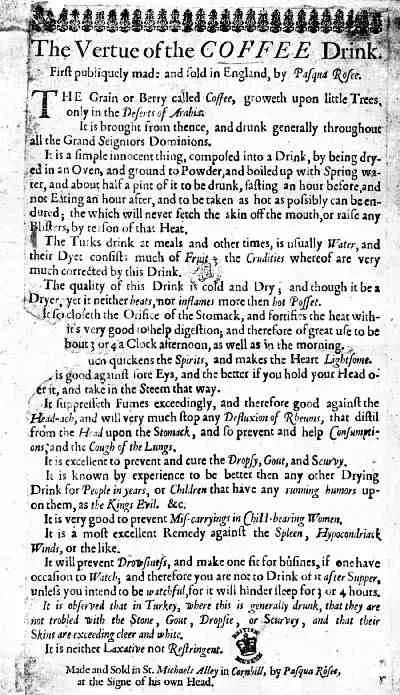
The bill without a date: Pasqua Rosee’s handbill — undated sheet, traditionally 1652 — in Ukers’ 1922 photo, captioned from the British Museum original. Figure receipt
Undated sheet · Ukers 1922 photo of BM original via Gutenberg · Public domain
Eleven days that shook the Alley
On 23 December 1675 the King makes a proclamation shutting every coffee-house after 10 January; it issues on the 29th — and on 8 January an additional proclamation withdraws the whole ban before it ever bites, in exchange for oaths and five-hundred-pound recognizances until 24 June. North’s verdict on the retreat: a convulsion and discontent would unavoidably follow. The houses never closed a single day.
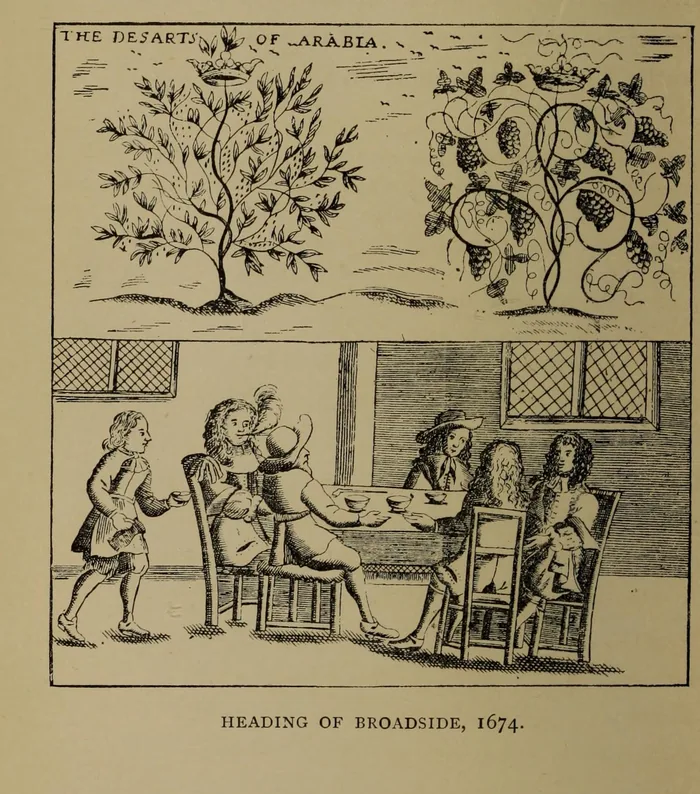
The paper war around the ban: a 1674 broadside heading, facsimile in Robinson’s 1893 history. Figure receipt
1674 facsimile · Robinson 1893 via IA scan · Public domain
Change Alley, 1698
The Royal Exchange grown vexatiously thronged, the money-dealers betake themselves to Change Alley — and John Castaing is posting the Course of the Exchange at Jonathan’s, twice a week, the first evidence of an organised exchange of its kind in London. The Tatler will call the house that general mart of stockjobbers; the Spectator will sit among its assembly. The jobbers have their room, and the room has its paper. The wits will drift west — Button’s fades after Addison dies in 1719 — but the market houses stay in the Alley.
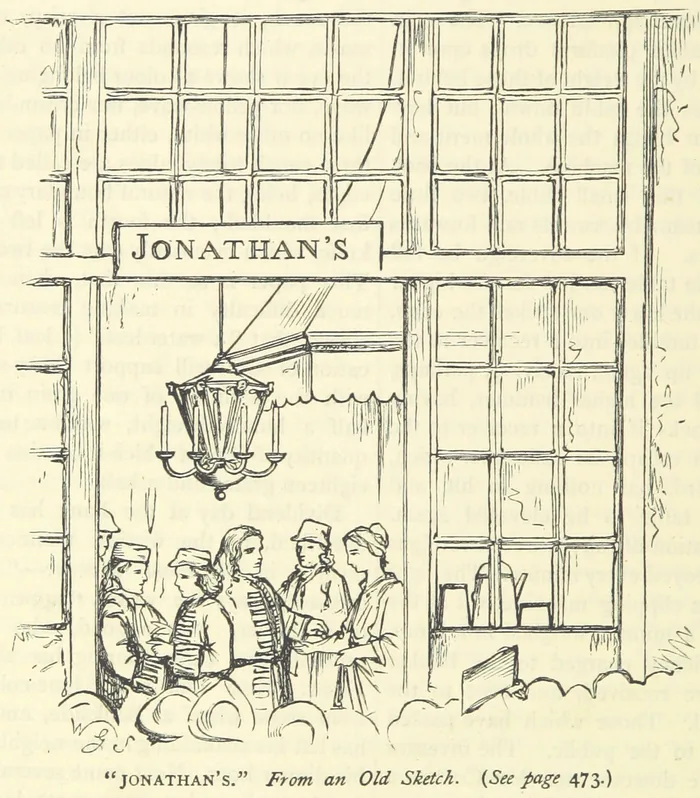
The jobbers’ door: Jonathan’s, from an old sketch — an 1887 copy of an older drawing of unknown date. Figure receipt
1887 copy of older sketch · Old and New London via Commons PD · Public domain
The lists leave
Watch the imprints walk out. In January 1753 Lloyd’s List absorbs the stocks and the Course of Exchange, sold at the bar of the house — and by 1758 Castaing’s Course names no coffee-house at all, only Shergold the broker and Castaing’s sister. In July 1773 New Jonathan’s resolves to be the Stock Exchange, christened with punch; in March 1774 New Lloyd’s opens over the Royal Exchange. Each trade took its price list and left.
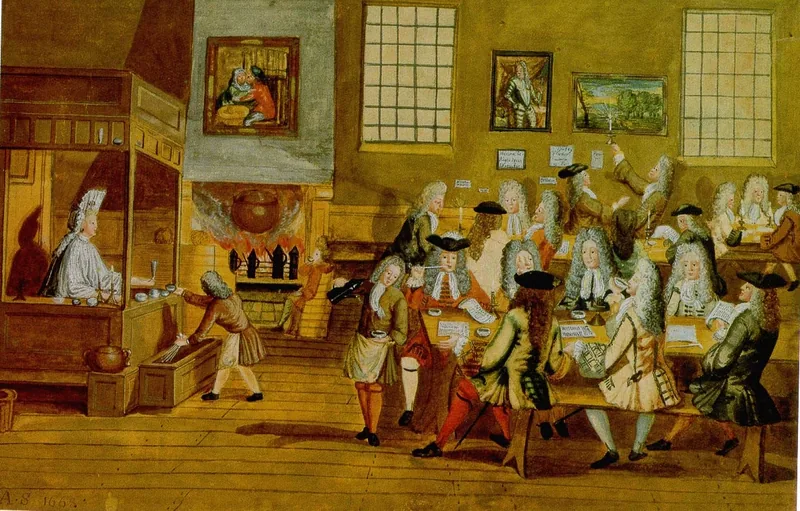
The room where it happened: a London coffee-house interior, inscribed 1668 — no single house, every house. Figure receipt
1668 · Anonymous watercolour via Commons PD · Public domain
The Alley, mapped
Read them against Rocque’s 1746 survey: Jonathan’s and Garraway’s stood in the alleys off Cornhill, Lloyd’s down on Lombard Street, the Baltic up in Threadneedle Street — tallow, oil, hemp, and seed men with their upstairs saleroom. Only Exchange Alley is engraved by name in this crop; the houses are placed from the texts. Garraway’s sells on into the railway age and is demolished by 1878; the Baltic becomes a limited company and builds on St Mary Axe. The morning is over; the institutions keep the hours.
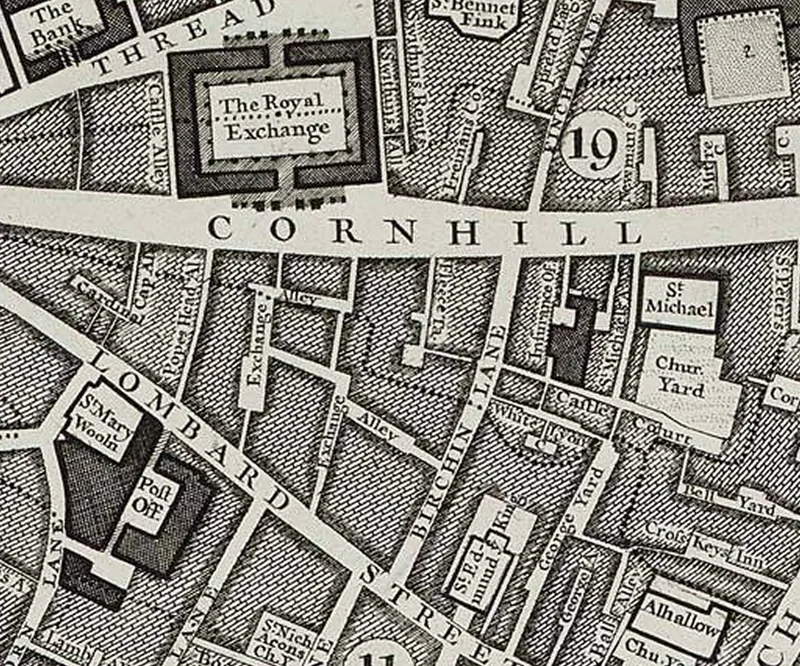
Work the morning on the map: Cornhill and its alleys on Rocque’s 1746 survey — Exchange Alley engraved, the houses placed from the texts. Figure receipt
1746 · Rocque survey via Commons PD · Public domain
The papers
News by house
Two passages carry the whole Alley: the scheme that assigned every subject its house, and the youth who read the news aloud to the customers.
Steele’s scheme first, in April 1709 — then the customers’ petition, in December 1710.
- “All accounts of gallantry, pleasure, and entertainment, shall be under the article of White’s Chocolate-house; poetry, under that of Will’s Coffee-house; learning, under the title of Grecian; foreign and domestic news, you will have from St. James’s Coffee-house; and what else I shall on any other subject offer, shall be dated from my own apartment.”
- “this coffee-house being provided with a pulpit for the benefit of such auctions that are frequently made in this place, it is our custom, upon the first coming in of the news, to order a youth, who officiates as the Kidney of the coffee-house, to get into the pulpit, and read every paper with a loud and distinct voice, while the whole audience are sipping their respective liquors.”
12 April 1709: the Tatler, No. 1. 23–26 December 1710: the Tatler, No. 268 — the customers of Lloyd’s, Lombard Street.
Three papers, three houses — and the lists that outlived them all are linked below.
Sources
Sources and receipts
Every claim here traces to a free text below. Diaries, periodicals, proclamations, catalogues, and the histories that name their primaries — read them yourself.
Diaries and periodicals
The lists
Proclamations and broadsides
Histories and lists
Images
- Interior of a London coffee-house, 1668 (Commons PD)
- Lloyd’s News No. 20, 15 October 1696 (Commons PD)
- Garraway’s Coffee House, pre-demolition sketch (Commons PD)
- Jonathan’s, from an old sketch (Commons PD)
- Rocque 1746, Cornhill and Exchange Alley crop (Commons PD)
- Pasqua handbill, Ukers photo of BM original (Gutenberg PD)


Set in open-licensed fonts, served locally.
Go further
One lane only touched here:
Three centuries later the coffee is specialty and the map is Bucharest’s: 193 cafés and 19 roasteries, verified door by door.
Answers, dated
Why tick the slips before judging?
Because the lists are the evidence and the houses are the question — a verdict without the tapes is a guess. Place twelve slips from their own lists, and the verdict means something.
Was the penny university real?
The verse is real; the 1672 label is not. The phrase comes from anonymous verse, first cited without source by D’Israeli — the complete 1672 broadside against coffee never says it. So the label never appears below.
What about Lloyd’s List 1734?
It started then — weekly, as a journal of commercial news — but nothing survives before 1741 and no early issue is free-readable. Our Lloyd’s slips are 1696 ship news and 1753 List leaves, both read directly.
Where did Jonathan’s go?
Nowhere: it renamed itself. On 14 July 1773 the brokers at New Jonathan’s resolved it should be called the Stock Exchange, wrote it over the door, and christened the house with punch.