Poiana Coțofenești — Assen — Bucharest
The golden helmet that went missing for 14 months
On the night of 25 January 2025, thieves with explosives broke into the Drents Museum in Assen and stole the Getic helmet of Coțofenești, some 2,400 years old. It stayed missing for 14 months, and experts feared it would be melted down. In April 2026 the helmet came home to Bucharest with a dent — and its eyes open.
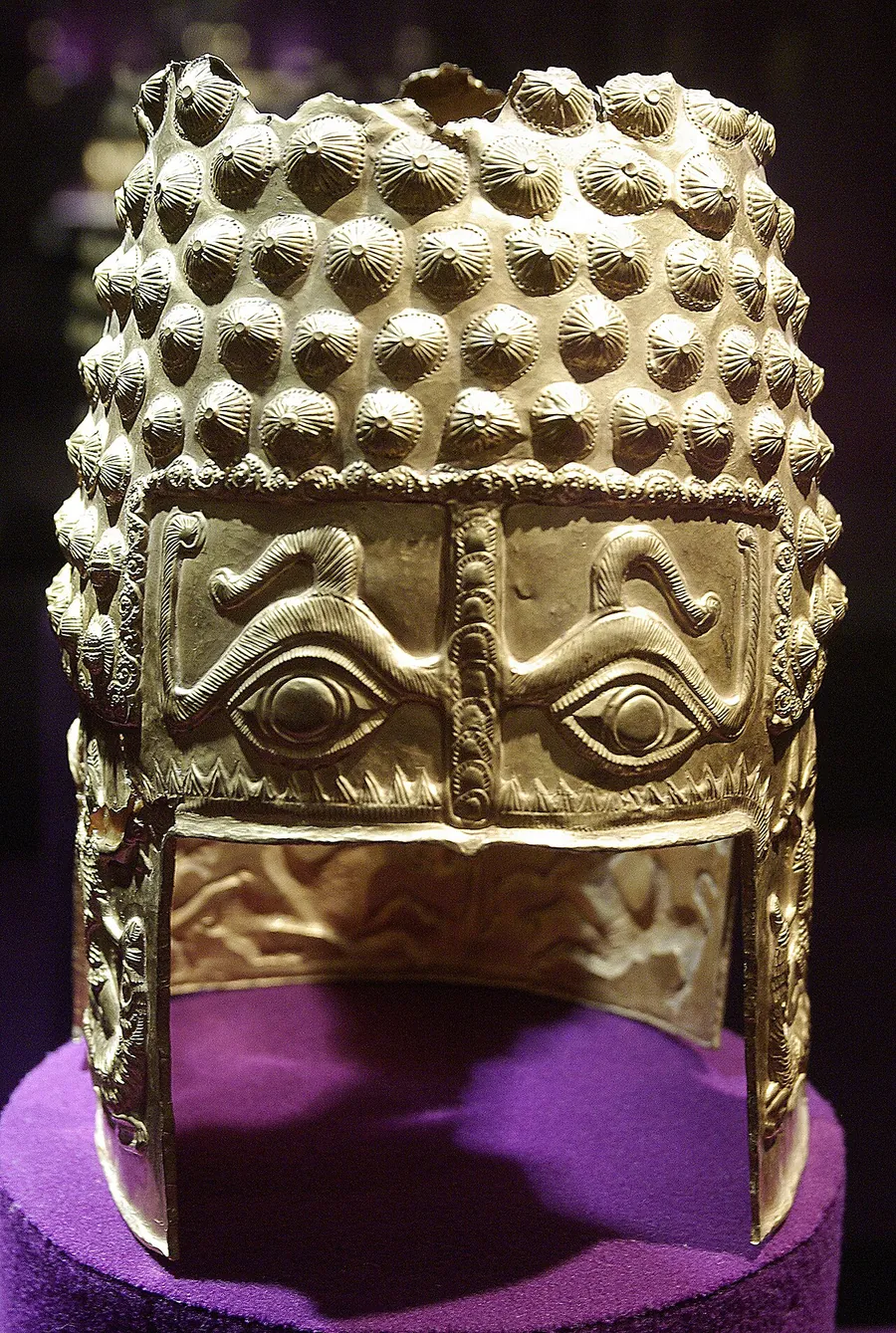

Two eyes that have not blinked for 2,400 years
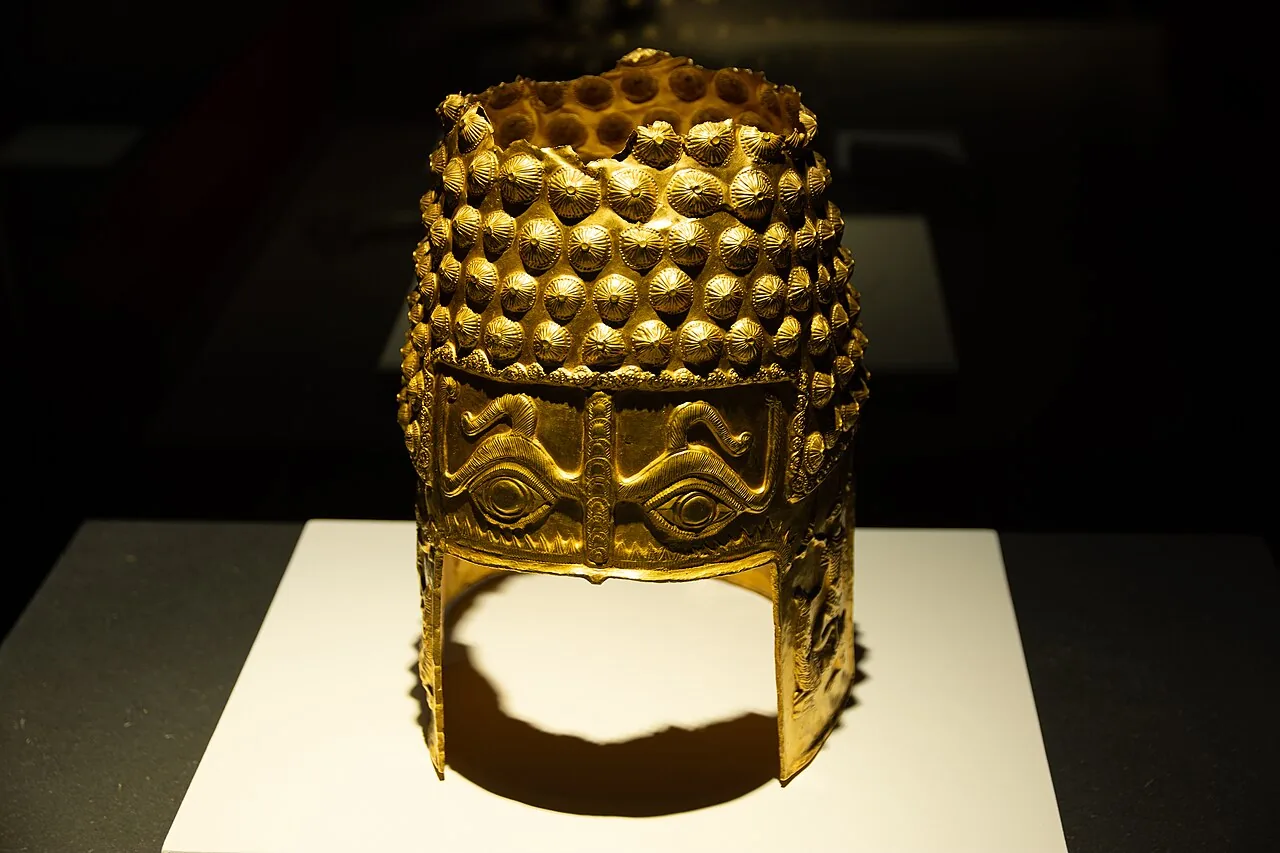
The helmet is a parade piece in electrum, a natural alloy of gold, silver and copper, made around 400 BC for a Getic king or aristocrat. Four zones tell its story; pick one.
-
The eyes
Two huge eyes stare from the pseudo-visor on the helmet's brow, above the face opening. Their purpose was apotropaic: to ward off the evil eye and the spells of whoever was beheld. Above the eyes curve doubled eyebrows, elongated, ending in volutes — a strange manner, without parallel in Getic art.
Eyes set above the wearer's eyes have also been read as a promise: I see twice as well, I have eyes like my hawk.
-
The sacrifice
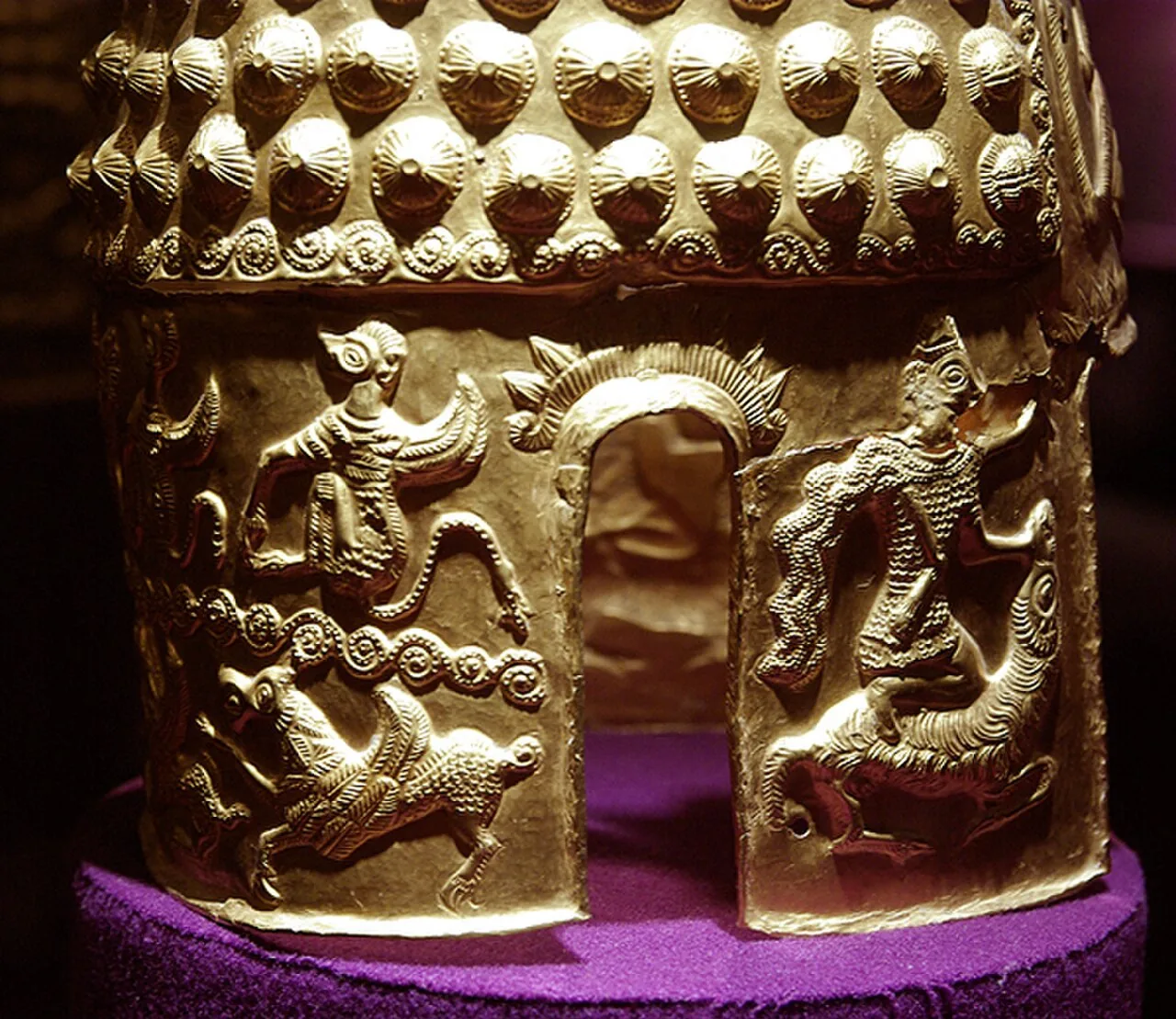
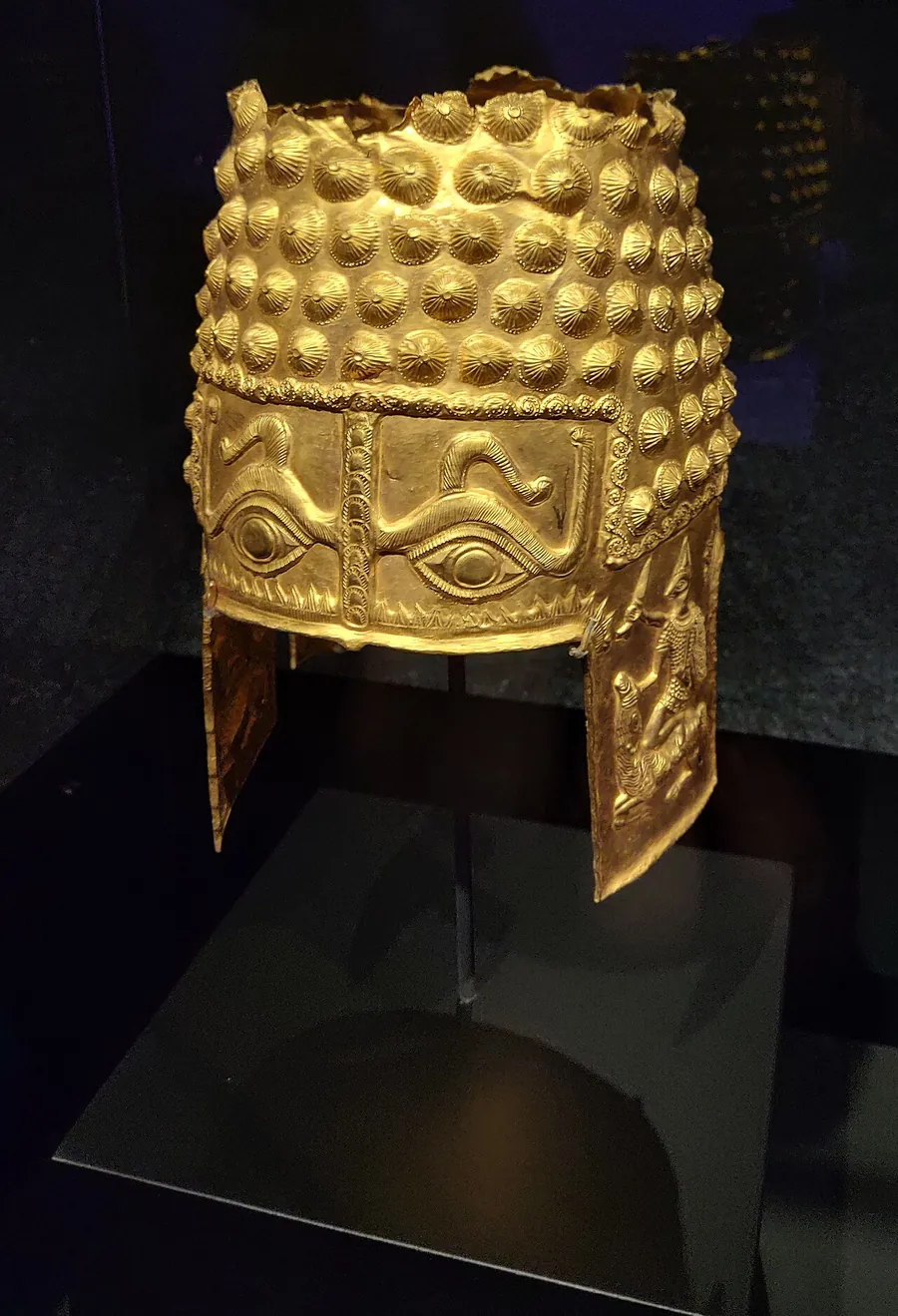
The cheek pieces show a hero clad in mail, helmeted, his cloak streaming, kneeling on the body of a ram and about to cut its throat with a short dagger. The antenna-hilted dagger in his hand betrays influences from western or central Europe.
The scene has been compared to the tauroctony of the Mithraic mysteries, and the hero has been called, by some, a king-priest-god. The readings remain hypotheses; the scene is certain.
-
The winged beasts
The neck guard carries fantastical animals: griffins with beaked herbivore snouts and winged beings read as harpies or chimeras. The sacrifice motif comes from Iranian art, through a Greek channel. The skull cap is studded with large bosses, and the top of the cap has been missing since discovery.
The mixture has divided specialists: Dumitru Berciu saw a Greek workshop catering to local taste, but the type of the helmet, he said, belongs to the locals — it is Getic.
-
The marks that are not writing
The helmet bears no inscription. No scholarly description records letters or a text to decipher. The rosettes, bands, triangles and spirals filling the fields are ornament. Everything that looks like a mark is decoration.

- Material
- Electrum, a natural alloy of gold, silver and copper: gold 760‰, silver 225‰, copper 10‰, per IFIN-HH analyses
- Weight
- 770 grams
- Height
- 24.3 cm
- Date
- Late 5th–early 4th century BC, around 400 BC
- Owner
- An unidentified Getic king or aristocrat
- Today
- Historical Treasury Hall, National History Museum of Romania, Bucharest
How a golden helmet ends up on a chicken coop
In the late 1920s, a child herding sheep on the pasture at Vârful Fundăturii, near Poiana Coțofenești, found the helmet in the grass. Surviving accounts say the child wore it as a toy for two weeks; the knocks chipped it, and the top of the skull cap came off. Then the helmet watered the chickens and ended up on top of the coop.
A merchant from Ploiești, Ion Marinescu-Moreanu, bought the helmet together with the detached piece — reportedly for 30,000 lei. He offered it to the Ministry of Arts through Ion Marin Sadoveanu, and in April 1929 the Ministry of Public Instruction and Cults bought it for the National Museum of Antiquities. Marinescu was celebrated as the saviour of a national treasure, then, after the 1928 elections, vilified for enriching himself.
The archaeologist Ioan Andrieșescu, professor of prehistory at the University of Bucharest, surveyed the site and drew a different conclusion: the piece belonged to a Geto-Dacian La Tène settlement, not to a grave or a hoard. The helmet was a stray find; only a few late Hallstatt sherds lay around it.
Until 1970 the helmet stayed at the National Museum of Antiquities; since then it has stood in the Historical Treasury Hall of the National History Museum of Romania. In 2021 it headlined in Madrid at “Tezaure arheologice din România. Rădăcini dacice și romane” (Romanian Archaeological Treasures: Dacian and Roman Roots), with 835 pieces from 39 museums.

The night at Assen
On the night of 25 January 2025, three hooded individuals smashed the door of the Drents Museum in Assen with a sledgehammer and a homemade bomb. The museum was hosting “Dacia: Empire of Gold and Silver” in the last weekend of its run, with more than 500 objects on loan from Romania. They took the helmet and three Dacian gold bracelets, some two millennia old, and vanished.
Dutch police arrested three suspects within days, but found no trace of the pieces. Experts feared the thieves would melt the gold: the helmet was too famous for anyone to sell. The museum's director, Harry Tupan, called 25 January “a dark day”.
In Bucharest the loan drew criticism, and on 28 January the culture minister, Natalia-Elena Intotero, dismissed the director of the National History Museum, Ernest Oberländer, for failing to protect the national heritage. The Dutch state reportedly paid €5.7 million in insurance compensation; Romanian officials refused to say what would become of the money.

The return
On 1 April 2026 the helmet and two of the bracelets were handed to the Dutch authorities after negotiations with the lawyers of the three suspects, as part of a pre-trial agreement. “It has been a roller coaster,” said prosecutor Corien Fahner. “Especially for Romania, but also for employees of the Drents Museum.”
On 2 April the pieces were shown to the press in Assen, in a case guarded by two armed police officers. Director Robert van Langh said the bracelets were intact and the helmet had a small dent, fully restorable. The third bracelet is still missing.
On 21 April the pieces landed at Henri Coandă Airport and were taken under escort to the National History Museum, where they were shown in a case flanked by masked, armed guards. “For us, this is a moment of joy, but also of contemplation,” said interim director Cornel Constantin Ilie. “For months, we have lived with the fear that part of our past could be lost forever. Today we can say that an essential part of this treasure has returned.”
The museum will show them to the public before restoration; restorers will also reglue an older repair. On 5 June 2026 a Dutch court (Northern Netherlands District Court) sentenced the three to 47 months in prison each; their identities were not released.
The return even made it onto postage stamps: the National History Museum launched “Aurul dacilor” (Gold of the Dacians), designed by Mircea Cantor, dedicated to the recovery of the treasure. The helmet had appeared on a 5-lei stamp in 1988 and on a 100-lei gold coin in 1999.
- Around 400 BCA workshop, probably Greek, makes the parade helmet for a Getic owner.
- Late 1920sA child finds the helmet on the pasture at Poiana Coțofenești.
- April 1929The Romanian state buys the helmet for the National Museum of Antiquities.
- 1970The helmet enters the Historical Treasury Hall of the National History Museum.
- 2021Headlining in Madrid: 835 pieces from 39 Romanian museums.
- 25 January 2025The Assen raid: the helmet and three bracelets vanish in the night.
- 28 January 2025The culture minister dismisses the director of the Bucharest museum.
- 2 April 2026The helmet and two bracelets, shown to the press in Assen. The third bracelet is missing.
- 21 April 2026The pieces land in Bucharest; the press sees them under armed guard.
- 5 June 2026The three thieves, sentenced to 47 months in prison each.
Sources
The description of the helmet follows the specialist literature; the raid and the return follow the press of the time. Renderings of Romanian titles into English are by Marius Comper.
- Wikipedia: “Helmet of Coțofenești” and “2025 Drents Museum heist” (en), “Coiful dacic de la Coțofenești” (ro). en.wikipedia.org/wiki/Helmet_of_Coțofenești
- Dumitru Berciu, Arta traco-getică (1969), pages 77–88. biblioteca-digitala.ro
- IFIN-HH: Analysis of Geto-Dacian gold artefacts from Poiana-Coțofenești and other sites (PDF, Romanian). proiecte.nipne.ro (PDF)
- BBC: Paul Kirby, “Ancient golden helmet recovered more than a year after Dutch heist” (2 April 2026). bbc.com
- Associated Press: “Priceless 2,500-year-old golden helmet returned to Romania after Dutch museum raid” (21 April 2026). nprillinois.org
- Smithsonian Magazine: Sonja Anderson on the recovery and the raid (7 April 2026). smithsonianmag.com
- Artnet News: the June 2026 sentences. news.artnet.com
- Europa Liberă România: first reactions after the theft (25 January 2025, Romanian). romania.europalibera.org
- HotNews: the recovery, 14 months after the raid (2 April 2026, Romanian). hotnews.ro
- Informat.ro: the “Aurul dacilor” issue, dedicated to the recovery. informat.ro
- UNESCO: the helmet's entry in the Virtual Museum of Stolen Cultural Objects. museum.unesco.org