Halley’s Comet: where it is now, and its whole 75-year orbit from 1986 to 2061
Halley’s Comet rounded the Sun in February 1986. In December 2023, farther out than Neptune, it reached the far end of its orbit and turned back. It returns in July 2061. Scroll to follow the whole orbit on positions computed by NASA’s Jet Propulsion Laboratory. Each screen you scroll is about two and a half months near the Sun and five years far from it.
On 9 October 2026 the comet was 35.02 AU from the Sun: 35 times Earth’s distance, or 5.24 billion km. It was moving at 1.00 km/s, about 3,600 km/h, and had 12,712 days to go until it rounds the Sun again.
The drawing shows the Sun, the planets on their orbits and Halley’s Comet on the path computed by NASA’s Jet Propulsion Laboratory. The clock at the top follows the scroll. For now, one screen is 75 days.
Distances are in astronomical units: 1 AU is the average distance from Earth to the Sun, about 150 million km. On 27 November 1985 the comet passes 92.6 million km from Earth, still falling towards the Sun.
9 February 1986
Closest to the Sun
Halley rounds the Sun at 0.59 AU, 87.8 million km: closer than Venus ever comes. It is moving at 54.5 km/s.
Earth is on the far side of the Sun, 1.55 AU from the comet.
14 March 1986
A spacecraft flies past
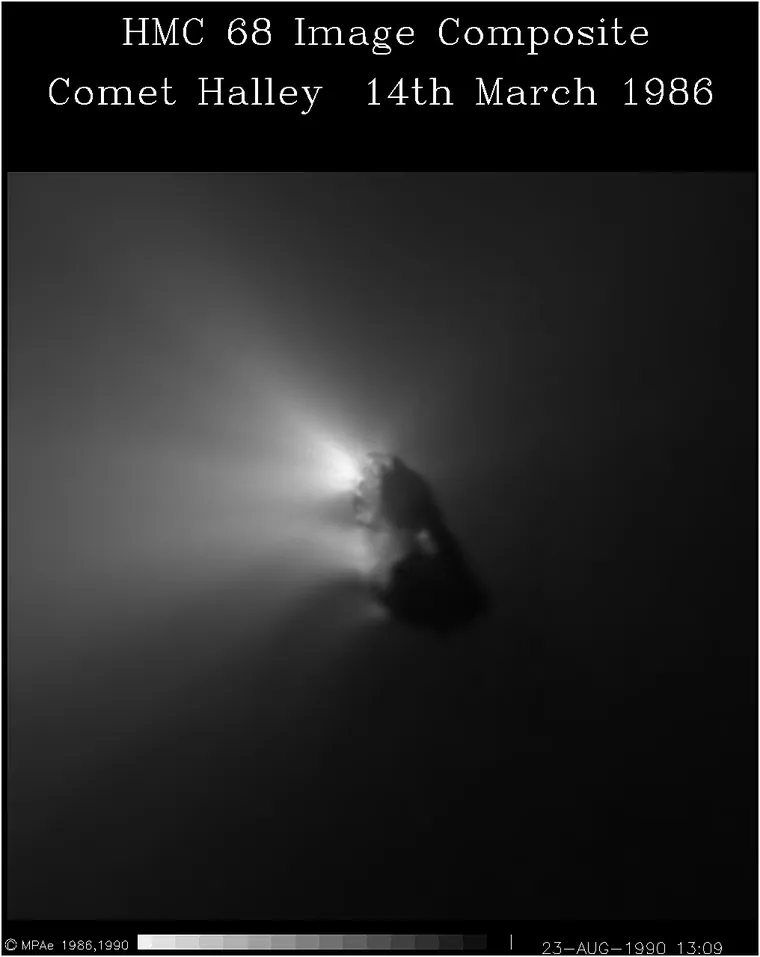
The European probe Giotto passes 596 km from the comet’s nucleus and photographs it: a very dark body about 15 km long.
The nucleus of Halley’s Comet, photographed by Giotto on 14 March 1986. ESA/MPS, CC BY-SA 3.0 IGO, via Wikimedia Commons
10 April 1986
As near to Earth as it came
On its way out the comet passes 62.4 million km from Earth. In May 1910 it had come within 22.6 million km.
9 July 1986
The clock speeds up
Five months after rounding the Sun, the comet is 2.6 AU out, past the orbit of Mars.
At 75 days a screen, the rest of the orbit would fill another 364 screens. From here, one screen is five years.
1987–1988
Past Jupiter’s distance, then Saturn’s
On 12 March 1987 the comet is as far from the Sun as Jupiter; on 3 October 1988, as far as Saturn. It has slowed to 11.7 km/s.
Of the 27,563 days of this orbit, it spends 793 inside Jupiter’s distance, counting the way in and the way out.
12 February 1991
An outburst nobody predicted
At the European Southern Observatory (ESO) in Chile, Olivier Hainaut and Alain Smette find the comet wrapped in a bright cloud, almost 300 times brighter than its bare nucleus should be. It is 2,141 million km from the Sun.
No comet had been seen to erupt that far out. ESO listed three possible causes and settled on none.
1994
As far as Uranus
On 25 April 1994 the comet is 19.2 AU from the Sun, the distance of Uranus. That year ESO’s New Technology Telescope still picks it up, at 18.8 AU and magnitude 26.5; the larger that number, the fainter the object.
2003
A point of light at 28 AU
Three 8.2-metre telescopes of ESO’s Very Large Telescope, observing together for three nights, record a point of light at 28.06 AU: the comet, with no sign of activity. ESO puts it at nearly 1,000 million times fainter than the faintest star the eye can see, and calls it the most distant observation ever made of a comet.
No later image of the comet turned up in the research for this page.
2 March 2006
Beyond Neptune’s distance
The comet is now farther from the Sun than Neptune, and stays there until 5 July 2041: 35.3 years, 47% of the whole orbit.
It is nowhere near Neptune itself. Its path is tilted about 18° to the plane of the planets’ orbits and runs well below it.
2014
On average, a sixth of Earth’s speed
Out here the comet moves at about 1.7 km/s. Over the whole orbit it averages 4.8 km/s and covers 11.5 billion km.
In the same 75.5 years Earth goes round the Sun 75 times and travels 70.9 billion km.
18 June 2021
Ten AU below the plane of the planets
The comet is 10.0 AU south of the plane in which the planets move, the lowest point of its path. Sunlight here is about 1,200 times weaker than on Earth.
The nucleus, ESO wrote in 2003, is “an inert ball of ice and dust”.
8 December 2023
The turn
35.14 AU from the Sun, 5.26 billion km. The comet is at its farthest and its slowest: 0.91 km/s, about 3,280 km/h, a 60th of its speed at the Sun.
From this day on, every day brings it closer to the Sun.
9 October 2026
Where it is now
35.02 AU from the Sun, and closing at 0.43 km/s. Sunlight takes 4 hours 51 minutes to reach it.
In the 1,035 days since the turn, 7.5% of the time between the turn and the return has passed. In that time the comet has come 0.4% of the way in towards the Sun.
5 July 2041
Inside Neptune’s distance again
17.6 years after the turn, the comet is closer to the Sun than Neptune. It is moving at 3.1 km/s, with 20 years to go.
12 May 2053
Uranus’s distance
Now eight years remain. The curve at the foot of the drawing shows what is coming: most of the fall happens at the very end.
2058–2060
Saturn’s distance, then Jupiter’s
The comet crosses the distance of Saturn on 3 December 2058 and of Jupiter on 27 June 2060, 13 months before it reaches the Sun.
As it nears the Sun its ices begin to turn to gas, and a cloud forms around the nucleus again.
28 February 2061
The clock slows down
One screen is 75 days again. The comet crosses the distance of Mars on 16 May 2061 and of Earth on 19 June 2061.
28 July 2061
Back at the Sun
0.59 AU from the Sun, at 54.3 km/s, 75.5 years after the last pass.
This time Earth is on the same side of the Sun. As it rounds the Sun the comet is 0.48 AU from Earth, against 1.55 AU in 1986, and the next day, 29 July 2061, it passes closest: 71.4 million km.
September 2061
And out again
By 5 September 2061 the comet is farther from the Sun than Earth, and the long half of the orbit begins again.
JPL’s orbit brings it back in 2134. On 7 May of that year it is due to pass 0.09 AU from Earth, nearer than in 1910.
Where was Halley’s Comet when you were born?
Choose your year of birth, and the day if you like. The date stays on your device; a link you share carries only the year.
Share this page
The whole orbit in one minute
The same drawing without the text. Press play, or move to any year between the two passes.
How long does Halley’s Comet spend near the Sun?
Of the 27,563 days between the two passes, the comet spends 78 days closer to the Sun than Earth is, and 35.3 years farther out than Neptune. The bar shows the whole orbit by time; the near-Sun part is the sliver at the left edge.
Distance from the Sun
Time spent there
Share of the orbit
Closer to the Sun than Earth
78 days
0.28%
Between the distances of Earth and Mars
69 days
0.25%
Mars to Jupiter
646 days
2.3%
Jupiter to Saturn
3.1 years
4.1%
Saturn to Uranus
11.1 years
14.7%
Uranus to Neptune
23.7 years
31.4%
Farther out than Neptune
35.3 years
46.8%
A planet on a near-circular orbit keeps an almost constant speed. A body on a long ellipse does not: Halley moves 60 times faster at the Sun than at its far point. Kepler stated the rule in 1609: the line from the Sun to the body sweeps equal areas in equal times.
This is why a comet seems to arrive suddenly. Halley takes 17.6 years to fall from its far point to the distance of Neptune, and 13 months to cover the last stretch from the distance of Jupiter to the Sun.
How many times has Halley’s Comet been seen?
Records identified with it go back to 240 BC. Counting 1986, the comet has rounded the Sun 30 times since then. Yeomans and Kiang, in 1981, had no observation for the pass of 164 BC; a later Durham thesis by Kevin Yau concludes that every return from 240 BC on was recorded. The chart shows the time between one pass of the Sun and the next, from the orbit Donald Yeomans and Tao Kiang computed in 1981 from Chinese and European observations; they call the 240 BC identification “probable”.
“Every 76 years” is an average. The pull of the planets has stretched the interval to 79.25 years and cut it to 74.42; the mean of the 30 intervals to 2061 is 76.7.
Years between one perihelion and the next. Each dot is a return, placed at its year. Computed dates: Yeomans & Kiang 1981 to 1910; JPL Horizons for 1986 and 2061. The open circle is the return of 2061.
837: six million km from Earth
By Yeomans and Kiang’s orbit the comet passed 0.04 AU from Earth on 11 April 837, about 6 million km. None of the recorded returns in their paper comes closer. In 1910 the distance was 22.6 million km; in 2061 it will be 71.4 million.
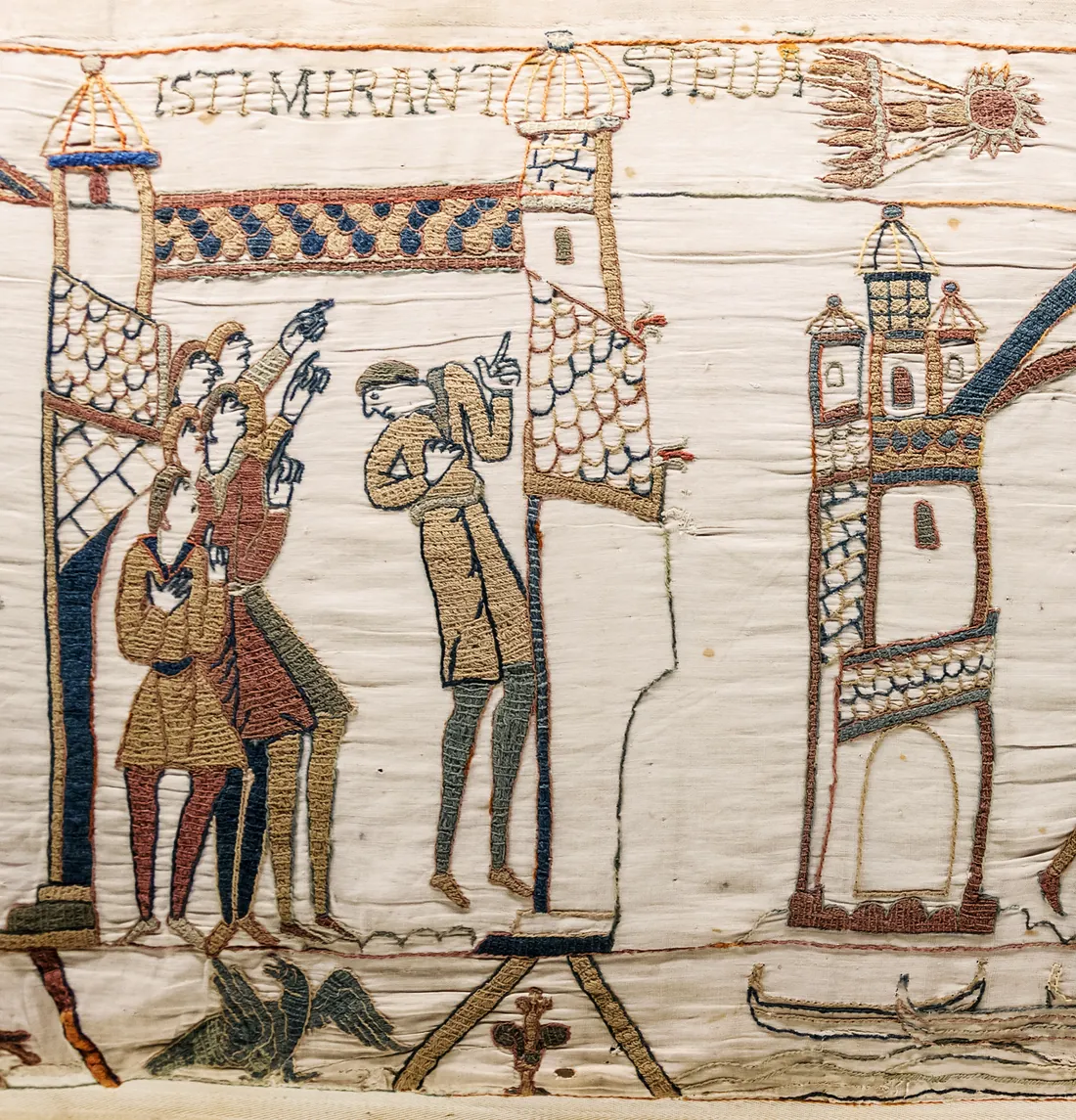
The Bayeux Tapestry, scene 32, about 1070s: “Isti mirant stella”, these men wonder at the star. Photo: Myrabella, Wikimedia Commons, public domain
1066: stitched into the Bayeux Tapestry
The comet rounded the Sun in March 1066. The embroidery, probably made in the 1070s, shows it above a group of men pointing: Isti mirant stella. The next scene shows the newly crowned King Harold. He died at Hastings that October.
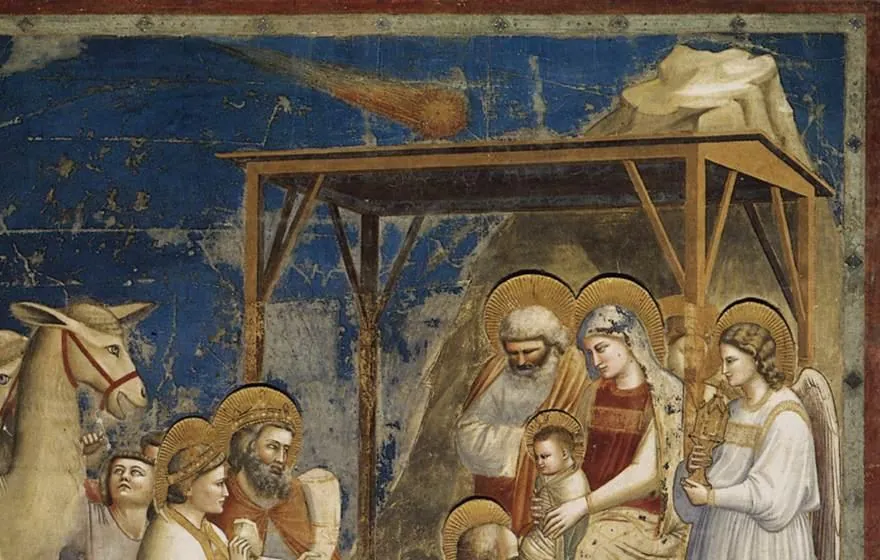
Giotto, Adoration of the Magi (detail), Scrovegni Chapel, Padua, about 1304–06. Web Gallery of Art, via Wikimedia Commons, public domain
1301: perhaps Giotto’s star
The star over the stable in Giotto’s Adoration of the Magi, in the Scrovegni Chapel in Padua, has a tail. In 1979 the art historian Roberta Olson argued that he painted it from the comet he had seen in 1301, a few years before he began the chapel. The fresco carries no date or label that would settle it.
1456: the comet and the siege of Belgrade
The comet rounded the Sun on 9 June 1456 and was seen in Europe that month. On 4 July the Ottoman siege of Belgrade began; the defenders under John Hunyadi broke it on 22 July.
A later story says Pope Callixtus III excommunicated the comet. His bull of 29 June 1456, which ordered prayers and the ringing of bells at noon, does not mention it.
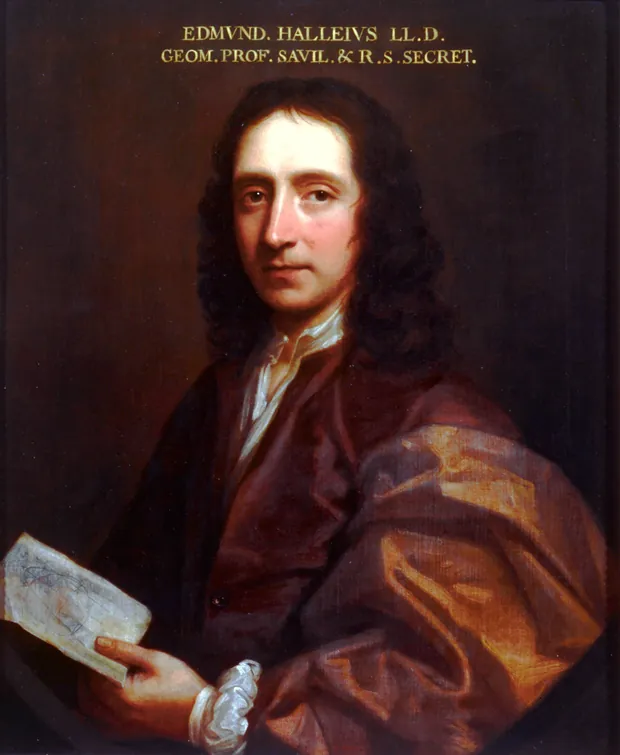
Edmond Halley, by Thomas Murray, about 1690. Royal Society, via Wikimedia Commons, public domain
1705: “I dare venture to foretell”
Edmond Halley computed the orbits of the comets of 1531, 1607 and 1682, found them almost the same, and concluded that they were probably one body. “Hence I dare venture to foretell, That it will return again in the Year 1758.”
He died in 1742. On 25 December 1758 Johann Georg Palitzsch, a Saxon farmer and amateur astronomer, found it. It rounded the Sun on 13 March 1759.
1835 and 1910: Mark Twain
“I came in with Halley’s comet in 1835. It is coming again next year, and I expect to go out with it.” Mark Twain said this to his biographer in 1909. He was born on 30 November 1835, 14 days after the comet rounded the Sun. He died on 21 April 1910, the day after it did so again.
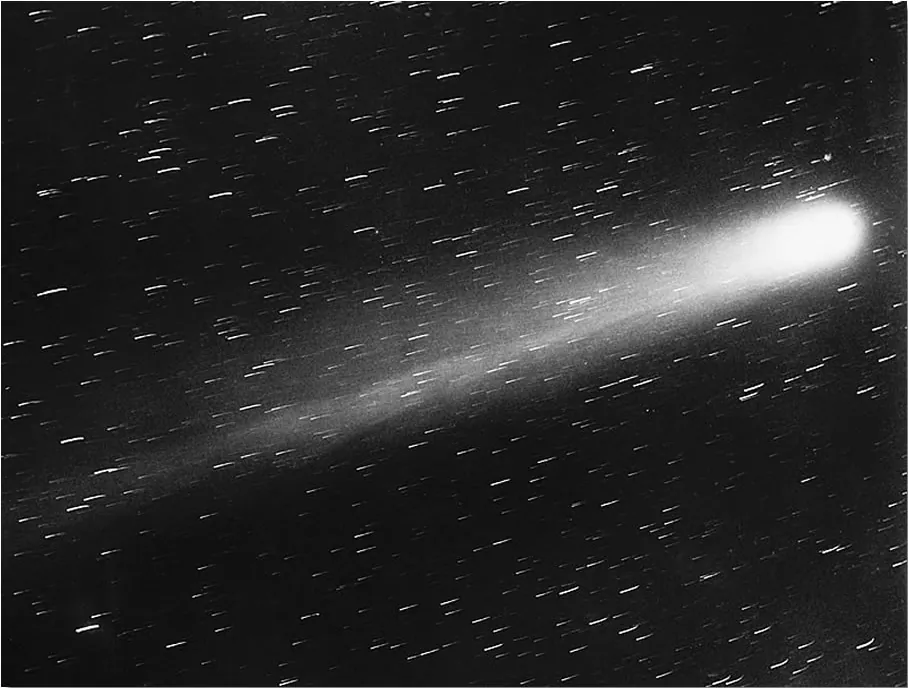
Halley’s Comet on 29 May 1910, photographed by E. E. Barnard at Yerkes Observatory. The New York Times, 3 July 1910, via Wikimedia Commons, public domain
1910: through the tail
On 20 May 1910 the comet passed 22.6 million km from Earth. Observatories announced that in the night of 18 to 19 May it would pass in front of the Sun and Earth would go through its tail; the bulletin of the Bucharest Observatory is one that survives in print. Astronomers had reported cyanogen, a poison, in the tail’s spectrum; newspapers ran with it, and “comet pills” were sold. Nothing happened.
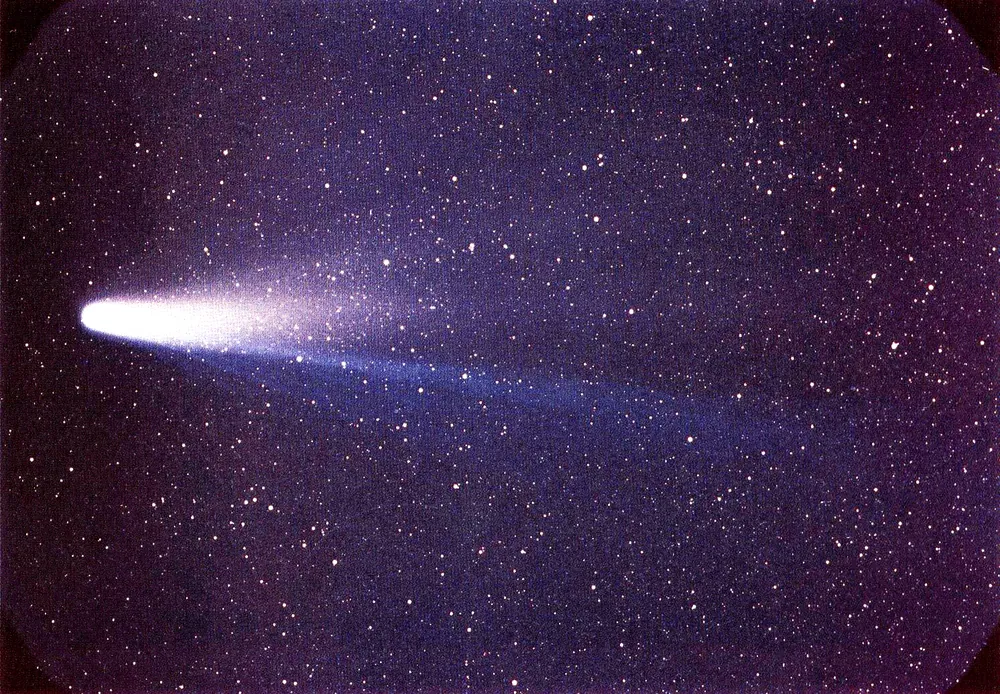
Halley’s Comet on 8 March 1986, from Easter Island. NASA / W. Liller, public domain
1986: the poor view
When the comet rounded the Sun, Earth was on the other side, and afterwards it never came nearer than 62.4 million km. Several spacecraft went to meet it instead.
Every return, 240 BC to 2061
Year
Closest to the Sun
Years since the pass before
Note
2061
28 July
75.46
Predicted (JPL orbit 75)
1986
9 February
75.81
Giotto flies 596 km from the nucleus
1910
20 April
74.42
22.6 million km from Earth on 20 May
1835
16 November
76.68
Mark Twain is born two weeks after the pass
1759
13 March
76.49
The first predicted return
1682
15 September
74.88
Used by Halley for his prediction
1607
27 October
76.14
Used by Halley for his prediction
1531
26 August
75.21
Used by Halley for his prediction
1456
9 June
77.58
Seen over Europe before the siege of Belgrade
1378
10 November
77.04
1301
25 October
79.07
Possibly the star in Giotto’s Adoration
1222
28 September
77.45
1145
18 April
79.08
1066
20 March
76.54
On the Bayeux Tapestry
989
5 September
77.13
912
18 July
75.39
837
28 February
76.78
0.04 AU from Earth on 11 April
760
20 May
75.63
684
2 October
77.55
607
15 March
76.46
530
27 September
79.25
451
28 June
77.36
374
16 February
78.83
295
20 April
76.92
218
17 May
77.15
141
22 March
75.15
66
25 January
76.29
12 BC
10 October
75.18
87 BC
6 August
76.73
164 BC
12 November
76.47
240 BC
25 May
–
The earliest record identified with it (China)
Can Halley’s Comet be seen now?
Not with the eye, and not with any ordinary telescope. In 2003 it took three 8.2-metre telescopes and almost nine hours of exposure to record it as a point. ESO estimated then that at its far point the comet would be only 2.5 times fainter, still within reach of the same telescopes.
What can be seen is its dust. Twice a year Earth crosses the stream of grains the comet has shed on earlier passes: NASA lists “two weak meteor showers each year: the Eta Aquarids in May and the Orionids in October”. In 2026 NASA gives the night of 21–22 October as the Orionid peak.
Questions about Halley’s Comet
Where is Halley’s Comet now?
On 9 October 2026 it was 35.02 AU from the Sun, about 5.24 billion km, and 35.35 AU from Earth. That is farther than Neptune, and nearly 10 AU south of the plane of the planets. It passed its farthest point on 8 December 2023 and is on its way back.
When will Halley’s Comet return?
It rounds the Sun on about 28 July 2061 and passes closest to Earth on 29 July 2061, at 0.477 AU (71.4 million km). The dates come from JPL’s orbit, fitted to observations from 1835 to 1994 and run forward; a small shift is possible.
How long does Halley’s Comet take to orbit the Sun?
75.5 years this time: 27,563 days from 9 February 1986 to 28 July 2061. The orbit before took 75.8 years. Over the recorded returns the interval has run from 74.42 to 79.25 years.
How fast does Halley’s Comet travel?
54.5 km/s when it rounded the Sun in 1986 and 0.91 km/s at its farthest in 2023. Averaged over the whole orbit: 4.8 km/s.
How big is Halley’s Comet?
The nucleus Giotto photographed in 1986 is about 15 km long and 7 to 8 km across (ESA gives 15 × 7.2 × 7.2 km). By ESO’s figure it reflects about 4% of the sunlight that reaches it.
Why is it called Halley’s Comet?
Because Edmond Halley argued in 1705 that the comets of 1531, 1607 and 1682 were one object and predicted its return in 1758. He did not discover it and did not live to see the prediction come true.
Method
The comet’s positions are state vectors from NASA JPL’s Horizons system (orbit solution 75, fitted to 8,518 observations from 1835 to 1994), taken every four days from 1909 to 2062, hourly around the passes of the Sun and every six hours around the far point of 2023. Distances are measured from the centre of the Sun. Every date and number about the orbit between 1909 and 2062 is computed from those vectors when the page is built; the rest come from the sources below.
The days of perihelion and aphelion are the minimum and maximum of that distance. Near the far point the distance changes very little from one day to the next, so the exact day depends on the orbit solution used: this one gives 8 December 2023, and 9 December 2023 is also often quoted. Dates after 1994 are a forecast of the same solution.
The drawing looks down on the plane of the planets from the north; the comet’s depth below that plane is not shown. Planet positions come from JPL’s approximate elements, good to a few hundredths of an AU here. The tail is drawn to show its direction, away from the Sun; its length is not to scale.
“As far as Neptune” and similar phrases compare the comet’s distance from the Sun with the average distance of the planet; the comet does not pass near these planets.
Returns before 1986 use the perihelion times in Table 4 of Yeomans and Kiang (1981), in the Julian calendar before 1582.