Pitești, Romania, 1969–1976 · the magazines' acceleration tests
The Dacia 1300 and its guide's 16.5-second claim
Built near Pitești in southern Romania, the Dacia 1300 was a version of the Renault 12 that became Romania's everyday car. Its technical guide, published in 1975, gave a time of 16.5 seconds from 0 to 100 km/h. Magazines in East Germany, Poland and Czechoslovakia that tested it between 1973 and 1976 recorded 17.9 to 19.5 seconds. Using the engine specifications and the measured top speed, the model gives 18.2 seconds to 100 km/h with the best choice of revs and 0.4 s per gear change. See how close you can get to the road-test times.
The benchmark run starts at 3000 rpm, with gear changes at 5900 rpm taking 0.4 s each. The FIA homologation form gives 5,500 rpm as the maximum.
What the technical guide gave
Production of the Dacia 1300 began in 1969 at the Colibași plant near Pitești, under licence from Renault. The car's technical guide, written by A. Brebenel, C. Mondiru and I. Fărcașu and published in 1975 by Editura Tehnică, gives a 1,289 cc engine with 54 metric horsepower (CP) at 5,250 rpm, measured to the DIN standard, peak torque of 9.6 kgf·m at 3,000 rpm, and a four-speed gearbox.
With two people in the car and a full tank, the guide gave 16.5 seconds from 0 to 100 km/h, 11.3 seconds from 0 to 80 km/h and a top speed of 145 km/h. Yet the power curve drawn in the same guide climbs above the rated figure, to about 58 CP.
What the magazines timed
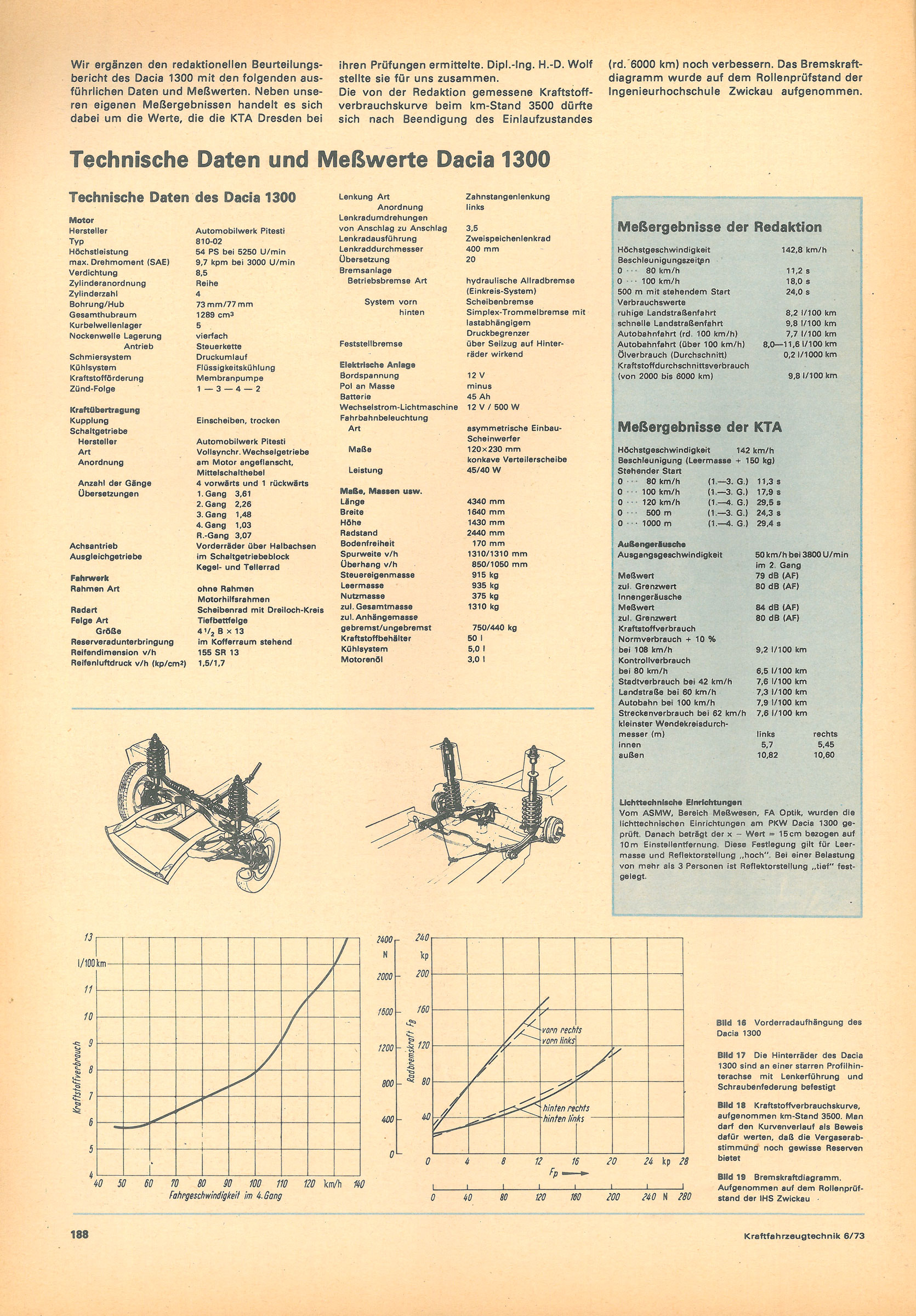
In 1973 the East German magazine Kraftfahrzeugtechnik (KFT) tested the Dacia in February and June, and the KTA test institute in Dresden ran a separate test with an extra 150 kg on board; the unladen car weighed 935 kg. The Polish magazine Motor tested it the same year with two aboard, and Czechoslovakia's Svět motorů in 1976. Times to 100 km/h: KFT 6/1973: 18.0 s; KTA Dresden 1973: 17.9 s; KFT 2/1973: 18.6 s; Motor 44/1973: 18.5 s; Svět motorů 34/1976: 19.5 s.
Measured top speeds: 142.8 km/h at KFT in June and 137 in February, 142 at KTA, 139.1 at Motor and 132.6 at Svět motorů. No test got below 17.9 seconds.
What the model predicts
With the 54 CP engine and an extra 150 kg aboard the 935 kg car, the model matches the measured top speed of 142 km/h at a CdA of 0.80 m². CdA is the drag coefficient multiplied by the car's frontal area. A rough cross-check, from the drag coefficient of 0.452 in T. Macarie's book on vehicle dynamics and the car's track width and height, gives 0.85 m².
At this CdA, the best time with 0.4 s gear changes comes from pulling away at 3000 rpm and changing gear at 5900 rpm: 18.2 seconds to 100 km/h and 11.6 to 80. With 0.3 s changes the model gets down to 18.0 seconds. The KTA and KFT tests, at 17.9 and 18.0 seconds, sit right at the edge of what a 54 CP car can do. With a gentler start and slower changes, as in town, the time to 100 km/h is 21.0 s.
Where 16.5 seconds would come from
To get down to 16.5 seconds with two aboard, about 1,050 kg, the model needs an engine about 5% stronger across the whole curve, with a peak of some 57 CP. The same engine would give a top speed of about 145 km/h, close to the guide's. The guide's figures fit a power above the 54 CP DIN stated in the same guide better; at 54 CP the model predicts slower acceleration and a lower top speed. It is one possible scenario, not a measurement.
The 1976 test also timed acceleration from 40 to 80 km/h in a single gear. In third, the model gives 9.3 s against 10.3 s in the test; in fourth, 14.9 s against 17.7 s. The car Svět motorů tested, with 5,000 km on the clock, performed worse in this test than the others; engine output is one possible explanation, alongside the car's condition and the test conditions.
Sources and method
The model calculates the force at the wheels using engine torque, the four gear ratios, the final-drive ratio and an assumed efficiency of 0.90. It then subtracts rolling resistance, using an assumed coefficient of 0.015, and air resistance. The torque curve passes through 9.6 kgf·m at 3,000 rpm and the torque inferred from 54 CP at 5,250 rpm; its shape between them is an assumption, and power never exceeds 54 CP. The wheel circumference, about 1.76 m, follows from the roughly 3,700 rpm at 100 km/h in fourth noted by KFT. CdA = 0.80 m² is the only fitted value, under these assumptions: with it the 935 kg car, with another 150 kg aboard, reaches 142 km/h, the top speed measured in Dresden. As the car pulls away, the clutch slips and the engine holds the selected revs until the clutch is fully engaged; during each gear change the engine delivers no torque to the wheels.
- A. Brebenel, C. Mondiru, I. Fărcașu, Autoturismul Dacia 1300, Editura Tehnică, 1975 (reeditare digitală). drive.google.com Engine, gearbox, mass (PDF pp. 10–15); the engine curve, fig. 1.3, and the stated performance (PDF p. 16).
- Kraftfahrzeugtechnik 6/1973, p. 188, și 2/1973, p. 58. fahrzeugmuseum-chemnitz.de The editors' and KTA Dresden's measurements, empty mass, gear ratios, 155 SR 13 tyres; 3,700 rpm at 100 km/h (p. 187); FIA homologation form 5496: maximum 5,500 rpm.
- Motor 44/1973, „Ocena testowa Motoru: Dacia 1300”. magazynauto.pl Top speed and acceleration.
- Svět motorů 34/1976, pp. 18–19. aukro.cz Standing-start and in-gear times in third and fourth; top speed 132.6 km/h.
- T. Macarie, Automobile. Dinamică, pp. 7–8. pdfcoffee.com The drag coefficient of 0.452 for the Dacia 1300.