Marius ComperDârjiu
Română

Dârjiu

Dârjiu: the date beyond the legend

The legend of Ladislaus unfolds on one wall. An inscription on the other supplies the date 1419 and names a man connected to the work.

Start the story ↓
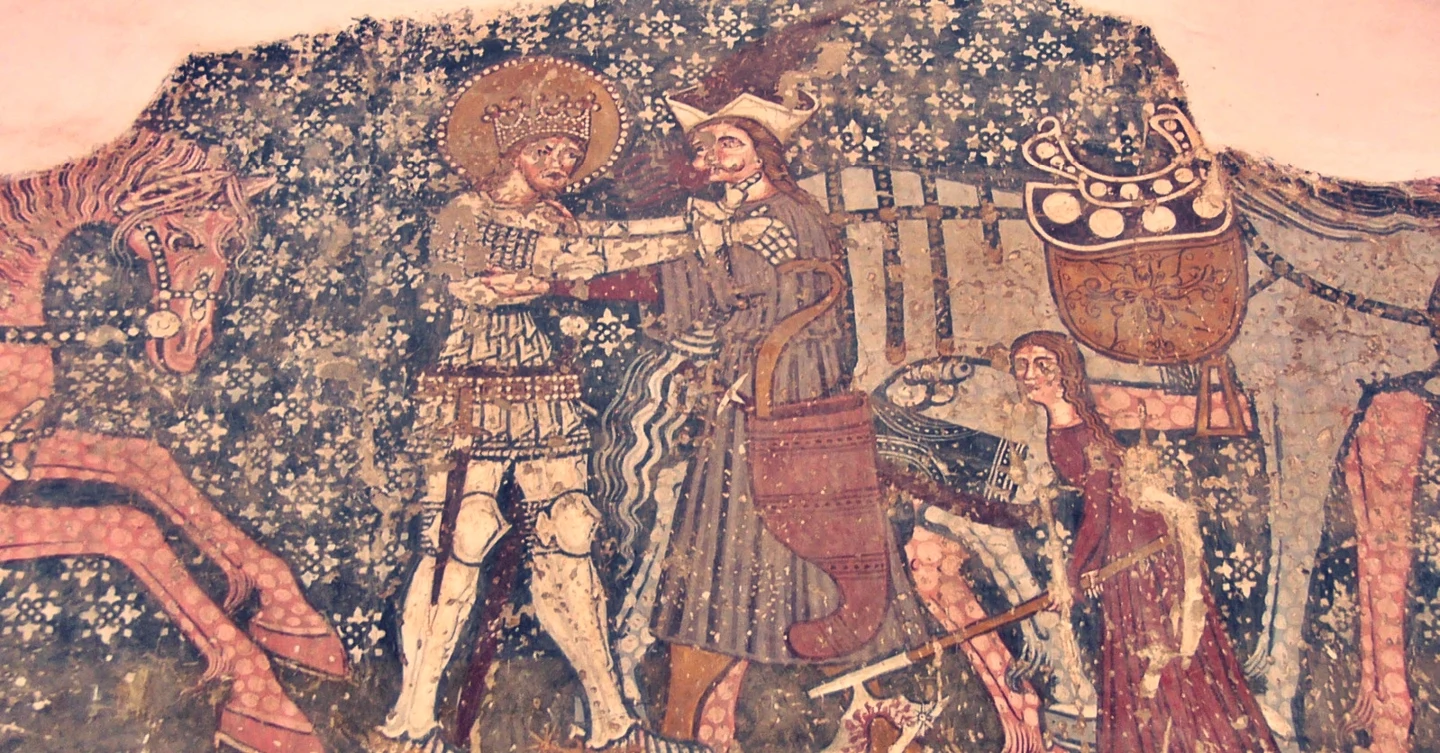
Mural detail with Ladislaus at left and the Cuman warrior at right.
The wrestling scene in the painted cycle on the church’s north wall at Dârjiu. Ladislaus is on the left. (Source · Vargatamas, Wikimedia Commons, 2006 · CC BY-SA 3.0)

01 · place

Mural detail with Ladislaus at left and the Cuman warrior at right.
The wrestling scene in the painted cycle on the church’s north wall at Dârjiu. Ladislaus is on the left. (Source · Vargatamas, Wikimedia Commons, 2006 · CC BY-SA 3.0)

01 · place

Two images, two questions

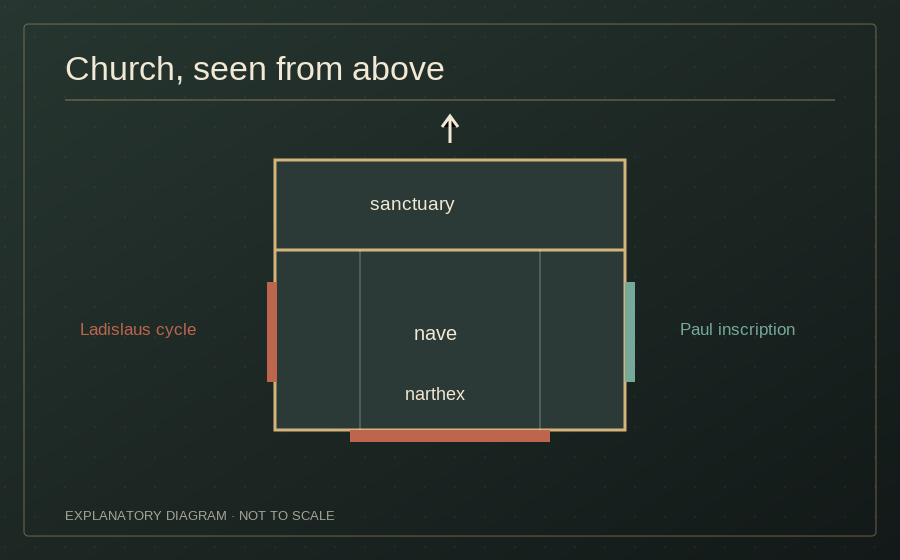
Two paintings in the fortified Unitarian church at Dârjiu answer different questions. The story of Ladislaus and the young woman unfolds on the north wall of the nave. On the south wall, a banner in the Conversion of Saint Paul bears an inscription with a name and the year 1419. [1] [2] [7]

This plan is orienting, not measured: it shows where the walls sit in relation to the nave and narthex. Notice the difference between the tale shown in paint and the information written on the painting itself.[1][4]
Mural detail with Ladislaus at left and the Cuman warrior at right.
The wrestling scene in the painted cycle on the church’s north wall at Dârjiu. Ladislaus is on the left. (Source · Vargatamas, Wikimedia Commons, 2006 · CC BY-SA 3.0)
Schematic church plan with the north and south walls highlighted.
North is up; the Ladislaus cycle is on the north wall and Paul’s inscription on the south. This is not a measured survey. (Source · Original editorial diagram based on the cited heritage and art-historical sources. · Original figure; schematic and not to scale.)
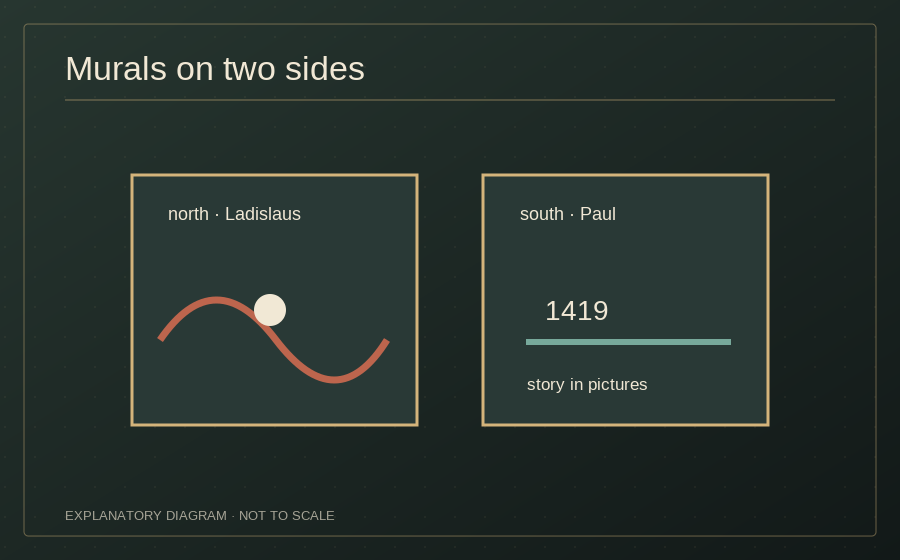
Two panels show the Ladislaus mural and the inscription on Paul’s mural.
This view shifts from the plan to two walls: one carries the tale, the other the date. (Source · Original editorial diagram based on the cited heritage and art-historical sources. · Original figure; schematic and not to scale.)

02 · the tale

A prince in the tale, a saint in memory

Ladislaus was still a prince when the battle of Chiraleș took place in 1068. The medieval tale shows him pursuing a warrior called a “Cuman” in chronicle tradition and rescuing an abducted young woman. The fresco dates to 1419, more than three centuries after the event it evokes.[3]

The painting is not an eyewitness report. Historians distinguish the battle known from written sources from the heroic episode shaped by medieval memory. By 1419, Ladislaus was venerated as a saintly king; the mural uses his story for an audience of its own time, whose reactions we cannot recover directly.[3]
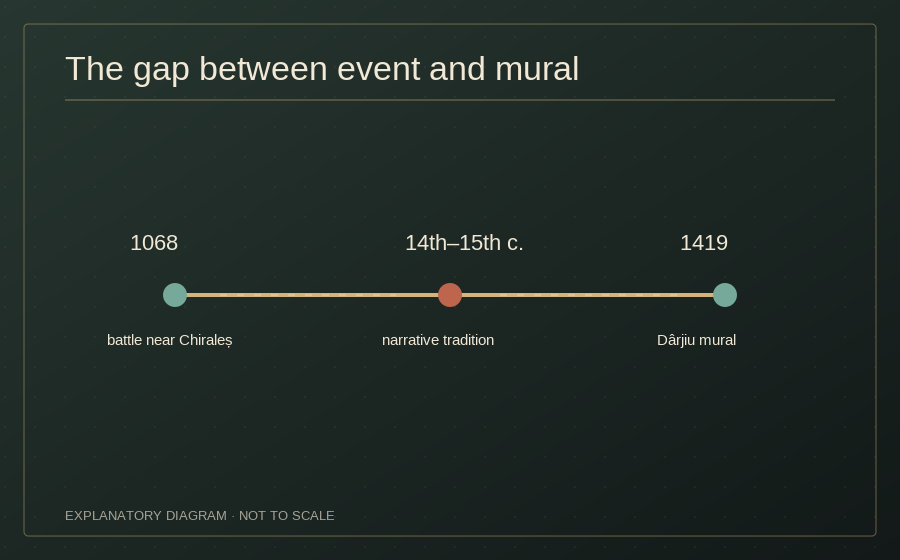
Timeline from the 1068 battle to the medieval tale and the 1419 fresco.
1068, the narrative tradition and the 1419 fresco are separate moments. The middle marker is approximate, not a secure date for the tale’s composition. (Source · Original editorial diagram based on the cited heritage and art-historical sources. · Original figure; schematic and not to scale.)

03 · reading

Follow the action across the wall

The north-wall cycle does not freeze a single moment. Its figures return across a sequence: battle, pursuit, the encounter between the two warriors, rescue of the young woman and rest. Repetition lets you follow continuous action across the wall.[3]

This diagram separates the tale into five waypoints to help you look. Its shapes are symbols, not copies of the painted figures; surviving scenes are fragmentary, so their order and boundaries should be checked against the mural rather than this guide alone.[3]
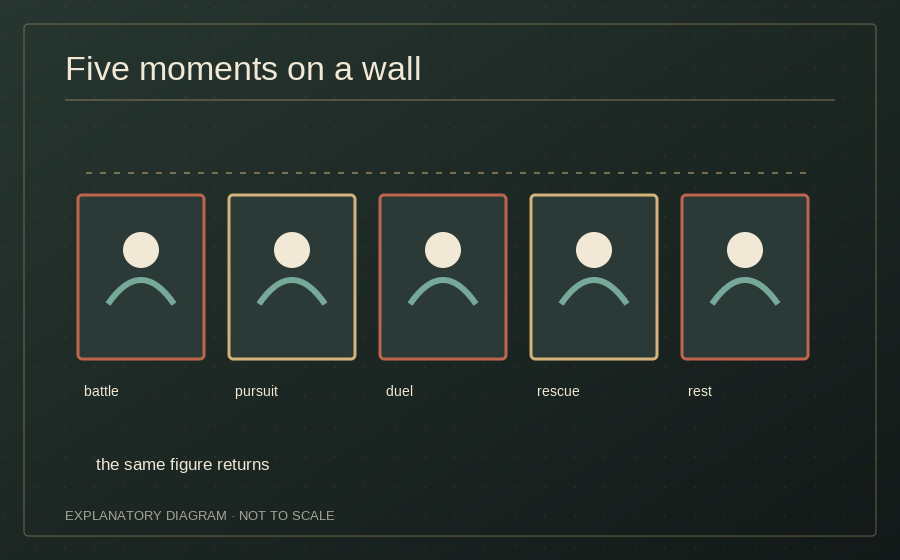
Five linked panels show episodes from the painted tale.
A reading guide to episodes described in the sources. It does not reproduce the original drawing or fill in lost sections. (Source · Original editorial diagram based on the cited heritage and art-historical sources. · Original figure; schematic and not to scale.)

04 · inscription

The year and the name on the banner

The banner names Paul, son of Stephen of Ung, and dates the work to 1419. The Latin “fecit depingere” can be read as “had it painted”, and art historian Zsombor Jékely identifies Paul as a donor. Other interpretations identify him as the painter. [2] [4] [7]

The name and year are visible within the painting. Who held the brush remains open. Scholars have also read the final words differently, including as an allusion to a beautiful girl. [4] [7]
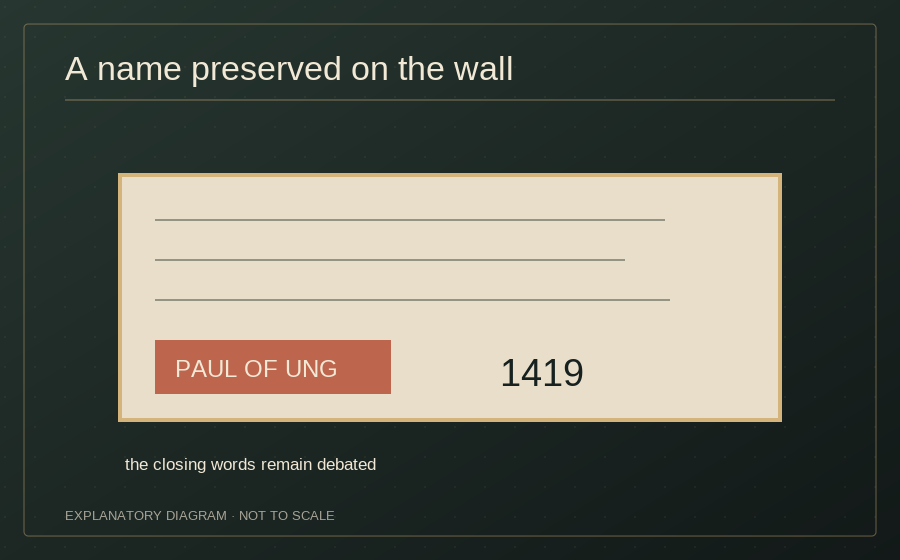
Schematic inscription with the painter’s name and the year 1419.
Interpretive diagram, not a facsimile transcription. The name and year are supported by the inscription; its ending remains debated. (Source · Original editorial diagram based on the cited heritage and art-historical sources. · Original figure; schematic and not to scale.)

05 · enclosure

When the wall begins to shelter

The church was fortified around 1520. In the 17th century, the rectangular enclosure was remodelled with bastions at its corners and another on the west side; walls and bastions had openings for firearms. Fortification changed how the community used the site without erasing its religious purpose.[1]

UNESCO records that storage sheds replaced part of the wall walk and held grain chests. This diagram compresses several phases into one outline: it shows relations between church, wall and bastions, not the exact form in a particular year.[1]
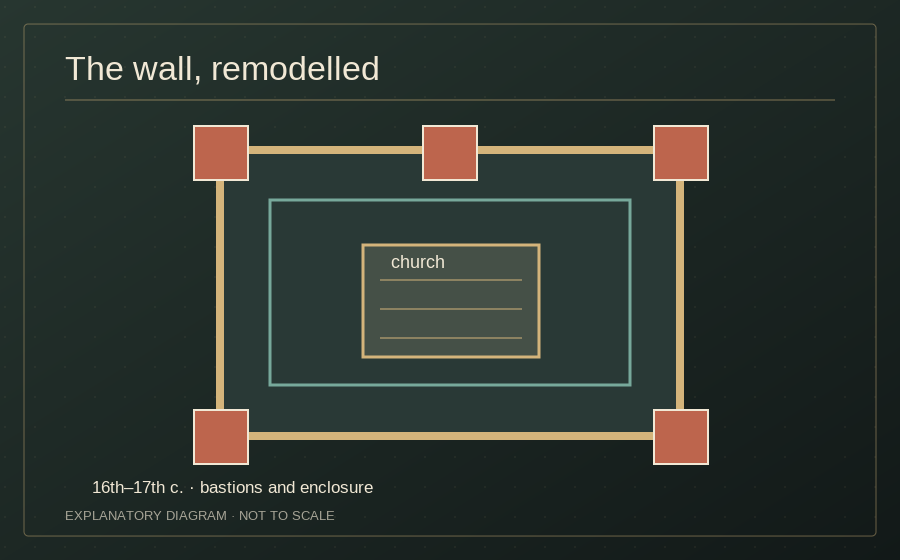
Schematic plan of the church, rectangular enclosure and bastions.
Church within an enclosure and bastions, not to scale. Storage occupied part of the former wall walk. (Source · Original editorial diagram based on the cited heritage and art-historical sources. · Original figure; schematic and not to scale.)

06 · return

Beneath the whitewash, another life

After the Reformation in the 16th century, the paintings were covered with whitewash. Repairs in 1887 brought mural fragments to light. The upper layer hid them from view; that sequence alone cannot tell us how much it physically protected each section.[2]

The paintings later underwent restoration and conservation. The cycle seen today is a medieval object shaped by repairs, discovery and modern interventions. A visible trace may belong to the original paint, deterioration or a restoration phase; assigning it requires specialist documentation.[5]
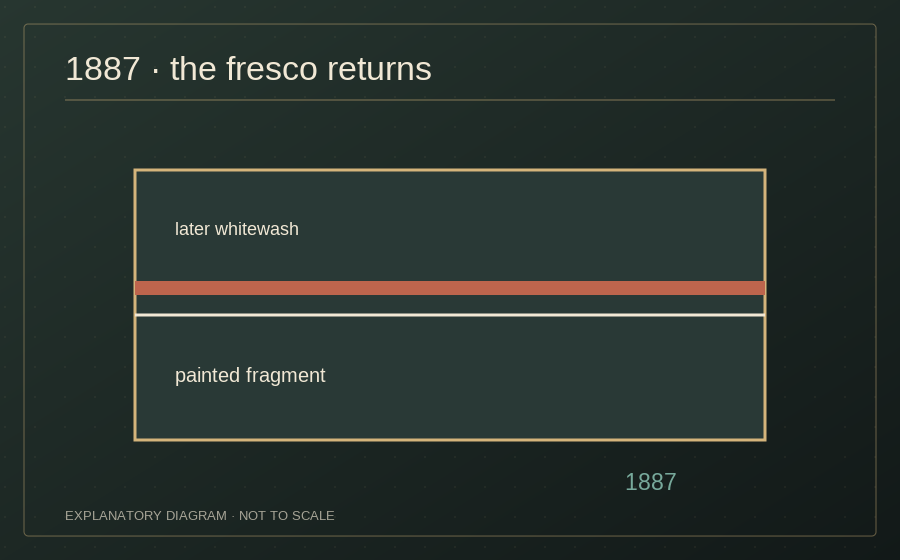
Wall section with whitewash above a fragment of fresco.
Explanatory section, not measured thickness: whitewash above a painted fragment. Not all areas survived in the same way. (Source · Original editorial diagram based on the cited heritage and art-historical sources. · Original figure; schematic and not to scale.)

Sources

At Dârjiu, a painted tale leads you to an inscription that preserves a painter’s name and the year 1419.

  1. UNESCO, nomination dossierDescribes the 1419 murals, fortification around 1520 and the enclosure remodelled in the 17th century.
  2. Fortified church of DârjiuSite history and the murals’ rediscovery in 1887.
  3. Study of the Saint Ladislaus cycleDistinguishes the painted tale from historical reporting and describes its scenes.
  4. Vladimir Agrigoroaei, the 1419 inscriptionAnalyses the inscription’s reading, Paul of Ung’s name and debate over its closing words.
  5. Ministry of Culture, church restorationReports conservation work and the murals’ place in the heritage ensemble.
  6. Vargatamas, photograph of the scene on the north wallPhotograph from 2006, resized for this page. CC BY-SA 3.0.
  7. Zsombor Jékely, mural workshops in TransylvaniaPages 38–39 identify the donor and place the inscription on the banner.