The map could not load. The text below contains every result.
The Getica, AD 551 · Ancient DNA, 2026
Ancient DNA backs Jordanes on one point: the Goths came from the north. That is about 2% of his book.
In 551, a former notary who traced his descent from the Goths wrote in Constantinople that his people had come from a northern island in three ships. On 28 October 2026, ancient genomes from Poland supported him. Yet the same book makes Burebista a king of the Goths, sends the Goths to beat Pharaoh, and gives them 2,030 years of history.
The Getica is the oldest surviving history of the Goths: Jordanes abridges the twelve books of Cassiodorus, now lost. For Romanians the book matters for another reason too. Many of the stories told about the Getae and Dacians, the ancient peoples of what is now Romania, from Deceneus to Comosicus, are read here, credited to the Goths. Below is the whole book, paragraph by paragraph: what the DNA confirmed, what Jordanes borrowed from the Getae, and what really happened on Romanian soil.
The picture is the whole book: each line is one of its 316 paragraphs, in Jordanes’s order. In blue, the departure from the north, backed by the DNA; in red, the history of the Getae and other peoples, credited to the Goths.
The departure from the north was real#
The study published in Nature on 28 October 2026, with 712 new ancient genomes, also analysed people of the Wielbark culture in northern Poland, from almost 2,000 years ago, a culture archaeologists usually link to the early Goths. Their ancestry looks most like that of people in eastern Scandinavia in the Bronze and Iron Ages.
Of the 27 Wielbark people analysed, 24 fall into the genetic groups of Scandinavia and the Baltic. The authors write that this supports the Goths’ own story of an emigration from eastern Scandinavia.
On the map each circle is a cemetery; its size shows how many people were analysed, its colour the share assigned to northern genetic clusters. A genetic group is not an ancestry percentage.
The Goths buried in Spain and Italy were mostly southerners#
The same study found something else among later Goths. Of the 16 people from graves the authors’ table associates with the Ostrogoths and Visigoths, in Spain, Portugal, Italy and Crimea, only 2 fall into Scandinavian or Baltic genetic clusters. The authors model the others’ ancestry as local.
The authors find the results consistent with a two-step model. First a group of people left Scandinavia. Then many others became Goths: they took up the language, the name and the way of life. “Goth” became an identity people could join.
The study has no genomes from the Romanian cemeteries of the Sântana de Mureș culture. At Sântana de Mureș only bone isotopes have been analysed, for 26 people. The study includes two people of Ukraine’s Chernyakhov culture, both in the northern groups.
Now, the book itself#
The Getica has 316 paragraphs, almost 20,000 Latin words. On screen each line is a paragraph, in Jordanes’s order, coloured by what it tells.
For 238–540 most events can be checked against other writers of the time, and historians still use the book, minding its legendary details. The big trouble is the start.

The part the DNA confirmed: about two words in a hundred#
The departure from Scandza under King Berig and the march to the Black Sea fill four paragraphs (25–28), plus one on the Gepids. That is between 1.4% and 2.6% of the book, depending on how you count the paragraphs at the edges.
Ex hac igitur Scandza insula quasi officina gentium aut certe velut vagina nationum cum rege suo nomine Berig Gothi quondam memorantur egressiNow from this island of Scandza, as from a hive of races or a womb of nations, the Goths are said to have come forth long ago under their king, Berig by name. (§25, tr. Mierow)
The DNA confirms a movement of people from eastern Scandinavia to the southern Baltic. It cannot confirm the king, the three ships or the year.
Jordanes gave the Goths 2,030 years#
Near the end, Jordanes writes that the Gothic kingdom fell in 540 “in almost its 2,030th year” (§313). That puts the start around 1490 BC, more than seven centuries before Rome.
On screen, the paragraphs now sit on Jordanes’s own clock. To fill 1,700 years without Goths, he took other peoples’ stories: those of the Getae and Dacians (red), the Scythians and Greek legend (violet).
Originem Gothicam historiam fecit esse RomanamHe made the origin of the Goths into Roman history. So King Athalaric praised, in 533, the book by Cassiodorus that Jordanes summarised. (Cassiodorus, Variae 9.25)
On real dates, the book shrinks#
Goths appear securely in Roman writers only in the 1st century AD, near the Vistula: “Gutones” in Pliny, “Gotones” in Tacitus. Their first attack on the Danube is in 238.
On screen, the paragraphs now sit at the year of the events they tell. The departure from the north moves 1,500 years later, into the first centuries AD, where archaeology and the DNA put it. The legends leave the timeline for the corner: they have no date. The red block stays put: it tells of other peoples, sometimes real events, sometimes uncertain or legendary ones.
Burebista was not a Goth#
Ancient writers often called the Goths “Getae” or “Scythians”, after the peoples who had lived in the same lands before them. Orosius even wrote: “the Getae, who are now the Goths”. Jordanes went further and moved everything he found about the Getae into Gothic history.
That is how Zalmoxis, Deceneus, Burebista, Comosicus and Coryllus, probably the Dacian king Scorilo, became Goths. It shows most clearly in the king who defeated the Roman general Fuscus in AD 86 or 87 (§76). Jordanes’s own source, Orosius, calls him Diurpanei Dacorum regis, “Diurpaneus, king of the Dacians”. Jordanes wrote “Goths” for “Dacians”.
The irony: almost everything told about Deceneus’s teachings, the astronomy, the 346 stars, the written laws and the capped priests, comes from Jordanes, who thought he was a Goth. Strabo mentions him only briefly, as Burebista’s priest and adviser, who had learned in Egypt.
The Goths and the Trojan War#
Jordanes wanted to tie the Goths to the most famous story of the ancient world as well. Once through legend: he makes a Gothic king of Telephus, son of Hercules, who in myth fights the Greeks on their way to Troy (§59–60). Telephus became a Goth because Jordanes confused Mysia in Asia Minor, Telephus’s land, with Moesia on the Danube. And once through history: in §108, Goths raiding Asia Minor in the 260s pass through “Troy and Ilium”, two names for one city, which, he says, had barely recovered from the war with Agamemnon.
vastantes itinere suo Troiam Iliumque, quae vix a bello illo Agamemnoniaco quantulum se reparantes rursus hostili mucrone deletae suntsacking Troy and Ilium on the way. These cities, which had scarce recovered a little from the famous war with Agamemnon, were thus destroyed anew by the hostile sword. (§108, tr. Mierow)
The Gothic raids in the Aegean are real. Ilium was then a prosperous Roman town, and the line about Agamemnon jumps 1,400 years. Whatever the Goths touched, if anything, was a Roman town built on the site of Homer’s Troy.
The Goths on Romanian soil#
The Getae were not Goths. But Goths did live on what is now Romanian soil, for about 150 years, from around 230–270 until 376. Archaeologists link the Goths to the Sântana de Mureș–Chernyakhov culture, named after a village near Târgu Mureș and one near Kyiv, which other peoples shared too.
In 376, fleeing the Huns, the Goths of Wallachia and Moldavia asked to cross the Danube. Their children and grandchildren entered Rome with Alaric on 24 August 410. It was Rome’s first capture by a foreign army in almost 800 years. Claudian, court poet of Emperor Honorius, wrote that Alaric had been raised by barbara Peuce, an island in the Danube Delta.
And Jordanes’s own grandfather was secretary to Candac, whose people had been given Scythia Minor, today’s Dobrogea, and Lower Moesia (§265–266).
On the map: the Goths’ places in Romania and along the Danube. Tap a point.
Read any paragraph#
Tap any line in the picture to read that paragraph in Latin, with Charles Mierow’s 1915 English translation.
The colour shows the kind of story. The buttons in the window take you to the paragraph before or after.
True or made up?#
Twelve claims from the Getica. For each, choose: it happened; it happened, but to someone else or differently; or it is made up. The answer appears once you choose.
- §25
The Goths came from Scandinavia.
Ex hac igitur Scandza insula quasi officina gentium…
Broadly true
People of the Wielbark culture, the first Goths in archaeologists’ view, carry mostly eastern-Scandinavian ancestry (McColl et al., Nature, 2026). What is confirmed is a movement of people who mixed with locals; the king and the date are story.
- §94–95
They came in three ships, and the slowest gave the Gepids their name: “gepanta” means “slow”.
…tribus tantum navibus vectos… gepanta dicitur
Made up
The three ships are a saga motif. “Gepanta” appears in no Gothic source: it is a mocking nickname invented to explain the Gepids’ name.
- §67
Burebista was a king of the Goths, and Deceneus taught them philosophy.
regnante Gothis Buruista Dicineus venit in Gothiam
Real but mixed up
Burebista and Deceneus were real (Strabo calls them Byrebistas and Dekaineos), but they were Getae, three centuries before any Goth reached the Danube. Jordanes even gets the period right: “when Sulla ruled”.
- §47
A king of the Goths beat the Pharaoh of Egypt and chased him back to the Nile.
Thanausis Gothorum rex Vesosi Aegyptiorum occurrit
Made up
The story comes from Pompeius Trogus, as summarised by Justin, where the Pharaoh “Vezosis” fights Scythians. Jordanes made them Goths. The Pharaoh is the legendary Sesostris, whose northern campaigns left no trace.
- §49–57
The Amazons were the Goths’ wives.
…Lampeto et Marpesia principatui subrogarunt
Made up
Queens Lampeto and Marpesia come from Justin and Orosius, where they are Scythian wives. The Amazons are Greek myth with a real background: many steppe graves hold women buried with weapons. The Goths arrived there a thousand years later.
- §65
Philip II, father of Alexander the Great, married the daughter of a Gothic king.
Medopam Gudilae regis filiam accepit uxorem
Real but mixed up
The marriage was real, around 340 BC. Athenaeus names the bride Meda, daughter of Cothelas, king of the Getae. “Medopa” and “Gudila” look like garbled forms. She was Getic, from the Lower Danube.
- §62
Today’s Constanța, ancient Tomis, was founded by a queen and bears her name.
Thomes civitatem suo de nomine aedificavit
Made up
Jordanes says Queen Tomyris built the town after defeating Cyrus. Herodotus makes her queen of the Massagetae, near the Caspian. Tomis was a Greek colony of Miletus, from the Archaic period.
- §76–78
The king who defeated and killed the Roman general Fuscus in AD 86 or 87 was a Goth.
Gothis autem Dorpaneus principatum agebat
Real but mixed up
The battle is real and was fought in Dacia. Jordanes’s source, Orosius, says plainly “Diurpanei Dacorum regis”: king of the Dacians. Jordanes just changed the word.
- §101–103
The Goths killed a Roman emperor in battle.
circumseptus a Gothis et ipse extinguitur
Broadly true
Emperor Decius and his son died at Abritus, in today’s Bulgaria, in summer 251, fighting the Gothic king Cniva. He was the first Roman emperor killed in battle by a foreign enemy.
- §108
The Goths sacked Troy.
vastantes itinere suo Troiam Iliumque
Real but mixed up
Jordanes reports a sack of Roman Ilium in the raids of the 260s, not of Homer’s Troy. The raids are certain; the sack of Ilium we know only from him. The line about Agamemnon is a flourish.
- §156
In 410 Alaric’s Goths sacked Rome but did not burn it, and spared the churches.
spoliant tantum, non autem, ut solent gentes, igne supponunt
Broadly true
The sack of 24–26 August 410 is certain. Orosius and Augustine, both contemporaries, say churches and those sheltering in them were spared. Some buildings did burn, for example near the Gardens of Sallust.
- §313
The Gothic kingdom lasted almost 2,030 years.
tandem pene duomillensimo et tricesimo anno
Made up
The arithmetic puts the start around 1490 BC. Goths appear in the sources only in the 1st century AD. The 2,030 years come from the Getae, Scythians and Amazons glued in front of Gothic history.
The kings Jordanes borrowed#
Each name below appears in the Getica as a king, queen or sage of the Goths. On top, Jordanes’s spelling; underneath, who it really was and where to find them in older writers.
- Zalmoxis the god or teacher of the Getae§39 · Herodotus 4.94–96
- Dicineus= Deceneu Burebista’s high priest§67–72 · Strabo 7.3.11 (Dekaineos)
- Buruista= Burebista king of the Getae and Dacians, c. 82–44 BC§67 · Strabo 7.3.11 (Byrebistas)
- Comosicus king and priest; known only from Jordanes§73 · no other source
- Coryllus= Scorilo? a Dacian king; probably Frontinus’s Scorilo§73 · Frontinus, Strategemata 1.10.4
- Dorpaneus= Diurpaneus “king of the Dacians”, who beat Fuscus§76 · Orosius 7.10.4
- Gudila= Cothelas king of the Getae, Philip II’s father-in-law§65 · Athenaeus 13.557d
- Thomyris= Tomiris queen of the Massagetae, near the Caspian§61 · Herodotus 1.205–214
- Antyrus= Idanthyrsus? probably the Scythian king who stood up to Darius§63 · Herodotus 4.76, 4.120–127; a modern identification
- Sithalcus= Sitalces king of the Odrysian Thracians, 5th century BC§66 · Thucydides 2.95–101
- Tanausis= Tanaus the Scythian king of Trogus’s legend§47 · Justin 1.1.6
- Telefus the Greek hero, a king in Mysia in Asia Minor§58–60 · Greek myth
Matching Antyrus with Idanthyrsus and Coryllus with Scorilo are modern scholars’ proposals. Comosicus appears in no other source.
What the Goths left in Romania#
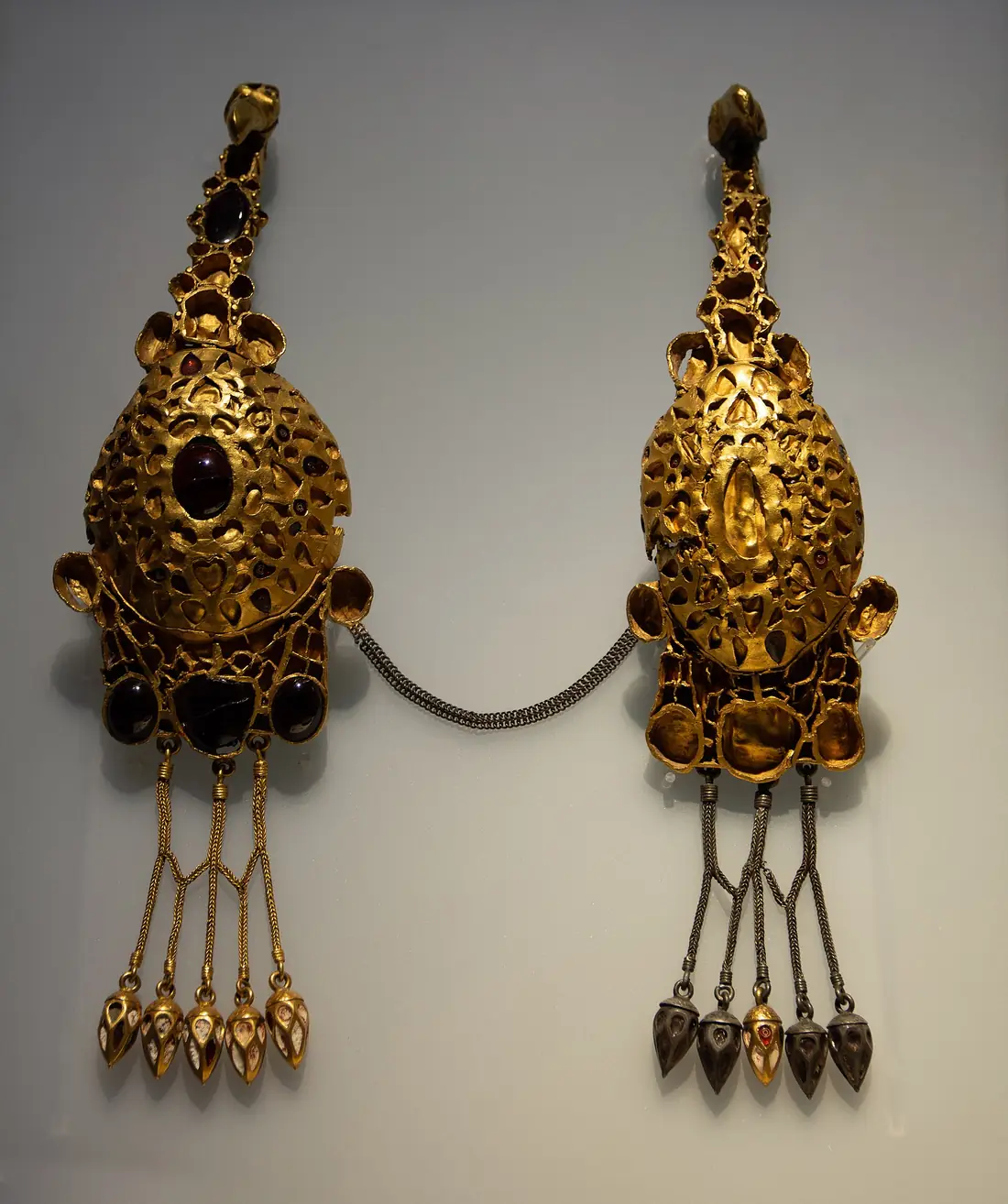
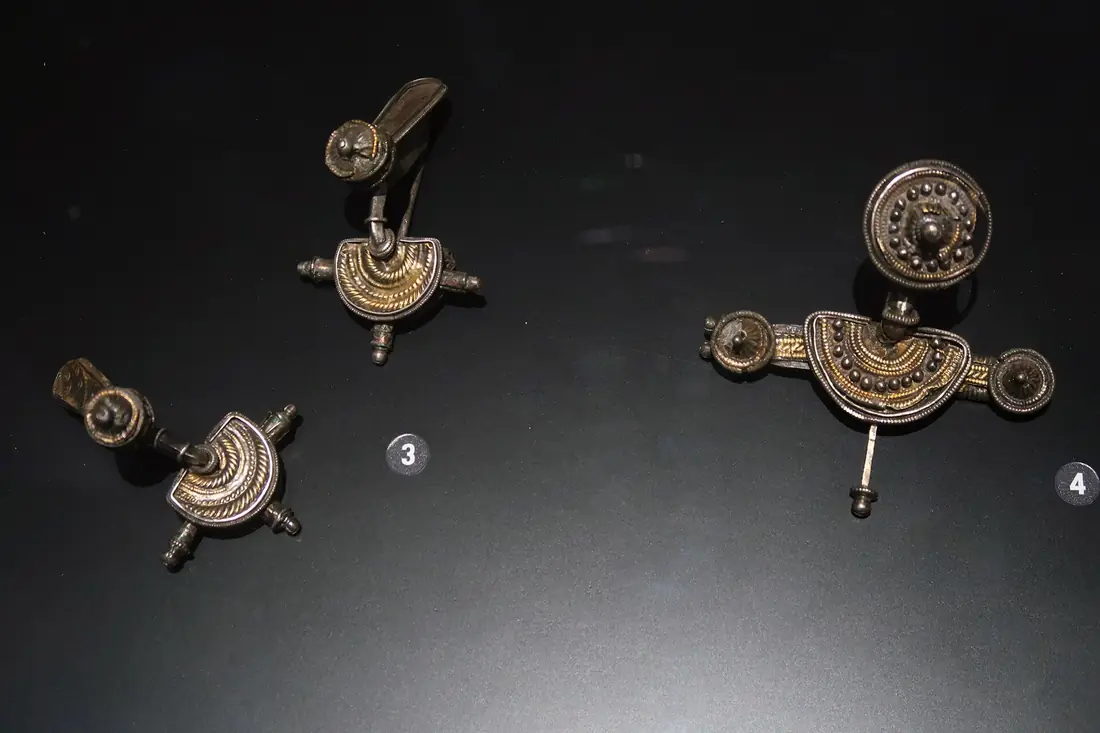
Jordanes was wrong to make the Getae the Goths’ ancestors. The real Goths did pass through here, though, and their traces survive in museums, in the church calendar and on a gold ring.
- 238 · The Goths’ first attack on the Lower Danube; after 250 the Sântana de Mureș culture spreads over Moldavia, Wallachia and Oltenia.
- 251 · At Abritus, in today’s Bulgaria, King Cniva kills Emperor Decius.
- 328 · Constantine the Great opens the bridge at Sucidava (Celei), almost 2.4 km long.
- 341 · Wulfila is made bishop “of the Christians in the Getic land”. Around 348 he is driven south of the Danube. He is credited with the Gothic alphabet and the Bible translation.
- 369 · Peace on the Danube between Emperor Valens and Athanaric, “judge” of the Tervingi Goths, sealed on boats in mid-river.
- 372 · Sabbas the Goth is drowned in the river Musaeus, usually identified with the Buzău, in Athanaric’s persecution.
- 376 · The Huns strike. Most Goths of Wallachia and Moldavia cross the Danube. Athanaric withdraws to “Caucaland”, a mountain country.
- 410 · Their descendants enter Rome with Alaric.
- 454–567 · The Gepids, the Goths’ kin, hold Transylvania: “Dacia, which is now called Gepidia”, writes Jordanes.
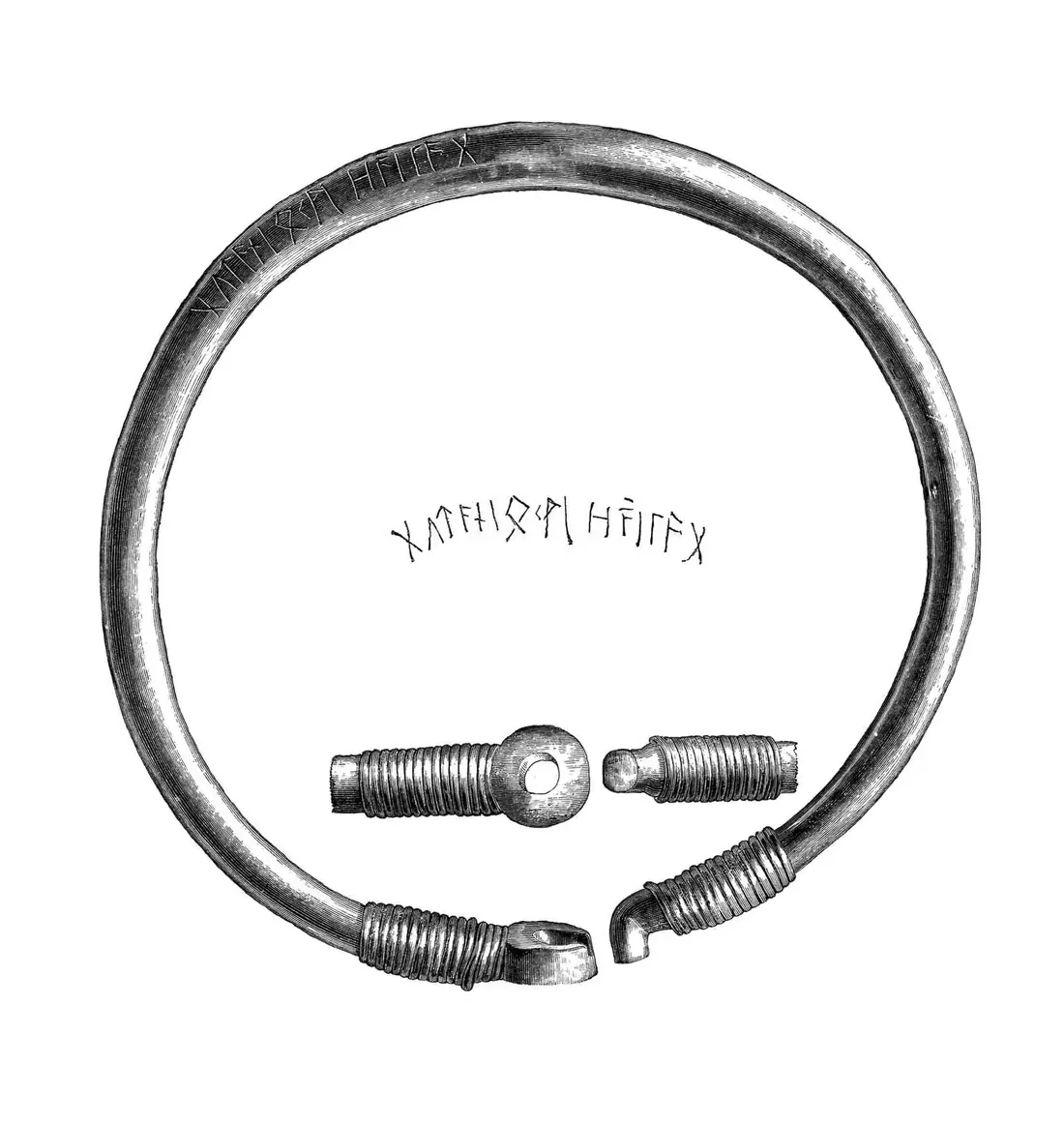
The best-known Gothic text found in Romania is on a gold neck-ring from the Pietroasele treasure, in old Germanic runes:
ᚷᚢᛏᚨᚾᛁᛟᚹᛁ ᚺᚨᛁᛚᚨᚷ
gutaniowi hailag
The first word is the Goths’ name; the last, hailag, means “holy”, cousin of English holy. The middle is disputed, because one rune was destroyed when the ring was cut after the 1875 theft. Readings range from “the Goths’ heritage, holy and inviolable” to “to the Jupiter of the Goths, holy”.




What did Gothic leave in Romanian?#
The Goths ruled here for over a century, so you would expect them to have left words behind. They left almost none. Old Romanian words with no Latin origin, such as viezure (badger), barză (stork) and mânz (foal), have relatives in Albanian and are usually placed in the old layer of the language, from before the Romans, though their etymologies are debated. Of the 2,270 meaning–word pairs in the Romanian loanword database (WOLD), none comes straight from Gothic, while 363 come from Slavic.
The usual explanation: the Goths ruled here for about 140 years as a ruling layer, then most of them left. The Slavs stayed and mixed with the locals, and Slavonic was the language of church and chancery for centuries.
- foal
fula · John 12:15In Gothic, a foal is fula, cousin of English foal. Romanian mânz has an Albanian relative instead, mëz: it belongs to the old layer from before the Romans. - badger
unattested in surviving GothicNo Gothic word for badger survives. The reconstructed Proto-Germanic form is *þahsuz (hence German Dachs). Romanian viezure has an Albanian relative, vjedull. - stork
unattested in surviving GothicNo stork in Gothic either; the reconstructed Proto-Germanic form is *sturkaz, hence English stork. Romanian barză is usually set beside Albanian bardhë, “white”, for its feathers. Ciorănescu disagrees. - glass, bottle
stikls · John 18:11The one solid link is indirect: Gothic stikls, “cup”, entered Slavic as stĭklo, and Romanian took it from Slavic. It is the best-supported Gothic word in Romanian, by a detour. - pit
groba · Matthew 8:20“The foxes have holes”: in Gothic, grōba. Romanian groapă and grōba seem to share a very old root, “to dig”. Romanian did not borrow it from the Goths.
Look up a word
Wulfila’s Gothic
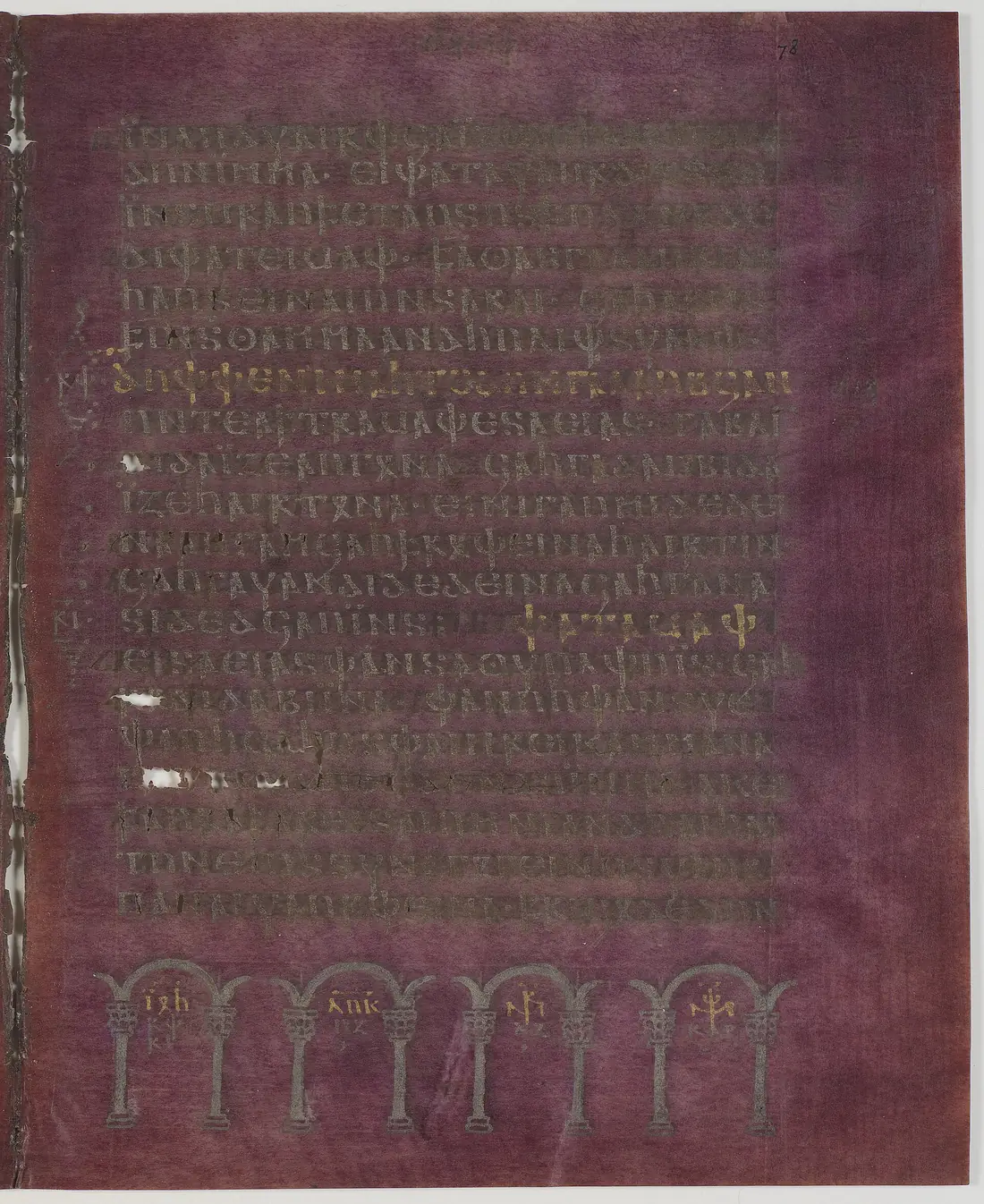

Wulfila, bishop of the Danube Goths, is credited with an alphabet built from Greek and Latin letters and runes, and with translating the Bible, the oldest substantial surviving text in a Germanic language. A few words, in his letters:
- bread
hlaifs · Matthew 6:11“Our daily bread”: hlaif. The Slavs borrowed it (Russian khleb); Romanian kept Latin panis. - father
atta · Matthew 6:9The Lord’s Prayer begins atta unsar in Gothic. The idea that Attila means “little father” is only a proposal. - king
þiudans · John 12:15The king is “the one of the people”, from þiuda, “people”. Hence also Gutþiuda, “the land of the Goths”, in the Gothic calendar. - world
midjungard · Luke 2:1The world is the “middle enclosure”, cousin of Old English middangeard, from which Tolkien took his Middle-earth. - camel
ulbandus · Luke 18:25“Easier for a camel to go through the eye of a needle”: ulbandus. Old English had the same word, olfend. - grape
weinabasi · Matthew 7:16A grape is a “wine-berry”. Wein comes from Latin vinum, like Romanian vin. - child
barnilo · Matthew 9:2“Be of good cheer, child!”: barnilo, “little child”. In Scotland people still say bairn. - grandmother
awo · 2 Timothy 1:5It appears just once in all of Gothic: “thy grandmother Lois”. - water
wato · Mark 9:22Almost as in English. - holy
hailag · the Pietroasele ringHailag, “holy”, appears nowhere in Wulfila’s Bible. It survives only on the gold ring from Pietroasele.
Gothic texts: Streitberg’s edition (1919), via Project Wulfila. Gothic letters are set in Noto Sans Gothic.
Who else believed the story#
Jordanes did not invent the confusion alone, and he was not the last to use it.
- 417 · Orosius, a priest from Hispania, writes “Getae illi qui et nunc Gothi”: “the Getae, who are now the Goths”. Jordanes quotes him (§58).
- c. 620 · Isidore of Seville turns the story inside out: “Daci autem Gothorum soboles fuerunt”, the Dacians were offspring of the Goths.
- 13th century · On Gotland, the Guta saga tells a similar departure: a third of the islanders, chosen by lot, leave and travel up the Dvina “to the land of the Greeks”.
- 1434 · At the Council of Basel, the Castilian bishop Alonso de Cartagena argues that the King of Castile outranks the King of England. One of his arguments: Castile’s kings descend from the Visigoths.
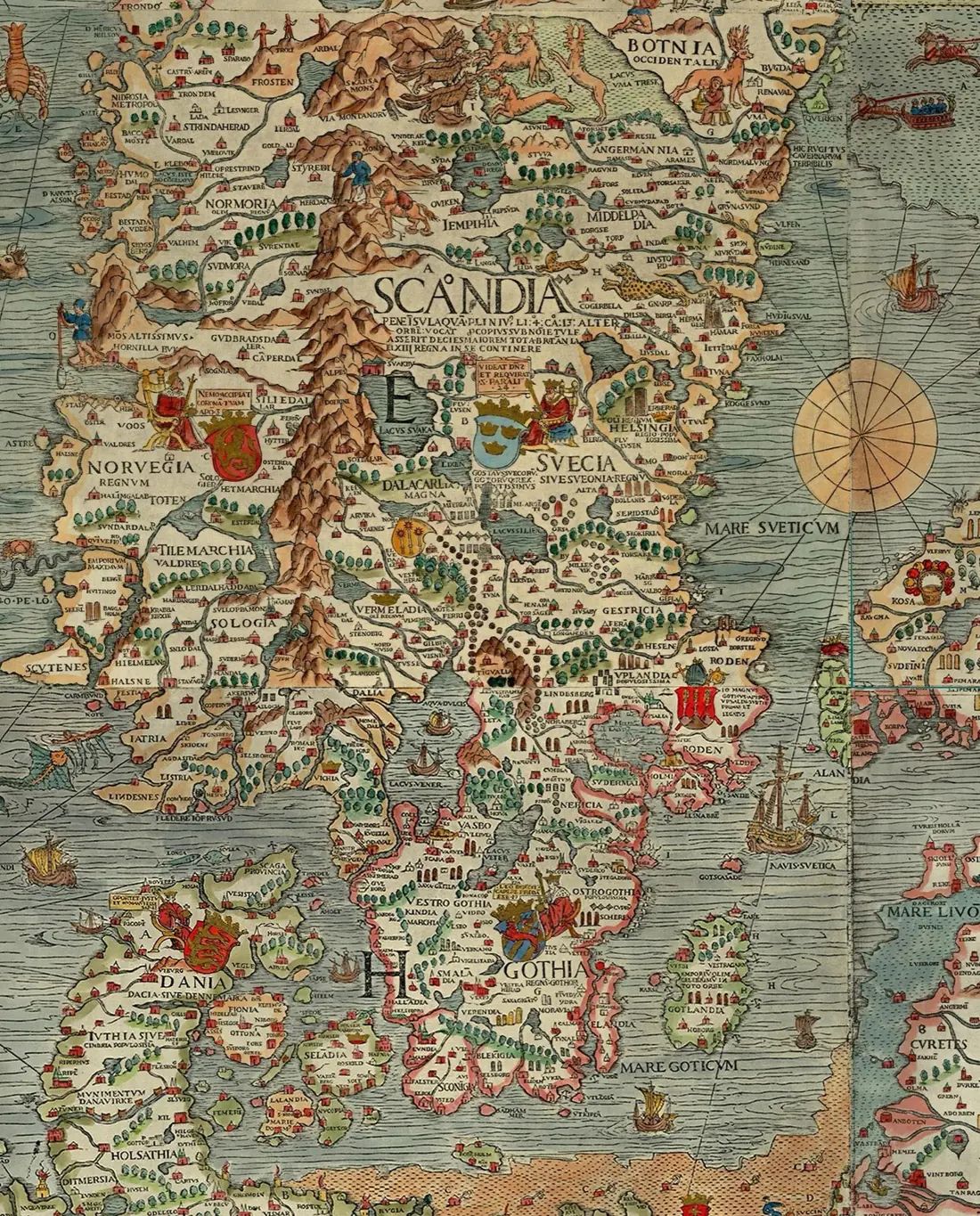
- 1554 · A history of all the “kings of the Goths and the Swedes”, from Noah’s grandsons to Gustav Vasa, appears posthumously, by Johannes Magnus, the Catholic archbishop of Uppsala who died in exile in Rome. A century later Olof Rudbeck would argue that Sweden was Atlantis.
- 1717 · Dimitrie Cantemir lists “Iornandis, a Goth, a Latin historian” among his sources. He rejects a Scandinavian origin for the Dacians and Getae, “as Iornandis thought”, but keeps Corrilus among the Dacian kings, also taken from Jordanes.
- 1913 · Nicolae Densușianu, in “Prehistoric Dacia”, translates Deceneus’s lessons from Jordanes and presents them as Dacian institutions.
- 1973 · On his accession, Carl XVI Gustaf takes the short title “King of Sweden”. His predecessors had been “Sveriges, Götes och Vendes konung”: kings of Sweden, the Goths and the Wends.

How the book was read#
The Latin text is Theodor Mommsen’s edition (1882), with his numbering into 316 paragraphs, taken from The Latin Library. The English translation is Charles C. Mierow’s (1915), in the public domain. The Romanian translations of key paragraphs were made for this page.
Each paragraph got a single type, by the people and period of its main action, not by names mentioned in passing. The rule was written before counting. A second reader, who had not seen the first coding, applied the same rule to all 316 paragraphs. They agreed on 294 of 316 (Cohen’s kappa 0.86). Figures on the page are given for both codings or rounded: “borrowed or legend” is 13.6% for the first reader and 12.9% for the second.
Shares are counted in Latin words, so that a long book is not judged by its number of short paragraphs.
On Jordanes’s clock, the departure from the north sits at the start of the 2,030 years, and legends at the dates his own chronology suggests, roughly. On real dates, each run of paragraphs sits at the years of the events it tells; legends have no date. On the axis, the years before AD 1 take just over half the width and the years after get a wider scale, so the real history fits.
The DNA map uses Supplementary Table 5.1 of McColl et al. (2026), licence CC BY 4.0. A person counts as “northern” if their genetic (IBD) cluster is a Scandinavian or Baltic one. Cluster membership is not an ancestry percentage: the paper gives no per-Goth percentages. Langobards are left out. One coordinate in the table (Monterrey-Estiviel) had its longitude sign flipped and was corrected.
Sources#
- McColl, H., Kroonen, G. et al. (2026). Tracing the spread of Germanic languages using ancient genomics. Nature, 28 Oct 2026. CC BY 4.0.
- Speidel, L. et al. (2025). High-resolution genomic history of early medieval Europe. Nature 637, 118–126.
- Stolarek, I. et al. (2023). Genetic history of East-Central Europe in the first millennium CE. Genome Biology 24, 173.
- Golubiński, M. et al. (2026). Cosmopolitanism in the depths of Barbaricum evidenced by archaeogenomic data from the Late Iron Age Goth community of the Masłomęcz group. Genome Biology 27, 50.
- Saag, L. et al. (2025). North Pontic crossroads: mobility in Ukraine from the Bronze Age to the early modern period. Science Advances 11, eadr0695.
- Major, I. et al. (2026). Isotope analyses reveal chronological and bioarchaeological consistency at a tribal community of the Sântana de Mureș-Chernyakhov culture in Transylvania. Scientific Reports 16, 11138.
- Iordanes, De origine actibusque Getarum, ed. Mommsen (1882), The Latin Library.
- Jordanes, The Origin and Deeds of the Goths, tr. C. C. Mierow (1915), Project Gutenberg.
- Orosius, Historiae adversus paganos 1.16.2 and 7.10.4; Cassiodorus, Variae 9.25; Claudian, De sexto consulatu Honorii 105; Herodotus 1.205–214, 4.93–96; Strabo 7.3.5, 7.3.11; Athenaeus 13.557d; Ammianus Marcellinus 27.5, 31.3–13.
- P. Heather, The Goths (1996); P. Heather and J. Matthews, The Goths in the Fourth Century (1991); W. Goffart, The Narrators of Barbarian History (1988); A. S. Christensen, Cassiodorus, Jordanes and the History of the Goths (2002); M. Kulikowski, Rome’s Gothic Wars (2007).
- Project Wulfila: the Gothic Bible, ed. W. Streitberg (1919).
- K. Schulte, Romanian vocabulary, World Loanword Database (WOLD).
- DEX (2009) and A. Ciorănescu, Romanian etymological dictionary, via dexonline.