An English monk, 725
How do you count to ten on a Roman's fingers?
An English monk wrote down in 725 a method by which the left hand counts to 99 and both hands together to 9,999. You begin by bending your little finger into your palm. And at the end you learn that a Roman would not recognize two of your five fingers.
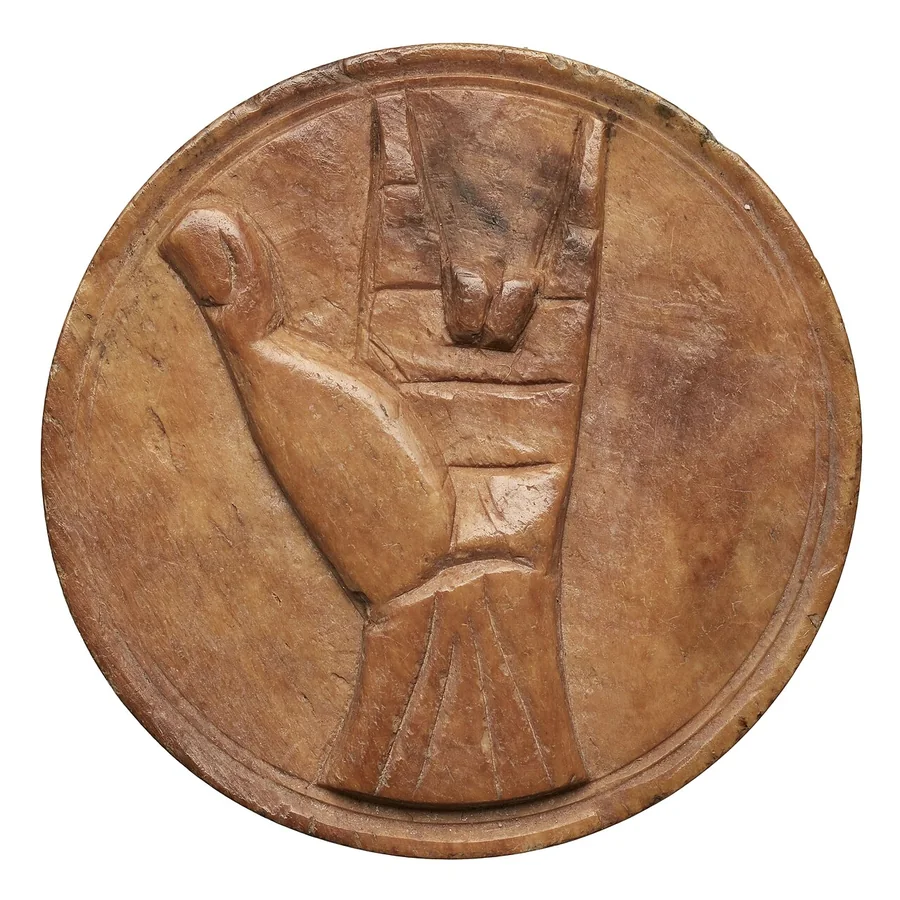
The hand that reaches 9,999
Bede the Venerable, a Benedictine monk in the north of England, described the system in the first chapter of De temporum ratione, the treatise on the reckoning of time finished in 725. The chapter is called De computo vel loquela digitorum, on reckoning and speaking with the fingers.
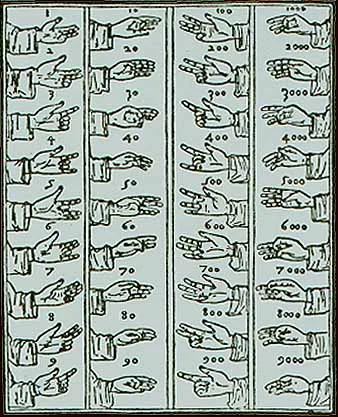
The rule fits in one sentence: the left hand carries the units and the tens, the right hand carries the hundreds and the thousands, in the same positions. The last three fingers of the left hand show the units from one to nine, while the thumb and index finger of the same hand show the tens from ten to ninety. One hand alone reaches 99; both together, 9,999.
One is shown by bending the little finger of the left hand into the palm; two adds the ring finger beside it, and three adds the middle finger. The same beginnings appear in Luca Pacioli's Summa de arithmetica, printed in Venice in 1494.
Give Bede a number
Type a number between 1 and 9,999 and see which finger fields the method assigns it to.
Left hand
54
The left hand shows 54
Right hand
54
The right hand shows 54
- 5,000on the thumb and index finger of the right hand
- 400on the last three fingers of the right hand
- 50on the thumb and index finger of the left hand
- 4on the last three fingers of the left hand
The starting example is 5,454: each hand shows 54.
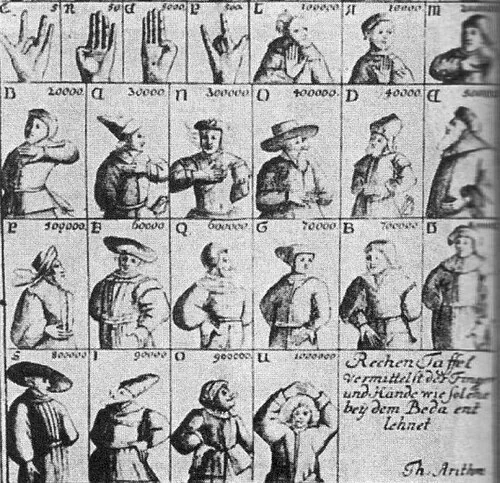
The system did not stop at the wrist: large numbers were shown with positions of the whole body. Ten thousand was shown with the hand on the chest.
Two fingers a Roman would not recognize
Latin called them index and pollex, and four Romance sisters keep them to this day. Italian says indice and pollice, French index and pouce, Spanish índice and pulgar, Portuguese indicador and polegar. Of the five major Romance languages, only Romanian replaced both: arătător and degetul mare.
Arătător comes from the inherited verb a arăta, to show, and degetul mare is a descriptive nickname, the big finger. Romanian knows the forms index and police too, but only as learned borrowings: index is the list at the back of the book, police is a dictionary neologism.
The rest of the fingers keep the Latin: mijlociu comes from mijloc, that is medius locus; inelar comes from inel, that is anellus; mic comes from late Latin miccus; and deget comes from digitus. Three names kept, two renamed.
| Latin | Italian | French | Spanish | Portuguese | Romanian |
|---|---|---|---|---|---|
| index | indice | index | índice | indicador | arătătorrenamed |
| pollex | pollice | pouce | pulgar | polegar | degetul marerenamed |
The hand, finger by finger
Touch each finger to learn its story.
All five names, in short
The thumb — renamed; the index finger — renamed; the middle, ring and little fingers — kept from Latin.
The index finger
Latin index
The Romance sisters say indice, index, índice, indicador. Romanian says arătătorul, the showing one, from the inherited verb a arăta, to show. The word index exists in Romanian only as a learned borrowing, with another meaning.
renamed
Whose finger is it?
Five Romance words, five answers. Each word is a finger's dictionary name.
1 of 5 · score 0
pollice in Italian
The answers, in short
pollice, pouce and pulgar are the thumb; indice, index, índice and indicador are the index finger.
What the page does not show
The details of each bend differ between sources — Pacioli himself reordered Bede's signs for symmetry — so the page shows only the division into fields: units, tens, hundreds, thousands. That division is the same everywhere.
The comparison covers the standard dictionary names in the five major Romance languages. Dialects, nicknames and small Romance languages fall outside the count.
The page does not say which finger Romanians start counting from today; today's habit is another inquiry.
Sources
The Romanian etymologies come from DEX, through dexonline; the rest, from the dictionaries cited for each word. The renderings from Latin belong to Marius Comper.
- Thijs Porck, “Bits of Bede. Or: Why Bede deserves his own museum” (2016) — the system's description. thijsporck.com
- Y. Nishiyama, “Counting with the Fingers”, International Journal of Pure and Applied Mathematics 85(5), 2013, after Menninger — one, two, three. ijpam.eu
- Wikipedia, “Finger-counting” and “Dactylonomie” — the field division. en.wikipedia.org · fr.wikipedia.org
- Encyclopaedia Britannica, “De temporum ratione” — the 725 dating. britannica.com
- dexonline, DEX '09: arătător · arăta · deget · neologism dictionary: police.
- Wiktionary: index · pollex · mijloc · inelar · mic — the Latin descendants of each name.
- Spanish dictionary: pulgar from Latin pollicaris. educalingo.com
- Matraga (Rio de Janeiro State University): polegar from Latin pollex. e-publicacoes.uerj.br
- Portuguese dictionary: dedo indicador, the finger between polegar and médio. collinsdictionary.com
- The file page for Pacioli's finger positions (1494) — the reordering for symmetry. en.wikipedia.org
