The linguistic atlas of Italy, 1928–1940
Where Italian dialects sound like Romanian
A century ago, fieldworkers for an atlas led by two Swiss linguists asked people in 407 villages of Italy and Switzerland what they called more than a thousand things, and wrote each answer down as it sounded. Where Italian says tavola, sole and fiele, some villages said mɛza, sorɛli and fer, much as Romanian says masă, soare and fiere. Pick a word and see what each village said.
Pick a Romanian word
Each patch on the map is a surveyed village. It lights up when the form recorded there comes from the same Latin word as Romanian and changed in the same way. We start with masă, table.
Archaisms: old words kept, replaced in Italian
Innovations: changes made as in Romanian
The 21 words, in brief
- masă (table): Latin had two words for table: mensa and tabula. Romanian kept the first, Italian the second (tavola). In 37 villages people said mɛza or mɛjzɐ: 17 in the Swiss canton of Graubünden, three Ladin villages in the Dolomites and 17 in Sardinia.
- alb (white): Italian replaced Latin albus with bianco, a Germanic word. Romanian kept alb. In the atlas, alv or alp appears only in the canton of Graubünden, in 18 villages.
- biserică (church): Romanian and Romansh took their word for church from basilica; Italian from ecclesia (chiesa). In 18 villages of Graubünden people said bɐzelɟɐ.
- cap (head): Italian says testa, from a Latin word for an earthenware pot. Romanian kept caput: cap. Forms from caput (kapu, ko, caw) were recorded in 111 villages, spread from the Po plain to Calabria.
- frate (brother): Italian switched to the diminutive fratello. Romanian kept frater: frate. 193 villages used a form without the diminutive: frati in the south, fraðe in Sardinia, frar in Graubünden.
- soră (sister): The same as with brother: Italian says sorella, a diminutive; Romanian kept soror: soră. In 126 villages the form had no -ella suffix.
- a ruga (to pray): Italian prays with pregare, from precari. Romanian has a ruga, from rogare. Only two Romansh villages said ruɡa dew, ‘to pray to God’.
- gură (mouth): Latin called the mouth os; Italian took bucca (bocca). Romanian gave gula, ‘throat’, the meaning of mouth. 9 villages did the same: ɡula in the Occitan valleys of Piedmont, ɡuɾɐ in Rochemolles.
- tulbure (cloudy): Classical Latin said turbidus, hence Italian torbido. Late Latin also had turbulus, the source of Romanian tulbure (cloudy). Forms from turbulus (torbol, turbɐlo, truvələ) appear in 113 villages, from Graubünden to Naples. Only 11 Lombard villages, around Canzo, Monza and Vigevano, also swap r and l as Romanian does: tulbur, tulbɐr.
- pădure (forest): Romanian pădure (forest) comes from padulem, a form of Latin paludem (marsh) with l and d swapped. The same swap appears in 50 villages, from Piedmont to Puglia and in Sardinia: padule, padyl. There the word still means marsh; in Romanian it came to mean forest.
- soare (sun): From solem, Romanian made soare, with l turned into r. 23 villages also have an r: sorɛli in Friuli, soredl in the Dolomites, sɔre in Sassari.
- moară (mill): Moară (mill) comes from mola, with l turned into r. In 26 villages the word for mill has an r too: muriŋ in Ticino, muɾiŋ in Liguria, murinu in Sassari.
- scară (ladder): From scala, Romanian scară. 19 villages said skara or ʃkarɐ, almost as in Romanian, mostly in Ticino, Lombardy and Liguria.
- fiere (bile): From fel, Romanian fiere (bile). 14 villages said la fer. Italian has fiele, with l.
- păr (hair): From pilus, Romanian păr (hair). 15 villages said per or piɾu; Italian says pelo.
- cur (arse): From culus, Romanian cur (arse). Italian says culo; 9 villages said kurə or kuɾu, from Norcia to Bronte.
- nor (cloud): Nor (cloud) comes from nubilum, with l turned into r. In 21 villages the cloud had an r too: nyrʊ in Ticino, nivura in Liguria.
- secară (rye): From secale, Romanian secară (rye). 16 villages had seɡra or siɣra; Italian has segale.
- purice (flea): From pulicem, Romanian purice (flea). 13 villages said pyrɐs or purɐs. Tuscany and Rome have purce, but there the r stands before a consonant, a different change that is not counted here.
- înger (angel): From angelus, Romanian înger (angel). 8 villages said andʒɛr or andʒiɾu.
- sare (salt): From salem, Romanian sare (salt). Here the likeness is rare: only 3 villages, among them Bronte (saɾi) and Sassari (sari).
What a village keeps, and what it changes as Romanian did
On the map for masă, the villages that talk like Romanians sit at two ends: in the Swiss mountains and in Sardinia. Between them, from Milan to Palermo, people say tavola. The same pattern repeats for white and church: the forms from albus and basilica survived only in Graubünden. The Italian linguist Matteo Bartoli described this pattern in the 1920s: isolated or peripheral areas often keep old words that the centre has replaced.
A kept word, though, says little about kinship. Mensa is the old Latin word; tabula, in the sense of table, is the novelty. If Romanian and Sardinia both say masă, that only shows neither took up the novelty; it does not show a shared history. Linguists call such words archaisms.
A change made in the same way, an innovation, says more. Latin called the mouth os. Spoken Latin moved to bucca, ‘cheek’, hence Italian bocca. Romanian went further: it took gula, ‘throat’, gave it the meaning of mouth and turned its l into r: gură. In the atlas, nine villages in the Occitan valleys of Piedmont also call the mouth ɡula, and Rochemolles says ɡuɾɐ, almost as in Romanian. Two changes, made the same way.
Dan Ungureanu gives an example from one sentence in Milanese dialect: ul vin e bun, ul vin e tulbure, ul vin e reo; le osa me doer; suna le campane. Almost every word shares a change with Romanian: buono shortened to bun, male replaced by reo (Romanian rău), le ossa mi dolgono shortened to oasele mă dor, suonano to sună. Innovations like these let us say, he argues, that Romanian split from the rest of Latin after northern Italy had already given up turbidus for turbulus.
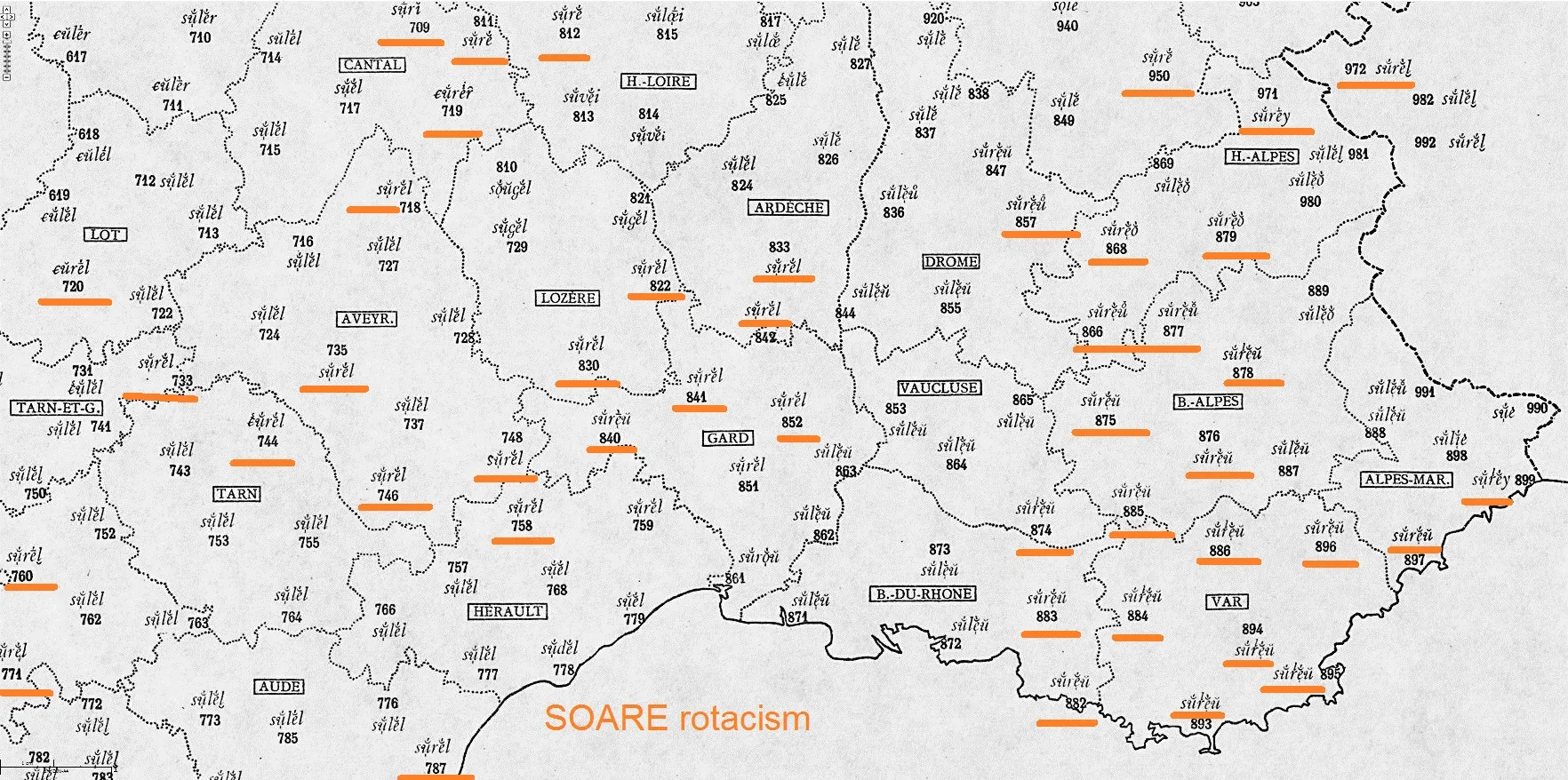
That is why the words on this page are split in two: 7 archaisms and 14 innovations. Most of the innovations are the l that became r: solem gave soare, mola gave moară. A similar change happened in Liguria, Piedmont and the Lombard-speaking valleys of Ticino. It is a common sound change that can also arise separately; Dan Ungureanu argues, however, that in the north-west it forms one old, continuous area that extends into France. The map below shows it.
Where r is said for l, from Liège to Sicily
The map below shows no villages: it shows the areas where l between vowels became r, as in Romanian, as Dan Ungureanu describes them in the chapter on rhotacism of his History of the Romanian Language. Pick an area for examples.
- The continuous area
- Eastern Provence and the Occitan valleys of Piedmont, Monaco, Liguria, Monferrato, Ticino and Alpine Lombardy, reaching into the Ladin valleys and the Ligurian colonies of Sassari and Bonifacio. Menton says sorey ‘sun’ and taura ‘table’; Genoese poems of around 1300 have sor, gora, angero, zer ‘frost’; Ticino has murin ‘mill’, scüra ‘school’; Ampezzo sciara ‘ladder’. In dialect, Milan was called Miran until the 17th century.
- Rare or old traces
- Lyon had fiâr ‘bile’ and ciar ‘sky’; Burgundy cier. In 1529 Geoffroy Tory noted that pupils from Burgundy and Forez said mer and fer instead of mel and fel. Franche-Comté and the southern Vosges have seroey ‘sun’, mŏrẽ ‘mill’; Wallonia li sir ‘the sky’; rare in Friuli (sorei) and Emilia (Bobbio gùra).
- Northern colonies in the south
- Bronte, Randazzo, Novara di Sicilia and Fantina in Sicily; Faeto and Celle in Puglia, Franco-Provençal colonies founded before 1275; Ripacandida and Pignola in Basilicata; the area that says kuru, from Norcia to Molise. According to Dan Ungureanu, this r was brought from the north.
- A different change
- In Gascony, Béarn and the Aran valley only double l becomes r: gallina gives garia, bella gives bera, as in Asturias. It is a different change from the Romanian one.
- Only ‘sun’, in France
- The areas where, on map 1241 of the Atlas linguistique de la France (1902–1910), ‘soleil’ is said with r: sūrēl, sərey, srēy, outlined by Dan Ungureanu. Other words once had r in other places too, but lost it long ago.
Dan Ungureanu argues that the continuous area of Provence, Liguria and Alpine Lombardy is neither an innovation that arose separately in each place nor a late development: it is old, it is retreating, and Piedmontese, which arrived later, split it in two. He attributes it to a substrate older than the Celts and cites Basque parallels: ainguru from angelu, gura ‘greed’ from gula, zeru from caelum. This is his interpretation; other linguists explain some of these rs differently, for example the one in sorelh as dissimilation of the two ls of *soliculum.
The village that changed its words as Romanian did: Bronte, in Sicily
Counting archaisms, the most ‘Romanian’ village is Vrin, in Graubünden: 7 out of 7. But Vrin has only 1 of the 12 innovations. It kept many old words without changing them as Romanian did. Counting innovations, first comes Bronte, a town on the western slope of Etna, with 9 out of 12. Next are Sassari, with 7 out of 10, and Canzo, near Lake Como, with 9 out of 14. Rome has 0 out of 12.
Bronte is an island within Sicily. Unlike the rest of Sicily, its dialect turns l between vowels into r: kuɾu, saɾi, fɛɾi. Its Sicilian neighbours say kulu, sali, fɛli. According to Dan Ungureanu, this r came from the north with settlers from Monferrato who founded neighbouring Maniace, and Sassari, in second place, is a Ligurian colony. Rhotacism in the south is borrowed. Bronte has few archaisms: 2 out of 7.
The ranking depends on the words chosen. They were chosen because a Romanian recognises them, and most innovations are one sound change repeated across several words, so the map shows where likenesses to Romanian cluster without measuring kinship. 200 villages have no innovation in the Romanian form.
- 1 Bronte 9 / 12
- 2 Sassari 7 / 10
- 3 Canzo 9 / 14
- 4 Rochemolles 5 / 8
- 5 Arcumeggia 8 / 13
- 6 Osco 7 / 12
- 7 Sonogno 7 / 12
- 8 Corticiasca 8 / 14
- 9 Olivone 6 / 11
- 10 Indemini 6 / 12
A hundred years later
Between 2016 and 2025, the ‘AIS, reloaded’ team at the University of Zurich went back to 86 villages in Italian-speaking Switzerland, Graubünden and Lombardy and asked the same questions. The words kept from Latin held on: the word for church from basilica (now mostly bɐzɛlɟɐ) is still heard in all 18 villages that had it, the word for table from mensa (now mostly majzɐ) in 17 of 17. The forms with r retreated faster. Mill with r survives in 8 of 13 villages, bile with r in 3 of 9. In Corticiasca, where people said ɛra fer at the first survey, they now say ra bile, as in Italian.
| Word | Then | Now | Chart |
|---|---|---|---|
| masă (table) | 17 | 17 | |
| alb (white) | 18 | 14 | |
| biserică (church) | 18 | 18 | |
| cap (head) | 30 | 27 | |
| moară (mill) | 13 | 8 | |
| scară (ladder) | 11 | 10 | |
| fiere (bile) | 9 | 3 | |
| păr (hair) | 10 | 8 | |
| nor (cloud) | 10 | 9 | |
| secară (rye) | 6 | 5 | |
| purice (flea) | 9 | 7 |
Search any word in the atlas
The atlas has 2,966 maps with answers, from father and bile to the names of spinning tools. Type a word in English, Italian or Romanian. Villages are coloured by the first sounds of the word recorded there, so patches of one colour usually say a related word.
How the atlas was read
The answers come from the Sprach- und Sachatlas Italiens und der Südschweiz (AIS), made by Karl Jaberg and Jakob Jud. The fieldworkers Paul Scheuermeier, Gerhard Rohlfs and Max Leopold Wagner wrote down each village’s answers in the field; the maps were published in eight volumes from 1928 to 1940. We use the digital edition of the ‘AIS, reloaded’ project (University of Zurich, 2026), which also gives every answer in the International Phonetic Alphabet. Transcriptions on this page are from that edition, without stress and length marks.
For each of the 21 words we took the atlas map that contains it (for example il fiele for bile, la tavola for table) and wrote a rule that looks, in the recorded form, for the stem of the Latin word with the same change as in Romanian: f, a vowel and r for bile; m, a vowel and z or s for table. We then read the matching forms one by one. A village with no answer to a question is left out of that word’s count.
For a ruga, the map asks ‘to pray to God’; for sun, ‘the sun rises’; for mill, ‘the mill’, where Romanian keeps mola and the dialects usually have molinum. Both have l turned into r, so they are counted together.
Three villages have no coordinates in the digital edition (Gambarare, Verbicaro and Bronte); we placed them at the town centre. The patches on the map are the areas closest to each village, cut off at about 45 kilometres; they show where the village is, not the borders of a dialect.
The 2016–2025 re-survey covers only Italian-speaking Switzerland, Graubünden and Lombardy, so ‘A hundred years later’ refers only to those villages.
Sources
- Loporcaro, M. et al. (2026). AIS, reloaded, dataset, version 2.0.0, University of Zurich. doi.org/10.5281/zenodo.19832160. Licence CC BY-NC-SA 4.0; the map data on this page are shared under the same licence.
- Jaberg, K. and Jud, J. (1928–1940). Sprach- und Sachatlas Italiens und der Südschweiz. Zofingen: Ringier. Browse it in NavigAIS and AIS, reloaded.
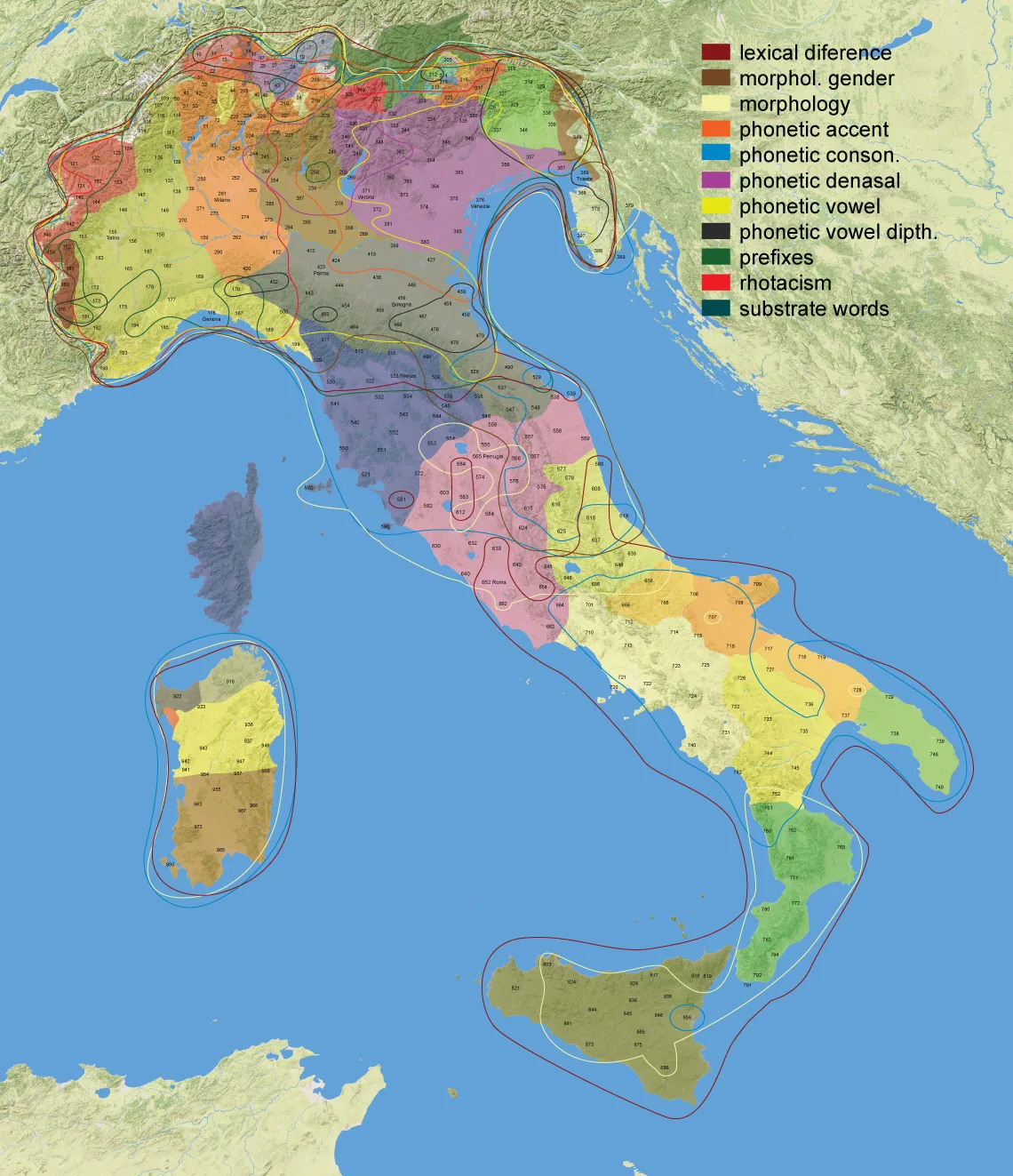
- The 374 annotated maps, the French ‘sun’ map and the chapter on rhotacism: Dan Ungureanu; summary map: Paul Stet.
- Gilliéron, J. and Edmont, E. (1902–1910). Atlas linguistique de la France, map 1241 ‘soleil’; public domain.
- Coastlines, lakes and borders: Natural Earth, public domain.
- Fonts: Gentium Book Plus (SIL International) and Newsreader, SIL Open Font Licence.