Marius ComperVânători-Neamț
Română

Dragoș Vodă Bison Reserve & Neamț Primeval Woods

From enclosure to forest: bison at Vânători-Neamț

Five bison were released into the forests of Vânători-Neamț in 2012. Follow how they got there and what researchers learned from the GPS collars worn by free-ranging bison.

Start with the three states ↓
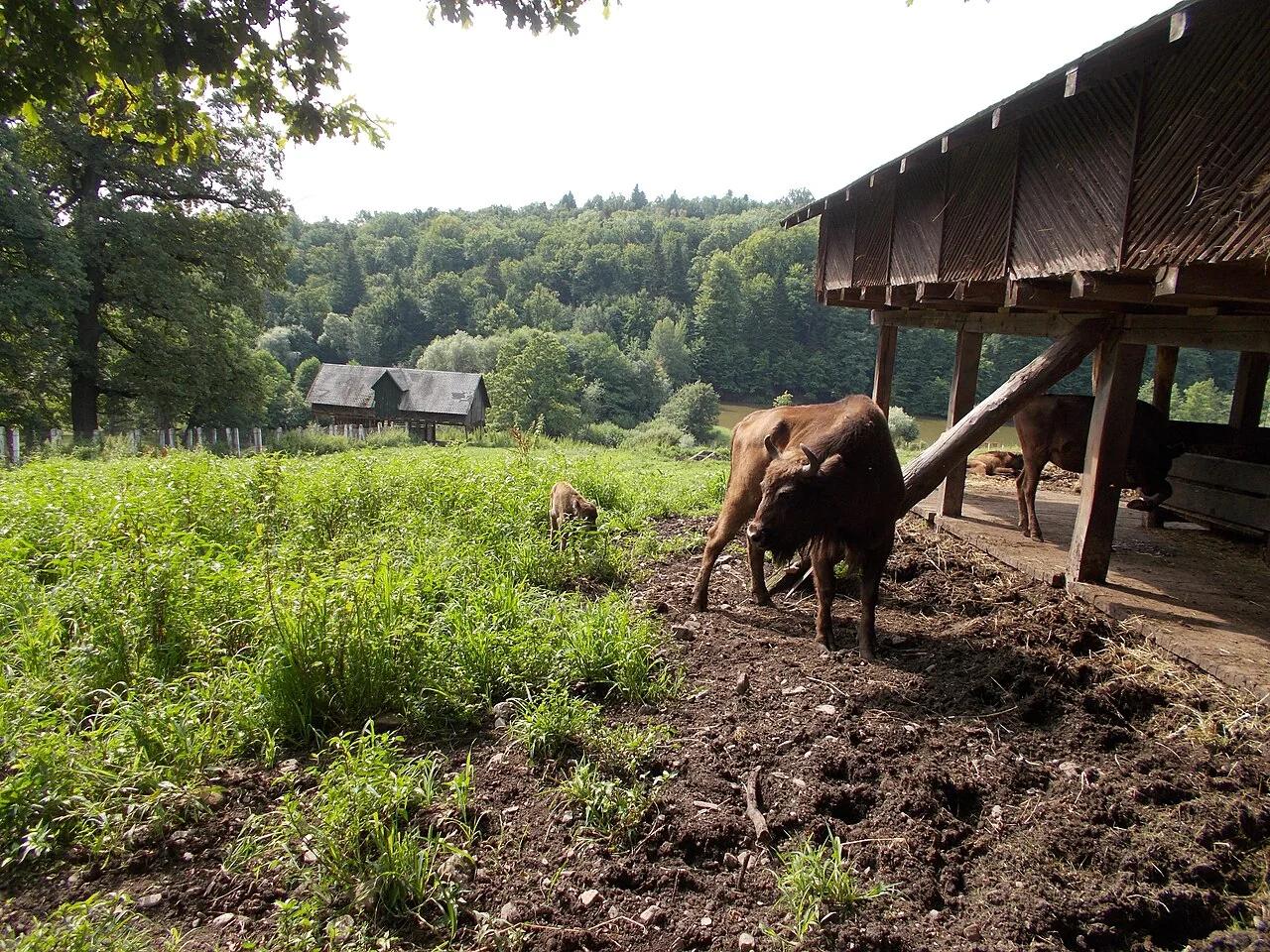
Bison in the clearing beside a shelter at Dragoș-Vodă reserve.
Nicu Farcaș, 2021, CC0. The shelter and feeding point show the reserve setting; this is not a forest-release image. (Source · Nicu Farcaș · CC0 1.0)

Three states

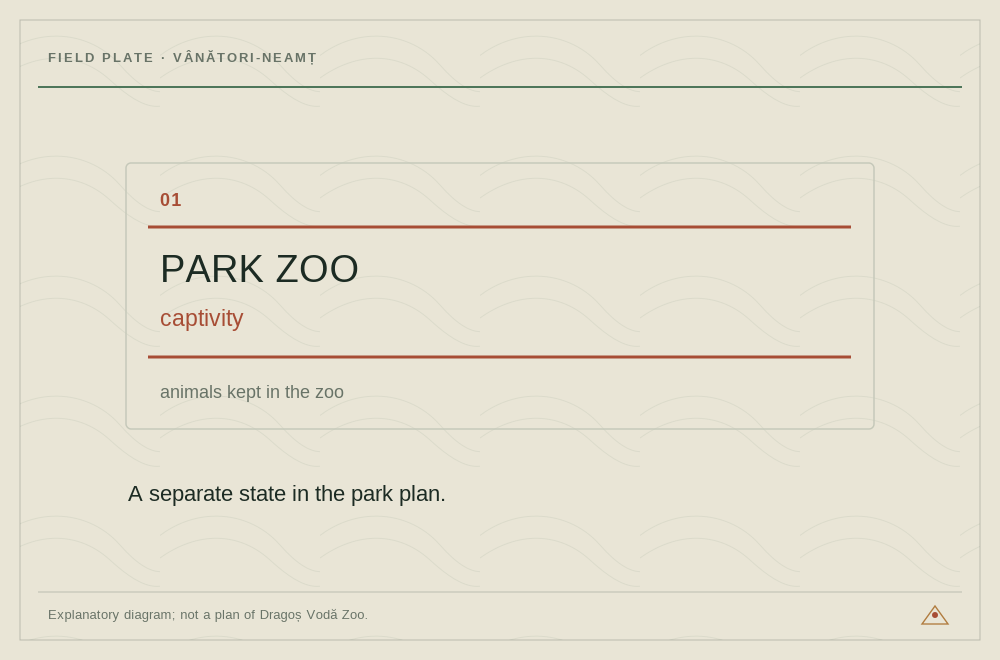
Explanatory diagram of a bison kept in captivity; not a zoo plan.
Dragoș Vodă Zoo is one of the three situations named in the plan. (Source · Explanatory diagram)

Three states

What does “free-ranging” mean here?

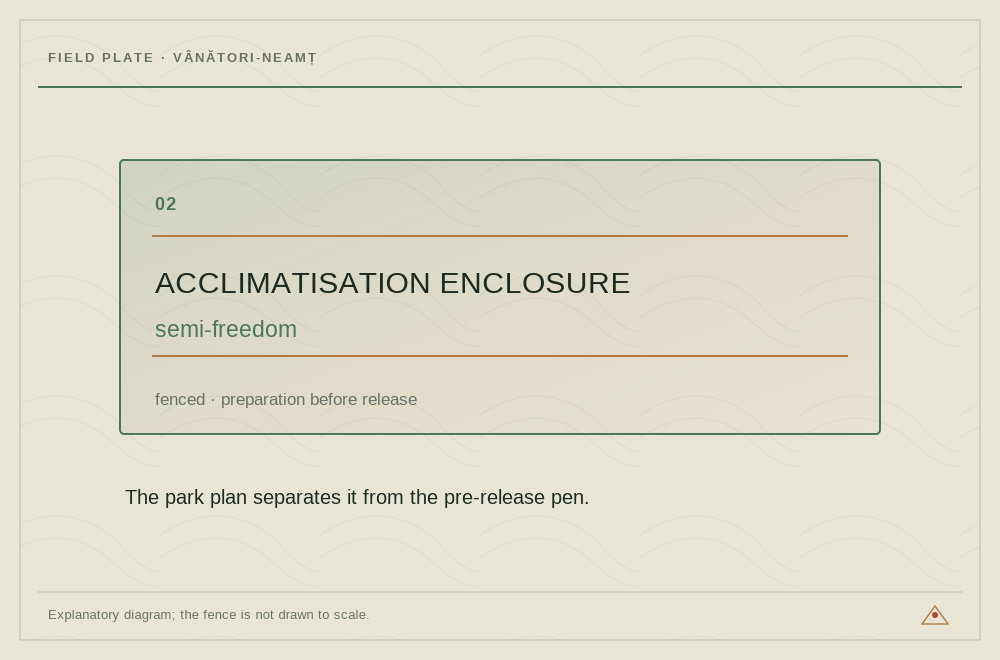
At Vânători-Neamț, “bison” can refer to three different situations. The park plan distinguishes animals kept in the Dragoș Vodă zoo, bison held in semi-freedom in the acclimatisation enclosure, and animals released to range through the protected area. A photograph taken in the reserve does not prove that the animal in the frame lives in the forest; place and status must be read separately. [2] [6]

This story follows the move from enclosures into free-ranging life, and how researchers measured that change. Switch among the three views: each shows a distinct setting, not a map of the fences or animals. The management plan uses three different categories and separately describes an acclimatisation enclosure of 189 ha and a pre-release area of 2.4 ha. [2]
Explanatory diagram of a bison kept in captivity; not a zoo plan.
Dragoș Vodă Zoo is one of the three situations named in the plan. (Source · Explanatory diagram)
Explanatory diagram of the acclimatisation enclosure; no scale or location shown.
The acclimatisation enclosure remains fenced and is distinct from the pre-release pen. (Source · Explanatory diagram)
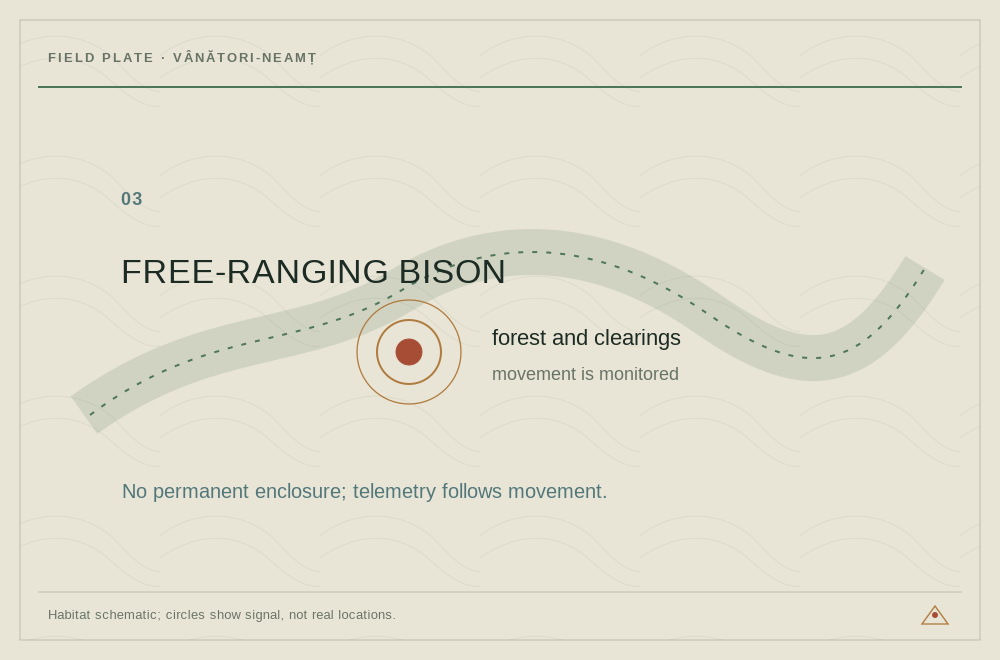
Schematic free-ranging habitat; the point and rings are symbols, not GPS data.
The open area illustrates the park’s category, not the positions of live animals. (Source · Explanatory diagram)

The reserve

The reserve came before release

The park’s history records that three bison of Polish origin were transferred from the Hațeg-Slivuț reserve to Vânători-Neamț in 1969. The same park’s education programme gives 1970. The park’s chronology records 12 bison in the reserve in 1977. [1] [3]

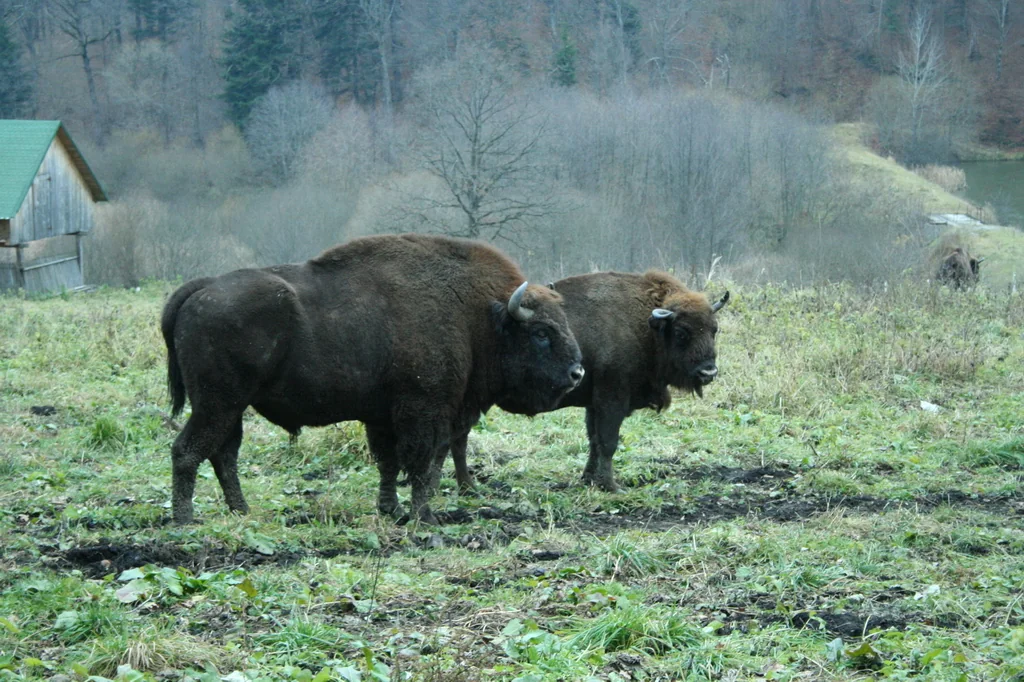
The photographs show two moments in the reserve, in 2005 and 2021. The later image shows a covered feeding point; neither documents the 2012 release or the life of any particular free-ranging herd. We use them to see the managed setting before turning to the records about the forest. [7] [8]
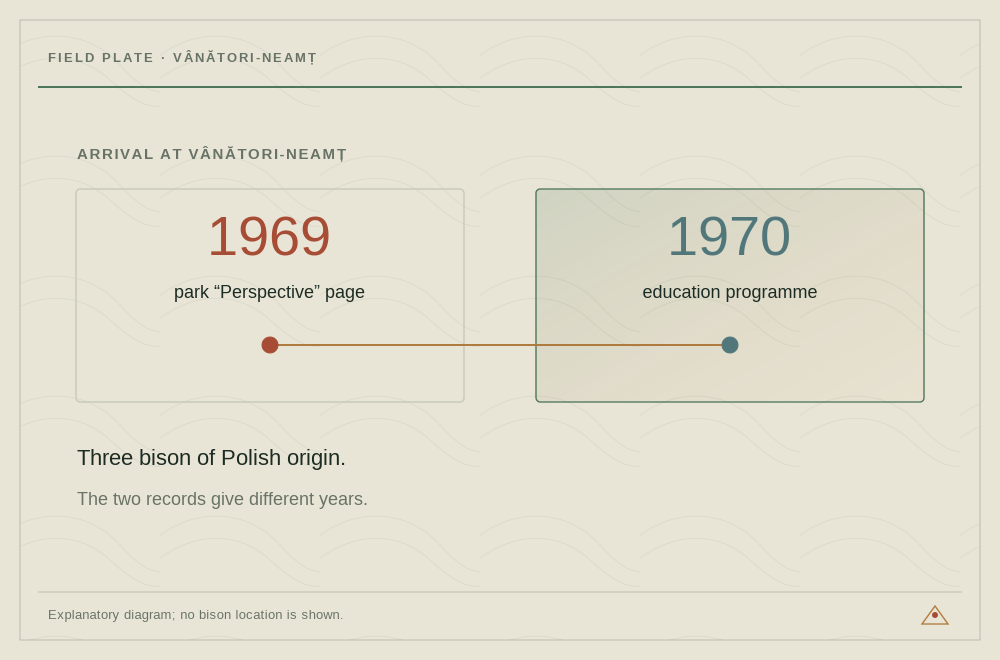
Comparison of the two dates published for the bison’s arrival at Vânători-Neamț, 1969 and 1970.
The park history dates the three bison’s arrival at Vânători-Neamț to 1969. Its education programme gives 1970. (Source · Explanatory diagram)
Two bison in a clearing, with a wooden hut at left and forest behind. Photograph from 2005.
The creator places the photograph at Vânători-Neamț; the frame does not identify the animals’ status. (Source · Ccezar2004 · Public domain by creator dedication)
Bison beside an open shelter and feeding point at Dragoș-Vodă reserve. Photograph from 2021.
The image shows bison by a covered feeding point; it is not a photograph of the forest release. (Source · Nicu Farcaș · CC0 1.0)

The enclosures

Two enclosures, two stages

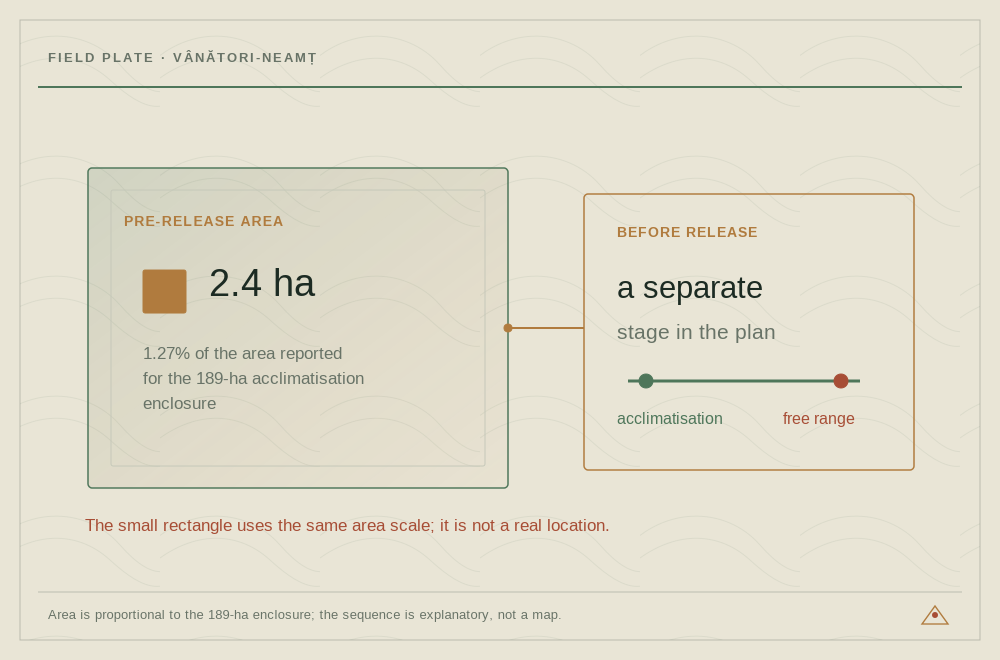
The management plan distinguishes the acclimatisation enclosure, where bison are kept in semi-freedom, from the pre-release enclosure, used before animals are set free. The first measures 189 ha in the plan; the second, 2.4 ha. They are not two names for one pen. Another education document gives 181 ha for the acclimatisation area without explaining the difference; here we use the plan’s figure and definition. [2] [3]

The park’s visitor guide also helps with an easy mistake: the bison safari looks for animals in the acclimatisation enclosure. Seeing a bison there does not mean you have seen a free-ranging animal. The diagram compares the published roles and figures, but does not show the enclosures’ real shapes, locations or proximity to each other. [2] [6]
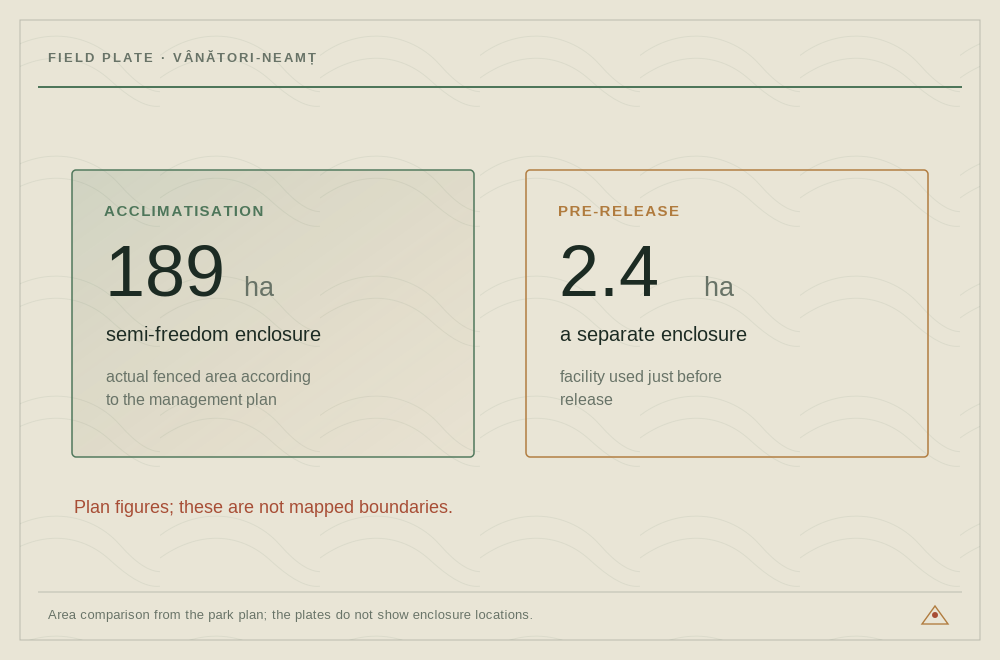
Explanatory plate: 189-ha acclimatisation enclosure according to the management plan.
The management plan gives 189 ha as the actual area of the enclosure; an education document gives 181 ha. The diagram is not a measured boundary. (Source · Explanatory diagram)
Explanatory plate: 2.4-ha pre-release area; not a mapped location.
The plan separately describes a 2.4-ha pre-release area, used before release. (Source · Explanatory diagram)

The release

The first group left on 22 March 2012

The park dates its first free release to 22 March 2012: five bison, three males and two females, aged between three and seven. The animals were fitted with radio collars so their movements and habitat use could be followed; soon afterwards, the first two free-ranging calves were recorded. [1]

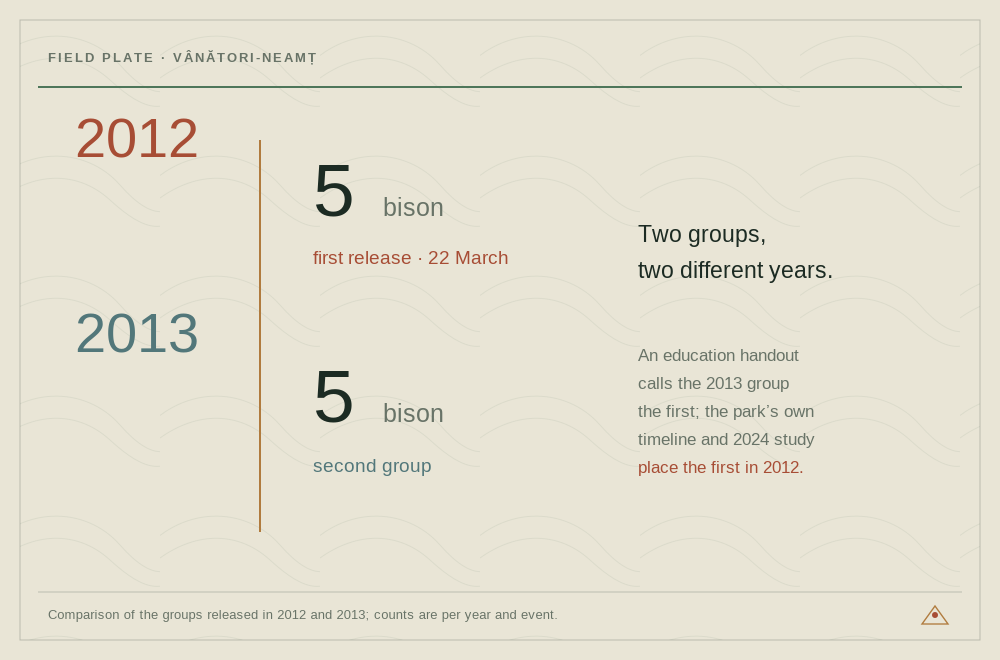
Why does 2013 sometimes appear as the year of the first release? A park education handout calls the 2013 group “the first”, but the park’s detailed chronology, Rewilding Europe and a 2024 research paper describe two successive groups: five in 2012, then five in spring 2013. The diagram keeps the first group distinct from the next one. [1] [3] [4] [5]
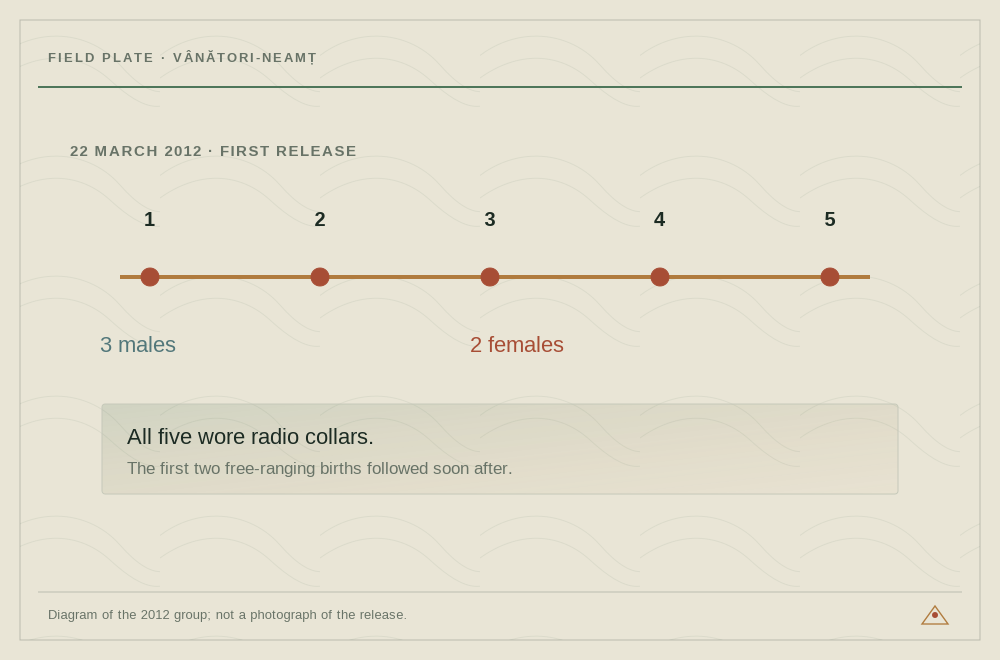
Five symbolic points: three males and two females released in 2012.
Diagram of the 2012 group; no depicted symbol represents an individual bison. (Source · Explanatory diagram)
Timeline: five bison in 2012 and another five in 2013; a park education handout disputes the first release year.
Comparison of two groups of five bison released in different years. (Source · Explanatory diagram)

Telemetry

Five bison, thousands of positions

A 2024 study analyses GPS data from five free-ranging bison—four females and one male—tracked between 2014 and 2019. The GPS collars recorded one position every two hours, up to 12 per day for an animal with a valid signal. The sample covers five individuals, not all bison in the park. [4]

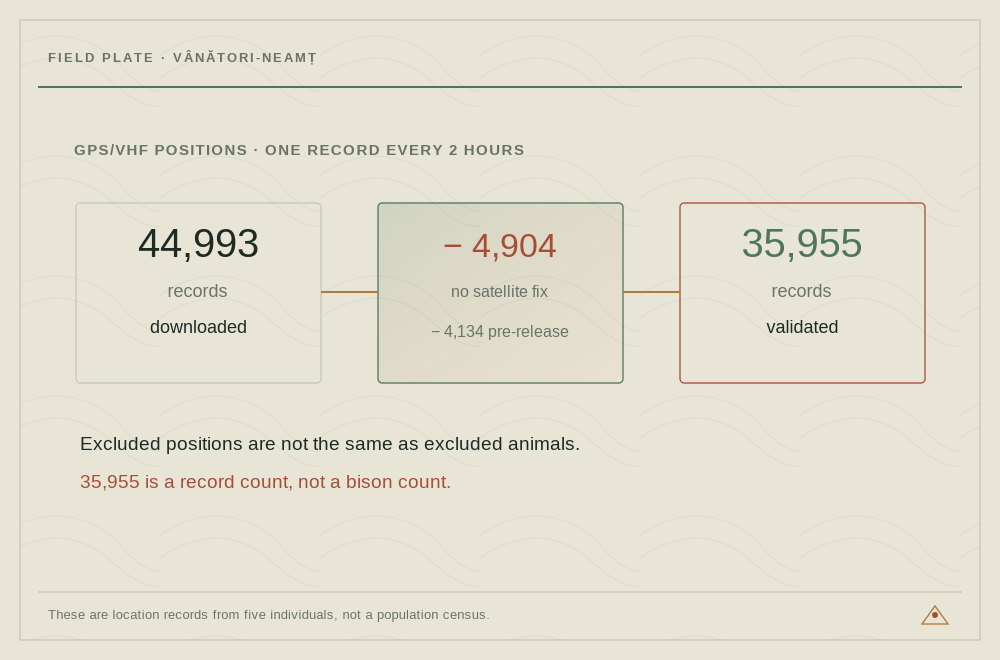
Researchers downloaded 44,993 records. They excluded 4,904 without a satellite fix and 4,134 from the pre-release period, then analysed 35,955 validated positions. Switch between the number of individuals and the data filter: the tens of thousands count positions, not animals. And points on a monitoring map are recorded moments, not a continuous census of the forest. [4]
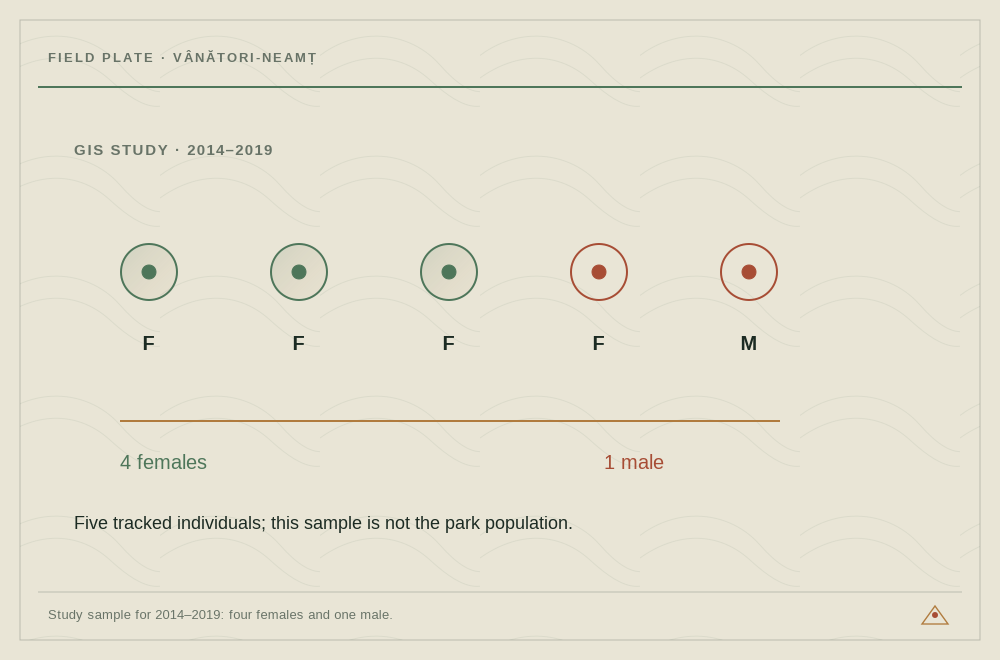
Five symbols: four females and one male wearing GPS collars in the 2014–2019 study.
The study tracks four females and one male from 2014 to 2019; the sample is not the park population. (Source · Explanatory diagram)
Study data filter: 44,993 raw records, exclusions and 35,955 validated positions.
35,955 is the number of validated GPS records after exclusions, not bison. (Source · Explanatory diagram)

The range

From GPS points to an area used

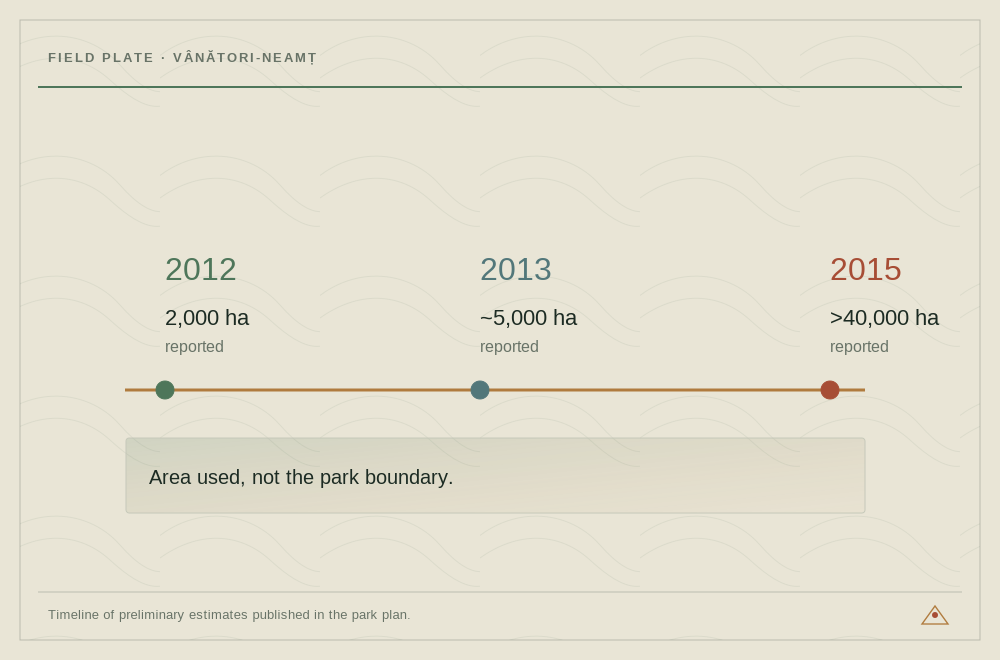
The management plan publishes preliminary estimates of the area used by free-ranging bison: 2,000 ha in 2012, about 5,000 ha in 2013 and more than 40,000 ha in 2015. These figures describe the reported range for each year across deciduous and mixed forests; they are neither the acclimatisation enclosure nor the park boundary. [2]

The plan says these were preliminary data available up to 2016. Researchers combined collar positions with observations about habitat use and movement; the circles here preserve only the area comparison. They do not show where any individual bison travelled and should not be used as a map of current movement. They show, for separate years, how much the reported area of bison use expanded. [2]
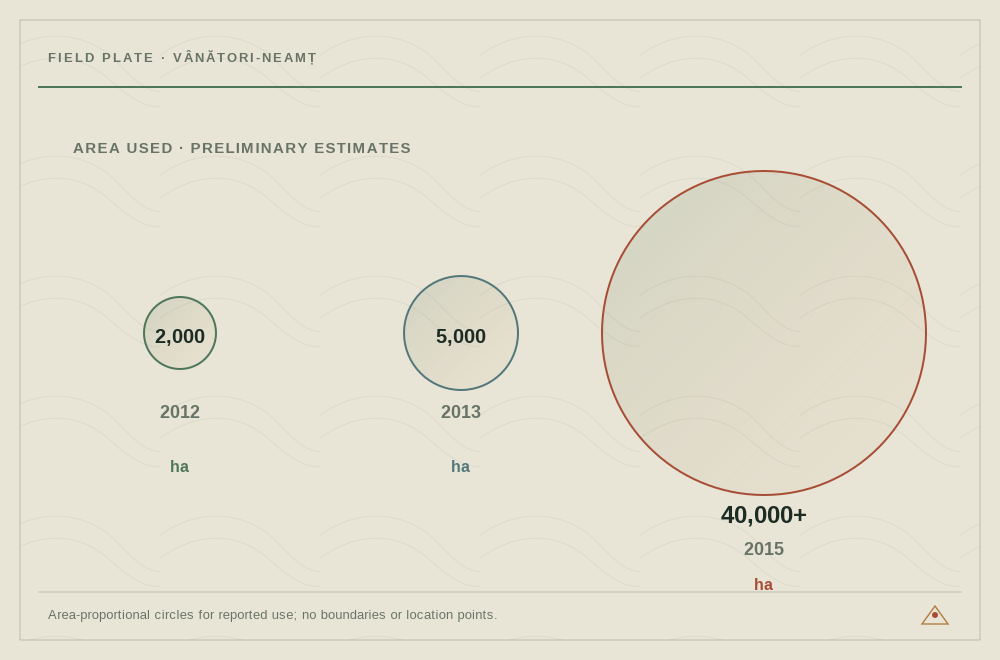
Preliminary estimates of area used: 2,000 ha in 2012, about 5,000 ha in 2013 and over 40,000 ha in 2015.
Circles compare only the areas reported in the plan; they are not map geometries. (Source · Explanatory diagram)
Timeline of preliminary areas reported for three separate years.
Timeline comparison of area used, not animal counts. (Source · Explanatory diagram)

Sources

At Vânători-Neamț, release was a dated event, and monitoring continued for years. Read the acclimatisation enclosure, pre-release area and forest separately, and the figures regain their proper scale: groups released, animals tracked, GPS records and reported areas.

  1. Vânători-Neamț Natural Park, “Perspectives”Park chronology for the first bison arrivals, the 22 March 2012 release, later groups and radio-collar monitoring.
  2. Vânători-Neamț Natural Park, management planDistinguishes zoo, acclimatisation enclosure and free-ranging animals; describes the 189-ha acclimatisation enclosure, 2.4-ha pre-release area and preliminary estimates of area used in 2012, 2013 and 2015.
  3. Vânători-Neamț Natural Park, education programmeAn official source that dates the first arrival to 1970, while the “Perspectives” page says 1969; its summary calls the 2013 group the first release, against the park’s detailed chronology and the 2024 study.
  4. Dănilă et al., “GIS analysis of the spatial distribution of European bison…” (2024)Analyses five GPS-collared bison during 2014–2019; specifies the recording interval, exclusions and number of validated records.
  5. Rewilding Europe, Vânători-Neamț projectConfirms two consecutive releases: five bison in 2012 and five in spring 2013.
  6. Vânători-Neamț Natural Park, “Bison safari”Describes visits to the acclimatisation enclosure, distinct from the free-ranging bison.
  7. Photograph: “Vanatori neamt.jpg” (2005)Two bison photographed at Vânători-Neamț; creator Ccezar2004 dedicated the image to the public domain.
  8. Photograph: Nicu Farcaș, “Dragoș-Vodă Bison Reserve” (2021)Bison by shelter and feeding point in the reserve; CC0. This is not a photograph of the forest release.