
Wild African elephants
Elephants may call each other by name. Scientists still disagree.
Wild elephants in Kenya seem to use calls meant for one listener. A 2024 study analysed 469 recorded rumbles and found evidence of it; a 2026 reanalysis says it is not proven. Start with the sound.
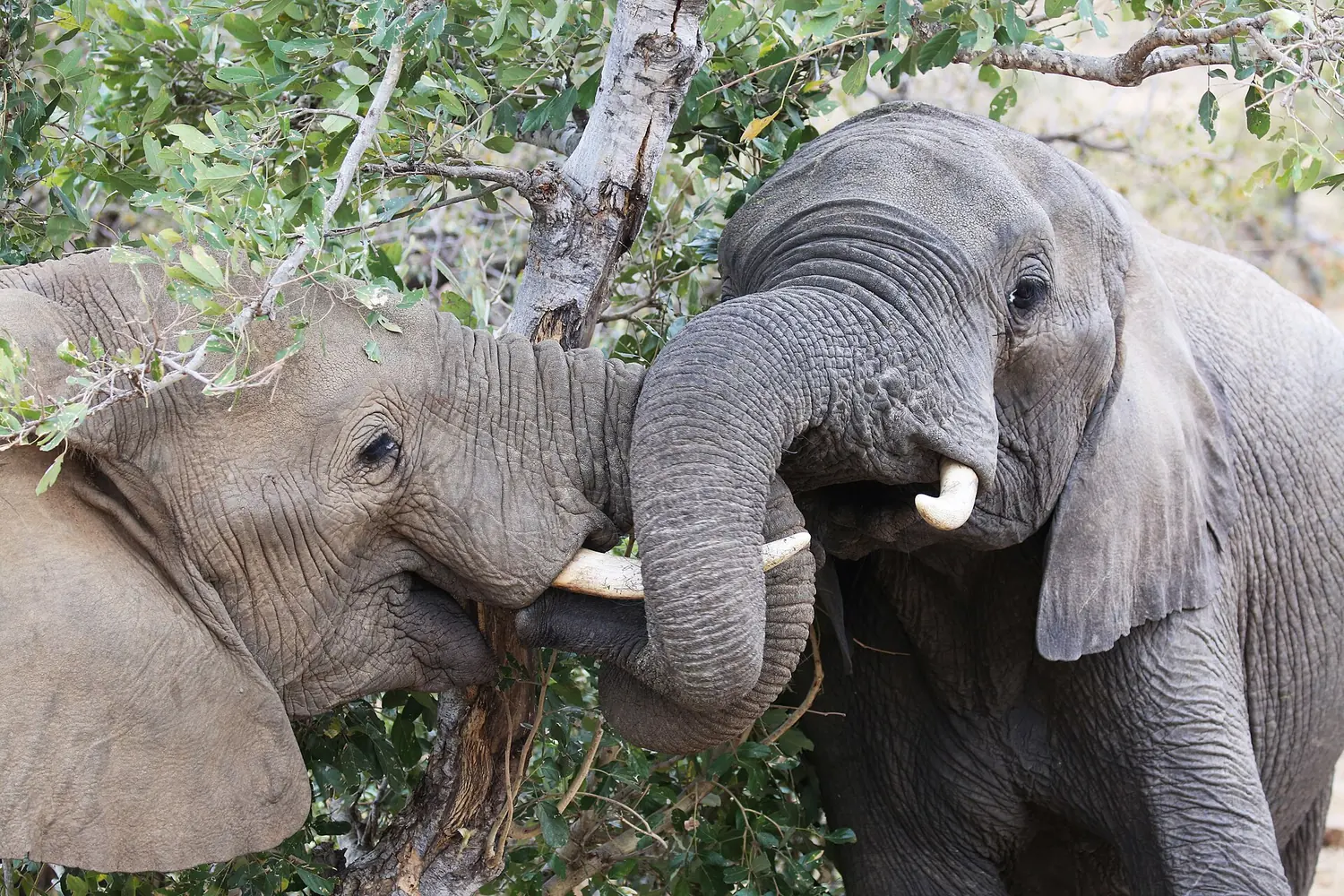
Lie down in the grass and listenTwo young elephants, Namibia. Photo: Giles Laurent, CC BY-SA 4.0.
Lie in the grass and listen

A dusk scene, imagined on a real photograph. A rumble arrives from far away and you answer it. Read on for the real recordings and numbers.
The call as recorded
Frequencies in the recording, 0 to 200 Hz: the call and, after it, the part used as your answer. In the first call, about 37% of the sound’s energy lies below 20 Hz, the usual lower limit of human hearing, and about 89% below 60 Hz (our own measurement from the recording).
You hear the rumble raised by three octaves, so that a phone speaker can play it. As recorded, most of its energy lies at the very bottom of human hearing or below it. “As recorded” is best on headphones.
An imagined scene on a real photograph (Kruger National Park, South Africa; the study's recordings were made in Kenya). Photo: leftcoastenvy, CC BY 2.0.
Who recorded what, and where
Researchers followed families of female elephants and their young in two parts of Kenya: Amboseli National Park (recordings from 1986 to 1990 and from 1997 to 2006) and the Samburu and Buffalo Springs reserves (2019 to 2022). They recorded from a vehicle, and they knew every elephant by the shape of its ears.

From these recordings they kept 469 rumbles in which the receiver was most certain: calls from 101 different elephants to 117 different elephants. There were no adult males among the callers. A rumble is the elephant’s main call, a low sound made in most situations.
Three kinds of call
- Contact callTo an elephant out of sight, more than about 50 metres away. The one it was meant for is the only adult who was separated, or the only one who answered.
- GreetingWhen one elephant walks up to another, to within touching distance.
- CaregivingWhen a mother or another older female comforts, nurses or wakes a calf.
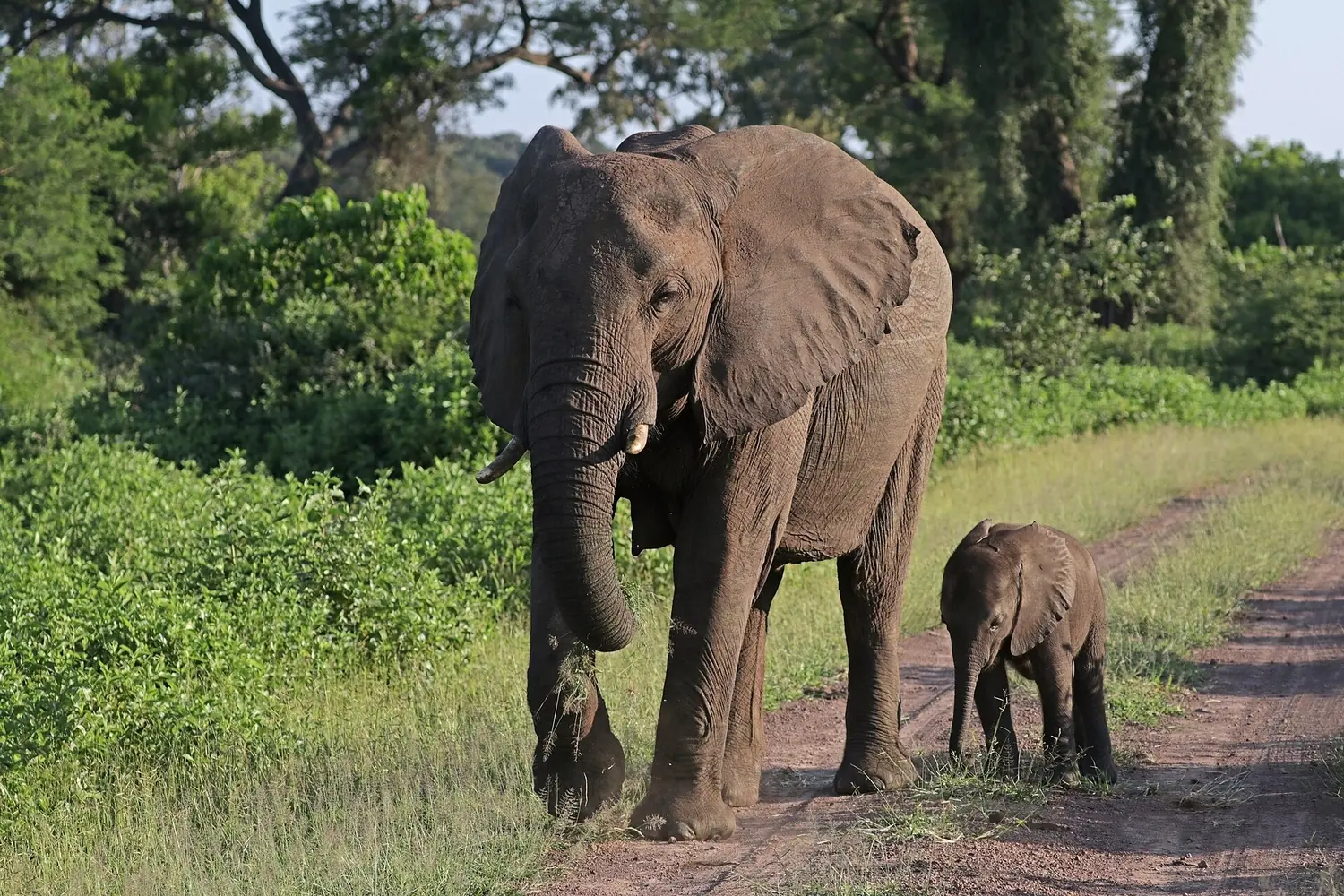
Could a computer tell who each call was for?
The researchers gave a computer measurements of each call’s sound and asked it to find who the call was meant for. Trained on shuffled measurements, which carry no information, it was right for about 8 calls in 100. On the real ones, for the 437 calls whose caller was also certain, it was right for 27 or 28 in 100.
8.0%
calls found, out of every 100
27.5%
calls found, out of every 100
That is far better than chance, and still wrong for most calls. The authors think that a name, if there is one, makes up only a small part of a rumble, and that many calls carry none.
Which calls gave the computer a signal?
Take the 327 calls the computer got consistently right or consistently wrong, after dropping calls with an uncertain caller or context and receivers heard only once. It found the receiver in 42% of contact calls and 47% of caregiving calls, but in only 4% of greetings.
Contact calls 58 of 138 · 42.0%
Caregiving 29 of 62 · 46.8%
Greetings 5 of 127 · 3.9%
A lit dot is a call whose receiver the computer found.
The authors wonder, with a “perhaps”, whether mothers put a label in caregiving rumbles “to help calves learn the labels with which others address them or because hearing the label is comforting for calves.”
Calls by adult females were matched far more often (33% of 274 calls) than calls by juveniles (4% of 53 calls). The authors suggest this may be because the behaviour “takes years to develop”.
Is it just copying a voice?
Dolphins and some parrots address each other by copying the other’s own signature call. If elephants did that, a call to one elephant would sound like that elephant. Human names are not like that: nobody’s name is an imitation of them.
In 236 calls the researchers could compare a call with the voice of the elephant it was meant for. In 141 of them (59.7%) the call was less like the receiver than that caller’s other calls usually were; in 95 it was more like. The computer could find the receiver in both groups, so the authors conclude that copying is probably not how it works, and add that a firm answer needs every caller’s whole repertoire recorded.
One more limit. Different elephants calling the same receiver did not use an obvious common sound: across different callers the computer found the receiver for 1.1% of calls, about what chance gives (1.4%). Yet calls from different callers to the same receiver were slightly more alike than calls to different receivers. The authors call this “mixed evidence”.
Do elephants notice a call meant for them?
In Samburu the team placed a loudspeaker, camouflaged or in the research car, about 49 metres from an elephant (between 40 and 59) and played a recording. Seventeen elephants took part: fifteen adult females, a nine-year-old female and a young male. Most heard two calls from the same caller, at least a week apart: one that had been addressed to that elephant, and one addressed to someone else. (One elephant heard only the first kind, one only the second, and one heard two pairs.)
After the call meant for them, the elephants approached the speaker sooner, called back sooner and called more often. All three differences were statistically significant (P = 0.009, 0.013 and 0.006).
The authors point out that they could not be sure every played call contained a label, which makes the difference more notable. In 2025 they fixed five data errors in this test: some figures changed, and the three differences above stayed statistically significant.
Why scientists disagree
In April 2026 Guha Dharmarajan, of Krea University in India, published a reanalysis of the same data in the journal Animal Behaviour. He concludes that the computer’s success comes from other patterns in the data, such as who was calling and when, and writes: “the use of name-like calls by elephants is inconclusive.” His abstract does not discuss the loudspeaker test.
Inferring “labels” or even “names” is “fanciful and the data do not permit such inferences.”
Robert Barton, anthropologist, Durham University
“I found no evidence that African elephants address one another with individually specific name-like calls.”
Kurt Hammerschmidt, German Primate Center
“I have no doubt that they’re addressing them with these, you know, unique labels.” Are they nicknames? Are they names? “Where do they come from?”
Karl Berg, University of Texas Rio Grande Valley
The study’s own lead author is careful too: “People might assume that elephant names work in exactly the same way as human names, which is not necessarily true.” Nobody has found where in a rumble a name would sit.
| Claim | Status |
|---|---|
| Calls carry something about who they are meant for | The computer’s result, now questioned by the reanalysis. |
| Elephants answer sooner when a call was meant for them | The loudspeaker result, from 17 elephants at one site; the reanalysis’s abstract does not cover it. |
| Elephants have names for each other, as people do | Not shown. The authors claim name-like vocal labels, not names, and say only that these are probably not imitations. |
| What a name would sound like | Unknown. |
Why would an elephant need a name?
Elephant families spread out and regroup through the day, so an elephant is often out of sight of the ones it is closest to. A call that reaches the right listener would help.
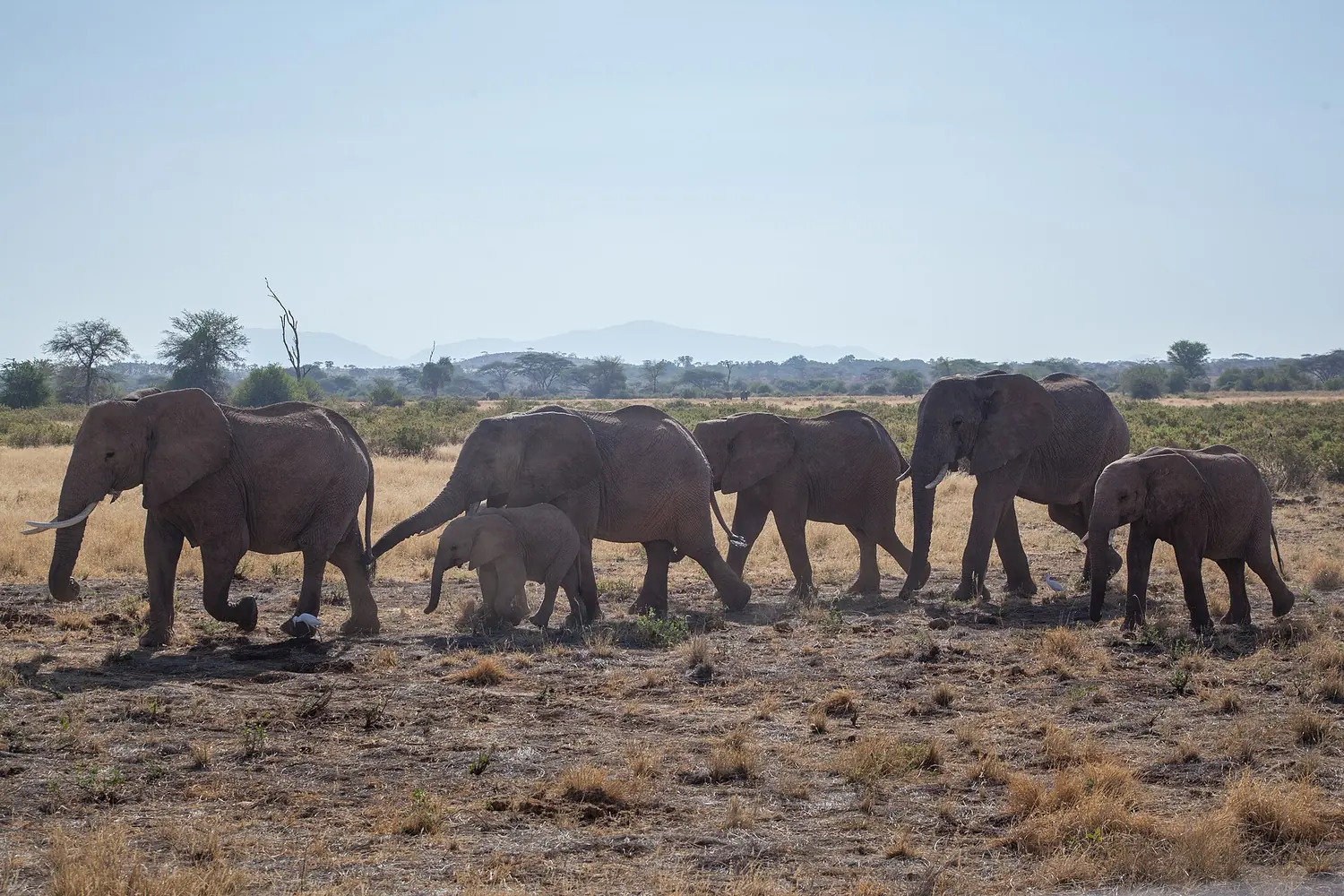
Elephant calls travel far. In Etosha, Namibia, elephants responded to recorded calls of several kinds played from 1.2 and 2.0 kilometres away, and the researchers estimated that the loudest calls would be audible to elephants at least 4 kilometres away.
And elephants know many voices. Researchers estimate that an adult female in Amboseli would need to know the contact calls of about 14 families, around 100 adult females.
Somewhere in Kenya this evening an elephant is calling to someone across the grass. We do not yet know what the name sounds like, or whether it is a name.
Sources and credits
What is real, and what is imagined
- RealThe photographs and the sound. The rumble is from a wild family in Samburu, Kenya, recorded for a 2010 study (King et al.) as “control” rumbles while the family rested; we raised it three octaves (and kept the length) for phone speakers. It is not one of the 2024 study’s calls, and we do not know whom it was meant for. Your “answer” is a later part of the same recording, so the exchange is staged. The strip showing the call is computed from that recording.
- RealEvery number about the study comes from the paper and its 2025 correction. Numbers marked as ours (the shares of energy below 20 Hz and below 60 Hz, the lit dots rounded from the paper’s percentages) are our own arithmetic.
- ImaginedThe dusk scene: its photograph is from South Africa, and the family that waits is a story, not a recording of anything.
- Not heard by anyoneA name. No one has isolated one in a rumble, and the question is open.
The studies and statements
- Pardo et al. 2024
- Author Correction 2025
- Dharmarajan 2026
- King et al. 2010
- Langbauer et al. 1991
- McComb et al. 2000
- Science Media Centre Spain, 10 June 2024
- NPR (via WAMC), 11 June 2024
The paper is behind a paywall; we read the authors’ accepted manuscript and the published correction. Calls counted per group (327, 138, 62, 127, 274, 53) are those the paper reports for its consistent-call analysis.
Credits
Photographs from Wikimedia Commons, shown at reduced size: hero, Giles Laurent (CC BY-SA 4.0); dusk, leftcoastenvy (CC BY 2.0); Amboseli, Ninaras (CC BY 4.0); greeting, flowcomm (CC BY 2.0); calf, Charles J. Sharp (CC BY-SA 4.0); herd, Weldon Kennedy (CC BY 2.0).
Rumble: King L, Soltis J, Douglas-Hamilton I, Savage A, Vollrath F, PLOS ONE 2010, audio S3, CC BY 2.5; trimmed, raised by three octaves and loudness-adjusted here. Evening sounds from the Mara, Tanzania: zachrau, Freesound 818986, CC0 (trimmed and looped).