Marius ComperHunedoara
Română

Dobra · former deanery reference

The bell tower, the chronicle and Dobra’s deanery

At Dobra a tower inscription records archpriest Iosif Nemeș, and a 1733 register links the village to dozens of other churches. The parish chronicle remembers those who served here, including after the deanery was abolished in 1950.

Follow the 1815 inscription ↓
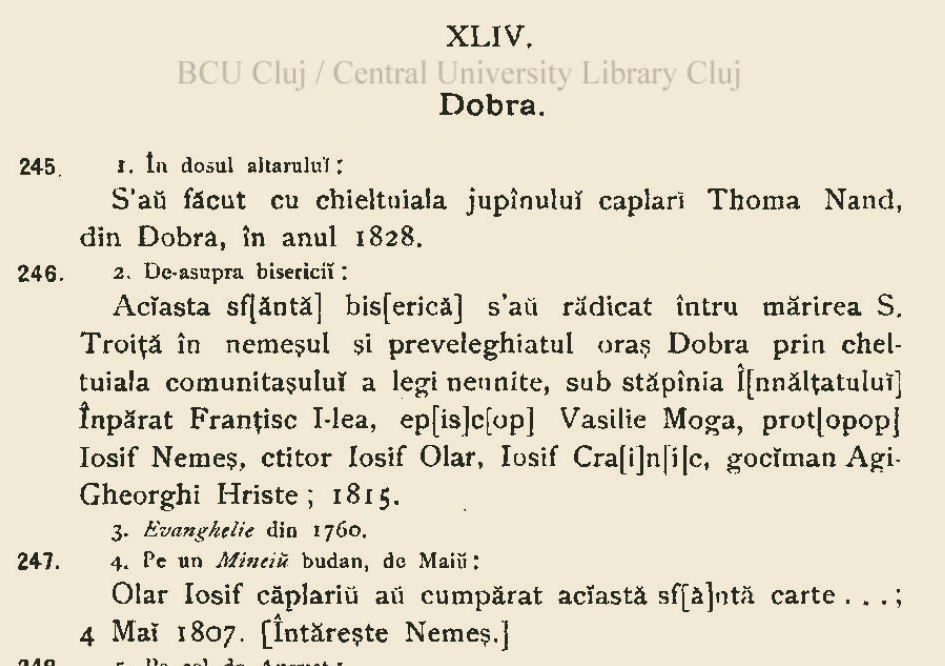
In the middle of the page, transcription no. 246 names archpriest Iosif Nemeș and gives the year 1815. Nicolae Iorga published it in 1906.
In the middle of the page, transcription no. 246 names archpriest Iosif Nemeș and gives the year 1815. Nicolae Iorga published it in 1906. (Source · Nicolae Iorga, 1906 · BCU Cluj · Public domain)

The tower

An inscription above the west entrance

An inscription was placed above the west entrance to Dobra church’s bell tower in 1815. Florin Dobrei cites it among the records of Iosif Nemeș, the village priest and archpriest, who oversaw construction of the church. [4] [8]

People from other villages also came to Dobra on church business. A register compiled 82 years before the inscription shows the size of the district at the time. [3]
In the middle of the page, transcription no. 246 names archpriest Iosif Nemeș and gives the year 1815. Nicolae Iorga published it in 1906.
In the middle of the page, transcription no. 246 names archpriest Iosif Nemeș and gives the year 1815. Nicolae Iorga published it in 1906. (Source · Nicolae Iorga, 1906 · BCU Cluj · Public domain)
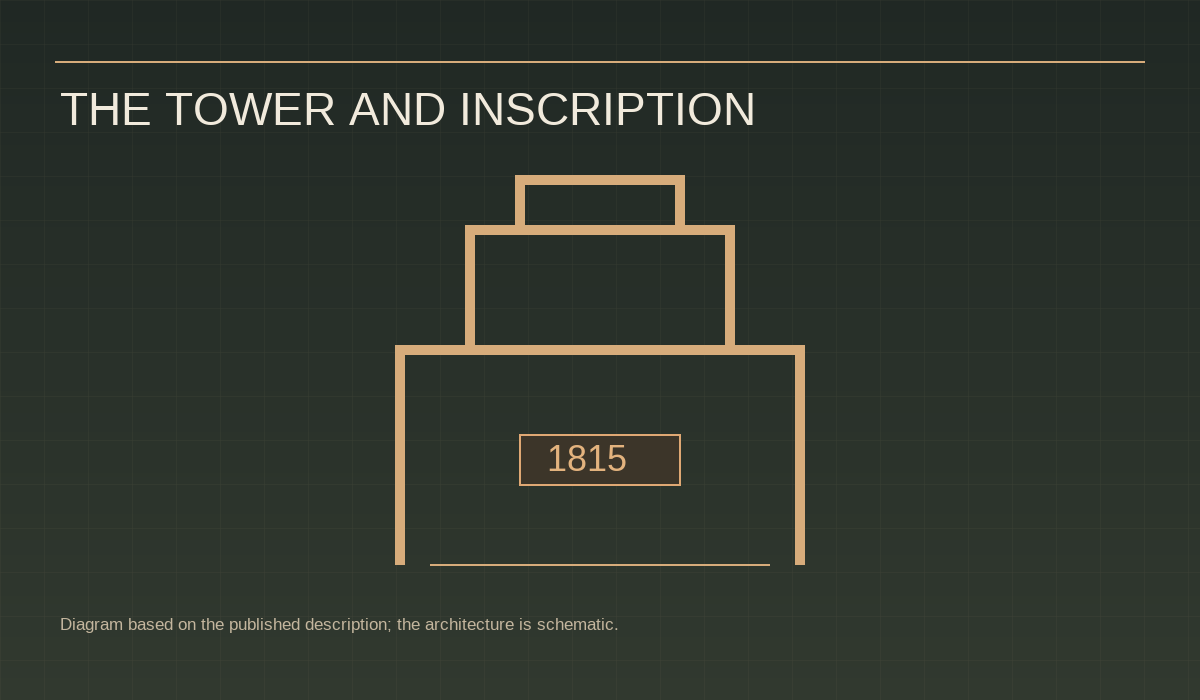
A west doorway below a schematic tower, with 1815 marked above the arch.
Editorial diagram composed from the inscription location described by Dobrei. (Source)

The district

How the district was counted in 1733

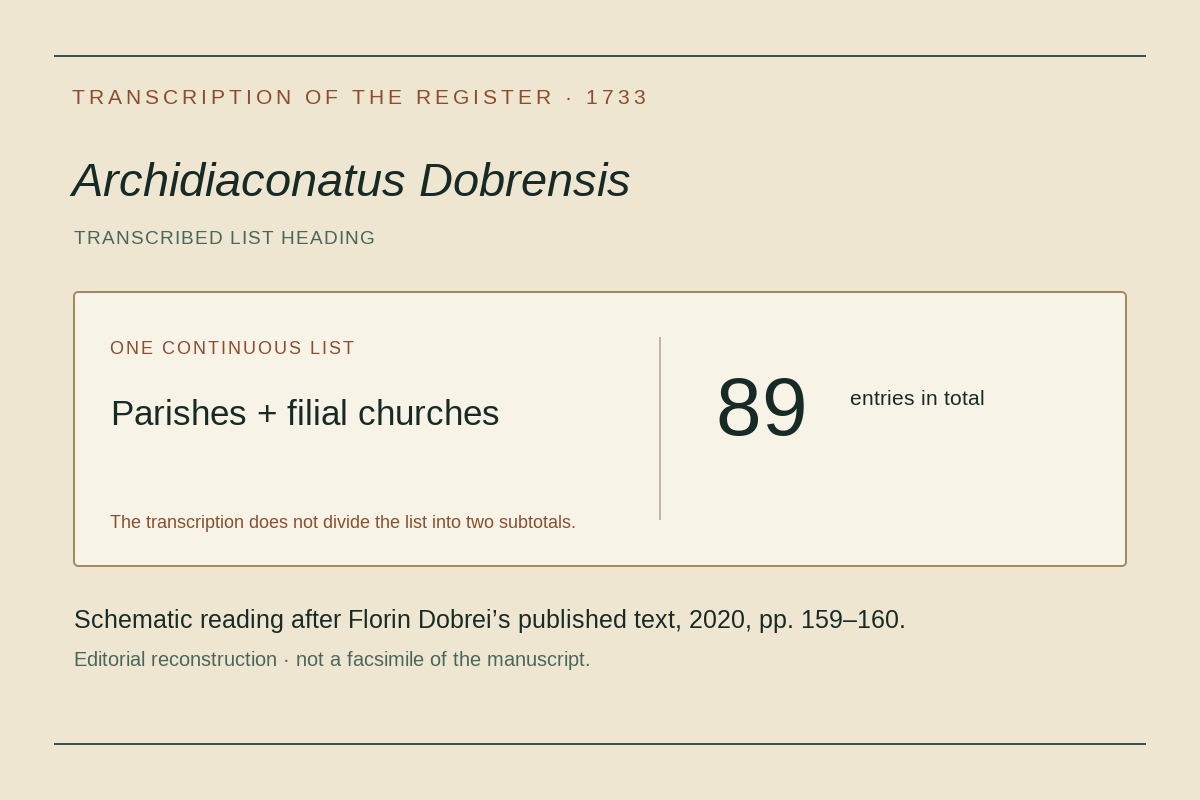
The 1733 church inventory of the Greek Catholic Church names the district Archidiaconatus Dobrensis. The list cited by Dobrei contains 89 parishes and dependent churches. The two types of congregation are listed together. [3]

Dobrei then traces a distinct Orthodox deanery, formed around 1759–1761 or somewhat earlier. The Orthodox registers of 1766–1767 help him trace its reach. Both institutions were associated with Dobra. The count of 89 comes specifically from the Greek Catholic inventory. [1]
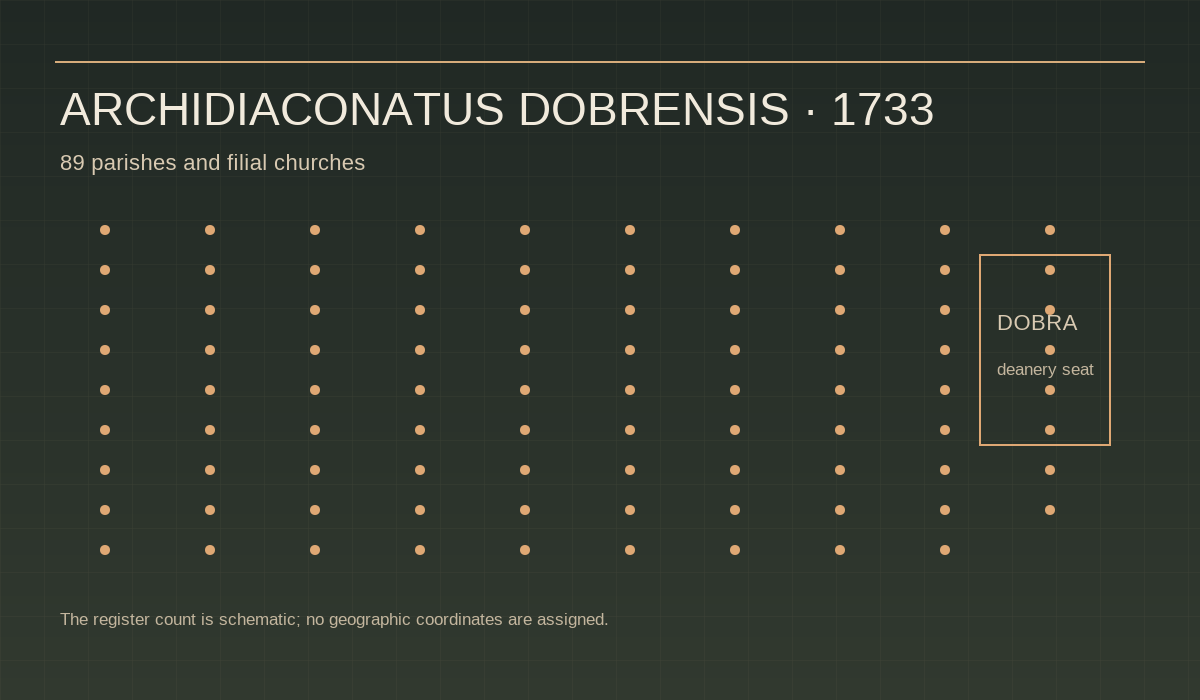
Schematic grid of 89 points for parishes and filial churches recorded in 1733.
89 marks represent the listed parishes and filial churches; the grid is schematic and carries no coordinates. (Source)
The register’s Latin heading and one total for parishes and filial churches.
Reconstruction from the transcription: the list combines parishes and filial churches, without separate subtotals. This is not a manuscript facsimile. (Source)
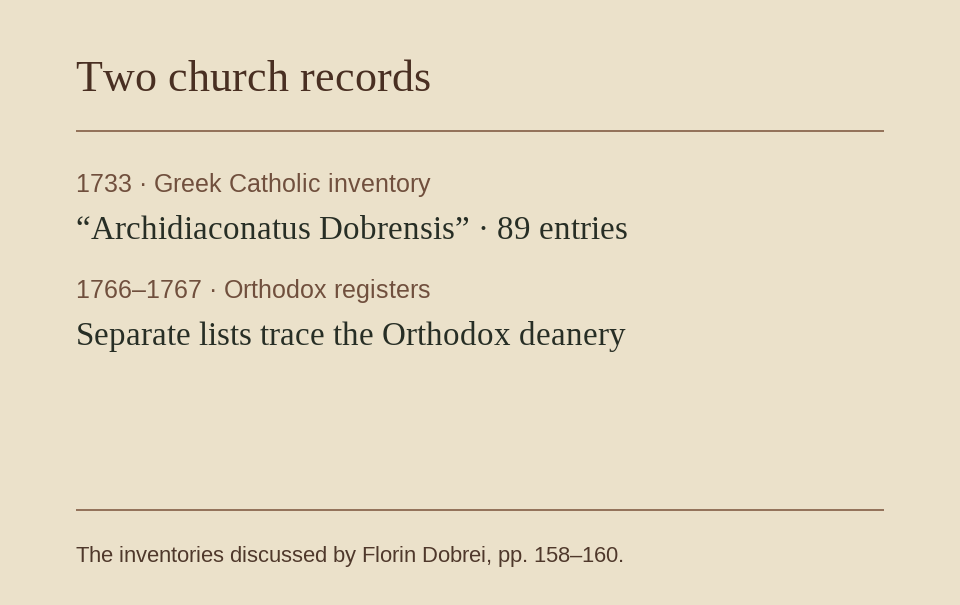
The inventories discussed by Florin Dobrei, pp. 158–160.
The inventories discussed by Florin Dobrei, pp. 158–160. (Source)

1714 and 1815

Two priests with the same first name

A note dated 1714 in a New Testament printed in 1648 at Bălgrad mentions an archpriest named Iosif from Dobra. Dobrei identifies him as Iosif Pop. At that date, the note shows that villages across the Mureș also came under the archpriest’s authority. [1] [7]

Iosif Nemeș, named in the 1815 inscription, came from a later generation. He was ordained in 1785 and made deputy archpriest in 1787. The Vorta book and the Dobra inscription name men who held the same church office at different times. [1] [4]
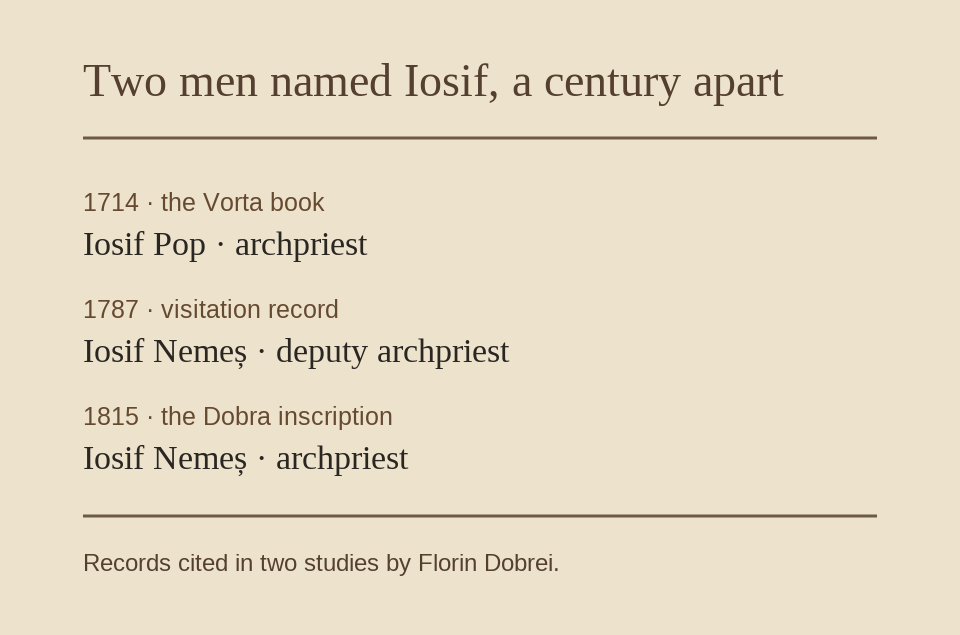
Records cited in two studies by Florin Dobrei.
Records cited in two studies by Florin Dobrei. (Source)

The chronicle

A chronicle begun in 1900

In 1900, priest Iosif Morariu began Dobra parish’s chronicle. The manuscript stayed in the parish archive and was continued through 2020. According to Dobrei’s study, it contains about a hundred leaves, or roughly two hundred pages. Rather than one voice, it gathers notes from several generations of priests.

Its authors were Iosif Morariu, Alexandru Florea, Alexandru Micu, Simion Ganța, Dumitru Popa and Emanuel Inișca. The changing hands are part of the source: the chronicle passes through changes of leadership and different periods, with each author writing as the priest serving at the time.
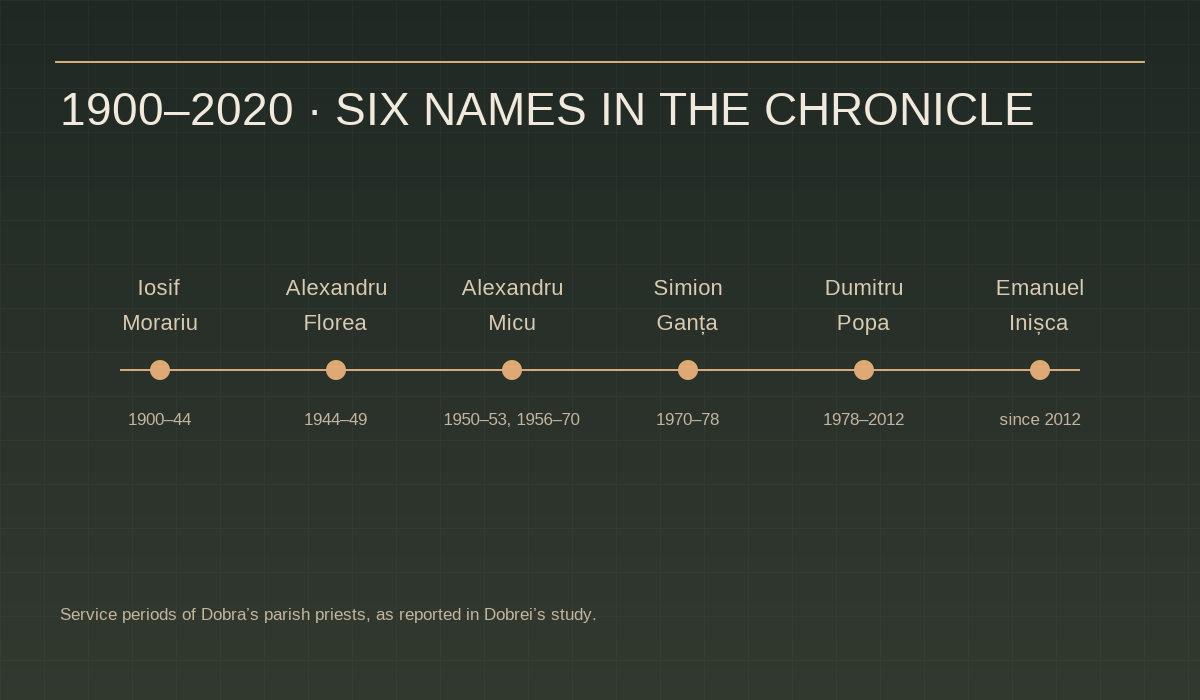
Six chronicle authors, from Iosif Morariu, 1900–1944, to Emanuel Inișca, from 2012.
Succession reported in the 2020 study; spans are each author’s years of service at Dobra parish. (Source)

An unknown date

What the chronicler could not find in the registers

Iosif Nemeș served until around 1835, when Nicolae Crainic took his place at Dobra. The parish chronicler wrote that the surviving registers and other documents he consulted had yielded no exact year for Nemeș’s death. [2] [1]

The 1815 inscription identifies the priest associated with the building. The name of the archpriest changes around 1835. The records answer those questions and preserve the open question of when Nemeș died. [2] [4]
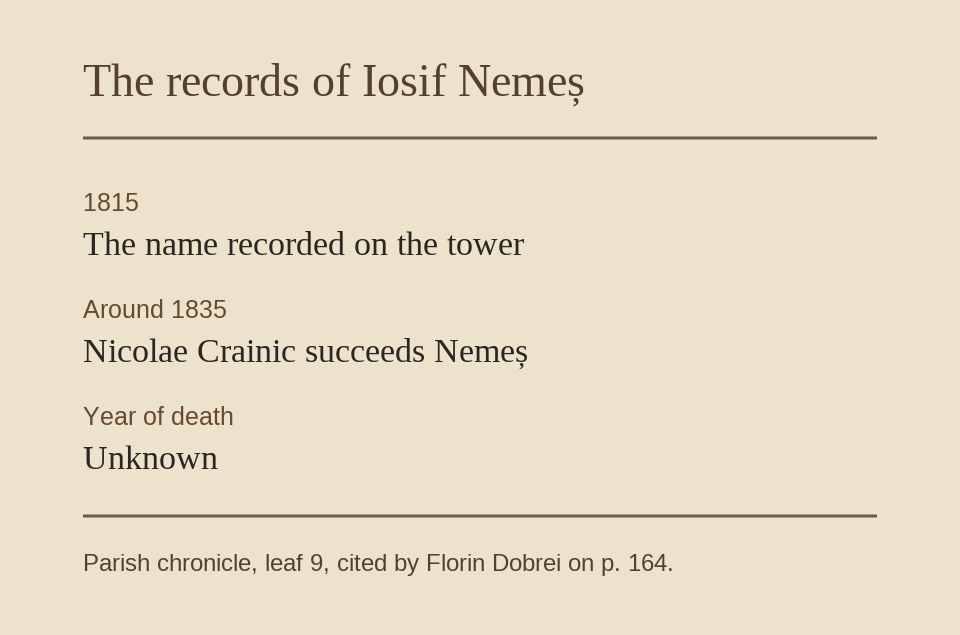
Parish chronicle, leaf 9, cited by Florin Dobrei on p. 164.
Parish chronicle, leaf 9, cited by Florin Dobrei on p. 164. (Source)

The ending

31 December 1950

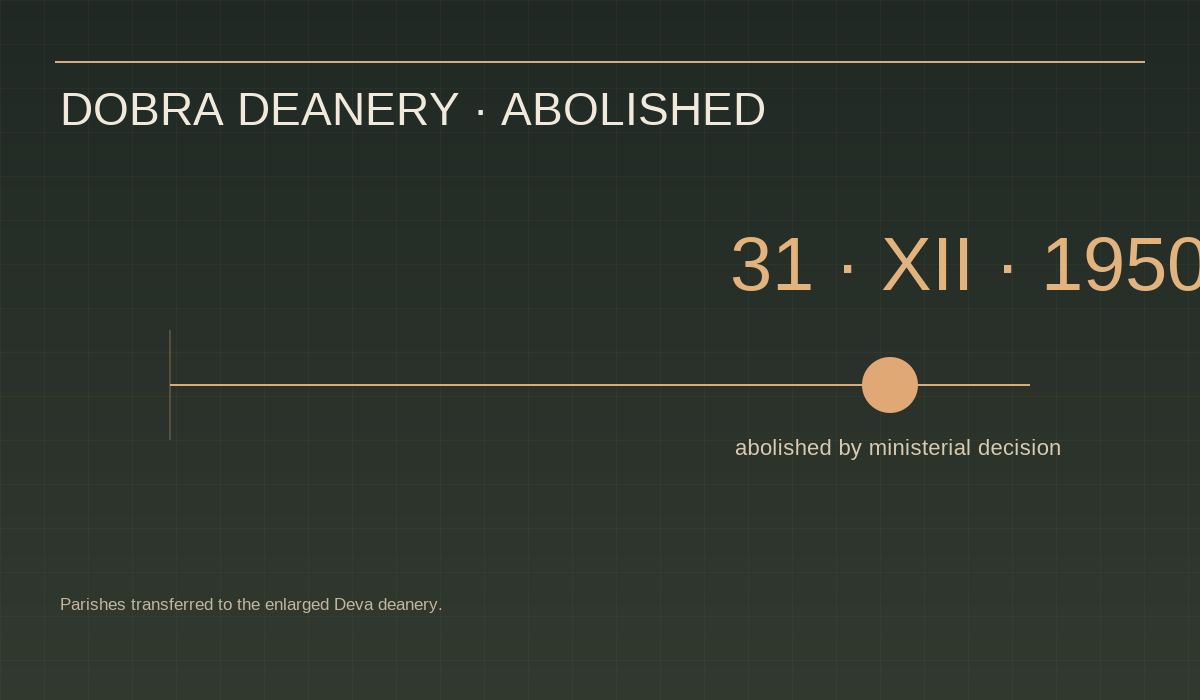
Decision no. 42,735, cited by Dobrei, ended the appointments of the district archpriests effective 31 December 1950. Dobrei records the abolition of Dobra’s Orthodox deanery at the end of that year. Its parishes and dependent churches passed to the enlarged Deva deanery. [5] [1]

The priests of Dobra continued their parish chronicle after the administrative change. Its manuscript was still in the parish archive in 2020 when Dobrei described its leaves. The local record carries the story beyond the date the ministry abolished the district. [2] [1]
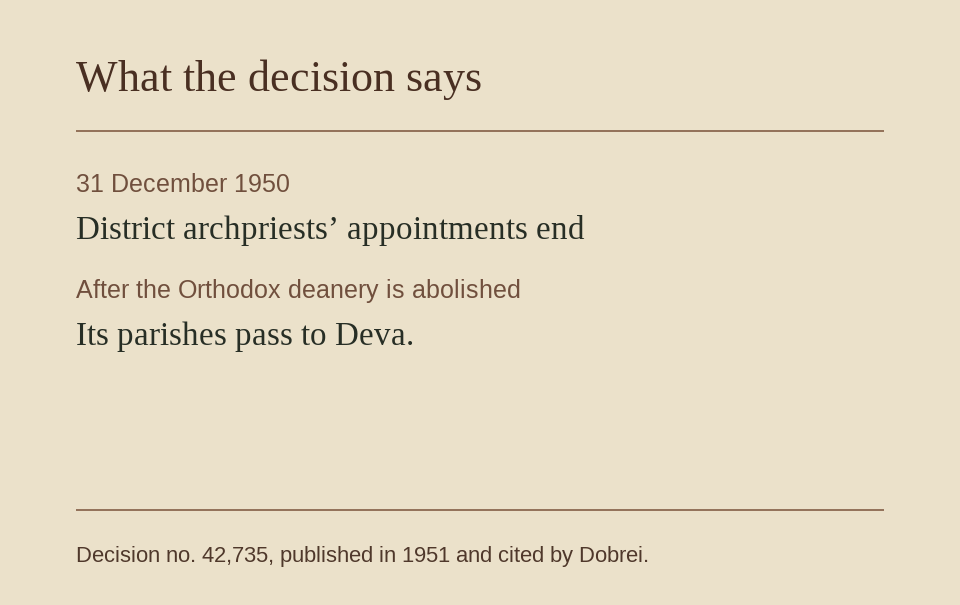
Decision no. 42,735, published in 1951 and cited by Dobrei.
Decision no. 42,735, published in 1951 and cited by Dobrei. (Source)
Timeline ends for Dobra deanery on 31 December 1950; parishes enter the Deva structure.
The diagram shows the date and administrative effect recorded in the decision. (Source)

Sources

The Greek Catholic inventory of 1733 shows the reach of one institution based at Dobra. The 1815 inscription records Iosif Nemeș, an Orthodox archpriest. The parish chronicle continued after the Orthodox deanery’s parishes passed to Deva.

  1. Florin Dobrei, “Notes from the history of the former Orthodox deanery of Dobra,” Sargetia, new series, XI, 2020, pp. 157–178.The study cites Dobra parish’s manuscript chronicle, ecclesiastical registers, annotated books and the 1950 ministerial decision.
  2. Chronicle of the Dobra church, 1900–2020 manuscript in the Dobra Orthodox Parish Archive, cited by Florin Dobrei.The article describes about 100 leaves (roughly 200 pages), continued by six priests.
  3. 1733 ecclesiastical conscription, “Archidiaconatus Dobrensis,” transcribed and discussed in Florin Dobrei, 2020, pp. 159–160.The study’s transcription lists 89 parishes and filial churches together, without an administrative distinction.
  4. The 1815 inscription above the west entrance of Dobra church’s bell tower, cited in Dobrei, 2020, p. 164.The study connects construction of the tower with priest and dean Iosif Pop.
  5. Decision no. 42.735/1950, published in Eparhia Ortodoxă Română Arad, Beiuș, Oradea, III, 1951, nos. 1–3, pp. 1–3, cited in Dobrei, 2020.The article reproduces the provision ending the district deans’ assignments on 31 December 1950.
  6. OpenStreetMap, Dobra settlement reference.Settlement-level reference for the former church centre; cited sources do not publish a surveyed tower point.
  7. Florin Dobrei’s study of Dobra’s priests, Astra Sabesiensis VI, 2020The 1714 book note is assigned to the period when Iosif Pop was parish priest and archpriest.
  8. Nicolae Iorga, Scrisori și inscripții ardelene și maramureșene, vol. II, 1906, p. 90, no. 246.The text of the 1815 inscription in Iorga’s published transcription. Digitized by BCU Cluj.