Biertan, 4th century
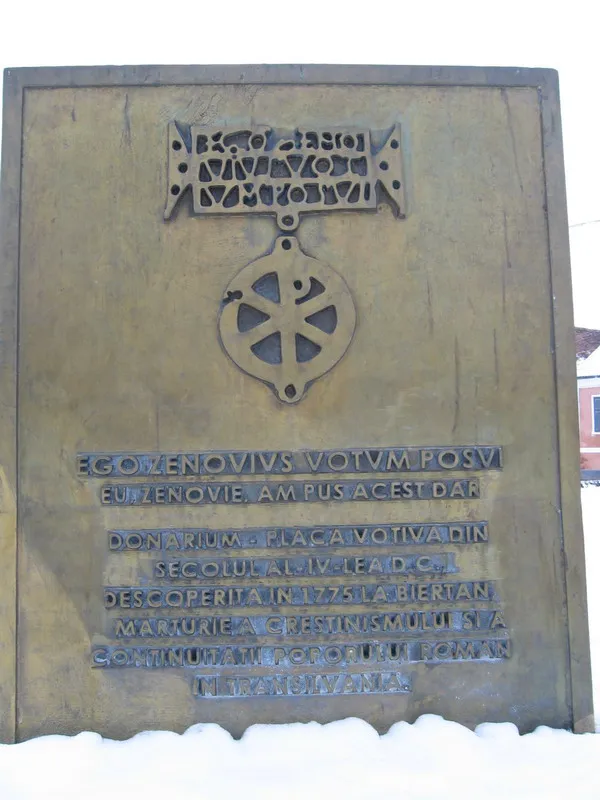
I, Zenovius, set up this gift
In 1775, in the Chinedru forest near Biertan, a bronze tablet came to light, its letters cut through the metal: ego Zenovivs votvm posvi. A Christian declared his offering in Latin, some 1,400 years before the forest gave it back. Two of the four words still live in Romanian, inherited straight from Latin.
☧
ego zeno vivs vot vm posvi
A bronze tablet with rings for hanging
The donarium has two pieces of cast bronze. The tablet, a tabula ansata — a plaque with triangular handles at the ends — carries the inscription in openwork letters, cut through the thickness of the metal. From it hung, on a small chain about ten centimetres long, a disc with the monogram of Christ, likewise bronze, likewise cut through.
The tablet is 32.5 centimetres long, between 12.6 and 13.2 wide, and 0.4 thick. The monogram disc measures between 19.5 and 23.7 centimetres across. The short ends of the tablet carry triangular additions with three holes each, and the middle of each long side once held a round suspension ring. The upper ring is lost, but the piece was whole when found: we know this from the account of the chronicler Michael von Heydendorff and from the drawing made in 1780 by Cardinal Giuseppe Garampi, kept at the Vatican Library.
The rings and the chain say the piece hung. What it hung from is reconstruction: probably the upper part of a church polycandelon or candelabrum. If the reconstruction holds, the tablet hung above a lamp, in a house of worship nobody has yet found.
The disc carries the monogram of Christ: X and P, the first two letters of the Greek name Christos (Χριστός). The sign spread as a Christian emblem after Constantine the Great won at the Milvian Bridge in 312, and reached the labarum, the standard of the Christian emperors. The donarium belongs to the world after 312: Christianity come into the open, with imperial insignia.
The tablet was found in 1775 in the Chinedru forest, about five kilometres south of Biertan, and entered the collection of Baron Samuel von Brukenthal. Then it sat forgotten in a Sibiu museum depot, until the historian Kurt Horedt brought it back to light. It now belongs to the collections of the Brukenthal National Museum in Sibiu.
- Where
- Chinedru forest, about five kilometres south of Biertan, Sibiu county; now the Brukenthal National Museum in Sibiu
- When
- 4th century; discovered in 1775
- Material
- Cast bronze, openwork letters
- Dimensions
- Tablet: 32.5 × 12.6–13.2 cm; monogram disc: 19.5–23.7 cm across
- Text
- EGO ZENOVIVS VOTVM POSVI
Four words, three rows, two pieces of bronze: a handled tablet and a disc with the monogram of Christ. Everything known for certain about the donarium fits in one sentence; everything unknown fills a debate.
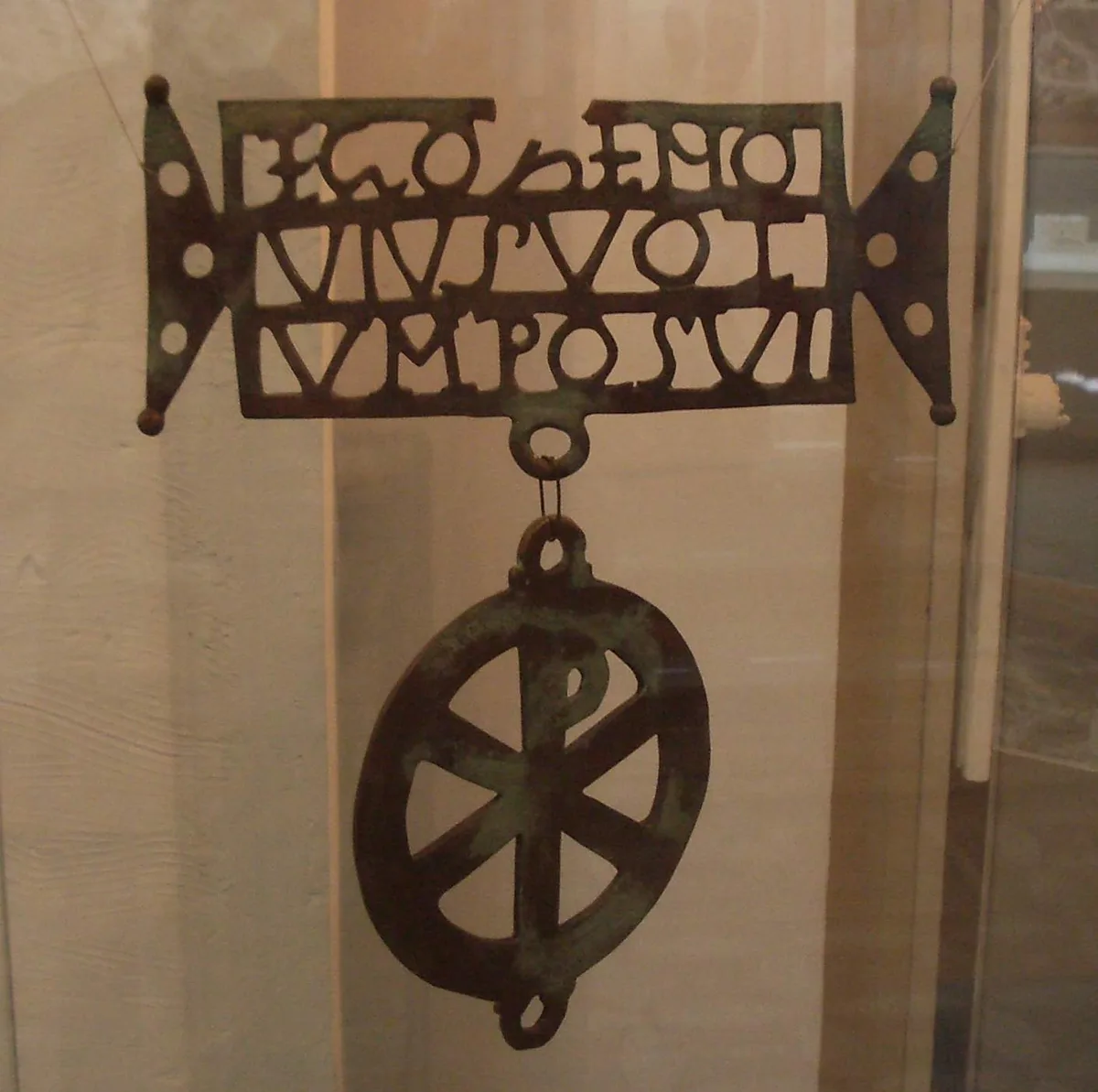

Four words: two survived, one is a name, one came back through French
Pick a word from the inscription. Its colour says what happened to it between Biertan and Bucharest.
- survived in Romanian
- a name with an eastern passport
- came back through French
2 survived in Romanian · 1 name · 1 back through French
-
ego
eu
survived in Romanian
Latin ego passed straight into Romanian as eu (“I”). It is the first person, said out loud: the donor speaks of himself, and the passage from ego to eu is direct inheritance. Reading ego on the bronze, you hear Zenovius’s voice.
-
zenovivs
Zenovie
a name with an eastern passport
Zenovius is the V-spelling of the name Zenobius, a name of eastern origin, widespread in late antiquity: neither Dacian nor Roman. All the inscription says about the man is his name — and the name says the East.
The replacement of B with V is called vetacism. Romanian knows the reverse shift, betacism: Latin veteranus gave bătrân (“old man”).
-
votvm
vot
came back through French
Votum was a solemn promise to the divine — and the gift that kept it. Romanian did not inherit the word directly: vot entered late, from French vote, meaning a ballot. The same Latin root, gone away and come home with a different meaning.
-
posvi
a pune
survived in Romanian
The perfect of the verb ponere, “to put”: posui means “I put” or “I set up”. The verb passed whole into Romanian — a pune, pus — and remains one of the most used verbs in the language. Zenovius “set up” the offering; Romanians still “put” the table.
Where the bronze comes from: two answers that do not agree
The inscription says who set up the gift. It does not say where the bronze was cast, nor how it reached the Chinedru forest. That is where the two answers begin.
It was set up here, by the people of here
The continuity reading: the donarium proves Latin-speaking Christians north of the Danube after the withdrawal ordered by Aurelian in 271. Historians such as Giurescu read it this way, and the Romanian Academy supports this reading. On this view the inscription and the piece are the work of a local craftsman — which would mean a Christian house of worship somewhere nearby, perhaps a wooden hermitage.
It travelled here, as loot or as goods
The other reading: the piece was cast at Aquileia, in northern Italy, and reached Transylvania as Gothic war booty or through trade. For it: no Roman settlements or Christian churches have been found near Biertan, and the circumstances of the 1775 find are poorly documented. Later perforations show the piece was reused — fixed onto a chest — perhaps as a pagan object, far from any altar.
The bronze does not say where it was cast. It says only who set it up, and with what thought: I, Zenovius, set up this offering. The rest is the readers’ business.
- 271Emperor Aurelian withdraws the administration and the army from Dacia, south of the Danube.
- 312Constantine the Great wins at the Milvian Bridge; the monogram of Christ becomes an imperial emblem.
- 4th centuryZenovius sets up the donarium — somewhere; where it was cast and first placed is unknown.
- 1775The tablet is found in the Chinedru forest and enters the Brukenthal collection.
- 1780Cardinal Garampi draws the piece, still whole then; the drawing is kept at the Vatican Library.

Eleven centuries later: the church and the marriage prison
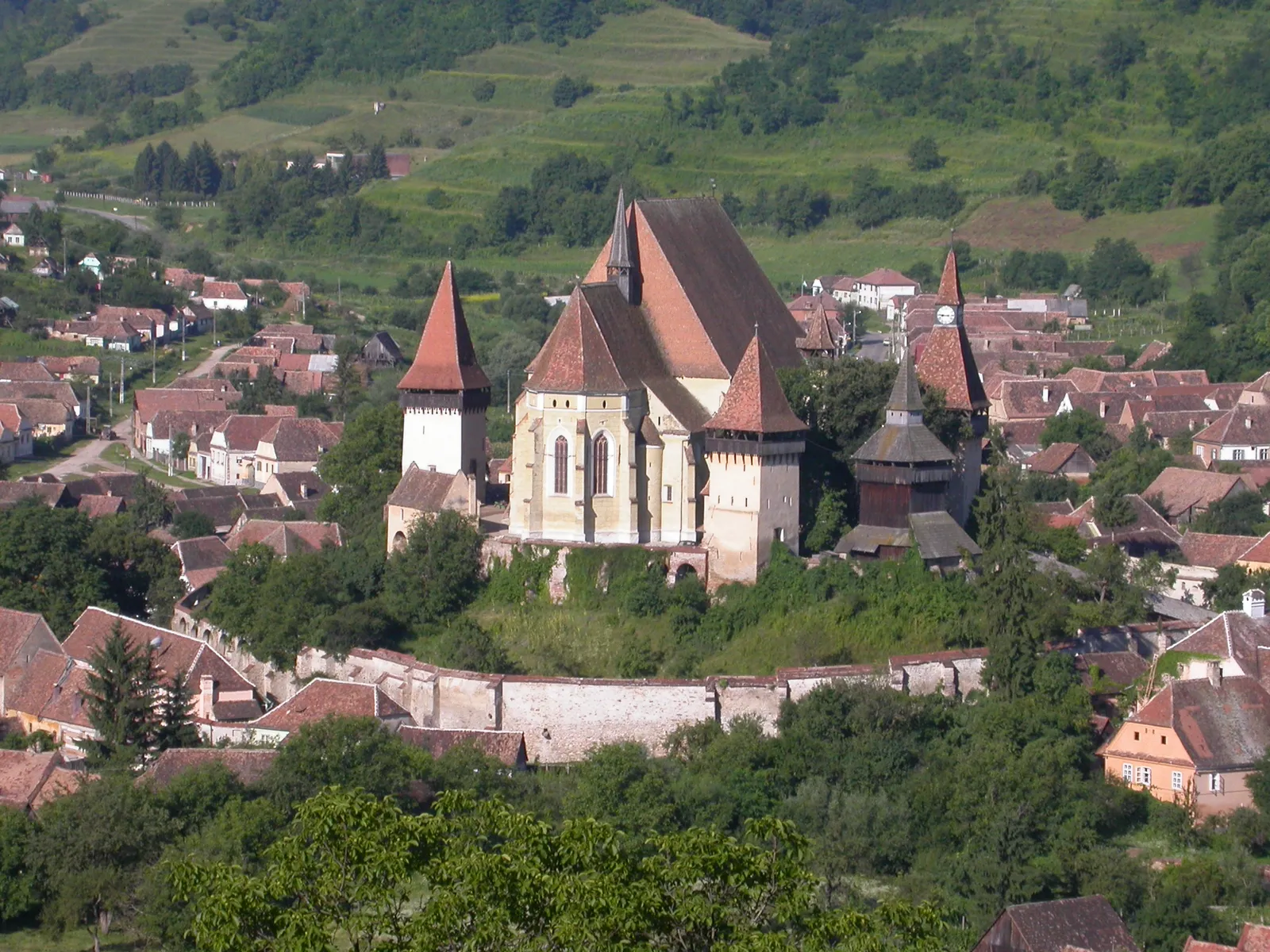
The donarium is from the 300s. The church of Biertan is from the 1500s: first mentioned in documents in 1412, the Gothic building of today was finished around 1522–1523. Eleven centuries fit between the bronze and the church — the story below belongs to another millennium.
The church is one of the best known Saxon fortified churches of Transylvania. It was inscribed on the UNESCO World Heritage list in 1993, and since 1999 it has belonged to the “Villages with Fortified Churches in Transylvania” site, alongside six other settlements.
In one tower of the enclosure stands the room that carried its fame beyond the walls: the so-called marriage prison. Legend says spouses bound for separation were locked up together for a few weeks, with a single bed, a single chair, and a single spoon, until they reconciled. And legend further says that in three hundred years, a single couple still went through with the divorce.

Sources
Etymologies are from the dexonline dictionaries (DEX). Inscription translation: Marius Comper.
- Wikipedia, “Donariul de la Biertan”: description, dimensions, bibliography (Horedt 1979, Fiedler 1996–1998, Gândilă 2018, Rubel 2014). ro.wikipedia.org/wiki/Donariul_de_la_Biertan
- Wikipedia, “Biertan Donarium”: dating, discovery, the two readings. en.wikipedia.org/wiki/Biertan_Donarium
- dexonline: vot (from Fr. vote), pune (Lat. ponere), eu (Lat. ego), bătrân (Lat. veteranus). dexonline.ro/definitie/vot
- Encyclopaedia Britannica, “Labarum”: the Christian standard of the Roman emperors, with the monogram of Christ. britannica.com/topic/labarum
- UNESCO, “Villages with Fortified Churches in Transylvania”: Biertan, inscribed in 1993, site extended in 1999. whc.unesco.org/en/list/596
- Council of Europe / Ministry of Tourism: the Biertan sheet, with the donarium as witness to the Latin-speaking Christian population. rm.coe.int (PDF)