The 1986 report
The 1986 report
What two newspapers recorded about Bavari
In a feature published on 22 October 1986, Mircea Florin Șandru presents Bavari as one of the stud’s leading stallions. He gives a time of 1:20.2 at Ploiești, without the race date, distance or finishing place. [1]
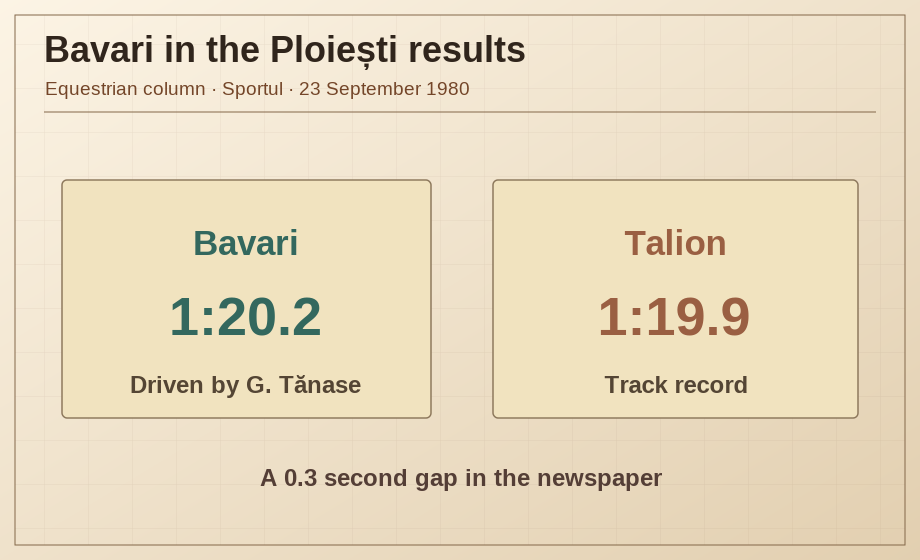
The same time appears in the equestrian column of Sportul published on 23 September 1980. The newspaper names G. Tănase as the driver and lists Bavari among the winners. It puts the stallion three tenths of a second from the track record of 1:19.9, held by Talion. The passage gives no distance. [8]
The trot
How do you recognise a trot?
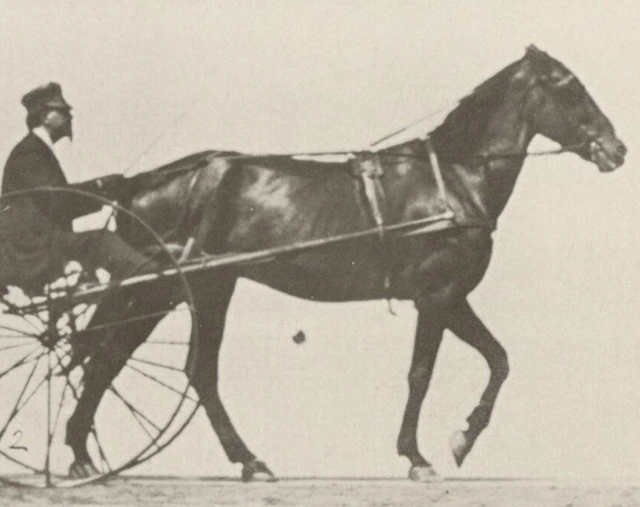
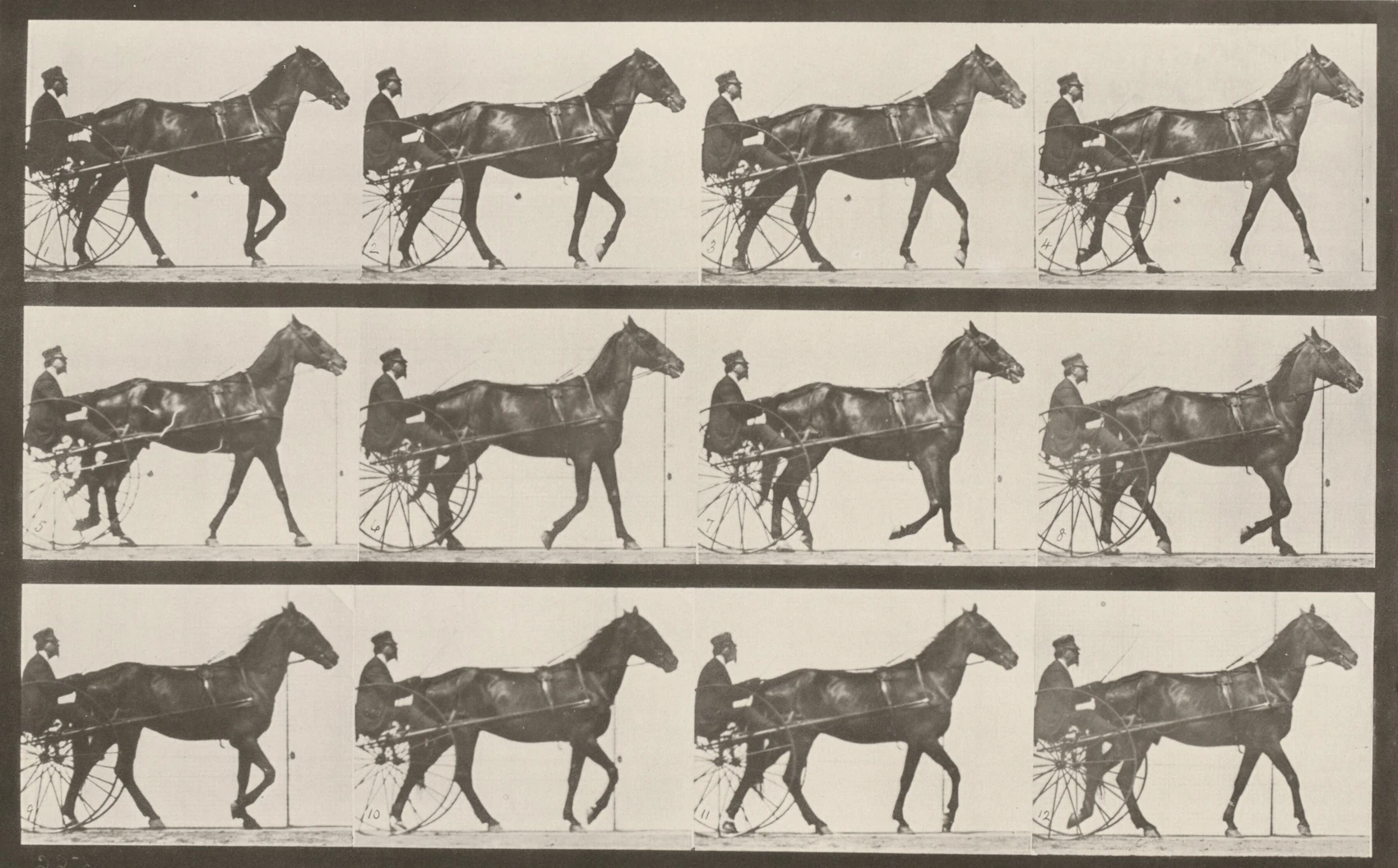
A horse at the trot moves diagonally opposite legs together. A foreleg on one side lifts with the hind leg on the other. Then the other pair takes over. In a harness race the horse pulls a sulky, a light two-wheeled vehicle that carries the driver. [7]
In 1887 Eadweard Muybridge published 12 photographs of Reuben, a horse he had photographed trotting in America. The pictures show the gait used in the Ploiești races in fine detail. Move from one frame to the next and follow the forehoof as it lifts. [6] [7]
Daily routine
The race began in the stable
Șandru describes horses in paddocks, then follows a working day in which care and movement form part of preparation. He names stud manager Gheorghe Stanciu and technician Angelica Dragomir. The sporting story gains people and labour, even though the feature does not publish a full schedule or a training sheet for each horse. [1]
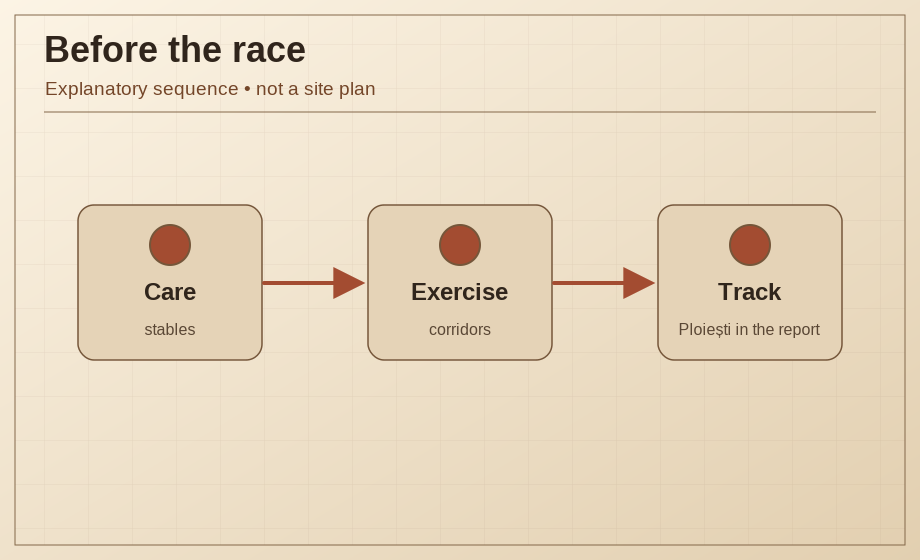
Romsilva now lists six stables, two exercise corridors and stores for feed. That inventory shows the scale of the facilities, but it does not tell us how the buildings were divided in 1986 or the exact route between them. The diagram below is an explanatory sequence, not an architectural plan. [2]
1953
A stud built for the plain
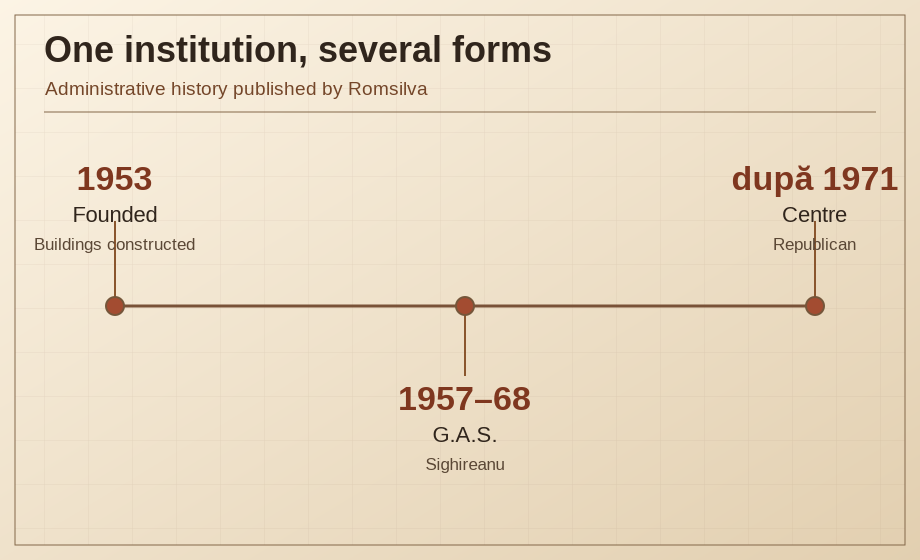
The stud was founded in 1953, when its buildings were also constructed, according to its official history. Its first Romanian Trotter stock came from Jegălia and Segarcea; a nucleus of Romanian Heavy horses was also kept there. These transfers show an institution formed by moving and organising breeding lines, rather than an unchanged local tradition stretching back before it. [2]
From 1957 to 1968 the stud belonged to Sighireanu state farm; after 1971 it became part of the Republican Centre. The institutional names help us follow who administered the site, but Romsilva’s page does not provide transfer documents or annual stock registers here. This chronology is the current owner’s published administrative history. [2]
Horses by name
A list of horses is not a race ranking
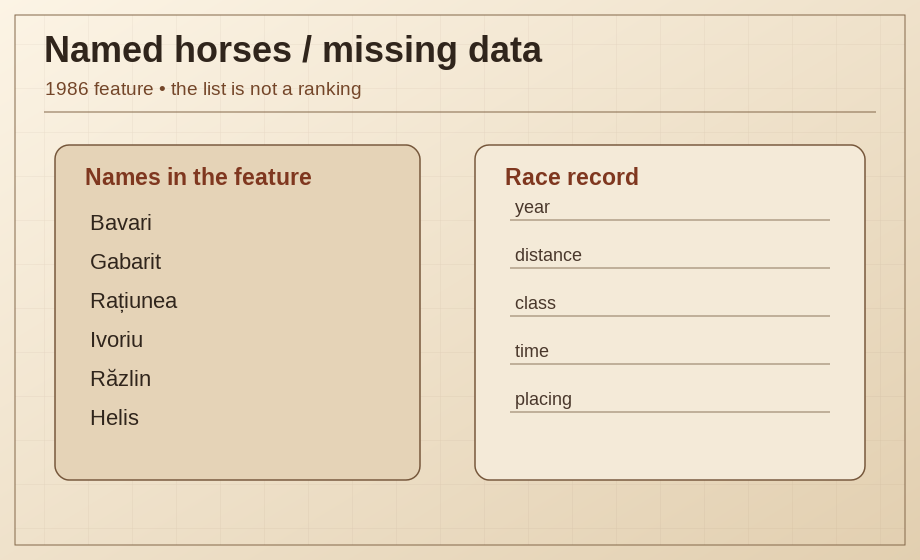
The 1986 feature lists horses which, the author says after consulting a “stud-book”, contributed to trotting successes: Gabarit, Rațiunea, Ivoriu, Răzlin, Helis, Setinar, Rodion and others. It claims that almost all four-year-old Romanian Trotting Derby wins in the previous decade went to Dor Mărunt horses. That is a journalist’s statement about a register he consulted, not an official winners list. [1]
To compare performances, each race would need a year, distance, class, time and placing. The feature does not provide all of those. The diagram offers two readings: the names as printed in the article, and the result fields needed to verify its claim. [1]
An institution changes
From public administration back to Dor Mărunt
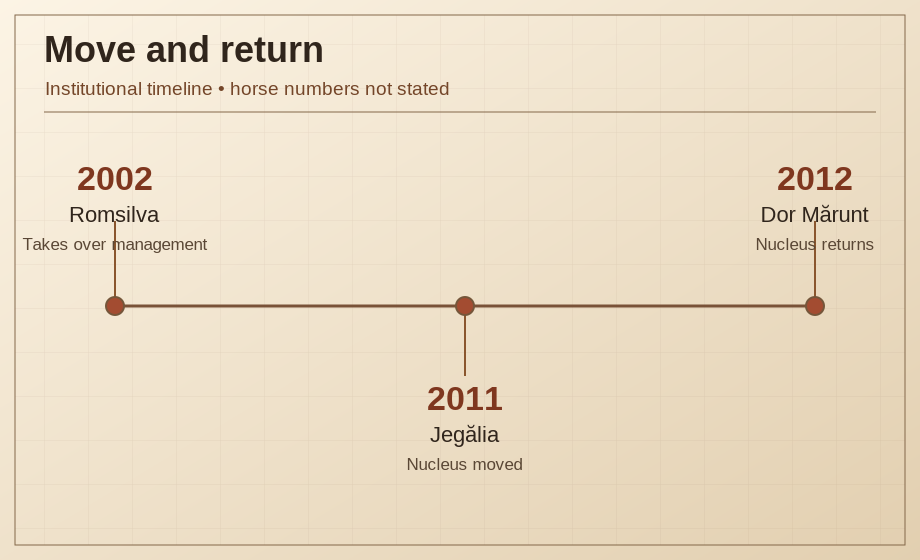
After 1989 the stud passed through successive administrations. Romsilva records its transfer into the agency’s management in November 2002; in November 2011 the breeding nucleus moved to Jegălia, then returned to Dor Mărunt in 2012. Since 2015 the facility has operated as a unit within the horse-breeding and management directorate. [2]
A move of the breeding nucleus matters: the same buildings do not automatically mean the same horse population, and continuity of an institution’s name does not prove continuity of every line. The available history gives no number of horses transferred or individual pedigree records for those years. [2]
The race programme
What does a Ploiești race record include?
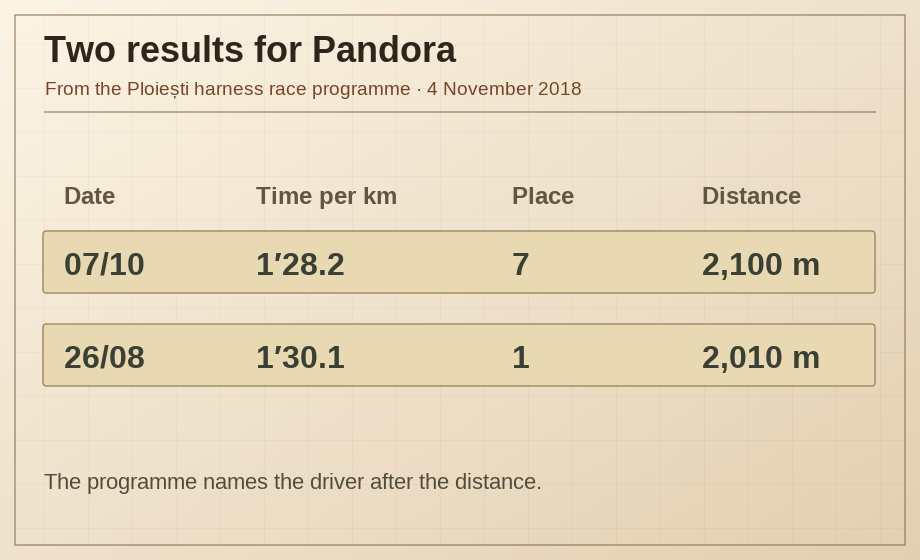
The programme for 4 November 2018 lists two horses from the Dor Mărunt stud, Ops and Pandora, in the Sinoe Prize. It gives previous performances for each. Pandora’s entry for 7 October lists 1′28.2 per kilometre, seventh place, and a distance of 2,100 metres. [10]
On 26 August, the same horse is listed with 1′30.1 per kilometre and first place, over 2,010 metres. Time per kilometre gives the average pace over the race. The 2021 local rules describe how it is calculated. The 1986 feature gives Bavari’s time, but leaves out his distance and finishing place. [10] [9] [1]
2014 and the present
The Derby won by Olimp
Romsilva says Olimp, bred and trained at Dor Mărunt, won the Romanian Trotting Derby in 2014. This is a named and dated victory, unlike the broad claim in the 1986 feature. Romsilva’s 2023 table is an inventory of public breeding stallions; it should not be read as a continuation of race results. [3] [4]
Today the stud combines horse breeding with agricultural activity and a role as a local landmark. For a reader arriving here, the story is larger than a podium: a race depends on an institution, facilities, caretakers and breeding lines, while the available sources preserve different fragments of that history. [2] [5]