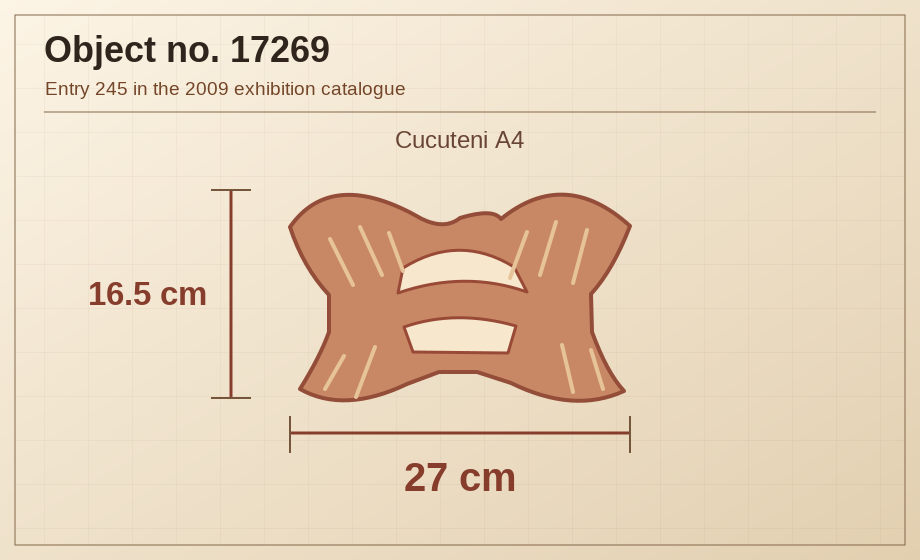
Two mouths
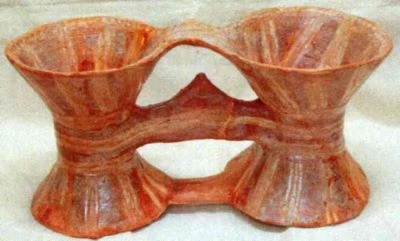
Two mouths
Look at the three bridges
At Drăgușeni in northern Botoșani county, the place known as Ostrov preserved objects made by people of the Cucuteni culture, known for their painted pottery. The record dates the vessel to the latter half of the fifth millennium or first quarter of the fourth millennium BCE. The photograph shows two flaring mouths and an open space between the two lower bodies. [1] [2] [5]
The name binocular vessel comes from the resemblance to a pair of binoculars. Trace the clay joining the bodies at the top, middle and bottom. The drawing picks out the three joins. Each is part of one object. [1]
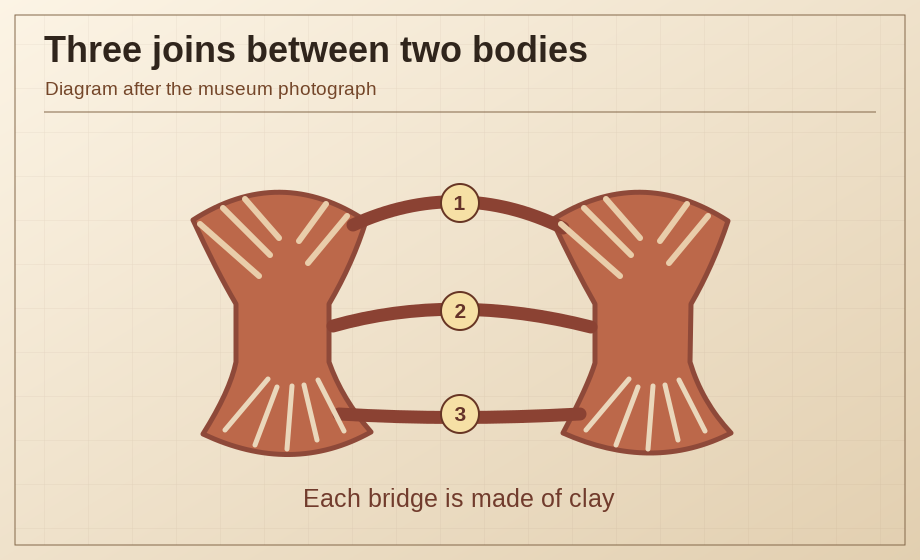
Clay
The grooves show in angled light
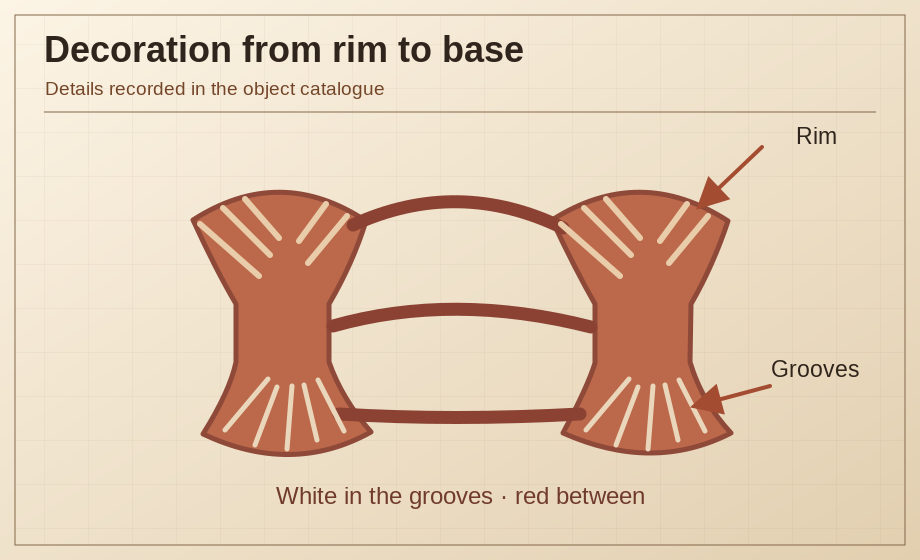
Colour does not cover the surface evenly. The museum record describes white in the grooves and red between them. The grooves are fine channels in the clay. On the outer wall they show most clearly where light falls across the vessel at an angle. [1]
Look at the upper rim. The record notes little cut hollows and radial grooves inside the lip. The diagram shows their direction. Together the photograph and the catalogue tell you where to look if you had the object in front of you. [1]
Ostrov
The vessel came from a settlement
Ostrov is near the village of Drăgușeni in the Podriga valley. Silvia Marinescu-Bîlcu records that Aristotel Crâșmaru found the site in 1964. Excavators investigated dwellings and pits here as well as collecting objects made of clay. [2] [3]
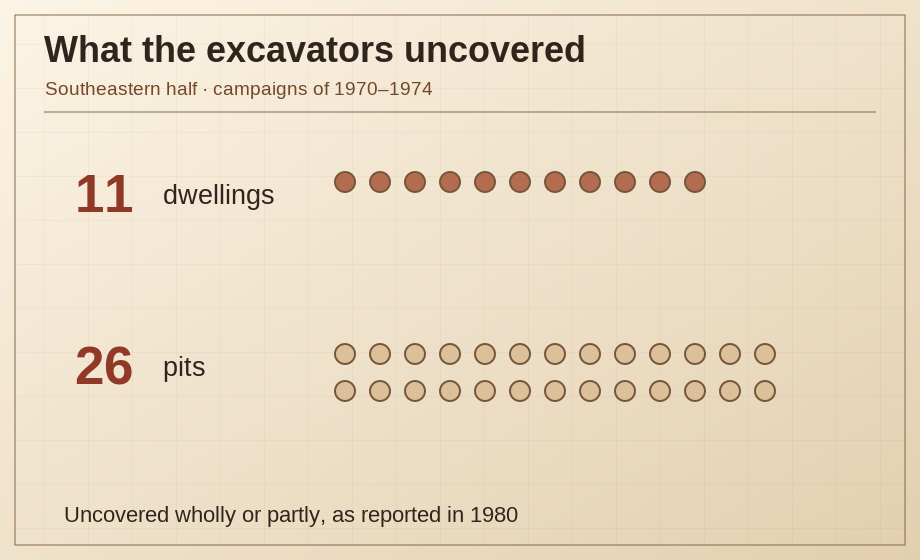
The diagram counts features investigated on the southeastern half between 1970 and 1974. Excavators uncovered 11 dwellings and 26 pits, some only in part. These are the features reported from one part of the site. [3]
Inside a dwelling
A vessel was found beside grinding stones
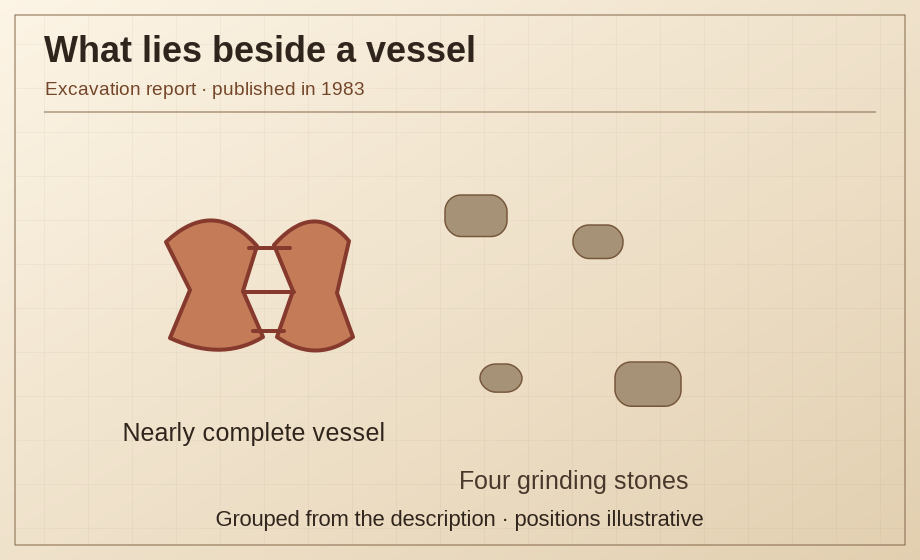
The report published in 1983 describes a nearly complete vessel of the same type among stones, grinding stones and sherds. It identifies four grinding stones. This shows that such a vessel could end up alongside objects used in a dwelling. [4]
The passage does not identify the vessel by the grinding stones as no. 17269. It tells us what was found beside one vessel of this type. Identifying its purpose would require evidence from other find contexts or traces that can be tied to its use. [1] [4]
In the catalogue
We know the height and length
The 2009 exhibition catalogue gives the Botoșani piece a height of 165 millimetres and a length of 270. The national record lists it in 2008 in Tezaur, the national category for movable heritage of exceptional value and gives the findspot as Ostrov. Inventory number 17269 lets you identify the same object in both places. [5] [1]
You can count the bridges on the photograph. The report shows what was found next to a vessel of the same type. The catalogue gives the measurements. You can establish each of these things while the precise use of the vessel remains open. [1] [4] [5]