Backyard crude: how oil divided the orchards, airspace, and bedrock of Prahova Valley
Naked well-diggers coated in lard descending hand-hewn oak shafts, four-engine bombers shearing walnut limbs thirty meters above family verandas, and a dozen competing private pipelines cutting through backyard cabbage patches. Along Prahova's oil belt, the industrial rush pushed past refinery gates into the domestic sphere, turning family orchards into an inhabited battleground.
To maintain historical rigor, this essay explicitly separates claims verified by archival records from oral folklore passed down across extraction fields and our own critical interpretations. Use the controls below to highlight or filter reading layers:
In the villages and foothill towns of Prahova, the ground was never an inert foundation or quiet farmland. For over a century and a half, the soil underfoot has been an unstable sponge, soaked with invisible gases and coursing with a dense, black, flammable liquid ready at any moment to seep into plum tree roots or turn a quiet Sunday into a blazing furnace.
Interpretation Along the Subcarpathian diapir folds of Prahova, where salt tectonics forced hydrocarbon beds close to the surface, industrial extraction merged directly into the domestic realm. The community's bond with petroleum was forged directly along roadside drainage ditches, in household cellars where heavy condensate vapors pooled, and around hand-dug wells whose wooden buckets brought up bitter, oily brine. Generations lived without panic upon a living geological fault line, developing an ethos of craft pride, quiet fatalism, and organic coexistence.
Chapter I
The manual era: lard-greased well diggers and white ox carts
Before steam-powered derricks and steel drilling bits colonized the hillsides of Buștenari and Telega, petroleum was extracted by raw physical labor at the outer boundary of biological endurance.
Verified Throughout the late nineteenth century, Wallachian crude oil was mined from artisanal hand-dug shafts known as "băi" (pits) or "fântâni" (wells). These square shafts, measuring barely one meter by one meter across, were shored with dovetailed oak beams to hold back collapsing marl and brine. Prahova's master well diggers—locally known as *băieși* or *fântânari de păcură*—pushed these hand-hewn pits to staggering depths of 150 and even 200 meters into the earth.
VerifiedArchival field record · Buștenari, 1898
Descending the oil pit: the physics of survival
Past 50 meters of depth, air turned lethally toxic with methane and hydrogen sulfide, while subterranean temperature and humidity climbed suffocatingly. The digger descended on a thick hemp harness tied beneath his armpits, completely naked. Before stepping into the pit mouth, his skin was coated from crown to heel with pure hog lard or beef tallow. This greasy layer served as his sole shield against devastating chemical burns inflicted by raw crude and corrosive formation brines.
Verified Ventilation was measured in seconds. At the surface, two men continuously cranked large oxhide bellows—identical to blacksmith bellows—forcing fresh air down a tarred canvas hose to the pit floor. A signal cord linked the digger to his surface crew: every two minutes, he was required to give a sharp tug on the rope. If the signal failed, the crew feverishly operated the horse-driven winch (*hecnă*) to haul him up before irreversible brain hypoxia set in.
Verified Lighting presented a lethal dilemma: a single spark from an open flame would trigger an instantaneous gas explosion. Prior to the arrival of safety lamps, diggers employed an ingenious optical solution: a concave mirror positioned at the surface caught direct sunlight and beamed a narrow column of light straight down the 150-meter vertical shaft. If rain fell or clouds gathered, excavation ceased immediately; blind digging in gas-saturated marl was suicidal.
Oil carters and the mud arteries
Verified Crude hoisted in leather bags was poured into earthen settling vats or massive oak casks. Before railroads and pipelines linked the fields, the entirety of Romanian petroleum transport relied on heavy wooden wagons hauled by four or six white Podolian draught oxen (*boi bălași*). These specialized carters, known as *păcurari*, navigated muddy roads from Telega and Buștenari to Ploiești, continuing onward to Danube port terminals at Giurgiu and Brăila.
Legend Village elders in Telega preserved the memory of these slow-moving convoys: the white oxen lost their coat color within weeks, their legs and muzzles stained black by sticky crude slopping over barrel rims on rutted roads. Legend claimed that Prahova's transport corridors smelled of petroleum from three leagues away, and carters never washed with water, scouring their hands instead with dry earth and wood ash.
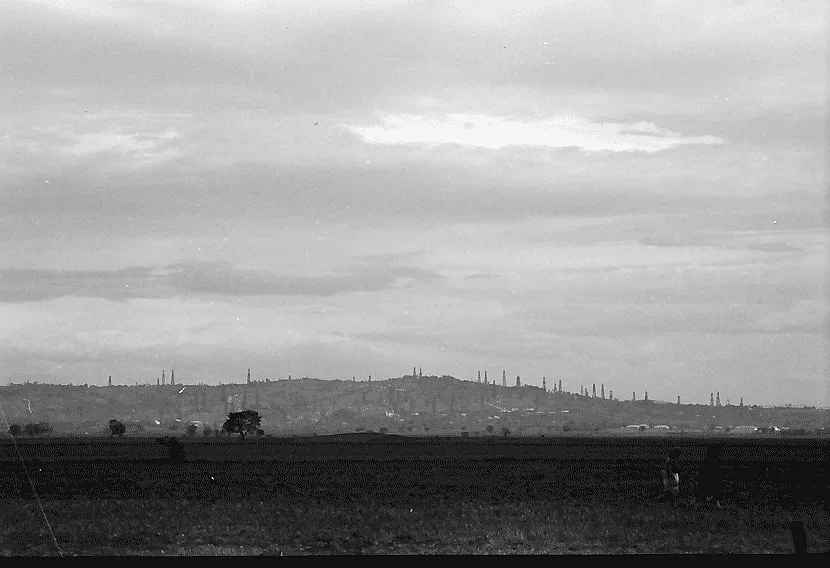
Wooden derricks and extraction rigs crowding directly into family orchards and homes in Câmpina, circa 1930. Along the Prahova fault line, industrial drilling colonized the domestic village core.
Photo: Willy Pragher / Landesarchiv Baden-Württemberg (Staatsarchiv Freiburg) · CC BY 4.0
Verified This primitive transport system catalyzed Romania's first industrial revolution. In 1857, brothers Theodor and Marin Mehedințeanu erected the world's first commercial refinery at the Râfov barrier on the outskirts of Ploiești, equipped with Austrian distillation units. That same year, Romania became the first nation to register official crude oil production in international records (275 metric tons), and Bucharest became the world's first city illuminated entirely by distilled lamp kerosene.
Interactive vertical cross-section
Subsurface stratigraphy: from family garden to deep reservoir
The dirt yard and plum orchard
+0 m
Estimated pressure1 atm
Gas compositionSurface vapors
Historic equipmentSpade, boots
Chapter II
August 1, 1943: firestorms and the air war fought in the grass
In global military history, Operation Tidal Wave is recorded as one of the boldest and costliest low-level aerial assaults of the Second World War. Yet for the families living around Câmpina, Moreni, and Ploiești, that sweltering Sunday was not an abstract battle map, but an apocalypse fought eye-to-eye at treetop height.
Verified 177 B-24 Liberator heavy bombers from the US Ninth Air Force took off from Benghazi, Libya, crossing the Mediterranean and Balkans without fighter escort. Their mission: obliterate Prahova's refineries, which supplied more than 30% of Axis aviation gasoline. To evade German early-warning Freya radars along the Bulgarian coast, American commanders ordered the bombers to fly at tree-canopy height: between 30 and 50 meters above ground.
Verified At Câmpina, the Steaua Română refinery—one of Europe's most technologically advanced facilities—was the primary target of Colonel Jack Wood's 389th Bombardment Group. At 2:00 PM, under blazing sunshine, 30-ton four-engine bombers roared over church steeples and factory chimneys. Children swimming in the Prahova River and women sitting on wooden verandas suddenly saw bombers so close overhead that propeller wash snapped walnut limbs and stripped roof tiles from houses.
VerifiedEyewitness ground account · Steaua Română Refinery, Câmpina
Eye contact at 30 meters
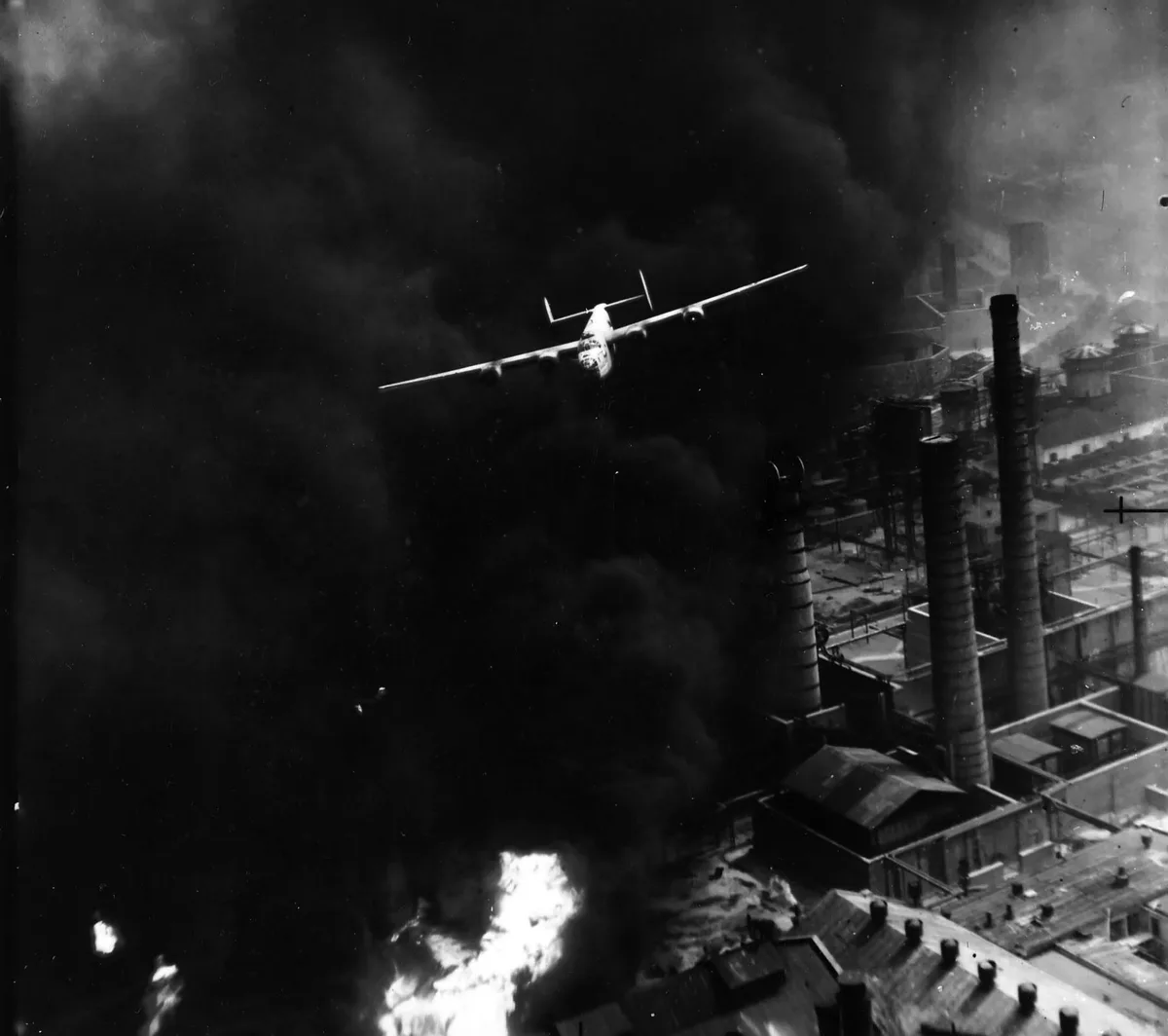
Unlike high-altitude bombings where aircraft are distant specks, on August 1, 1943, soldiers and civilians locked eyes. Câmpina residents distinctly saw the facial expressions of American waist gunners leaning out of open side hatches; several gunners waved urgently for civilians to scatter and drop flat. Simultaneously, German 20 mm and 37 mm Flak batteries, concealed inside haystacks along railway embankments and mounted on armored flatcars, fired horizontally through orchard fences, residential windows, and oil storage tanks.
B-24D The Sandman (piloted by Lt. Robert Sternfels) emerges at treetop level through refinery smoke and delayed blasts over Astra Română, 1 August 1943. Flying at 30–50 meters evaded German radar but brought four-engine bombers into eye-to-eye contact with people on the ground.
Photo: Jerry J. Joswick / USAAF / US National Archives · Public domain
The unsung stand at the boilers
Verified When incendiary bombs punctured Steaua Română's massive fuel reservoirs, hundreds of tons of blazing crude erupted in fiery tidal waves down factory roads toward the Prahova River. Amid catastrophic pandemonium, Romanian technicians, boilermen, and cracking operators in the Dubbs thermal cracking units and the refinery power station made an extraordinary decision: rather than fleeing to air-raid shelters, they remained at their valves under strafing fire to manually depressurize boilers and thermal cracking batteries operating at 22 atmospheres and over 400°C. Venting these pressurized vessels prevented a catastrophic boiling liquid expanding vapor explosion (BLEVE) that would have leveled Câmpina's central district.
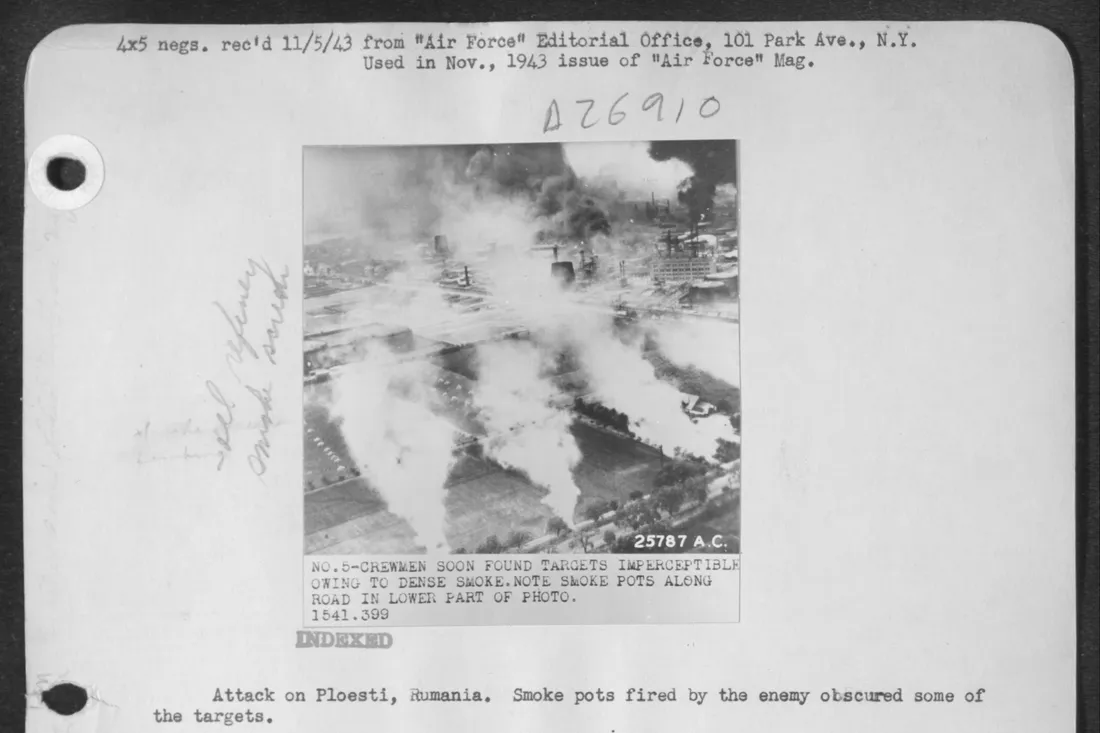
German smoke pots burning heavy crude oil to blind attacking bombers and shroud the Prahova refinery corridor, photographed from an incoming B-24 during Operation Tidal Wave.
Photo: USAAF / US National Archives · Public domain
Verified The toll was staggering: 53 B-24 bombers were shot down or lost. Dozens of smoking wrecks crashed into cornfields and orchards between Câmpina and Ploiești. Unlike other war zones where fallen crews faced mob violence, Romanian peasants ran to the burning wreckage, pulled severely burned airmen from cockpits, washed wounds with cold well water, and shielded them in haylofts until safe transfer to Romanian Royal Gendarmerie custody, leading to care at Câmpina's hospital and eventual internment at Timișul de Sus.
Legend Across Moreni and Băicoi, elders recounted the tale of an American aviator who parachuted from a blazing Liberator directly into an open earthen crude settling pit. Despite severe burns, the viscous crude smothered his burning flight jacket. He was reportedly fished out by two elderly villagers wielding long wooden bean poles. While absent from official Ninth Air Force logs, the story embodies local mythology: the ground that burns is also the ground that swallows and saves.
Ground reconstruction
August 1, 1943: minute-by-minute among the derricks
13:45
The rumble beyond the hills
A scorching Sunday afternoon...
Chapter III
Backyard pipelines and the topography of a mined orchard
While drilling rigs and refineries captured international headlines, the most permanent imprint of petroleum upon daily existence remains the labyrinthine network of pipelines that still traverses private property across Câmpina, Moreni, and Buștenari.
Verified The origin of this aboveground and subsurface tangle lies in late-nineteenth-century mineral law. The Civil Code of 1864 recognized the surface landowner's absolute ownership over the subsoil, and the Mining Act of 1895 preserved petroleum as an exception to state mineral monopolies, leaving concessions open to private negotiation. Freehold peasants (*moșneni*) held orchards and pastures fragmented through generations into narrow strips (*funii* or *delnițe*), measuring barely 5 to 15 meters wide and stretching hundreds of meters up hillside slopes.
Verified When international oil consortiums competed aggressively across Prahova, they negotiated leases individually with each smallholder. This produced surreal legal gridlock: German-backed Steaua Română leased an 8-meter parcel, Anglo-Dutch rival Astra Română leased the adjacent strip, and Standard Oil's subsidiary Romano-Americana leased the next. Because competing trusts adamantly refused to let rival oil flow through their lines, every company laid its own dedicated gathering pipes across orchards and roadways.
InterpretationMorphology of an extraction homestead
Domesticating toxic steel
The long-term legacy was an uncanny hybrid landscape. Up to twelve parallel pipes ran along a single village dirt lane: some buried barely half a meter deep, others mounted on wooden sawhorses or iron cradles bridging drainage ditches and fences. When towns expanded after the war and residential construction boomed, the lines remained untouched. Families built barns, summer kitchens, and poultry coops directly on top of active or abandoned pipelines.
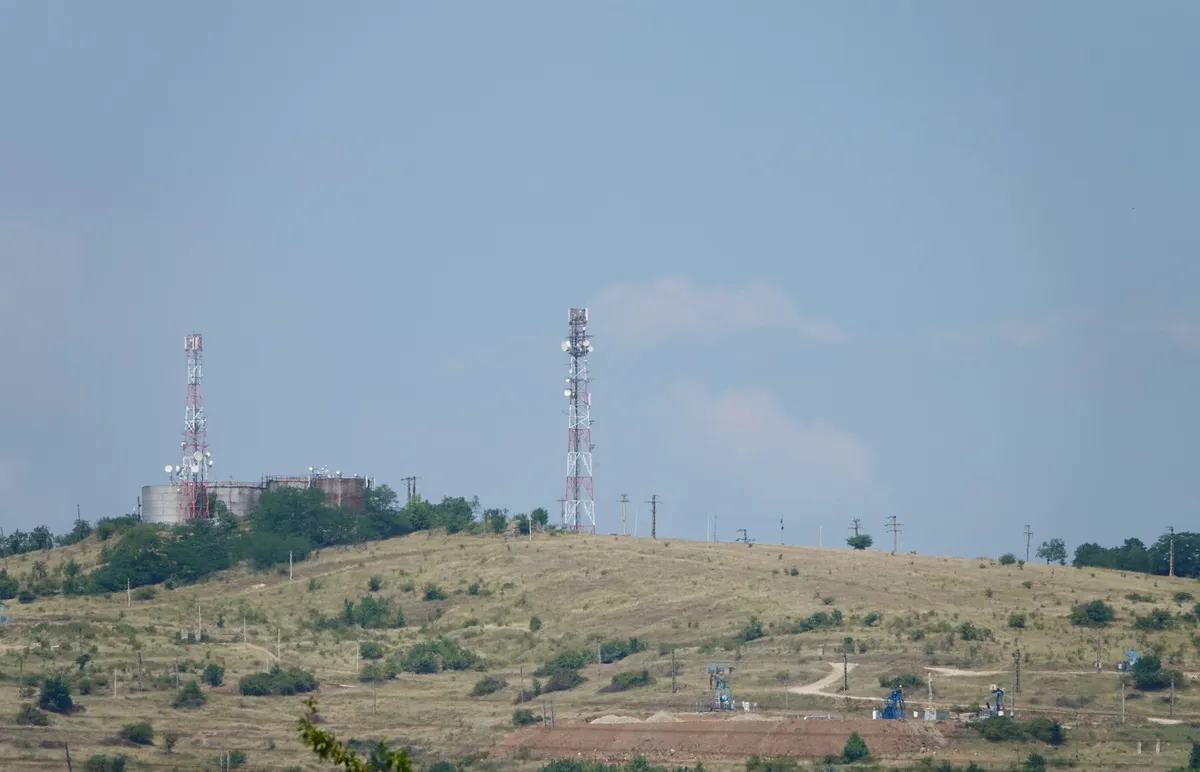
Operating pumpjack beside an orchard in Țintea-Băicoi. Over generations, heavy steel rigs and gathering lines became fixtures of the domestic Prahova landscape.
Photo: Nenea hartia / Wikimedia Commons · CC BY-SA 4.0
Verified In Moreni and Buștenari, warm pipelines carrying pumped crude oil became de facto domestic fixtures. Because paraffin-rich Romanian crude congealed at near-freezing winter temperatures, companies ran parallel steam trace-lines alongside the main oil conduits to maintain flow. As a result, radiating thermal heat melted snow in a one-meter strip above the pipes, creating dry footpaths through winter drifts that school children walked along daily. Spanning muddy ditches, 200 mm pipes served as footbridges, and gardeners trained grapevines and climbing beans around rusted steel conduits.
Interpretation This intimate proximity exacted a profound ecological price. Village soil remains impregnated with heavy bitumen and aromatic hydrocarbons. The shallow water table was permanently fouled; water drawn from backyard wells smells of gasoline and leaves salty brine residues. Anyone attempting today to dig a house foundation, install a water line, or plant fruit trees strikes the heavy steel casing of a company nationalized in 1948.
Legend Folklore in Buștenari still remembers the "oil millionaires" of the 1920s: illiterate peasant landowners enriched overnight by concession royalties who ordered Viennese grand pianos from mail catalogs. Hauled on ox carts over axle-deep mud, the ornate pianos proved too wide to fit through cottage doors and ended up under open farm sheds, repurposed as corn bins or chicken coops.
Interactive domestic cartography
Anatomy of an oilfield homestead in Moreni
Select a property element to inspect its archival record:
Domestic space
Dwelling house
Ground reality today:
The legacy of earth that refuses to forget
Interpretation The oil roads of Prahova Valley did not vanish with declining production or the shuttering of historical refineries. They persist within the physical fabric of communities. A person born in Moreni or Câmpina recognizes the heavy, sweet scent of gas condensate anywhere; they know their orchard soil is dark through a century of seepage from derrick timbers, rather than rich plant humus.
Between the naked well diggers descending into the suffocating abyss, the terror of August 1, 1943, fought at walnut-branch level, and the backyard pipelines over which children still hang swings, Prahova forged an unprecedented European reality: a civilization that turned volatile fuel into home and living fire into an ordinary neighbor.
Methodology, certainty ledger, and archives
Research framework
This project examines the ecological and anthropological transformation of Prahova Valley across 170 years. Engineering parameters regarding well depths, formation pressures, and production volumes derive from historical publications of the Geological Institute of Romania and monographs by Ludovic Mrazec (1910). Details concerning manual pit excavation and bellows ventilation are verified against Prahova and Dâmbovița County Archives.
Primary sources: Operation Tidal Wave
Mission logs of the US Ninth Air Force (389th Bombardment Group, Câmpina), Flak-Division 5 operational war diaries (General Alfred Gerstenberg, Bundesarchiv-Militärarchiv Freiburg), shift logs of the boiler power station at Steaua Română Refinery (August 1, 1943), and eyewitness testimonies compiled in Ploesti: The Great Ground-Air Battle of 1 August 1943 (James Dugan & Carroll Stewart).
Primary sources: Land tenure and pipeline networks
The Romanian Mining Act of April 21, 1895 (Monitorul Oficial no. 22); cadastral concession maps of Buștenari, Telega, and Moreni municipalities (1900–1938); Nationalization Decree no. 119/1948 nationalizing industrial, banking, mining, and transport enterprises (Monitorul Oficial no. 133 bis, June 11, 1948).
Historical research, writing, and interface design by Marius Comper, September 2026.