After the bin · Bucharest · November 2026
Bucharest Sector 1’s waste tax enters the income from treated waste as zero lei: the operator did not send the figure
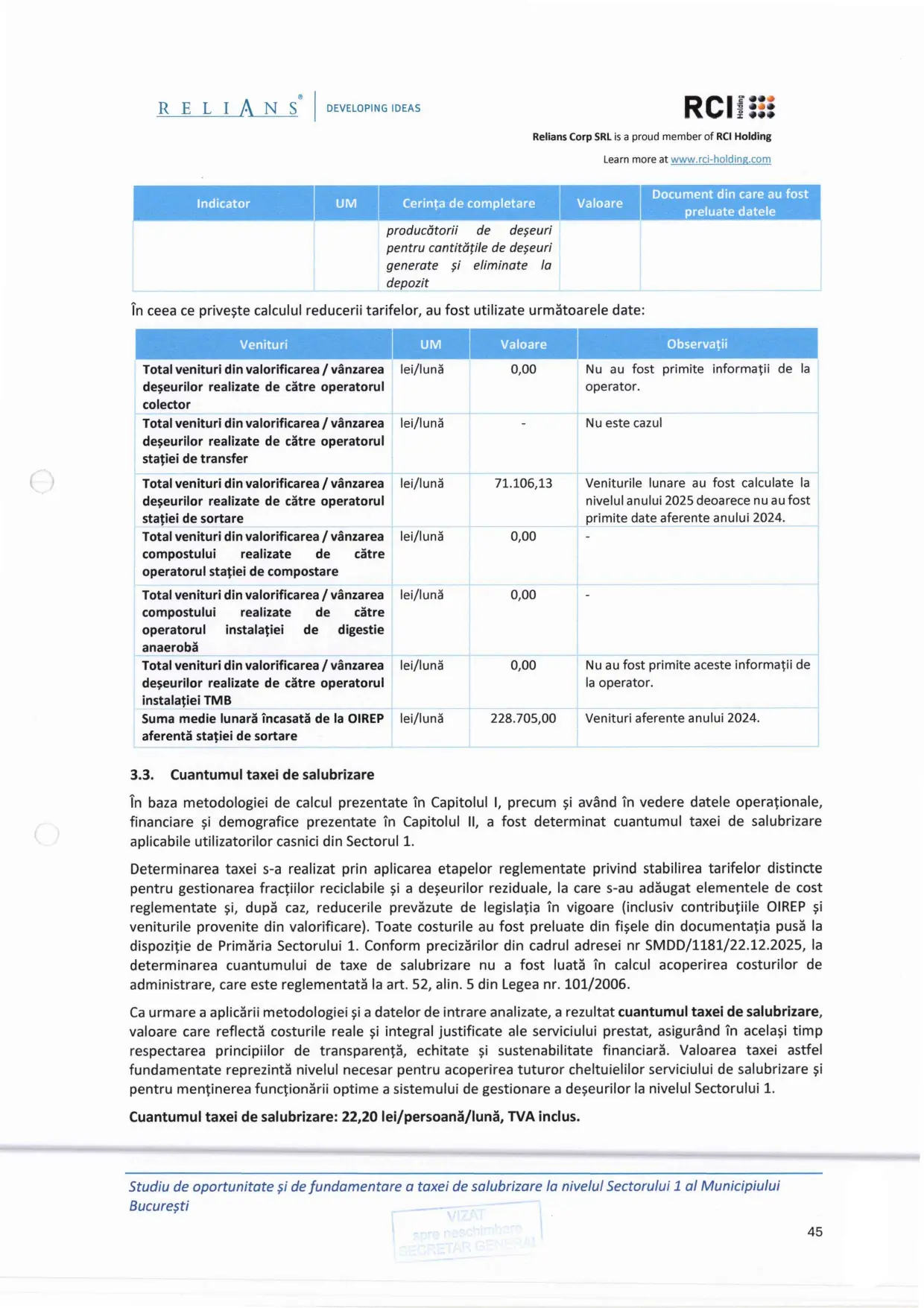
The study behind Sector 1’s new waste tax of 22.20 lei per person a month enters the income from selling materials recovered at the treatment plant as 0.00 lei, with the note “This information was not received from the operator.” Had it been subtracted like the sorting station’s income, every 100,000 lei a month would have lowered the tax by about 46 bani (hundredths of a leu) per person. The public documents consulted do not say how much it was.
The study’s table of income that lowers the tax#
On 22 October 2026, Bucharest’s Sector 1 adopted a special waste tax for residents who receive the service without an individual contract with the operator: 22.20 lei per person a month including VAT, from 1 January 2027. The amount comes from a study by the consultancy Relians Corp SRL, adopted together with the council decision.
The tax adds up what the sector pays the operators who collect, sort, treat and landfill the rubbish, then subtracts what the operators earn by selling recovered materials and the money paid by companies that put packaging on the market. This table, on page 45 of the study, lists the income that gets subtracted.
The treatment plant’s income, as entered: 0.00 lei#
For the mechanical-biological treatment plant (TMB in Romanian), which takes mixed rubbish, pulls out plastic, metal and paper and prepares the rest for burning or landfill, the table enters 0.00 lei a month. The note beside it: “This information was not received from the operator.” For the operator that collects the rubbish, the same: 0.00, information not received.
A zero in the table does not mean the operator sold nothing. It means the study did not receive the amount from the operator and entered it as zero. Nor does the study say whether the treatment fee, 454.94 lei per tonne before VAT, already accounts for that income. If it does, subtracting it again could count the same money twice; the documents do not show which treatment is right.
Two income figures entered, from different years#
Two amounts do appear on the same page. For the sorting station, the study uses an income from recovery and sale of 71,106.13 lei a month, computed “for 2025 because data for 2024 were not received”. The organisations through which packaging producers pay for recycling paid 228,705.00 lei a month, a 2024 figure.
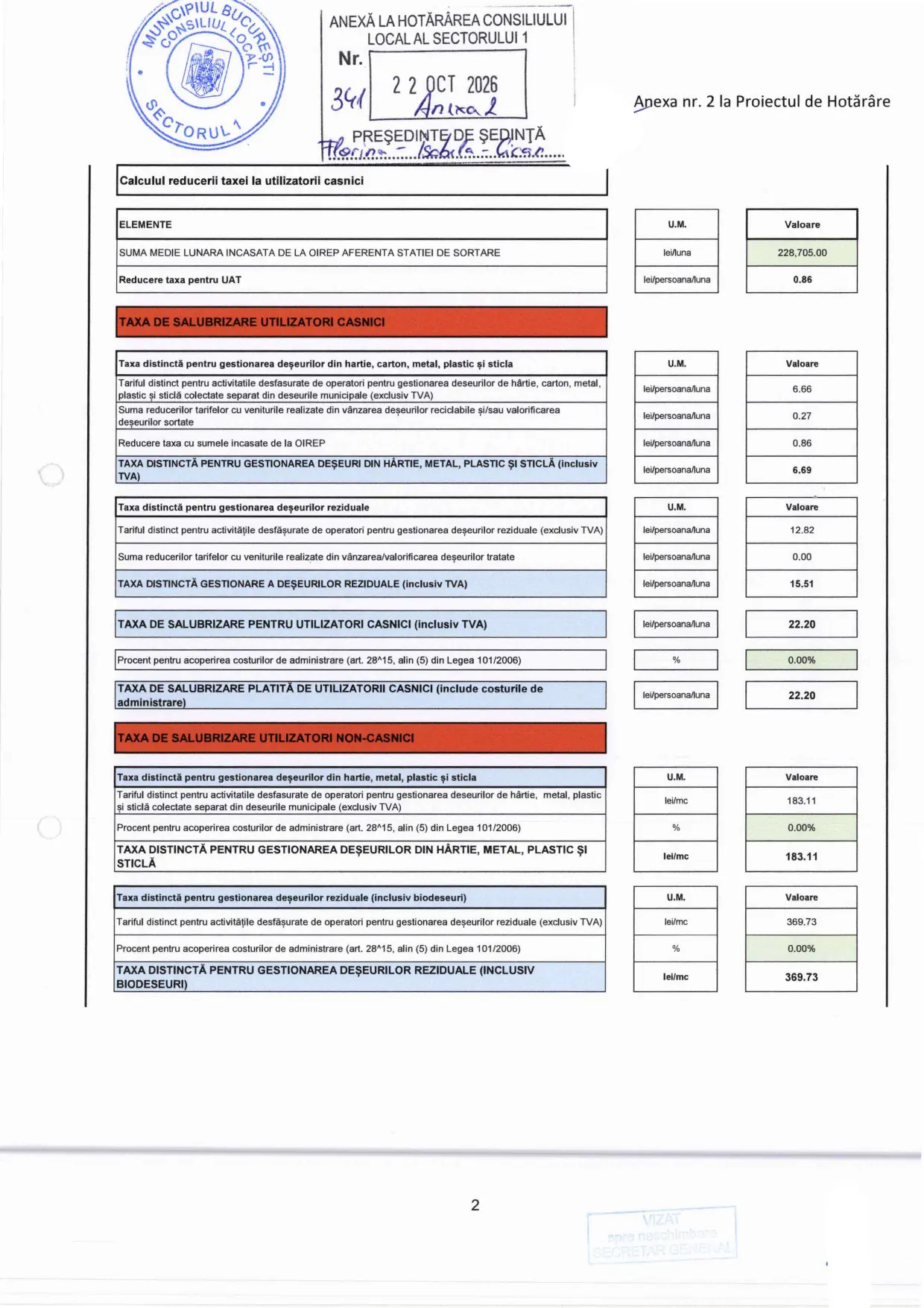
Divided by the number of residents in the calculation, the two lower the tax, before VAT, by 0.27 and 0.86 lei per person a month.
Where the zero enters the 22.20-lei tax#
The decision’s calculation annex splits the tax in two. For paper, plastic, metal and glass: 6.66 lei, minus 0.27 and 0.86, plus 21% VAT, which gives 6.69 lei. For residual, mixed rubbish: 12.82 lei, minus 0.00 from “the sale or recovery of treated waste”, plus VAT, which gives 15.51 lei.
6.69 plus 15.51 makes 22.20. The calculation can be redone leu by leu from the annex, and the zero sits exactly in the line for residual rubbish, the part that goes to treatment.
How many people share the cost#
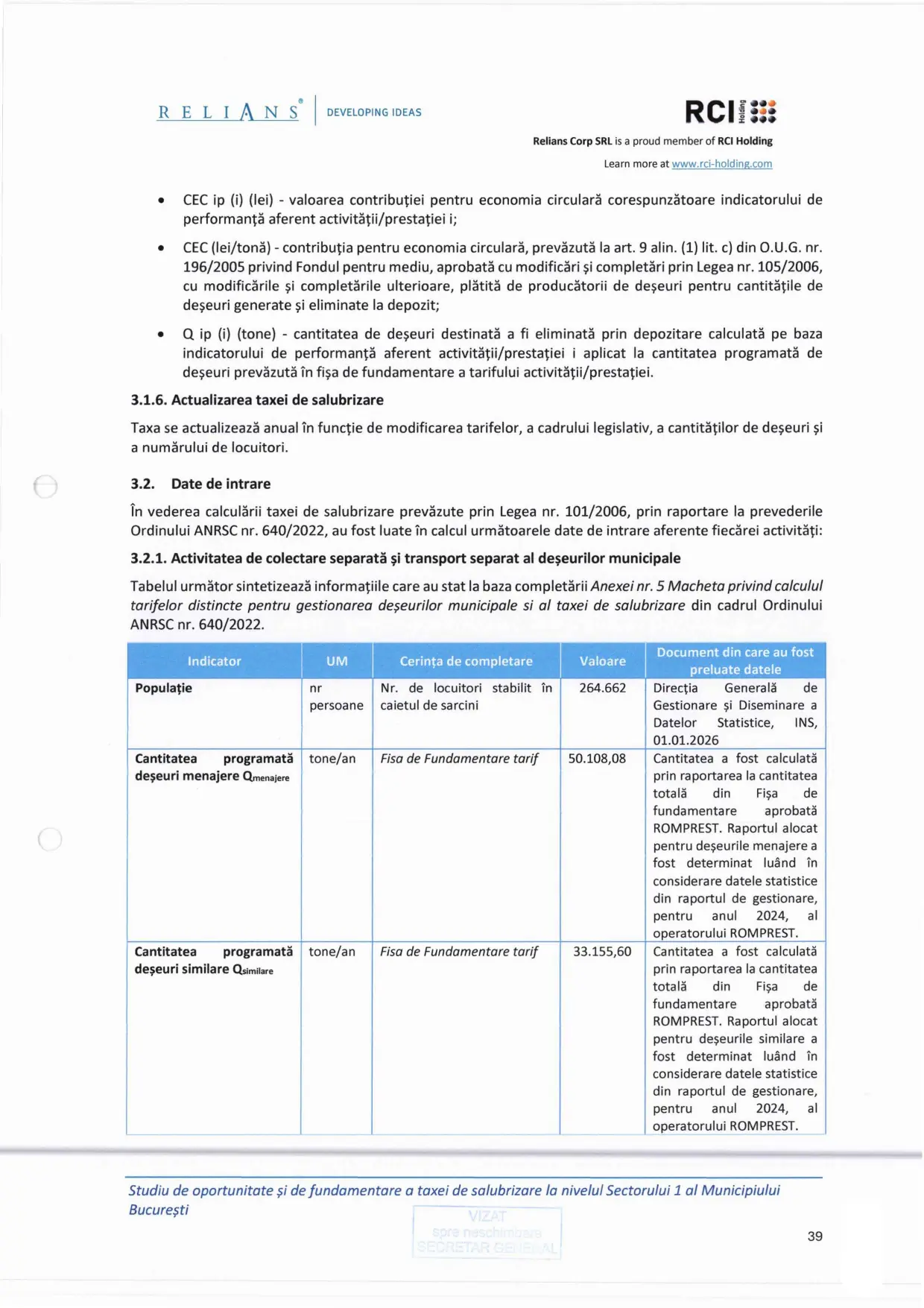
On page 8, the study says that “the resident population will be used” and estimates Sector 1’s at 217,978 people in 2024. The calculation, however, divides the costs by 264,662 people, “the number of inhabitants set in the specifications”, from national statistics for 1 January 2026.
The larger the number, the smaller the amount per person. The study does not explain how its 2024 resident estimate relates to the number used in the calculation, nor say, in that table, what kind of population the second number measures.
What a Sector 1 household pays#
The tax is charged per person, to households that receive the service without an individual contract. Choose how many people live in the home and whether the household receives the subsidy.
The subsidy is granted automatically, until 31 December 2029, to households that follow the separate-collection rules; every household is presumed to follow them unless shown otherwise.
- Tax
- a month
- Subsidy from the sector’s budget
- − a month
- To pay
- a month
And if the treatment plant’s income had been known?
Choose a monthly income for the treatment plant. The calculation subtracts it the way it subtracted the sorting station’s income: divided by 264,662 people, with VAT.
With zero, as in the study, the tax stays at 22.20 lei.
The annex does not show how income from treatment would have been applied: in the same table, the “mechanical-biological treatment fee” row also reads 0.00 lei per person. The value chosen shows the mechanism, not the real income, which does not appear in the public documents consulted.
Had the income gone in by the same rule, it would have taken about 218,700 lei a month, roughly 2.6 million lei a year, to lower the tax by 1 leu per person a month.
More rubbish sent to treatment, fewer materials reported#
For the whole city, the ADIGIDMB page shows one improvement and one decline. Rubbish sent straight to landfill fell from 325,944 to 241,252 tonnes, down 26%. Rubbish sent to treatment rose from 235,448 to 290,181 tonnes, up 23%.
Fewer materials, however, were reported coming out of the plants. Recyclables fell from 13,181 to 13,041 tonnes, and waste recovered for energy (prepared for burning in cement kilns or power plants) from 81,068 to 51,561 tonnes. As a share of the tonnes sent to treatment in the same year, reported recyclables fell from 5.6% to 4.5%, and waste reported for energy recovery from 34.4% to 17.8%. A year’s output-to-input ratio is indicative: stock and timing between years can shift it.
A tonne sent to treatment is not a tonne recycled. Out of treatment come materials for recycling, fuel, residues for landfill, evaporated water and stock waiting to move on. Energy recovery is not recycling and is not added to it. For 2026 the page shows zero recyclables and zero energy recovery, but 38,202 tonnes of residues landfilled; the monthly series available stops in March, so it is not clear whether the first two zeros are quantities or missing data.
Where each sector’s rubbish went, month by month, beside the treatment contracts: rubbish sent straight to landfill, sector by sector.
Two versions of 2024
ADIGIDMB’s annual report for 2024, a PDF, gives different numbers for the same year than the web page: 16,962 tonnes of recyclables instead of 13,181, and 75,719 tonnes recovered for energy instead of 81,068. With the PDF figure, the fall in recyclables in 2025 would be larger. The comparison above uses the web page for both years so as not to mix versions; the documents consulted neither explain the difference nor say which series to use.
How bids for treatment were scored#
In the open tender for treating the residual waste of all six sectors, the winning bid was chosen 50% on price, 40% on recycling and 10% on landfill. A bid had to promise at least 7% recycling and at most 56% landfill. Five lots were awarded, for Sectors 1, 2, 3, 5 and 6, with a total awarded value of 547.9 million lei before VAT: the value of the contracts, not money paid. Sector 1’s contract 57, signed on 2 February 2026, is lot 1, worth 107 million lei, according to the notice in the EU’s Official Journal.
For Sectors 1 and 4, ADIGIDMB also awarded contracts by negotiation without prior publication of a notice, for 12 months. There, price counted for 80%, and recycling and landfill for 10% each; the recycling minimum was 3%, with landfill at most 57%. Sector 1 thus has two awards; the notices do not show how the emergency award relates to contract 57.
price recycling landfill
These are the tender’s conditions, not what the winners promised. Sector 1’s study quotes contract 57: of the residual waste accepted in a year, the operator must send at least 7.1% to recycling, at least 30% to energy recovery and at most 55% to landfill; for recycling, the legal minimum is 3%. The winning bids do not appear in the public documents consulted.
The rules adopted by Bucharest’s General Council in July 2026 say what happens when a treatment plant misses the 3% recyclables minimum: the operator pays the shortfall in tonnes multiplied by the average sale price of recyclables. The penalty therefore depends on an average sale price for recyclables. Separately, Sector 1’s tax study says it did not receive the operator’s income from recovery.
The documents that would allow a check#
For every tonne, the chain has the same links. Marked here: the ones found in the public documents consulted, and the ones not found.
- Award notice and scoring rules (in public documents)
- Winning bid: the result promised (not found in public)
- Tonnes received at the plant, monthly (in public documents)
- What came out, and where each material went (not found in public)
- The report in which the authority accepts the result (not found in public)
- Invoice and payment (not found in public)
- Penalty calculated and collected (not found in public)
- Income from selling materials (not found in public)
- Tax calculated for residents (in public documents)
in public documents not found in public
Questions the public documents consulted do not answer:
- How much did Sector 1’s treatment plant earn from selling materials and fuel in 2024 and 2025?
- Does the 454.94-lei-per-tonne fee already include that income? If so, the study’s zero is right.
- Did the operator send the information after February 2026, and if so, was the calculation redone?
- What average sale price does ADIGIDMB use when it calculates the penalty for missing recyclables, and does the operator of Sector 1’s plant report the same price?
- Which series for 2024 is the validated one: the web page or the PDF report?
Where the decision stands#
As of 15 November 2026, none of the sources consulted (the decision as published by Sector 1’s town hall and the decisions register at hcl.usr.ro) showed a suspension or annulment of decision 341. On 13 November, Buletin de București reported that Bucharest’s Prefecture had gone to court to annul three other Sector 1 decisions (146, 147 and 211), on changing the sanitation operator; decision 341 is not among them. The USR party announced on 23 October that it would challenge the tax in court. The tax is scheduled to apply from 1 January 2027.
How the figures were calculated#
Treatment results are those published by ADIGIDMB on its “Tratarea deșeurilor” page, saved on 15 November 2026: municipal waste collected mixed (code 20 03 01) and what came out of the treatment plants. They exclude separately collected waste and do not describe all of Bucharest’s recycling.
City-wide numbers come from the same page’s annual cards for 2024 and 2025, saved the same day. Output shares are calculated here, dividing each reported output by the tonnes sent to treatment in the same year; they are not certified indicators for any contract.
Values from Sector 1’s study are read from the scanned pages of the adopted decision. The tax was recalculated from annex 2: every line gives the same value to two decimals. The calculation for treatment income applies the rule visible in the annex for the sorting station (monthly income divided by 264,662, then VAT); the annex does not show whether the same rule would have applied to treatment.
Scoring weights and thresholds come from the award notices in SEAP, Romania’s public procurement system (CAN1161134, CAN1163955, CAN1163956). For Sector 4, one criterion in the emergency notice is titled “landfill” while its description and formula concern recycling; it is read here by its description.
What was reported before
The ranking of sectors by how much they send to treatment was published by Gabriel Kolbay in SpotMedia (29 January 2026) and picked up by Împreună suntem București; ADIGIDMB’s 2024 report was covered by Alexandra Nistor in HotNews (24 July 2025); the award of the treatment contracts, by Marian Păvălașc and Andrei Tomanciuc in NewsCenter (September 2026). Răzvan Chiruță, in Buletin de București, reported on 19 October 2026 the number of people in the calculation, the 6.69 and 15.51 lei split and the 0.27 and 0.86 lei reductions, and on 23 October the USR party’s demand for the amounts to be reconciled.
Sources#
- ADIGIDMB, waste treatment page: tables and contracts by sector (saved 15 Nov 2026)
- Sector 1 council decision 341/22.10.2026, with the study and annexes (PDF, Sector 1 town hall)
- Decision 341/2026 in the hcl.usr.ro decisions register
- ADIGIDMB, 2024 waste management report (PDF, 17 Apr 2025)
- SEAP, award notice CAN1161134, open tender (March 2026 version)
- EU Official Journal, TED notice 164958-2026 (contracts 41/44, 42/43 and 57)
- SEAP, award notice CAN1163955, Sector 1, negotiation without prior publication
- SEAP, award notice CAN1163956, Sector 4, negotiation without prior publication
- Bucharest General Council decision 325/29.07.2026, sanitation rules, annex (p. 92)
- Buletin de București, 19 Oct 2026: the Sector 1 waste tax
- Buletin de București, 23 Oct 2026: USR to challenge the tax in court
- Buletin de București, 13 Nov 2026: Prefecture seeks annulment of three decisions
- SpotMedia, Gabriel Kolbay, 29 Jan 2026: the sectors and the Vidra landfill
- Împreună suntem București, Feb 2026: sectors that recycle and sectors that bury
- HotNews, Alexandra Nistor, 24 Jul 2025: how much Bucharest recycles
- NewsCenter, Marian Păvălașc, 18 Sep 2026: the 122-million-lei contract for Sector 4’s waste
- NewsCenter, Andrei Tomanciuc, 20 Sep 2026: treatment contracts, sector by sector