Interactive simulation · The inner ear
Balance in your ear — The three canals that sense rotation
Spin on a chair and stop dead: the room keeps turning for a moment. In the inner ear, fluid in the three semicircular canals keeps moving after the head has stopped, and the brain reads a rotation that is no longer there. The simulator below shows the lag, step by step.
The simulator did not start in this browser. The mechanism, in brief, follows below.
Head-turn simulator
At rest
- Head
- 0 °/s
- Fluid
- 0 °/s
- Cupula
- 0 %
- Signal
- quiet
- head
- signal read by the brain
- eyes, via the vestibulo-ocular reflex
The target stays put while the head stays put.
Three fluid-filled rings read every turn of the head
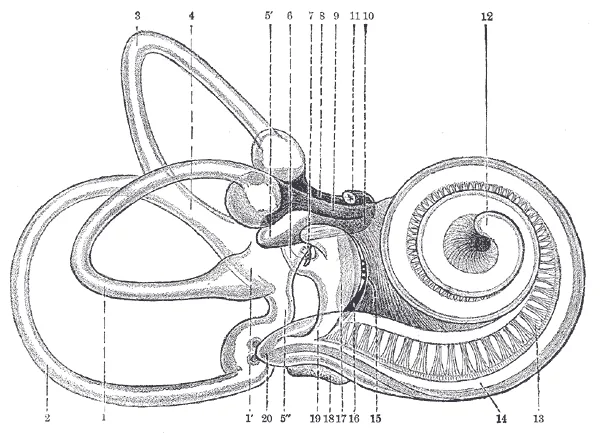
Each inner ear houses three semicircular canals: one horizontal and two vertical, set roughly at right angles to one another. The vertical pair sits at about 45 degrees to the midline plane of the head. Together they cover every direction the head can turn.
At the base of each canal sits a swelling, the ampulla. Inside, the fine hairs of sensory cells reach into a membrane stretched across the passage, the cupula. When the head turns in the plane of the canal, the fluid lags behind and pushes the cupula towards the side opposite the movement. The bent hairs change the cells' signal, and the vestibulocochlear nerve carries the news to the brain stem and cerebellum.
A steady turn cannot be felt for ever: the fluid catches up with the canal, the cupula straightens, and the signal fades. A sudden stop does the reverse: the fluid carries on for a moment and bends the cupula the other way. The brain receives a rotation that is no longer happening, and the room appears to spin.
The eyes listen to the same signal. The vestibulo-ocular reflex moves them against the head, holding the image still on the retina. After a sudden stop the reflex obeys the false signal and shifts the eyes with an imaginary turn: the target slips from view until the fluid settles. Head position and straight-line travel are read separately, in the utricle and saccule; the simulator above follows rotation only.
Dizziness or vertigo?
The Romanian explanatory dictionary defines amețeală as the state of losing the sense of balance, and vertij, as a medical term, as the same. The dizziness that follows a spin is a healthy signal from a working organ, not an illness. Repeated spinning sensations that arrive uninvited belong to a doctor, not to a simulator.
Method and limits
- The anatomy and mechanism follow sections 14.1 Sensory Perception (the equilibrium subsection) and 14.2 Central Processing (the vestibulo-ocular reflex) of OpenStax Anatomy and Physiology, second edition, and the balance-disorders page of the American National Institute on Deafness and Other Communication Disorders. Word senses follow the Romanian explanatory dictionary through DEXonline.
- The simulator is a demonstrative model, not a measurement: the fluid follows the head with an illustrative constant of four seconds, the eye reflex uses an idealised gain of one, and the chart shows normalised percentages, not clinical degrees.
- The after-stop effect appears only after a spin of at least two seconds; below that threshold the model settles with no readable signal. The threshold belongs to the staging, not to physiology.
- Diseases that cause vertigo are outside this subject. The archive figure shows real anatomy; the animated drawing shows the schema.
Sources
- OpenStax, Anatomy and Physiology second edition, sections 14.1 Sensory Perception (the Equilibrium subsection) and 14.2 Central Processing (the vestibulo-ocular reflex) — openstax.org, CC BY 4.0 licence, with attribution. Accessed 21 September 2026; second-edition links verified 24 September 2026. The full text was also read in the first-edition Pressbooks mirror, where the same section is numbered 15.4.
- National Institute on Deafness and Other Communication Disorders, Balance disorders — nidcd.nih.gov, American federal public information. Accessed 21 September 2026.
- DEXonline, amețeală (DEX '98: the state of losing the sense of balance) and vertij (DEX '09, medical: amețeală, from French vertige). Accessed 21 September 2026.
- Henry Vandyke Carter, Membranous labyrinth, plate from Gray's Anatomy (1918), public domain — Wikimedia Commons, file verified 21 September 2026.
