
Can You Stop at Exactly One Second?
Start a hidden timer and stop it when you think exactly one second has passed. After five attempts, every miss appears in milliseconds and the photo finish shows whether each press landed early or late.
Experiments to try on your own, with family or in class. Write down what you expect, explore the project and revisit your answer.
Your answers stay in this browser. Download or print them; they are not sent to a teacher or an external service.
Three short tests. Before each one, write down how close you expect to get. Then compare your expectation with the result.
Start a hidden timer and stop it when you think exactly one second has passed. After five attempts, every miss appears in milliseconds and the photo finish shows whether each press landed early or late.

A 5-round visual precision test: tap the center of the circle without a compass. A steel needle drops to measure your error in millimetres and determines whether your eye lifts the perceived center above the true axis.

4 estimates with randomly drawn anchors in 2 minutes: an instrument that measures your pull toward the first figure — your personal ruler (anchor / estimate / truth) and anchoring index.
Choose a place and two generations’ birth years. Explore temperature, warm nights and drought separately: they measure different things.
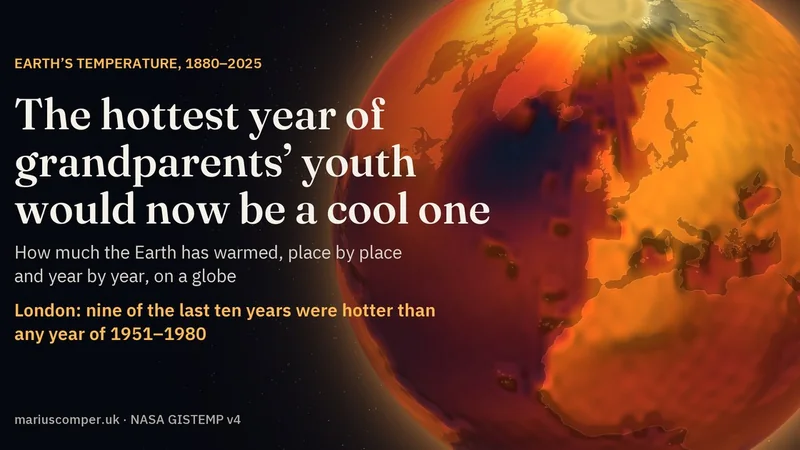
NASA’s temperature record on a globe, year by year from 1880 to 2025. Around London, nine of the last ten years were warmer than 1959, the hottest year between 1951 and 1980. With the numbers for 6,552 towns and cities and a family’s birth years. In Romanian and English.
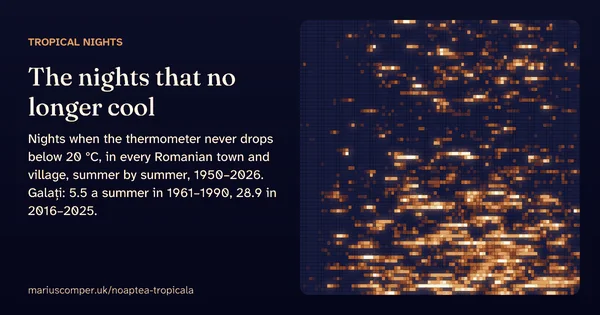
A tropical night is one when the minimum temperature never drops below 20 °C. Galați, in Romania’s eastern lowlands, averaged 5.5 a summer in 1961–1990 and 28.9 in 2016–2025; Craiova 1.9 and 12.4. Every summer since 1950, night by night, for any Romanian town or village.
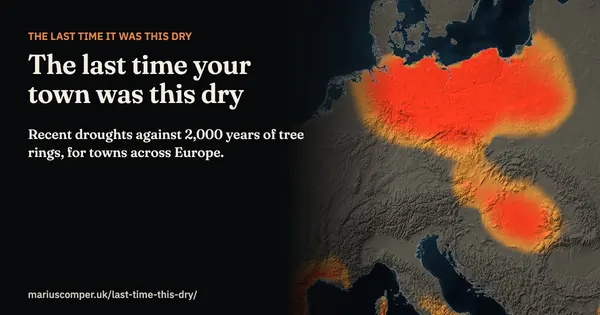
A drought atlas made from tree rings, from the year 0, set against instrument records for 1903–2025 and read with its own errors. Around Berlin, Warsaw, Prague, Budapest and Timișoara the recent four-summer run is the driest since at least 1500 in more than nine of ten simulations; around London, Paris and Madrid the instrument record already holds a drier one. For your town: the last time it was this dry. In English and Romanian.
Start with familiar words and check which relationships can be demonstrated. Similarity between two forms is the beginning of the question.

A map of 1,016 basic words in 107 languages, from Iceland to Kamchatka, starting from your own. Tea took two roads, the cuckoo names itself, the moon also names the month in 57 other languages, and in Georgian “mama” is father. Plus your own line between green and blue, across 110 languages.
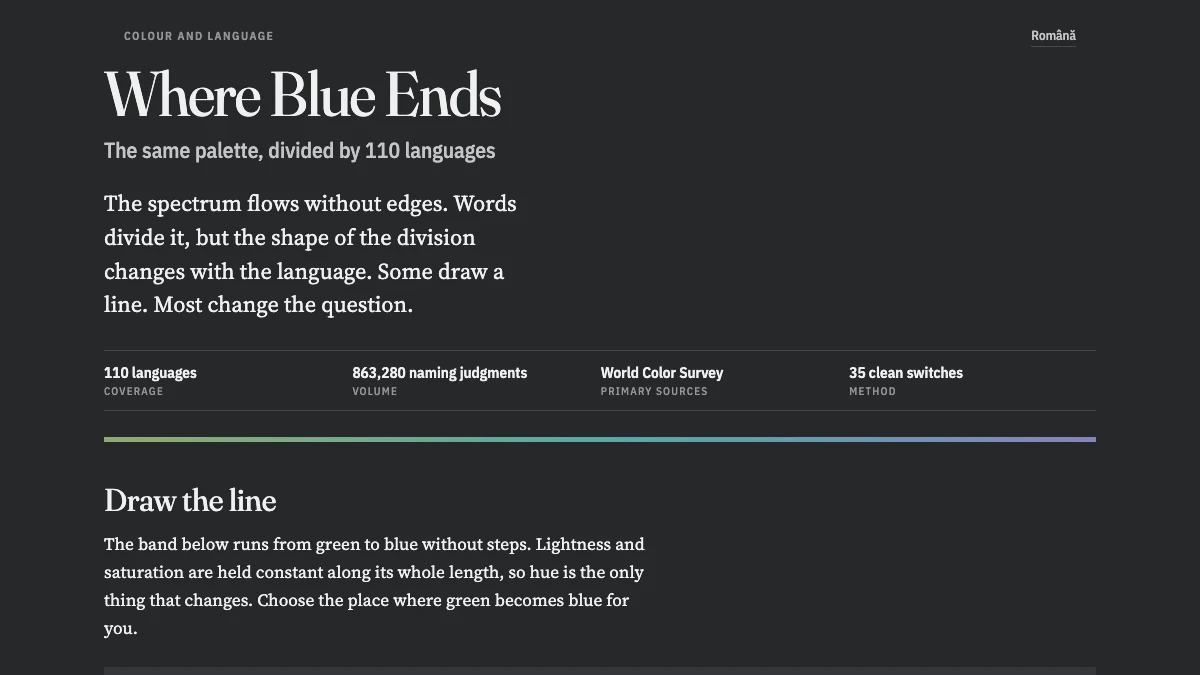
Draw the line between green and blue, then see why one clean switch describes only 35 of the World Color Survey's 110 languages.
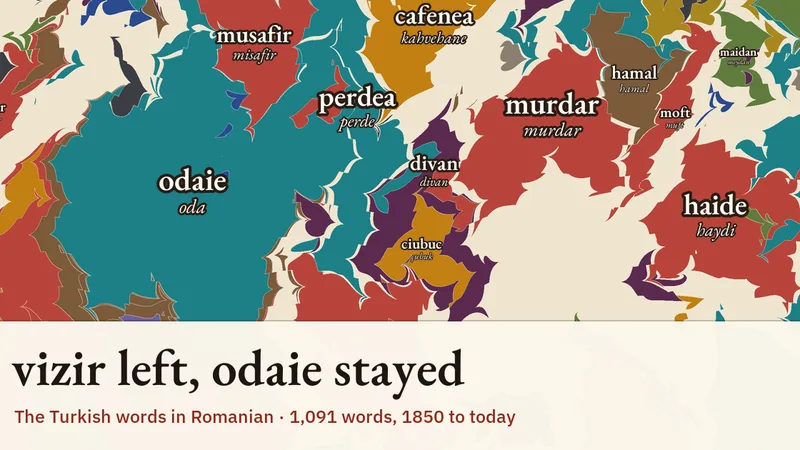
All 1,091 Romanian words that came from Turkish and Tatar, on a sheet of live ebru marbled paper: each blot of ink is a word, sized by how often it appears in Romanian books of 1850–1949 and in today's films. Between 1850 and 1925 the words of the state fell in Romanian books by 60–74%, whatever their language, Turkish, Greek, Hungarian or Slavic; the words of the house and the table stayed. With a false-friends game between Turkish and Romanian, the Turks and Tatars of Dobruja commune by commune, and five centuries of history. In Romanian, English and Turkish.