Social history · 1835–1836
The Scăieni Phalanstery
In 1835, on an estate in Wallachia, dozens of people tried to turn a French utopia into a way of life. The experiment survived for less than two years. Even its exact location is now uncertain.
A theory of the perfect society arrives on an indebted Wallachian estate.
In brief
- WhatAn agricultural-manufacturing colony on the theory of Charles Fourier: the Societatea agronomică și manufacturieră, also called the Colonia soților agronomi — the Colony of the Agronomist Associates.
- WhereOn Emanoil Bălăceanu's Scăeni estate, in Saac county, Wallachia — today the town of Boldești-Scăeni, Prahova county.
- WhenOpened 10 March 1835; dissolved in autumn–winter 1836. The last members had left by 30 December 1836.
- WhoTeodor Diamant (1810–1841), Fourier's Parisian disciple, and the landowner Emanoil Bălăceanu — with dozens of soți agronomi.
- Why it vanishedDebts and sequestration, a breached contract, a rift between the founders, and administrative dissolution orders. No single cause explains everything.
“Phalanstery” renders phalanstère: Fourier's imagined community-building, where hundreds would have lived, eaten and worked together.
Act I — The Blueprint
How the utopia was supposed to work
Before it reached Scăieni, the phalanstery was a social machine of dizzying precision drawn on paper. Charles Fourier (1772–1837), a French commercial clerk, proposed a procédé, a recipe for achieving pleasurable work and harmonious coexistence through organisation, without recourse to revolt.
The basic unit was the phalanx: 100 to 300 families of unequal fortunes, living in one vast common building — the phalanstery. Reckoning no fewer than 810 human character types, Fourier demanded exactly 1,620 people for the complete model: enough for every passion to find its working series.
What separates Fourierism from later communism is property. Fourier did not abolish it: inheritance and individual ownership remained, and the community's income was split into three dividends — 5/12 for labour, 4/12 for capital, 3/12 for talent. Rich and poor became associates; agriculture stayed the central occupation, with manufactures as its complement for winter days.
Work itself was to be redesigned: short sessions, tasks chosen by inclination, cheerful rotating teams, so the senses would never dull. Education, canteen, workshops and gardens — all under one roof. The complete 1,620-person model, though, had been realised nowhere: the only attempt, the colony at Condé-sur-Vesgre near Paris, begun in 1832, was small and barely started.
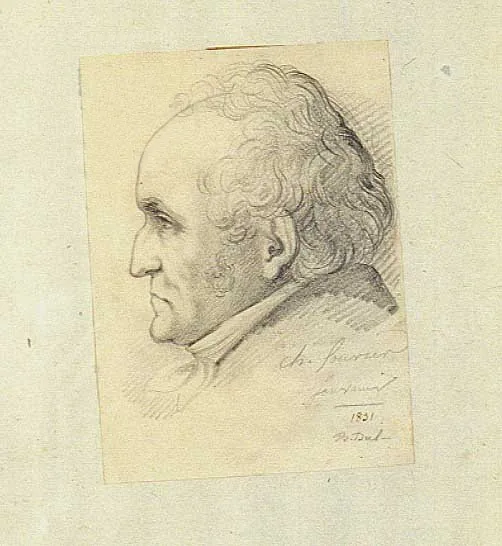
Foto: Alexandre Baudet-Dulary, 1831, Public domain, Collection André Breton (via Wikimedia Commons)

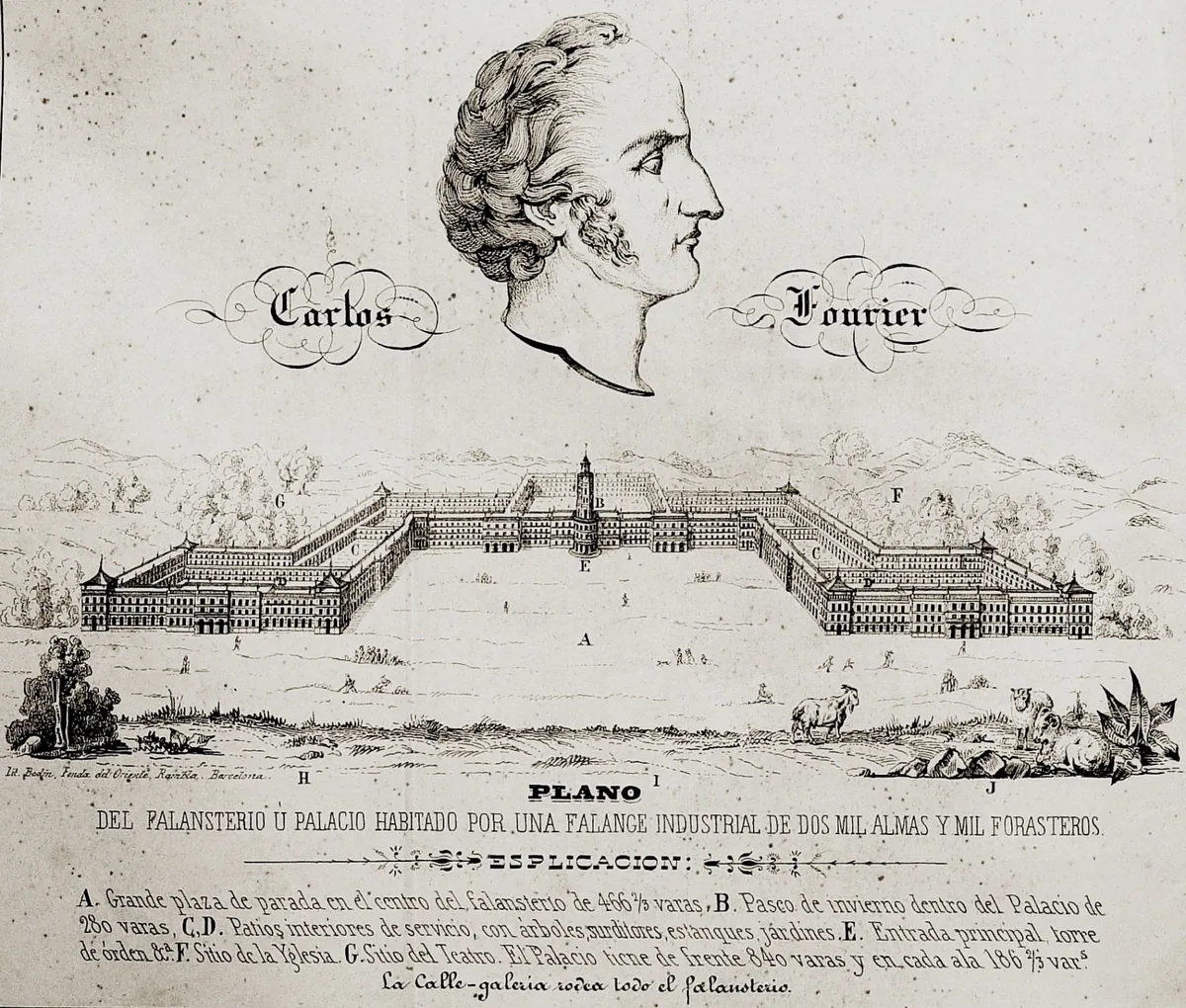
Foto: autor necunoscut, începutul sec. XIX, Public domain, via Wikimedia Commons

Anatomy of a utopia
Seven parts of the Fourierist machine. Touch each part to see its theoretical role — and what became of it at Scăieni.
Labour
Short sessions, tasks by inclination, rotation between teams. Work was to be organised as play.
At Scăieni: 8 hours a day with no weekly rest, fixed by contract and detached from personal inclination.
Capital
Received 4/12 of income. Capitalists kept their property and were invited to invest as shareholders.
At Scăieni: the capital was the estate itself — leased, not donated, and encumbered by debt.
Talent
Received 3/12 of income: the engineers', artists' and organisers' share, paid for skill.
At Scăieni: Diamant's promised lessons — mathematics, social economy, French — were never taught.
Education
Children raised in common boarding schools, learning trades and sciences by practice; the school a small phalanx.
At Scăieni: a “pension” announced with fanfare in 1835; the school was banned by order on 29 September 1836.
Housing
Everyone under one roof: private flats, but common canteen, halls and workshops. The building was half the system.
At Scăieni: no purpose-built phalanstery is documented — the colony seems to have used the old manor houses, plus cells built around a courtyard.
Agriculture
The central occupation and measure of all things. Fourier dreamed orchards, gardens and harvests as a continuous feast.
At Scăieni: members complained that estate labour meant digging wells and clearing scrub. The promised farming never happened.
Crafts
Manufacturing workshops complemented farming in winter and on rainy days; they diversified and sweetened work.
At Scăieni: the promised “factory” never existed; complainants say forest clearance was all they saw.
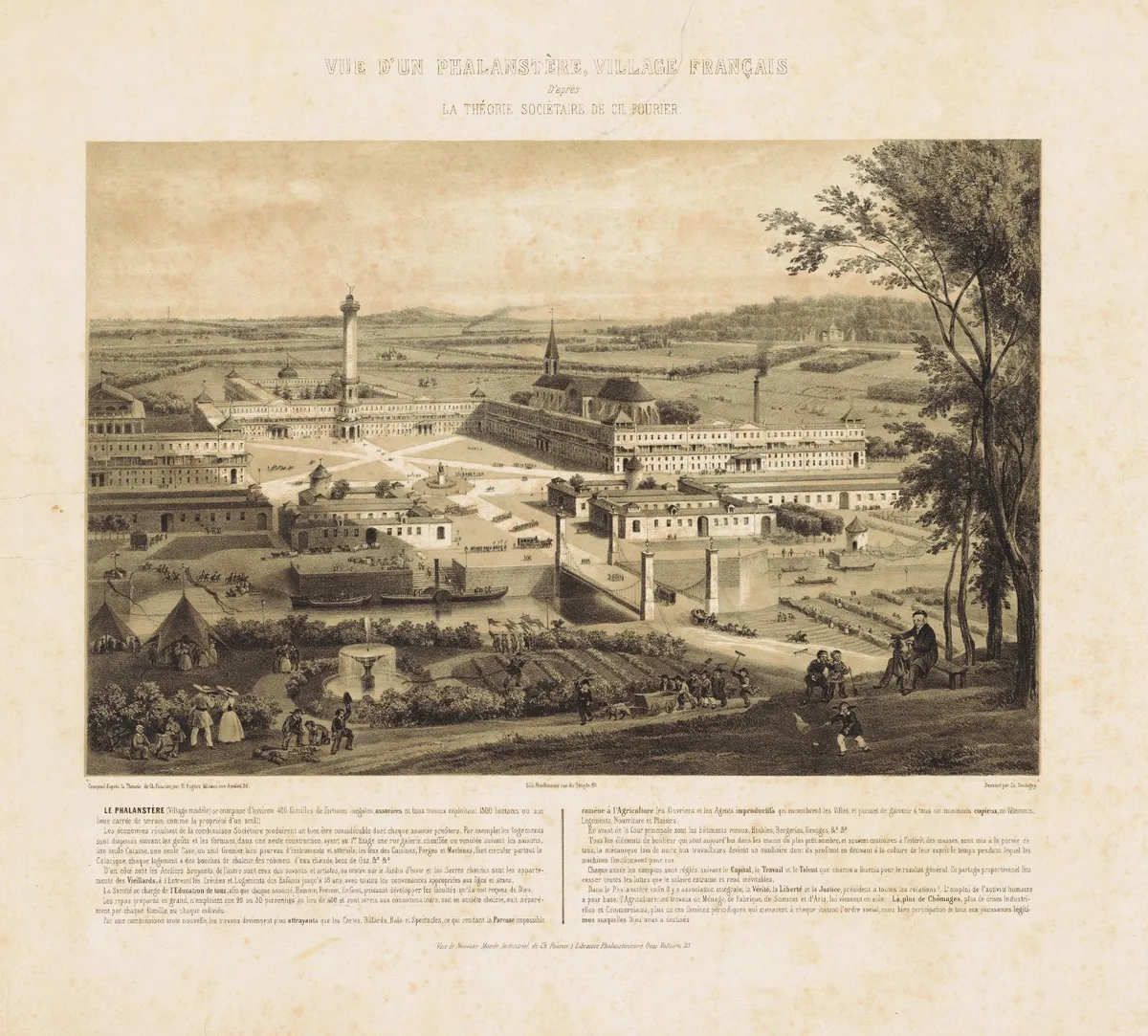
Foto: H. Fugère, sec. XIX, Public domain, Houghton Library, Harvard (via Wikimedia Commons)

Evidence: The theoretical model
- Claim
- The theoretical model
- Evidence
- Fourier syntheses via the anthology Mari gânditori francezi ai veacului XIX and the Cojocaru–Ornea 1966 monograph, summarised by Dohotaru 2011.
- Source date
- Secondary sources 1966–2011 on Fourierist writings of 1808–1837.
- Source type
- Type: academic synthesis.
- Confidence
- High for the model's structure.
Act II — The idea travels
Paris → Bucharest → Scăieni
The theory needed a carrier. It found Teodor Diamant — born probably in 1810 as Theodoros Mehtupciu Diamantides, a scholarship student at Munich's cadet school who declined Greek service, a pupil of revolutionary Paris and, from 1833, a convinced Fourierist.
His path is reconstructed from German, French and Romanian archives. Sent to Munich in 1828 on a grant from the Dositei Filitis Foundation — which supported Greek youths from the Principalities — he earned the cadet-school diploma but refused a lieutenant's rank and service in Greece. In February 1830 he broke with Bavaria and reached Paris, where he stayed four years. What he studied there is uncertain: neither the universities nor the Paris police record him; the only witnesses are his letters and late recollections.
The end of the road is certain: through Victor Considérant he joined the Fourierist movement, published the brochure Aux amis de la liberté, de la justice et de l'ordre in April 1833, lectured in his flat on Rue des Mathurins-Saint Jacques and promoted Fourierism in the streets. He visited the Condé-sur-Vesgre colony near Paris — the world's first Fourierist attempt — and left it, disgusted by departures from Fourier's doctrine.
In spring 1834 he returned to Wallachia with a self-assumed mission, writing to his brother that he brought “something new” — “the solution to a social problem thought insoluble, even in France”. Ion Heliade Rădulescu immediately published him in Curierul românesc — then the country's only periodical — with three cautious, skilful June 1834 articles on the “new system”: jobs for all, light and pleasant work, farm technology, association.
How an idea travelled in 1834
- Fourierlectures and books, Paris
- Diamantstudent and intellectual networks
- Curierul românescprint, Bucharest
- Wallachian elitesboyars, doctors, professors
- Scăienithe experiment
A page from 1834
From Diamant's articles, as transcribed in the Cojocaru–Ornea 1966 monograph. The original appeared in Curierul românesc, year VI, nos. 17–21, June 1834.
„Fieșcare poate să se îndeletnicească după dorința sa la lucrarea câmpului și a grădinilor, la meșteșuguri, la științe, la menaj (căsnicie), la educația pruncilor și la frumoasele arte…”
In English: everyone may take up whatever occupation they wish — field and garden work, crafts, sciences, household, raising children, the fine arts. The model town has fine gardens, a theatre, boarding schools for boys and girls, every kind of workshop, schools, and everything needed for people's learning, use and pleasure.
Two letters to Fourier
Diamant wrote to the Master from Bucharest. Both letters survive in the French National Archives in Paris. The two years between them measure the disillusionment.
- 24 June 1834: euphoriaFreshly arrived, he reports three cultivated estates offered by owners turned “zealous partisans of the societary procedure”, with boyars, doctors and professors offering money. He only awaits the prince's return from Constantinople to make him the first shareholder — and urgently asks Fourier for the building's detailed plan: how many seristères, rooms, dormitories, dining halls, kitchens.
- 3/15 June 1836: the riftFrom 601 Podu Mogoșoaiei, a depressed Diamant warns Fourier against his associate: he refuses 2,000 ducats for a garden near Bucharest, is deep in debt with no credit, and wants only the founder's glory. “He thinks only of his glory, never of lifting humanity from its misery.” Diamant begs leave to demonstrate with 140 enslaved families alone.
Evidence: Letters and articles
- Claim
- Letters and articles
- Evidence
- Letters: National Archives, Paris, Fourier/Considérant collection 10 AS 25; the first edited by Mladenatz 1958 and Cojocaru–Ornea 1966, the second by Zane 1972 and Ioncioaia 2009 (appendix, in full). Articles: Curierul românesc VI, nos. 17/7 June, 18/10 June, 21/21 June 1834, reproduced in Cojocaru–Ornea, pp. 399–404.
- Source date
- Documents 1833–1836, edited 1958–2009.
- Source type
- Type: contemporary documents + correspondence.
- Confidence
- High.
Act III — The estate
Utopia needed land
The theory needed material support. The other half of the story is a man and an estate: Emanoil Bălăceanu and Scăieni — with debts, lawsuits, labour tenants and slaves, a few kilometres from Ploiești.
Emanoil (Manolache) Bălăceanu, born 1807, was the son of Nae Bălăceanu of Ploiești and heir to a considerable fortune including the Scăeni estate, then in Saac county. The files show an indebted owner, tangled in litigation; how much was Fourierist conviction and how much calculation cannot be established from the documents. Zigu Ornea fixed his double portrait: “wrought of shadow and light”, with “generous-romantic impulses and self-interested mercantile urges”.
What is certain: the estate was encumbered by debt and placed under sequestration, and litigation with previous tenants ran through the whole experiment. The lease money collected from the associates went towards old debts, bypassing the farm. The sequestration was lifted after a court challenge — too late to matter.
Here lies the first great deviation from the model: Fourier required the land to be donated to the association. At Scăieni the estate was leased to the society, for money. The original contract was deposited at the local tribunal in March 1835; the private arrangement between Diamant and Bălăceanu was never preserved — which is why we shall never know exactly why members complained they never once saw Diamant at the farm.
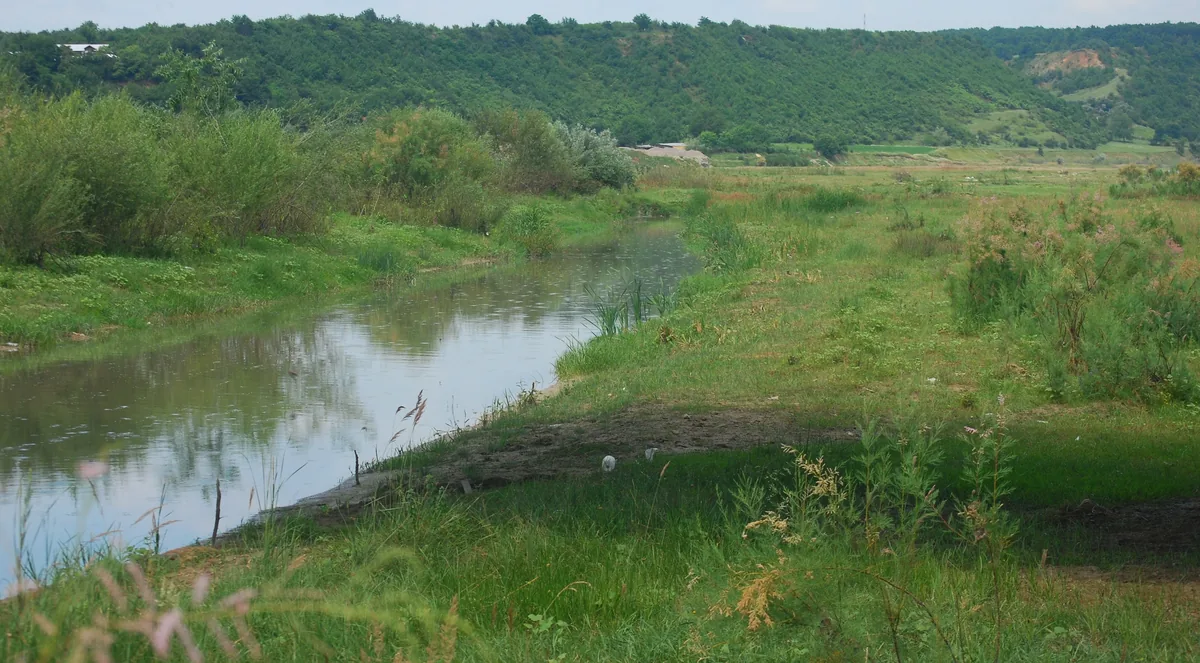
Foto: Andrei Stroe, 2017, CC BY-SA 4.0, via Wikimedia Commons

Evidence: Estate and debts
- Claim
- Estate and debts
- Evidence
- Dohotaru 2011 (after Cojocaru–Ornea 1966): debt-burdened estate, sequestration at previous tenants' complaint, litigation belatedly won by Bălăceanu; Diamant–Bălăceanu contract not preserved. Lease contract at the tribunal: Stan–Gaiță 2021.
- Source date
- Documents 1835–1836 via monographs.
- Source type
- Type: documents + synthesis.
- Confidence
- High for debts and sequestration; medium for litigation detail.
Locating the site
Where exactly was the phalanstery?
The question with the most honest answer in the whole story: nobody knows exactly. The National Archaeological Repertory — site file 131078.02, updated in 2025 — states plainly that “its exact location is not known; it is presumed to have operated near the boyar manor”. Any photo labelled online as “the phalanstery ruins” should be viewed with that reservation.
Known ✓
- Today's town: Boldești-Scăeni, Prahova county — then the village of Scăeni, Saac county.
- The “Dormition of the Mother of God” church, mapped in 1791 and documented in 1833 on the estate of spatharios Manolache Bălăceanu — at the corner of Colinei and Falansterului streets.
- Falansterului Street still exists — the only direct toponymic trace.
- The manor houses and enclosure wall stood north of the church.
Likely ?
- The phalanstery operated next to the manor — the old two-storey parental buildings, plus cells built around a court, “in a square like monasteries”, in the description quoted by the Repertory.
- There was no gate — “it was said that in the phalanstery's time, gates were thought useless”.
Unknown …
- Which buildings housed the dormitories, workshops and school.
- Whether any new building was ever raised for the colony.
- Any standing ruin today that could be attributed to the phalanstery with certainty.
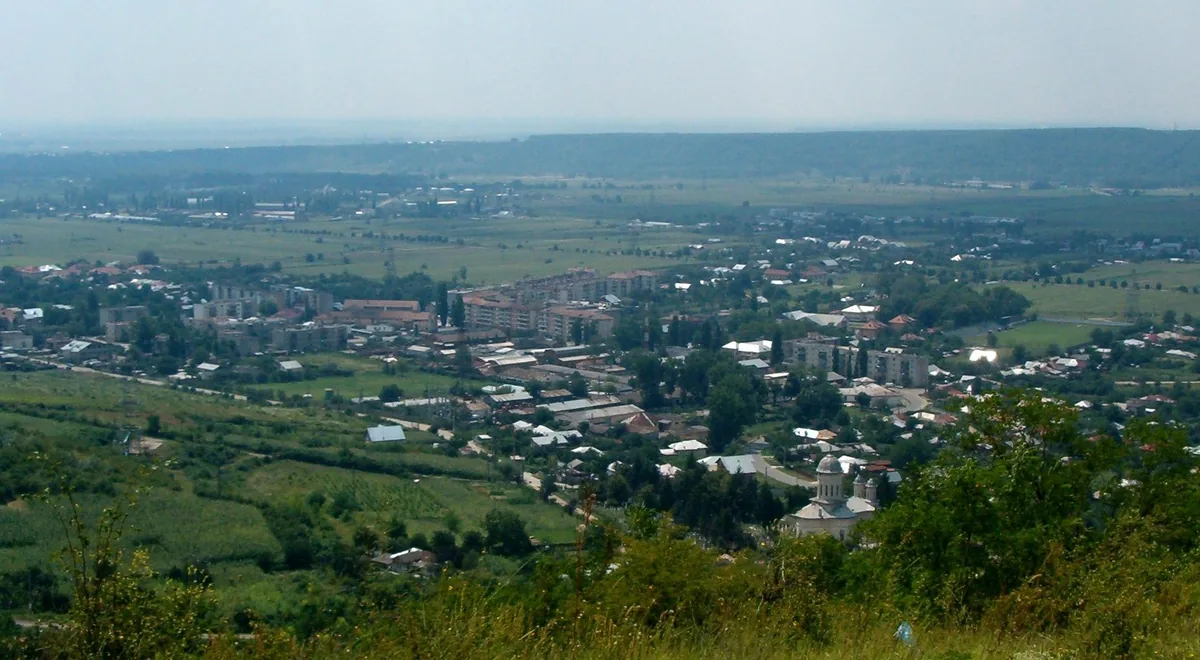
Foto: Andrei Stroe, 2004, CC BY-SA 2.5, via Wikimedia Commons

Evidence: The site
- Claim
- The site
- Evidence
- National Archaeological Repertory, site 131078.02, National Heritage Institute; file updated 03.01.2025, sourced to Frînculeasa 2024 (Boldești-Scăeni urban plan). Falansterului Street verified on OpenStreetMap.
- Source date
- Heritage register 2024–2025.
- Source type
- Type: archaeological record.
- Confidence
- Limited by definition: the Repertory itself declares the uncertainty.
The document
A contract for paradise on Earth
The idea of the phalanstery took the form of a signed paper. On 10 March 1835 the society opened as the Agronomic and Manufacturing Society, and the contract reached the local tribunal. Members came for an extraordinary promise, preserved in their statements: “the golden age, the earthly paradise”.
Below, each pledge appears beside what people found in practice. The right-hand column quotes the complaint of the 14 associates to the divan, in the published transcription's spelling.
Lodging, food, clothing
The promise
The contract promised shelter, meals and clothes for all associates.
Documented reality
“Instead of lodging, like culprits under arrest; instead of food…; instead of clothes and footwear, each wrote home to have them sent.”
An 8-hour day
The promise
Eight hours of work a day — a revolutionary norm when peasants worked 14–16 hours.
Documented reality
“Whoever did not work eight hours a day was given no food. And what food? Worse than a poor peasant's.”
Factory and farming
The promise
Manufacturing workshops and modern farming, “after Carl Furie of France”.
Documented reality
“Instead of a factory, clearing the forest of brambles and stumps…; instead of farming, digging wells, ditches, pits.”
Learning
The promise
Mathematics, social economy, French “and other useful sciences”, taught by Diamant.
Documented reality
“Instead of social economy they learned how to make a quarter-loaf last a day or two; instead of mathematics, counting the eight hours.”
Liberty
The promise
Free association, no coercion — “gates were thought useless”.
Documented reality
“He read their letters and fined them; kept them standing guard day and night, two hours at a time, barefoot, through frost and rain.”
The golden age
The promise
“We shall find in it the golden age, the earthly paradise.”
Documented reality
“Instead of the golden age, the darkest age; instead of the earthly paradise, worse than sinners in hell.”
The presentation above is a typographic reconstruction from the texts published by Stan–Gaiță 2021 and Dohotaru 2011 (after Cojocaru–Ornea 1966, pp. 307–308), not a facsimile of the deeds.
Evidence: Contract and complaint
- Claim
- Contract and complaint
- Evidence
- Opening on 10 March 1835 and clauses: Stan–Gaiță 2021. Complaint of the 14 to the judicial divan, criminal section: Dohotaru 2011, after Cojocaru–Ornea, pp. 307–308. The divan sided with the complainants; Bălăceanu appealed.
- Source date
- Documents 1835–1836, edited 1966–2021.
- Source type
- Type: deeds + petitions.
- Confidence
- High; the petition's tone — visibly overwrought, per Dohotaru.
The community
Who were the “agronomist associates”?
Here the story becomes social history. On 20 September 1836 the investigator sent by the Interior Department submitted the list of those at the phalanstery: 53 active members, to which a list by Bălăceanu adds 14 associates “not at Scăieni”. Each dot below is a person from those lists.
28 from Scăieni · 21 from Bucharest · one each from Pitești, Focșani, Gorj and Mehedinți — plus 14 elsewhere. Origin is the only systematically preserved variable; the age, sex, occupation and status of most remain unknown.
The lists do not agree with each other
- 53 active + 14 absentthe 20 September 1836 inquiry list + Bălăceanu's listdocumented
- about 60 associatesthe authorities' count, cited by Dohotarudocumented
- about 100 memberslate press reportsunverified
The exact total of everyone who passed through the colony cannot be established: the lists classify people differently, at different moments. Any single figure would be fiction.
The freed slaves
According to the Marushiakova–Popov synthesis (2009), repeated by later syntheses, the colony's first inhabitants are said to have included Roma slaves of Bălăceanu, freed and set to work in the new association — a chronology that could not be verified directly in the documents. What is certain is that the 1836 complaint shows Roma working alongside the rest. In 1835 Wallachia, where slavery was the law and general emancipation would come only in December 1855 (Moldavia) and February 1856 (Wallachia), the mere presence of people freed from slavery in a colony was extraordinary.
The associates' complaint shows Roma working alongside the rest — the farm's cattle even “belong to the Gypsies”. The question the documents pose without resolving: what did “equality” mean inside a community founded on a boyar estate, in a slave society? Diamant would return to it in 1841, proposing colonies for state-owned slave families.
A note on language: quotations keep the period terms (“slaves”, “Gypsies”), marked as such; the editorial text uses “Roma”.
Evidence: The people
- Claim
- The people
- Evidence
- The 53+14 list and origins: Stan–Gaiță 2021 (inquiry documents). About 60: Dohotaru 2011. The Roma manumission: Historia 2013 report + mentions in the 1836 complaint; “first members” status — Marushiakova–Popov 2009 via syntheses, not directly verified here.
- Source date
- Documents 1836 + historiography.
- Source type
- Type: nominal lists + interpretations.
- Confidence
- High for lists; medium for the manumission chronology.
The translation machine
Fourier vs. Scăieni
Drag the slider from THEORY towards REALITY and watch the model deform. Each pair below sets the French paragraph against the Wallachian one.
Theory
~1,620 people
The model demanded exactly 1,620 complementary temperaments.
Reality
67 names on lists
53 active plus 14 absent on 20 September 1836 — a community numbering in the dozens.
Theory
Donated land
The owner gave the estate to the shareholders' association.
Reality
Leased, sequestered estate
A lease contract for money; debts, lawsuits and sequestration throughout.
Theory
Purpose-built palace
The phalanstery-palace, with seristères, dormitories and dining halls drawn by Fourier.
Reality
Adapted old manor
The old parental houses plus cell rooms around a court — per the description quoted by the RAN; no gate, no plan from Paris.
Theory
Harmonised passions
Everyone works at what they love, in cheerful, free series.
Reality
8 hours, no rest
A contractual norm, night guard duty, fines; letters opened and read.
Theory
Equal associates
Labour, talent and capital share 5/12 – 3/12 – 4/12 of earnings.
Reality
Disgruntled tenants
14 members sue the association for breach of contract and their money back.
Theory
A universal model
A recipe valid anywhere, from Paris to St Petersburg.
Reality
A Wallachian case
Saac county, the Organic Regulation, slavery, statute labour — and a prince demanding a new name.
Evidence: The comparison
- Claim
- The comparison
- Evidence
- “Model” column: Dohotaru 2011 after Fourier/Cojocaru–Ornea. “Scăieni” column: Stan–Gaiță 2021 (lists, inquiries), Dohotaru 2011 (contracts, complaint), RAN (buildings).
- Source date
- Original synthesis from cited sources.
- Source type
- Type: editorial comparison.
- Confidence
- Each cell points to its evidence; the whole is interpretation.
Daily life
What we can reconstruct
No scene below is invented. Each row also says how we know: documented, proposed in the programme, reported late, or unknown.
- Eight hours, no SundayEight hours a day, continuously, with no weekly break, as stipulated by contract.documented
- Estate labourDigging wells and ditches, clearing scrub — per the members' complaint.documented
- Meals in commonA common canteen, as in the model; confirmed by late reports and the manor's logic.reported late
- Opened letters, fines, guard dutyLetters opened and “fined”; guard day and night, two hours at a time — per the complaint.documented
- A school “after Carl Furie”Farming and drill, economies, humanities, catechism, mathematics, music, dance, drawing — announced, with no proof that they were taught.proposed
- Manufacturing workshopsThe contract's “factory”; members say they never saw it.proposed
- The colony's childrenChildren's presence and number do not appear systematically in the surviving lists.unknown
- A calendar with no holidaysA hypothesis repeated by some commentators; Dohotaru calls it hasty.unknown
Autumn 1836 — the clock
The dissolution, almost day by day
The end can be followed in the files. The dots below are the people of the 20 September list; before the list the headcount is unknown, and after it they go out only where the documents plainly say what became of them.
State on 20 September 1836: 67 of 67.
- 14 September 1836The Saac county administration reports on its inspection of the phalanstery.
- 17 September 1836The Interior Department orders medelnicer Pâcleanu to investigate the “Agronomist Associates” “without delay”.
- 20 September 1836Pâcleanu submits the list of those at the phalanstery: 53 active; Bălăceanu adds 14 absent.
- 29 September 1836The resolution bans the school and the phalanstery: the governor must “without fail have it dissolved”.
- 30 September 1836Mihai Ghica, the prince's brother, orders the Saac administration to dissolve it.
- autumn 1836A petition for a modern plough (“instrument plough”); Prince Alexandru Ghica feels insulted and demands the society change its name.
- 8 November 1836Diamant witnesses a will by Bălăceanu — their rift was, at least formally, partial.
- early December 1836Bălăceanu is arrested.
- 4 December 1836Ten more members are detained, accused of armed resistance to the liquidation; sent under escort to Bucharest.
- 30 December 1836Sub-governor Iordache Bilciurescu reports that all members have left.
Dating of the plough petition differs between accounts (September vs. 1 November); the cautious “autumn 1836” is kept.
Evidence: The chronology
- Claim
- The chronology
- Evidence
- All dates and wordings: Stan–Gaiță 2021, after archival files. The 8 November will: Ioncioaia 2009 after Cojocaru–Ornea p. 434. The armed-resistance charge: the file's wording (“allegedly resisted”), not established fact.
- Source date
- Documents 1836, edited 1966–2021.
- Source type
- Type: administrative files.
- Confidence
- High.
Analysis
Why did it fail?
Several mechanisms fed one another and brought about the failure:
What the evidence shows ↓ · What remains uncertain ↓
- MoneyLease money from members paid old debts, leaving none for investment; sequestration on the estate.How much actually reached the farm, leu by leu, is unknown.
- The stateInspections, resolutions, a dissolution order, arrests — autumn and winter 1836.How much was ideological fear and how much bureaucratic routine stays interpretable.
- LandLeased, not donated; mortgaged and litigated — the inverse of Fourier's model.The full detail of the disputes with previous tenants.
- PeopleDiamant breaks with Bălăceanu in summer 1836 and never runs the colony; members sue the association.Bălăceanu's intimate motives: conviction, calculation, or both.
- Scale67 names against 1,620 — too few for the division of passions.Whether more members would have changed anything cannot be known.
- TheoryA model designed for industrial France, applied to an estate of statute labour and slavery.How much Fourier each of the 67 associates understood.
Afterlife
Every era made its own Scăieni
The experiment lasted under two years; its interpretations have lasted nearly two centuries. The readings below appear as layers of memory, without any claim to be “the correct one”.
- 1836–1880 — Silence and rumourThe files sleep in archives. Diamant dies in 1841; Fourierism stays a Bucharest salon topic into the late 1830s.
- 1880–1900 — The memoirsIon Ghica publishes his Letters to Vasile Alecsandri: Diamant becomes a character — gentle, brilliant, exiled to Snagov. The last detail has no archival cover.
- 1935 — The first synthesisD. Popovici, Santa Cetate: the fullest vision of its time; it admits the justice of the petitions — “built on one man's fanaticism and mined by another's interested calculation”.
- 1958–1966 — The communist recoveryScrieri economice (1958), then the Cojocaru–Ornea monograph (1966): solid documentation, ideologically predetermined theses — Diamant as a forerunner of socialism.
- 1979–1982 — The filmFalansterul, directed by Savel Stiopul: a censored premiere at the Scala (7 May 1979), then an uncensored cut smuggled to France and selected for the Quinzaine des Réalisateurs, Cannes 1982.
- 1994–2008 — The post-communist trialAntohi sees the seed of dystopia in utopia; Achim and Crețu treat it as farce. Documents matter less than the trauma of the fallen regime.
- 2006–2011 — Back to the fileIoncioaia publishes the June 1836 letter and proves the Diamant–Bălăceanu rift; Dohotaru shows how each historiography rewrote its Scăieni.
- 2021–today — Documents and heritageStan–Gaiță publish the chronology of repression; the RAN registers the site with unknown location; Boldești-Scăeni keeps a street, a school and a statue.
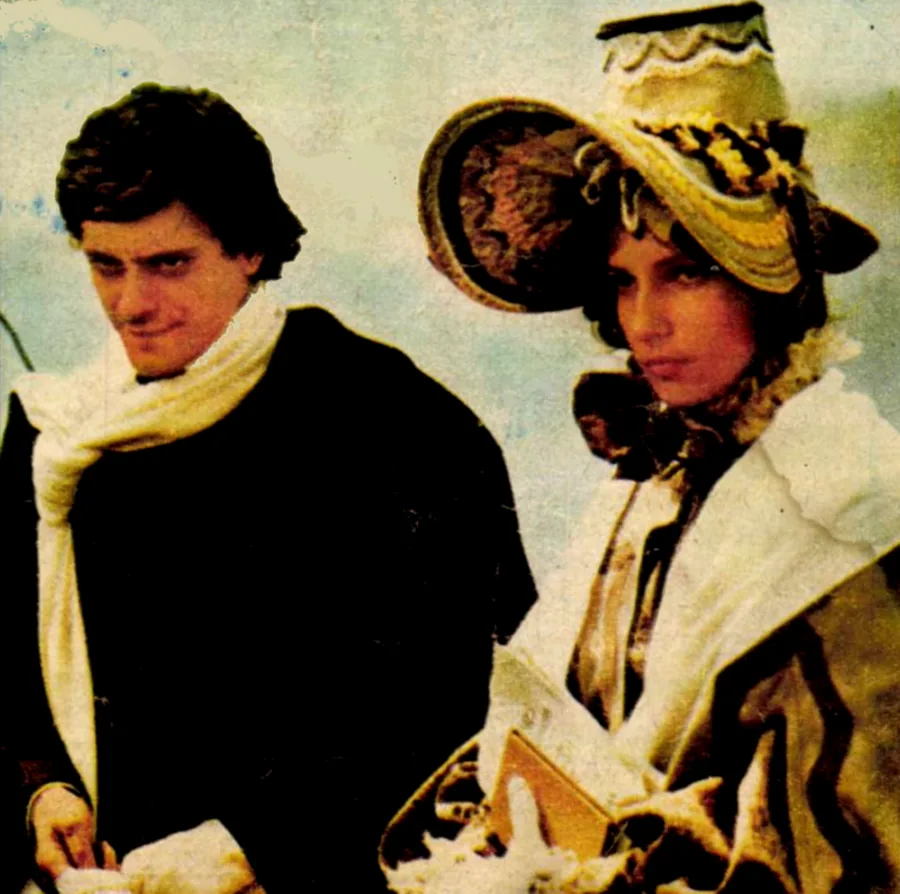
Foto: anonim, 1979, Public domain, Revista Cinema 5/1979 (via Wikimedia Commons)
_and_Julieta_Sz%C3%B6nyi_(Cati%C8%9Ba_Fanache)_in_Falansterul,_1979.png)
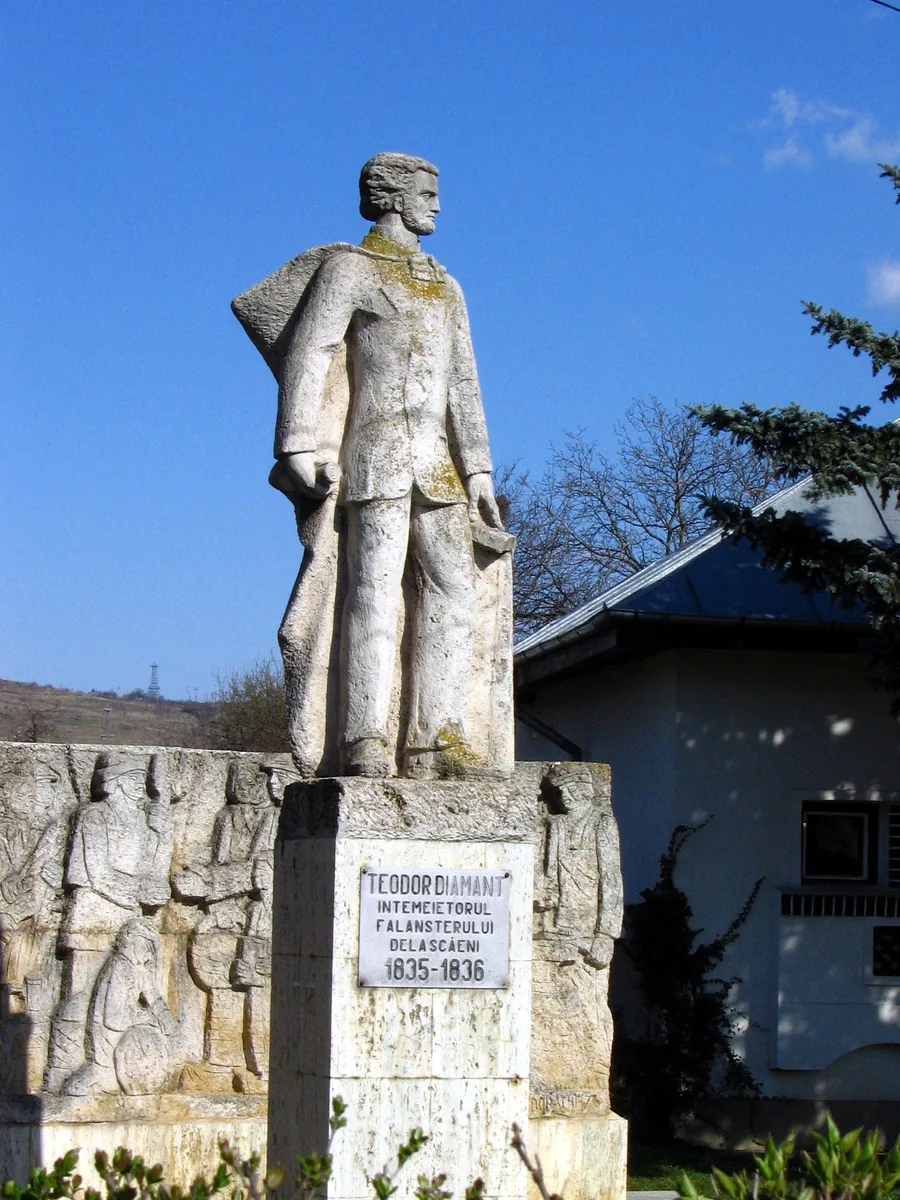
Foto: Andrei Stroe, 2008, CC BY 3.0, via Wikimedia Commons

Evidence: Afterlife
- Claim
- Afterlife
- Evidence
- Film: Adevărul 2019 after Stiopul's memoirs; IMDb entry tt0157611. Historiography: Dohotaru 2011 + Ioncioaia 2009. The “Teodor Diamant” school: the school's site, teodordiamant.ro.
- Source date
- Sources 1935–2026.
- Source type
- Type: mixed.
- Confidence
- High for dated facts; interpretations are attributed.
The traces of an attempt
The phalanstery left the paperwork of a failed attempt — a contract, lists of names, a furious petition, debts, and dissolution orders — a rarer legacy than the new society it sought.
In them you can see, as nowhere else in Romanian history, the moment a theory of how people ought to live collided with how they already did: with leases and statute labour, with slaves and promissory notes, with a prince and his constables.
Scăieni leaves doctrine unsettled, showing the reader utopia as seen from the courtyard of an indebted estate.
Questions
What was the Scăieni Phalanstery?
An agricultural-manufacturing colony founded on 10 March 1835 on the Scăeni estate (today Boldești-Scăeni, Prahova), on the theory of the French socialist Charles Fourier. It was officially called the “Agronomic and Manufacturing Society”, and members called themselves “agronomist associates”.
Who founded it?
Teodor Diamant (1810–1841), a young intellectual returned from Paris as Fourier's disciple, together with the landowner Emanoil (Manolache) Bălăceanu, who owned the estate. The two broke off relations in summer 1836.
What does “phalanstery” mean?
From the French phalanstère (phalange + monastère): Fourier's imagined community-building, where hundreds would have lived, eaten and worked together. No such building is documented at Scăieni: the colony seems to have used the existing boyar manor.
How long did it operate?
The National Archaeological Repertory speaks of “one year and seven months, between 1835 and 1836”. The archival milestones: the opening on 10 March 1835 and the last members' departure, reported on 30 December 1836. Its effective life as a society was shorter still: inquiries began in September 1836.
Where was it?
On the Scăeni estate, today the town of Boldești-Scăeni (Prahova). The exact site is unknown: the Repertory presumes it operated near the Bălăceanu manor, north of the church at the corner of Colinei and Falansterului streets.
Why was it dissolved?
Through a combination of causes: debts and sequestration, a contract breached towards members, the Diamant–Bălăceanu rift, and the administrative orders of 29–30 September 1836, followed by arrests in December.
Who was Teodor Diamant?
A Wallachian intellectual (1810–1841): Sf. Sava school, the Munich cadet school (1828–1830), four years in Paris, where he became Fourier's disciple. After Scăieni failed he worked as a surveyor; he died of tuberculosis in 1841.
What was his connection to Charles Fourier?
He attended Fourier's lectures in Paris, wrote to him from Bucharest (the letters survive in the French National Archives) and asked him for the building's plan. Fourier is said to have advised starting with 300 children aged 3 to 13.
Was the Scăieni Phalanstery communist?
No, in the modern sense. Fourierism kept private property and split income between labour, talent and capital. The “forerunner of socialism” label comes from communist historiography, which needed historical legitimacy.
Does the building still exist?
Nobody knows which building it would have been. The estate's old church was demolished after 1943, and the boyar manor did not survive as an ensemble. Photos labelled online as “the phalanstery ruins” have no archaeological confirmation.
Sources and bibliography
Documents and document editions
- T. Diamant to Ch. Fourier, 24 June 1834 and 3/15 June 1836 — National Archives, Paris, Fourier/Considérant collection 10 AS 25, file 3; the second in full in Ioncioaia 2009, appendix.
- T. Diamant, three articles in Curierul românesc, VI, nos. 17/7 June, 18/10 June, 21/21 June 1834 — reproduced in Cojocaru–Ornea 1966, pp. 399–404.
- T. Diamant, Aux amis de la liberté, de la justice et de l'ordre…, Paris, April 1833 — reproduced in Cojocaru–Ornea 1966, p. 386+.
- T. Diamant, Scrieri economice, ed. G. Mladenatz, Bucharest, 1958 (posthumous).
- Petition of the 14 associates to the divan — in Cojocaru–Ornea 1966, pp. 307–308.
- I. Ghica, Scrisori către Vasile Alecsandri: Teodor Diamant — late memoirs (text on Wikisource).
Studies
- C. I. Stan & A. Gaiță, “Teodor Diamant – Mehtupciu și falansterul de la Scăieni”, Analele Buzăului XIII, 2021 — chronology, lists, contracts.
- A. Dohotaru, “Falansterul de la Scăieni și proiectul unei lumi mai armonioase”, Yearbook of the “George Barițiu” Institute, Historica L, 2011, pp. 127–140.
- F. Ioncioaia, “Utopism și context istoric. În jurul unui epistolar”, Yearbook “George Barițiu”, Historica XLVI, 2009, pp. 221–243; and “Les promesses de l'Harmonie”, Cahiers Charles Fourier 17–18, 2006–2007.
- I. Cojocaru & Z. Ornea, Falansterul de la Scăieni, Bucharest, 1966 — the reference documentary monograph, with the historiographic reservations shown.
- Gh. Zane, “Saint-simonism și fourierism în România” + “Corespondența T. Diamant – Ch. Fourier”, in Studii, 1980.
- D. Popovici, “Santa Cetate”, 1935; S. Antohi, Civitas Imaginalis, 1994; D. Berindei, “Le Phalanstère de Scaieni”, Cahiers Charles Fourier 2, 1991.
Heritage and fieldwork
- National Archaeological Repertory, site 131078.02 (former Bălăceanu manor and phalanstery), file updated 03.01.2025 — ran.cimec.ro.
- Falansterului Street, Boldești-Scăeni — own verification on OpenStreetMap (2026). Map: OpenStreetMap contributors (ODbL).
Press and cultural memory
- A. Epure, “Cum a păcălit regizorul Savel Stiopul autoritățile…”, Adevărul, 19.02.2019 — the film Falansterul (1979) and Cannes 1982.
- V. Mihăilă, “Falansterul de la Scăieni – un experiment social uitat”, Historia, 19.04.2013 — used selectively, with reservations (a competition entry).
- L. Dologa, “Eșecul unei revoluții: Falansterul de la Scăieni (I–II)”, Ziare.com, March 2013.
- The “Teodor Diamant” Technological School, Boldești-Scăeni — teodordiamant.ro.
Method
- Every figure shows its source; lists that disagree are shown side by side, never melted into one total.
- “Documented / proposed / reported late / unknown” marks the basis of each claim.
- Quotations keep the published transcriptions' spelling; editorial interventions are marked.
- Historical photographs are exclusively reusable (public domain or Creative Commons), with author, date, institution, licence and link.
- No visual reconstruction is presented as evidence: plans and maps drawn for this page are marked “interpretive reconstruction”.
- Mistakes get corrected: write to the site's contact page with the source, and the page notes the change below.
Photographs: Wikimedia Commons (authors and licences at each image) · Map: OpenStreetMap (ODbL) · Documents: French National Archives (via editions), RAN · Photos were resized and converted to WebP.
Changelog
- 16 September 2026 — first edition: 15 sections, 7 reusable images, 10 questions.
- 16 September 2026 — revision: wordings corrected after review (RAN duration vs. archival milestones, undocumented building, Roma manumission chronology, unknown headcount before 20 September 1836).