A story going around says the Wallachian boyar was Greek, that the Turks hunted Greek-speakers, that he discovered his Romanian self to save his life. We took the story stone by stone and asked the documents — including two pages from his own book, printed in Romanian in 1826.
1 true
1 partly true
2 false
3 unsourced
NoThe short answer: no. And the one fully true part of the story — the flight to Brașov — is the least sensational.
The claim“They fled en masse to Brașov, from the Turks' wrath”
Here the documents side with the story. When the Ottoman hosts entered the country, the national boyars and bishops crossed the mountains into Transylvania — so many that the Sibiu authorities grew alarmed, and Chancellor Teleki had the Corona (Brașov) boyars deported further inland, for fear of the revolutionary contagion.
Dinicu was among them: he had left for Brașov with the dead prince Alexandru Suțu's family. And he did not hide there. On 12 July 1821 he signed the refugee boyars' memorandum to the tsar, against the Ottoman occupiers' atrocities; in 1822, letters to Pini and to the new Prince Grigore Ghica — the last a request for money “so he could return to the country”, which is to say, plainly, a means of further delaying a return to a still unsafe place.
One nuance, and it matters: for Golescu, 1821 was not a unique flight but the fourth in 24 years — “from the unsettledness of it all”, as he himself puts it. In 1802 he had fled across the same mountains from Pazvantoglu. Unsettledness was the regime, not the accident.
The documents
The 12 July 1821 memorandum to the tsar, signed at Brașov by the refugee boyars — a protest against Ottoman atrocities.
BCU Cluj, “Dinicu Golescu în vremea sa”, after Documente 1821
In 24 years, forced to flee across the border 4 times “from the unsettledness of it all”.
Gheorghe Popp on Dinicu Golescu
TrueThe flight, the memorandum, the letters: all documented.
The claim“the Turks unleashed a genocide against Greek-speakers north of the Danube”
The slaughter is real; the target, as the comment describes it, is not. Ypsilantis's hosts were crushed at Drăgășani; at Secu the remaining Eterists held out to the end — by 1828, two of the fighters were still alive. Bucharest fell to the Chehaia, feared for tolerated massacres and lootings; on 6 August the Ottomans liquidated even their circumstantial ally Fochianos with all his Arnauts.
But the documented targets are rebels, Eterists, and those suspected of ties to them — plus a population caught in the middle of a general terror. The massacre of Greeks as such, with the Patriarch hanged on Easter Sunday, is documented at Constantinople — another theatre, other victims.
The word “genocide” thus moves north of the Danube what happened south of it. The violence was appalling; evidence of a hunt by spoken language is missing.
The documents
Of the Eterists at Secu, two were still alive in 1828.
The 1821 historiography, via the cited article
On 6 August 1821, the Ottomans liquidate Fochianos and all his Arnauts, lured back to Bucharest.
The 1821 historiography, via the cited article
Partly trueThe slaughter is documented; the linguistic target is not.
The claim“they hunted those who did not speak Romanian well or spoke with an accent”
We searched for this hunt — in memoirs, in the cited diplomatic reports, in the histories of 1821 — and did not find it. No trace of Turks testing accents north of the Danube, nor of “French and English sources” attesting it.
What the documents say instead overturns the frame. The man who carried the 77 boyars' pledge to Tudor was Dinicu Golescu himself — so the Russian spy Liprandi records. And Tudor, far from hunting him, sheltered his family: brother Iordache received a Pandur guard that escorted him all the way to Transylvania.
In 1821, danger stalked you by camp, not by accent. And Golescu was, on paper, in the camp that needed shelter.
The documents
The 77 boyars' pledge to Vladimirescu, presented through Dinicu Golescu.
Liprandi, via the cited historiography
Iordache Golescu, escorted to Transylvania under Pandur guard, on Tudor's orders.
The claim“they Romanianised in a process called «self-colonisation»”
The name does not exist in historiography. It looks invented for the occasion — and once the name falls, so does the mechanism it dresses: nowhere is there a documented process by which Greek boyars changed their nation overnight for fear of the Turks.
What actually happened is more interesting, and documented. In July 1822 the Sultan dismantled Phanariot rule and named native princes — Grigore Ghica in Wallachia, Ioan Sturdza in Moldavia. The Greek abbots were removed from the dedicated monasteries. And when the Porte wanted them back, by a firman of 1827, it was Golescu who reprinted old Matei Basarab's charter, to show his contemporaries “on whose side the right is”.
Institutional Romanianisation, yes — and Golescu was among its instruments. A process by this name, no.
The documents
“Parmi ces boyars qui doivent être passés de la Transylvanie en Russie on compte M. Taniko (Dinicu) de Golesco et M. Aleko Philippesco, dit Vulpe…”
The Austrian agent Kreuchely, diplomatic dispatch, winter 1822–1823 — “among the boyars who must have crossed from Transylvania into Russia count Mr Taniko (Dinicu) de Golesco…”
In July 1822, the Sultan ends Phanariot rule: Grigore IV Ghica and Ioan Sturdza, “native” princes.
The 1821 historiography, via the cited article
UnsourcedThe term does not exist in historiography.
The claim“Old parvenus like Golescu had nowhere left to return to”
The Golescus came from somewhere: their name from the Golești estate in Argeș, back in the 16th century — a cup-bearer Radu served under Radu Paisie — revived at the start of the 18th by Radu of Leordeni, of the same parts. Old native stock with a full pedigree, not Greeks arrived in the Phanariots' wake.
Prince Caragea's era had already caught them as players — a satire of the time lists them among the predators: “Chiriac seals, Golescu empties, Belu flays, Caragea scorches”. Local men, with local sins. And Dinicu's father had opened, back in 1814 at Golești, a school for “the village's learning in the Romanian tongue”, carried on by the son until “the time of the well-known uprisings”.
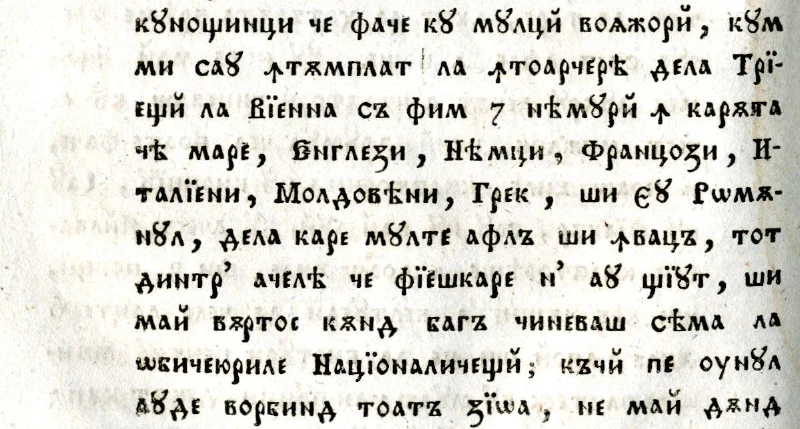
And then, page 122 of the 1826 book. Dinicu rides back from Trieste to Vienna in a diligence of seven nations and writes, black on white, who the seventh is:
Buda, 1826, p. 122. The passage, transcribed:
“…cunoștinți ce face cu mulți voiajori, cum mi s-au întâmplat la întoarcerea dela Trieștii la Vienna să fim 7 neamuri în carâta cea mare, englezi, nemți, franțozi, italieni, moldoveni, Grec, și eu Românul, dela care multe află și învață, tot dintr' acelea ce fieșcare n' au știut, și mai vârtos când bagă cinevaș seama la obiceiurile naționalicești; căci pe unul aude vorbind toată ziua, ne mai dând…” (“…the acquaintance one makes with many travellers, as it befell me, on the return from Trieste to Vienna, to be 7 nations in the great coach: English, Germans, French, Italians, Moldavians, a Greek, and I, the Romanian, from whom they learn and find out much, all of those things which each did not know, and especially when one pays heed to the national customs; for you hear one of them talking all day, no longer giving…” — translation mine)
Moldavians, a Greek — and he, the Romanian. Written halfway between flight and print, not to escape, but to remember.
FalseNative stock since the 16th century; Romanian — in his own hand.
The claim“He did not know Romanian well enough to write a book… why he wrote in Greek”
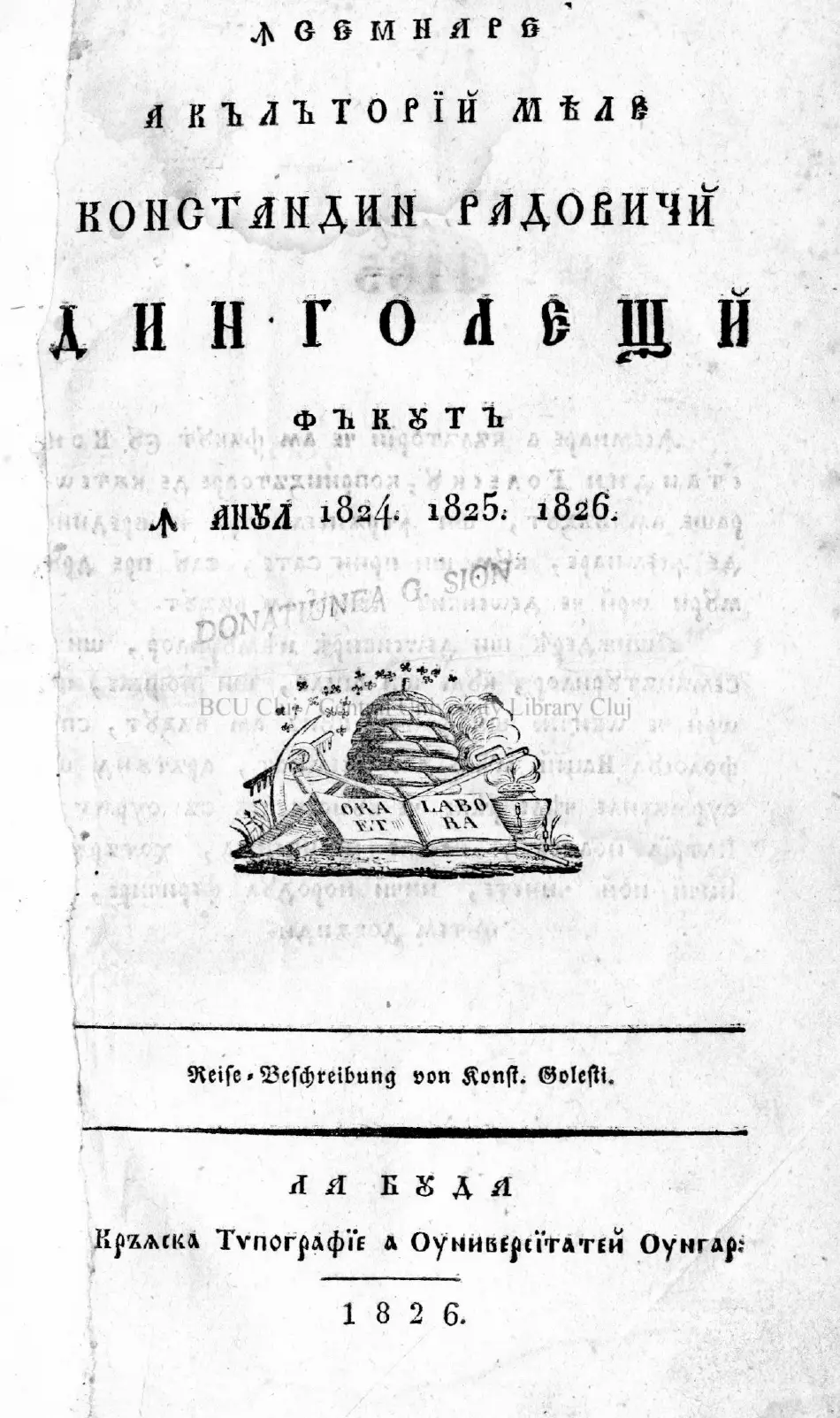
The book exists, and it is in Romanian: 240 pages, printed at Buda in 1826, in Cyrillic letters — the alphabet Romanian was then printed in. The title page:
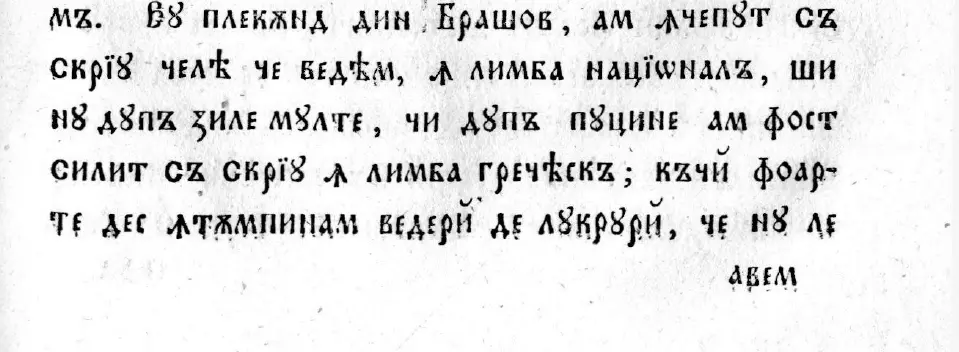
The title page, Buda 1826. The book's name and the author's, in Romanian.Buda, 1826, p. 107. The “Greek” passage, transcribed:
“Eu, plecând din Brașov, am început să scriu celea ce vedeam, în limba națională… am fost silit să scriu în limba grecească…” (“I, leaving Brașov, began writing what I saw in the national tongue… I was forced to write in the Greek tongue…” — translation mine)
The passage is real — and says the reverse of the claim. Golescu speaks of his road notes, begun in Romanian and switched to Greek “of necessity”, because Romanian lacked the words (fountain, statue, cascade). And he prints the shame himself: his companions asked whether he wrote in the national tongue, and he had to say it was Greek — “for in our fatherland, all sons of the nobility are more accustomed to write in the Greek tongue”. It is no pretext; it is an indictment demanding Romanian schools, placed inside the very book written in Romanian. And in 1826–1827 he himself translates from Greek: the Adunare de pilde (416 pages) and the Elementuri de filosofie morală, “rendered into the Romanian tongue for the use of Romanian youths”.
FalseThe book is in Romanian; the Greek passage is a confession, not a pretext.
The claim“the famous «retevei din tei, miriște de mei» comes from this period”
The word exists: the dictionary gives it as folk speech, “a short piece of wood; a cudgel”, etymology unknown. So far, nothing to object to.
The saying, though, we could not find. It is not in the full text of the Însemnare — searched in full, not by sampling. It is not in the studies of the Golești. It is nowhere on the searchable internet, in any form. It may lie in an unprinted collection or a family memory; it may be a fine recent invention.
This page's rule is simple: what cannot be proven is marked, not filled in. If a source surfaces, the verdict below changes here, with the source beside it.
UnsourcedThe word exists; the saying — nowhere to be found.
Eight steps, eight years — from Prince Suțu's death to the Romanian translations.
January 1821Prince Alexandru Suțu dies. Tudor Vladimirescu raises Oltenia; Alexander Ypsilantis crosses the Prut with the Eterists.
February–April 1821Bucharest falls to Tudor, then to Ypsilantis. Boyars flee toward Transylvania. Golescu leaves for Brașov with the dead prince's family.
May–August 1821The Ottomans crush both hosts — Drăgășani, Secu — and terrorise the country. Bucharest under the Chehaia; Fochianos and his Arnauts liquidated on 6 August.
12 July 1821At Brașov, Dinicu signs the refugee boyars' memorandum to the tsar, against the Ottoman occupiers' atrocities.
July 1822The Sultan dismantles Phanariot rule — Greek princes from Constantinople — and names native princes: Grigore Ghica and Ioan Sturdza. Greek abbots removed from the dedicated monasteries.
Winter 1822–1823Golescu does not return with the bulk of the refugees; he leaves for Russia with other boyars. The trip's purpose is unknown.
1824–1826Three journeys starting from Brașov — Pest, Vienna, Trieste, Italy, Munich, Switzerland. His sons placed in schools in Munich and Geneva.
1826–1827He prints the book at Buda, in Romanian. He reopens the Golești school. He translates from Greek into Romanian. A literary society.
The true story is better than the sensational one. A boyar who printed his own shame in his book — that he had taken his notes in Greek — so that Romanian schools would fix it. A refugee who, instead of hiding, signed memoranda, printed books, and translated from Greek precisely so Romanian youths would no longer need Greek.
1821 pulled his country from under his feet twice — once with the flight, once with the occupation. His answer was not to change his nation. It was to print his language.
No. The Golescus were native boyars, named for the Golești estate since the 16th century. He calls himself “the Romanian” in the 1826 book, schooled his village in Romanian from 1814, and translated from Greek into Romanian.
Why did he flee to Brașov in 1821?
Like hundreds of boyars and bishops: Ottoman hosts had entered the country and were crushing every trace of revolt. He left with dead Prince Suțu's family, and at Brașov signed the refugees' memorandum to the tsar. For him it was the fourth flight in 24 years.
Did the Turks hunt Greeks in Wallachia?
The repression struck rebels, Eterists, and suspects — with documented cruelty. But a hunt by spoken language, with an accent test, appears in no source. The massacre of Greeks is documented at Constantinople, not in the Principalities.
When did Phanariot rule end?
In July 1822, when the Sultan named native princes: Grigore Ghica in Wallachia and Ioan Sturdza in Moldavia. The Greek abbots were then removed from the dedicated monasteries.
In what language did Golescu write?
The 1826 book is in Romanian, in Cyrillic letters. In Greek he took only some of his road notes — and he printed the fact as a national shame, demanding Romanian schools. Then he himself translated from Greek into Romanian.
What does “eu românul” mean?
It is how he presents himself in a diligence of seven nations, between Trieste and Vienna: English, Germans, French, Italians, Moldavians, a Greek — “and I, the Romanian”. Page 122 of the 1826 edition.
Where does “retevei din tei” come from?
For now, from nowhere documented. The word “retevei” is in the dictionary; the whole saying we found neither in Golescu's book nor anywhere else. Find it with a source, and the verdict changes.
The Buda 1826 edition, scanned by BCU Cluj (dspace.bcucluj.ro, public domain). Read in the Pienescu transcription; both shown passages are letter-checked against the scan. Book quotations follow the companion project’s rule: modernised spelling, kept vocabulary and word order. English renderings are my translations.
Studies
“Dinicu Golescu în vremea sa — a profile sketch” (BCU Cluj, restitutio), Gheorghe Popp, Fotino, Iorga — via the companion project and its research.
1821
The uprising’s historiography (the cited Wallachian uprising of 1821 article, referring to Oțetea, Djuvara, Liprandi, Karpat), read 18 September 2026.
Dictionaries
dexonline, “retevei”: folk speech, “a short piece of wood; a cudgel”, etymology unknown.
What we searched and did not find
“The accent hunt”: searches in memoirs, cited diplomatic reports, and histories of 1821 — nothing.
“Self-colonisation”: a search of the searchable historiography — the term does not occur.
“Retevei din tei”: the Însemnare's full text (Pienescu transcription) + exact web searches — nothing.