A fall calculated from the inside of the planet
Jump into a hole through the Earth
Picture a straight tunnel from your feet, through the centre of the Earth, to the far side. The air has been pumped out, the walls hold, and for now the Earth stands still. You step in. What follows is the fall, second by second, calculated from the standard model of what the planet is made of.
How long would it take to fall through the Earth? Using Earth's PREM density profile, 38 minutes 11 seconds. The familiar 42 minutes assumes a planet of uniform density.
Reading moves the clock. The real-time fall lasts as long as the real one would.
0:00
You let go. In the first second you drop 4.9 metres, as from a diving board. From the instant your feet leave the edge you are in free fall, effectively weightless like an astronaut, because you and everything you carry accelerate together. What changes is how hard the planet pulls and how fast you go.
0:50
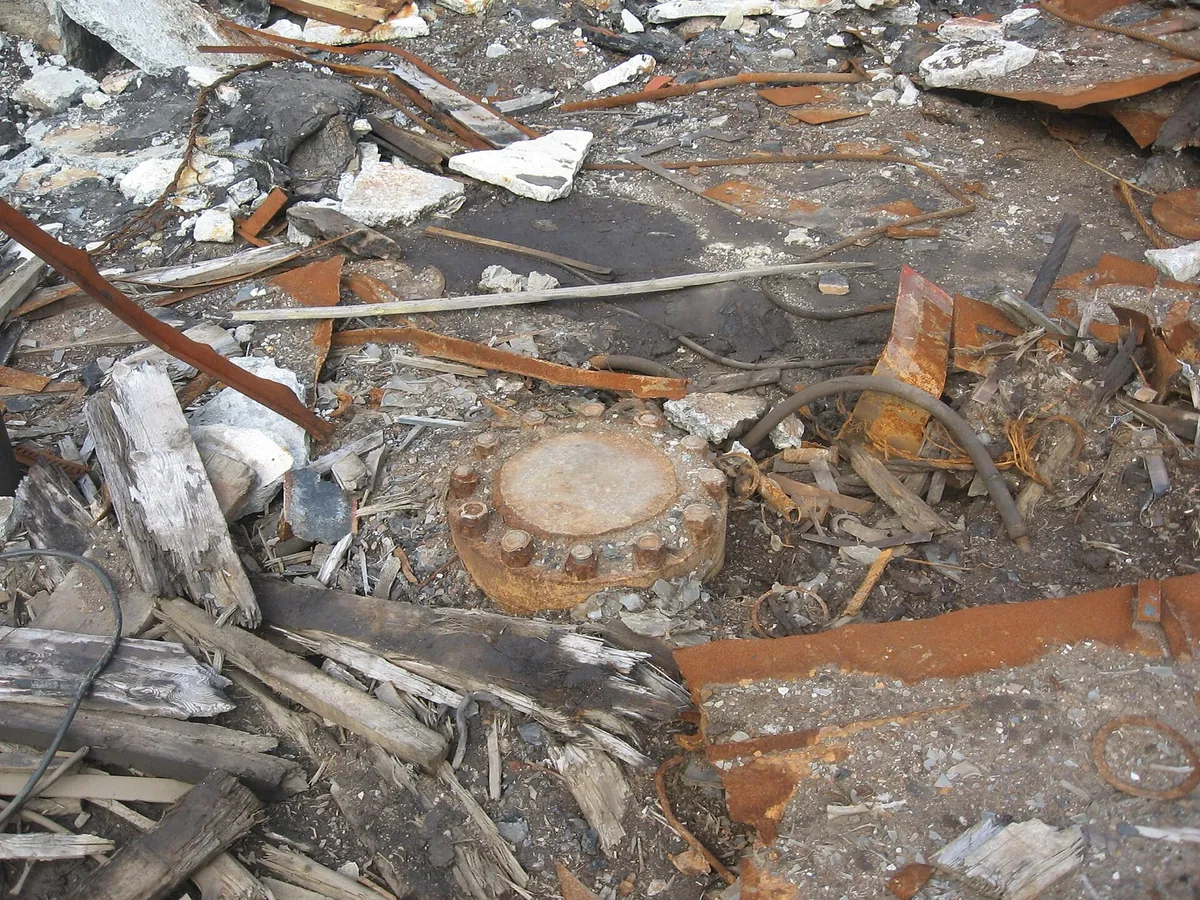
12.3 km down. This is as deep as anyone has ever drilled: the Kola Superdeep Borehole in Arctic Russia, 23 centimetres wide, begun in 1970 and taken to this depth in 1989. You got here in 50 seconds and are passing 1,770 km/h.
1:11
The crust ends 24 km down (the model's world average) and the mantle begins. Every ocean, city and mine on Earth lies in or on the layer you have just crossed in 70 seconds.
4:45
400 km. The mantle is solid rock. At this depth the pressure, 132,000 atmospheres, squeezes its main mineral, olivine, into a denser crystal. Earthquake waves speed up here, which is how seismologists found the boundary. You are passing 10,130 km/h.
11:40
Something unexpected: the planet now pulls harder than it did at the surface. A person who weighs 70 kg at home, held still on a scale at this depth, would read 72.7 kg. You feel none of it, because you are falling, but the pull keeps growing. The reason is below.
12:44
2,891 km: the bottom of the mantle and the edge of the core. The pull is at its strongest, 8.8% more than at the surface. Beyond the tunnel walls, rock gives way to liquid iron and nickel at about 4,000 K. You have covered a third of the trip, in time.
14:50
You cross the liquid outer core at up to 34,710 km/h. This slowly churning metal, 2,258 km thick, generates Earth's magnetic field.
17:01
5,150 km: the inner core, a ball of solid iron 2,443 km across, about 70% of the width of the Moon. It is about as hot as the surface of the Sun, and it stays solid only because the pressure, 3.25 million atmospheres, keeps the iron from melting.
19:05
The centre. You pass it at 35,710 km/h, 9.9 km a second, faster than a satellite skimming the ground would need to go (7.9 km/s). Here the pull is zero: the whole planet surrounds you and pulls equally in every direction.
20:05
Everything now runs in reverse. The pull that sped you up now points behind you, and it slows you down in the mirror image of the way in: the same speed at the same depth.
25:27
Out of the core and back into the mantle, 25 min 27 s after you jumped. The last third begins.
37:00
The crust of the far side. You are rising at 2,490 km/h and losing almost 10 metres a second of speed every second.
38:11
You come out on the far side of the planet with your speed at exactly zero. From Bucharest that is the South Pacific, at 44.4° S, 153.9° W, 1,760 km from the nearest land, New Zealand's Chatham Islands. Grab the edge. If you don't, you fall back and arrive home 1 h 16 min after you left, and go on swinging for ever.
The surprise
You get heavier on the way down
Common sense says the pull should weaken on the way down, since more and more of the planet is above you. Newton showed in 1687 how to count it: a shell of matter exerts no net pull on anything inside it, so at any depth only the ball of rock beneath you matters. In a planet with the same density throughout, that pull shrinks in a straight line to zero at the centre. That is the dashed line.
Earth is far from uniform. The rock of the crust and mantle weighs 2.6 to 5.6 tonnes per cubic metre; the metal of the core weighs 9.9 to 13.1. On the way down through the light outer rock you leave little mass behind you and get closer to the heavy core, so the pull grows. It peaks at the edge of the core, 2,891 km down, at 10.69 m/s², and only then falls to zero.
kg Changing it changes the scale reading, not the fall time.
This is why the trip is shorter than the physics textbooks say. The standard answer, from Paul Cooper's 1966 paper Through the Earth in forty minutes, assumes a uniform planet and gets 42 min 10 s. Alexander Klotz repeated the calculation in 2013 with Earth's PREM density profile, inferred from seismic data, and got 38 minutes. The calculation on this page gives 38 min 11 s, the same as his.
The wrong model that gets almost the right answer
Klotz's paper holds a stranger result. Pretend gravity never changes: a steady pull of one standard g, 9.81 m/s², all the way down, flipping direction at the centre. That is plainly false, since the pull has to reach zero at the centre. Yet it gives 38 min, only 11 seconds short of the PREM answer. The uniform planet, which at least gets the centre right, is off by almost four minutes.
The reason is the curve above. Through the whole mantle the real pull stays within 9% of its surface value, so a faller under constant gravity keeps pace. The real pull only collapses inside the core, and by then you are moving at more than 27,000 km/h and spend just minutes there. At their furthest apart, just before the centre, the two fallers are about 54 km from each other. Klotz's paper reports a maximum difference of 50 metres. Repeating the comparison with this page's model gives 54 km, and a reproduction of the interpolation method the paper describes gives 77 km. We could not reconcile the figures: the half-trips differ by 5.5 seconds, and at almost 10 km a second that alone means tens of kilometres.
The fall splits into three equal thirds
The mantle is 2,891 km thick. The core, crossed from edge to edge, is 6,960 km. Yet you spend the same time in each part: 12 min 44 s going down through the mantle, 12 min 44 s crossing the core, and 12 min 44 s climbing out through the mantle on the far side. The three parts agree to within a third of a second.
The core is 2.4 times as long as the mantle is thick, but you cross it close to top speed. The equal split is a property of this particular planet's layers, a coincidence rather than a law; a planet built differently would divide the trip differently.
Where would you come out?
The tunnel runs through the centre, so the exit is your antipode: the same latitude on the other side of the equator, half a turn of longitude away. Choose a place, or turn the left-hand globe.
From Bucharest you come out in the South Pacific, at 44.4° S, 153.9° W, 1,760 km from the nearest land. From Madrid you come out in New Zealand; from Beijing, in Argentina. Lisbon and Buenos Aires just miss: Lisbon's exit is in the Tasman Sea off New Zealand, Buenos Aires's in the Yellow Sea off China.
Most people would come out at sea. On the Natural Earth outlines used here, only about 13% of land has land at its antipode. Most of that is South America opposite China and its neighbours, and Canada and Greenland opposite Antarctica. Spain sits opposite New Zealand.
Any straight tunnel takes about 40 minutes
The tunnel does not have to pass through the centre. Dig a straight one between any two cities: it slopes down, levels off and climbs back up, and gravity does all the work of the trip. A frictionless rail or wall has to hold you on the line, since gravity pulls towards the centre rather than along the tunnel; the rail pushes sideways and adds no energy. In a planet of uniform density every such trip takes exactly the same time, 42 min 10 s, whether the tunnel goes to Constanța or to Sydney. A longer tunnel is also steeper, and the two effects cancel out.
In the real Earth, short tunnels stay close to that time. Bucharest to London takes 42 min 4 s. Long tunnels reach down into the dense interior, where the pull is stronger, and they are faster: Bucharest to Sydney takes 38 min 49 s, at up to 32,070 km/h.
| From Bucharest to | Tunnel length | Deepest point | Top speed | Time |
|---|---|---|---|---|
| Constanța | 204 km | 1 km | 450 km/h | 42 min 10 s |
| Vienna | 856 km | 14 km | 1,920 km/h | 42 min 9 s |
| London | 2,082 km | 86 km | 4,680 km/h | 42 min 4 s |
| New York | 7,199 km | 1,114 km | 16,960 km/h | 41 min 5 s |
| Beijing | 6,705 km | 953 km | 15,690 km/h | 41 min 13 s |
| Cape Town | 8,076 km | 1,443 km | 19,300 km/h | 40 min 48 s |
| Buenos Aires | 10,434 km | 2,714 km | 26,540 km/h | 39 min 46 s |
| Sydney | 11,855 km | 4,035 km | 32,070 km/h | 38 min 49 s |
The catch: the planet is turning
So far the Earth has stood still, and it does not. The ground in Bucharest moves east at 332 metres a second as the planet turns. When you jump you keep that eastward speed, but deeper down the tunnel wall is closer to Earth's axis and moves more slowly. You drift east of the tunnel. In a tunnel two metres wide you would touch the eastern wall after 18 seconds, 1.6 km down.
Isaac Newton suggested this effect to Robert Hooke in a letter of November 1679 as a way to prove that Earth rotates: a ball dropped down a deep well should land slightly east of the point directly below where it was released.
Of the tunnels through the centre, only the one along Earth's axis, from pole to pole, escapes the problem. Any other would need walls that guide you without friction; with such a guide, the spin changes the trip time by only a couple of seconds. With friction you would lose speed on every pass: you would stop short of the far side, fall back, and after many swings come to rest at the centre.
Why nobody will ever dig it
The deepest hole ever made is the Kola Superdeep Borehole in north-west Russia, which reached 12,262 metres in 1989. That is 0.19% of the way to the centre. The rock kept getting hotter than the drillers had expected; in 1992 a branch of the hole was abandoned at 180 °C.
Further down, no material could hold a tunnel open. At the edge of the core the pressure is 1.3 million atmospheres and the temperature about 4,000 K; at the centre the pressure is 3.6 million atmospheres. The outer core is liquid metal. The tunnel on this page exists only in the calculation.
People have asked this for two thousand years
The question is at least two thousand years old. For most of that time nobody knew what the tunnel would pass through.
Plutarch
In On the Face in the Moon, one of Plutarch's characters mocks the Stoic idea that everything heavy falls towards the centre of the world. It would mean, he says, that masses falling through the Earth stop at the centre, or, carried past it, swing back again. He meant it as an absurdity. It is the right answer.

Galileo Galilei
In the Dialogue Concerning the Two Chief World Systems, Salviati says a ball dropped towards the centre would “passerebbe oltre al centro, salendo altrettanto quanto scese”: it “would pass beyond the centre, rising as much as it fell” (translation: Marius Comper). Elsewhere in the book, a clod of earth dropped down such a well overshoots the centre, returns, and finally comes to rest there.
Stefano della Bella, Wikimedia Commons, CC0
Athanasius Kircher
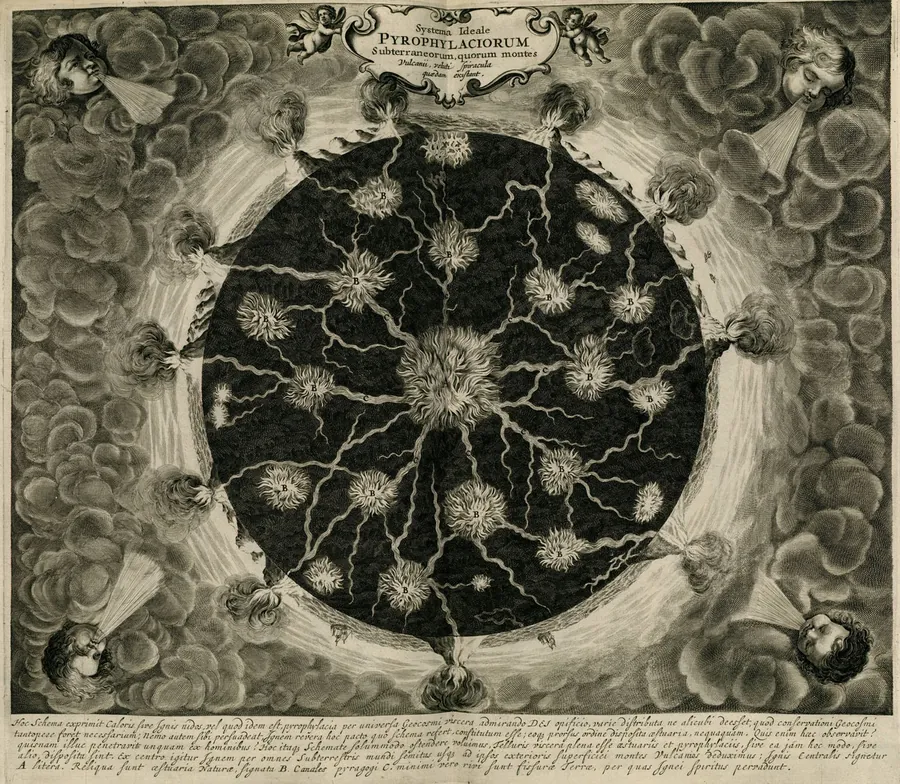
The Jesuit scholar's Mundus Subterraneus pictured the inside of the Earth as a network of fire channels feeding the volcanoes.
Athanasius Kircher, Wikimedia Commons, public domain
Hooke and Newton
In letters to Robert Hooke, Isaac Newton sketched the path of a body falling into a turning Earth. Hooke answered that, without resistance, it would move along something like an ellipse. Historians count the exchange among the steps towards Newton's law of gravitation.

Lewis Carroll
Falling down the rabbit hole, Alice wonders: “I wonder if I shall fall right through the earth! How funny it'll seem to come out among the people that walk with their heads downward!”
John Tenniel, Wikimedia Commons, public domain

The layers are found
Earthquake waves revealed the layers you fall through. Andrija Mohorovičić found the base of the crust in 1909, Beno Gutenberg put the edge of the core at about 2,900 km in 1914, and Inge Lehmann, in a 1936 paper titled simply P′, showed that the core has a solid centre.
Even Neuhaus, Wikimedia Commons, public domain
Cooper, Klotz
Paul Cooper worked out the 42-minute trip through a uniform Earth, and noticed that every straight tunnel takes the same time. Alexander Klotz redid it with the PREM model of Earth and found 38 minutes.
How this was calculated
The fall is computed from PREM, the Preliminary Reference Earth Model published by Adam Dziewonski and Don Anderson in 1981, which gives the density at every depth as inferred from earthquake waves and the planet's free vibrations. From the density we add up the mass beneath each depth, find the pull of gravity there, and follow the motion second by second. The tunnel is straight, airless and frictionless; the Earth is a sphere that does not turn, except in the section on rotation; the crust is the model's average 24.4 km, without an ocean layer. The result, 38 min 11 s, matches Alexander Klotz's calculation with the same model.
Pressures come from the same model. Temperatures are estimates from laboratory experiments on iron (Anzellini and colleagues, 2013): about 4,050 K at the edge of the core and about 6,230 K at the edge of the inner core, each uncertain by about 500 K. The globes use Natural Earth country outlines at 1:110,000,000, so small islands can be missed; the share of land with land on the far side was measured on the more detailed 1:50,000,000 outlines. The drift towards the wall uses the standard formula for the eastward deflection of a falling body, valid for the first few kilometres.
Checking the precision: refining the calculation from a 400 m grid with 2-second steps to a 12 m grid with 0.1-second steps changes the total time by less than 0.03 s. The converged thirds last 763.46 s, 763.76 s and 763.46 s. The constant-gravity model uses standard gravity, 9.80665 m/s², as Klotz does; holding this model's own surface value (9.826 m/s²) instead would give 37 min 58 s. The separation between the two fallers is compared only on the way in, while both are above the centre. For the reproduction, gravity was computed at the PREM reference depths, interpolated linearly between the two nearest, and the motion stepped every 0.01 s.
Sources
- Dziewonski & Anderson (1981), Preliminary reference Earth model, Physics of the Earth and Planetary Interiors 25: 297–356. Tabulation used: ObsPy
prem.nd. doi.org/10.1016/0031-9201(81)90046-7 - ObsPy, PREM tabulation github.com/obspy/obspy/blob/master/obspy/taup/data/prem.nd
- Klotz (2013/2015), The gravity tunnel in a non-uniform Earth arxiv.org/abs/1308.1342
- Cooper (1966), Through the Earth in forty minutes, American Journal of Physics 34: 68–70 ui.adsabs.harvard.edu/abs/1966AmJPh..34...68C
- Anzellini et al. (2013), Melting of iron at Earth's inner core boundary, Science 340: 464 doi.org/10.1126/science.1233514
- Kola Superdeep Borehole: depth, dates and diameter en.wikipedia.org/wiki/Kola_Superdeep_Borehole
- Plutarch, On the Face in the Moon, ch. 7, Loeb translation by H. Cherniss (1957) penelope.uchicago.edu/Thayer/E/Roman/Texts/Plutarch/Moralia/The_
- Galileo, Dialogo sopra i due massimi sistemi (1632), Day One and Day Two, Edizione Nazionale text it.wikisource.org/wiki/Dialogo_sopra_i_due_massimi_sistemi_del_m
- Newton and Hooke letters of 1679–80, summary by T. Timberlake sites.berry.edu/ttimberlake/teaching/newton-hooke/
- Lewis Carroll, Alice's Adventures in Wonderland (1865), ch. 1 gutenberg.org/cache/epub/11/pg11.txt
- Lehmann (1936), P′, extracts and interpretation courses.seas.harvard.edu/climate/eli/Courses/EPS281r/Sources/Inn
- NASA, Moon fact sheet (diameter 3,474.8 km) nssdc.gsfc.nasa.gov/planetary/factsheet/moonfact.html
- Natural Earth, land and country outlines (public domain) naturalearthdata.com/
Images
- The Kola borehole, 2012: Rakot13, Wikimedia Commons, CC BY-SA 3.0
- Frontispiece of Galileo's Dialogue, 1632: Stefano della Bella, Wikimedia Commons, CC0
- Kircher's fire channels, Mundus Subterraneus: Athanasius Kircher, Wikimedia Commons, public domain
- John Tenniel, the White Rabbit, 1865: John Tenniel, Wikimedia Commons, public domain
- Inge Lehmann, 1932: Even Neuhaus, Wikimedia Commons, public domain
,_август_2012.JPG)