Râșnov, near Brașov, Romania · dug 1623–1640
The Râșnov fortress well: how long a stone takes to fall 146 metres
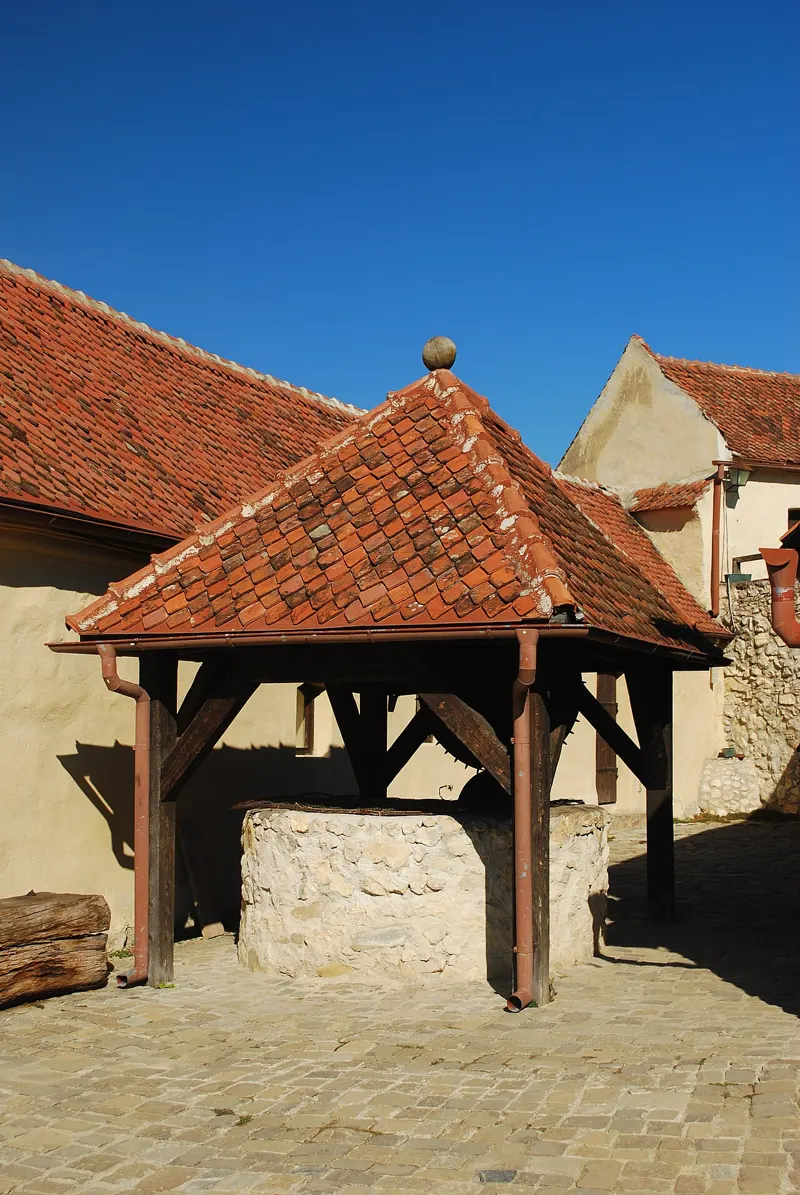
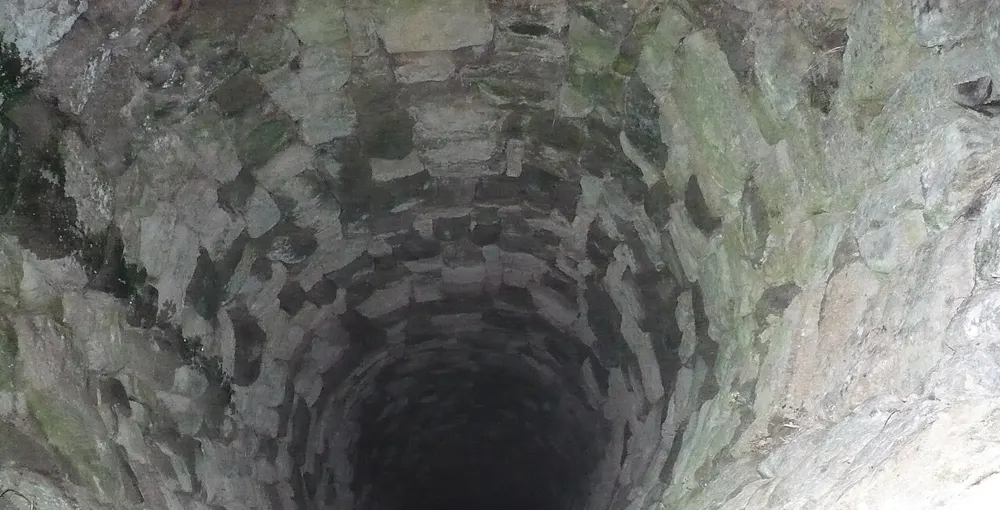
In the courtyard of the hilltop fortress at Râșnov, a town near Brașov in Romania's Transylvania region, workers cut into the rock for 17 years until they reached water, about 146 metres down. In 1640 a 4 cm stone would have reached the water after almost six seconds, and the sound would have needed almost half a second more to reach the top. In 2011 a climber who took tourists down it said it was silted up at about 68 metres.
where the stone is after each second
Sound starts when you press the button.
Why the fortress needed a well
Râșnov fortress stands on a hill above the town of Râșnov, near Brașov, and guarded the Bran road, one of the ways into Transylvania. For a long time it had no water inside its walls: according to local tradition, during long sieges the people sheltering in the fortress went out through the main gate at night to fetch water from a spring only they knew about.
In 1612, after a siege, the fortress surrendered to Prince Gabriel Báthory of Transylvania. The siege showed that the fortress could not hold out without a well in its courtyard.
Who dug it, and how long it took
"Work began the day after the feast of the Ascension in 1623 and ended in July 1640, when they reached water," says the historian Nicolae Pepene, director of the Brașov County History Museum.
From 1623 to 1633 two craftsmen from the Transylvanian town of Făgăraș, Baltres (or Boltres) and Andreas, did the work; from 1633 to 1640 the well-diggers Feltern Lange and Andreas Erwisch. Their 1633 contract, kept in the Brașov archives, gave each of them 2 florins a week, 5 okas of beer a day (an oka was a local unit of measure) and wine on Sundays. The whole well cost about 2,000 florins.


The legend of the two Turkish prisoners
Guides and many travel pages say the well was dug by two Turkish prisoners, who are said to have been promised their freedom once it was finished. The Adevărul article quoting Nicolae Pepene says the legend began circulating in the 1970s. The town accounts record that Râșnov hired and paid craftsmen, stonemasons and carpenters for the work.
How deep the well is
The town council minutes of 1640 give the depth in fathoms: "67 mining fathoms" or "76 land fathoms". The length of these fathoms is not stated; with the Viennese fathom, later the official unit of the Habsburg Empire (1.8965 m), 76 fathoms would be 144 m. Today's sources give 143 to 147 m: the historian Nicolae Pepene 146 m, a 2010 report by the Romanian broadcaster Pro TV 147 m, English Wikipedia 143 m. For a 4 cm stone, the difference between 143 and 147 m is 0.11 s.
From the last quarter of the 18th century the well was no longer used and slowly filled: in 1891 it measured 98 m. In 2011 a climber who took tourists down it said it was silted up at 68 m. At 68 m, the stone hits the silt after 3.88 s and is heard after 4.08 s.
None of these sources gives the shaft's diameter, so the drawing shows it schematically. In 2010 climbers from Brașov went down the well; the town authorities wanted to let visitors abseil 84 m down the well. In the shaft they found rubbish and recent coins.
Why not five point nine seconds
If air did not slow it, a stone of any size would fall 146 m in 5.46 s; with 0.43 s more for the sound to reach the top, you would hear the splash after 5.89 s. But air holds it back: a 4 cm stone falls for 5.96 s, a 2 cm pebble for 6.47 s, a 6 cm stone for 5.79 s.
The size of the stone changes the time until you hear the splash more than the spread of depths in the sources: 0.68 s between the 2 cm pebble and the 6 cm stone at the same depth, against 0.11 s for the 4 cm stone between 143 and 147 m.
The calculation for a fall in a vacuum can be checked against a real drop-test facility: at NASA's Glenn Research Center in Ohio an experiment capsule falls 432 feet (132 m) inside a vacuum chamber, and NASA gives 5.18 s of free fall. The same formula gives 5.18 s.
Sources and calculation
The fall is computed step by step for a round piece of limestone (2,700 kg/m³), with the drag coefficient of a sphere (0.47), in air at 10 °C at about 800 m elevation (1.13 kg/m³), with gravitational acceleration at the fortress's latitude (9.804 m/s²). Sound travels up the shaft at 337 m/s. For the reader's block, a storey is taken as about 2.9 m (146 m / 50). An angular stone can experience more drag than a spherical one, and the temperature in the shaft has not been measured.
- Adevărul, „Zece lucruri mai puțin cunoscute despre Cetatea Râșnov”, cu istoricul Nicolae Pepene. adevarul.ro The 1612 siege and water fetched at night; work from 1623 to July 1640; 146 m (subheading: 145 m); the craftsmen Baltres and Andreas from Făgăraș; the accounts; the origins of the legend in the 1970s.
- Burzenländer Kalender 2013, foaia pentru noiembrie, „Die Bauernburg von Rosenau”. burzenland.de Well cut into the rock 1623–1640, over 2,000 florins; depth in the 1640 council minutes: "berg lofftern 67, auff dass landt lofftern … 76"; unused from the last quarter of the 18th century; 98 m in 1891.
- Historia, „Cetatea Râșnov, între legendă și istorie”. historia.ro The diggers of 1623–1633 (Boltres and Andreas) and 1633–1640 (Feltern Lange and Andreas Erwisch); the 1633 contract; the cost of 2,000 Rhenish florins.
- Crișana, reportaj din 2011 cu alpinistul Mihai Mândreanu. crisana.ro The well "146 metres deep, silted at 68 metres".
- Wikipedia, „Klafter” (germană). de.wikipedia.org The Viennese fathom, 1.8965 m.
- ProTV, „Turism în adâncuri: coborârea pe corzi în adâncul fortăreței din Cetate”, 20 noiembrie 2010. stirileprotv.ro "147 metres in documents"; rope descent to 84 m; rubbish and recent coins.
- Wikipedia, „Râșnov” (engleză). en.wikipedia.org The 143 m depth.
- NASA Glenn, „Zero Gravity Research Facility”. nasa.gov 132 m of free fall, 5.18 s.
- Wikipedia, „Drag coefficient”. en.wikipedia.org Drag coefficient 0.47 for a sphere.