Marius Comper RO

Bucharest, 1970 · the memory of the FELIX C-256

Your name, in rings of ferrite

The FELIX C-256, presented in 1970 as Romania’s first “third-generation” computer, the kind built with integrated circuits, kept every bit in a ring of ferrite half a millimetre across. Type your name further down and see how it would have been written into its memory bit by bit, then punched on a card and printed.

1970 · Calea Floreasca

A French computer, assembled in Bucharest

In 1968 communist Romania bought the licence for the IRIS 50, a computer made by the French firm CII, according to Vasile Baltac, who led its move into production. The choice was to build a domestic industry under a Western licence rather than import finished machines. In 1970 the first Romanian unit was assembled from French parts at the FEA works in Bucharest and installed in a ground-floor room with windows on Calea Floreasca, a Bucharest avenue. The room promptly became the Computing Centre.

The name refers to Dacia Felix, a phrase Roman coins used for Dacia, the province that covered much of present-day Romania; Romanian-built Renault cars were named Dacia in the same spirit. The 256 is the maximum internal memory: 256 kilobytes. In October 1970 a FELIX C-256 stood in the central pavilion of the Bucharest International Fair, inside a transparent booth that kept out heat and dust.

650
IRIS-compatible FELIX mainframes, 1970–1990
≈ 160
FELIX C-256s, Baltac and Gligor’s estimate
11
of them exported to China
≈ 200 m²
floor space of one installation, per a textbook
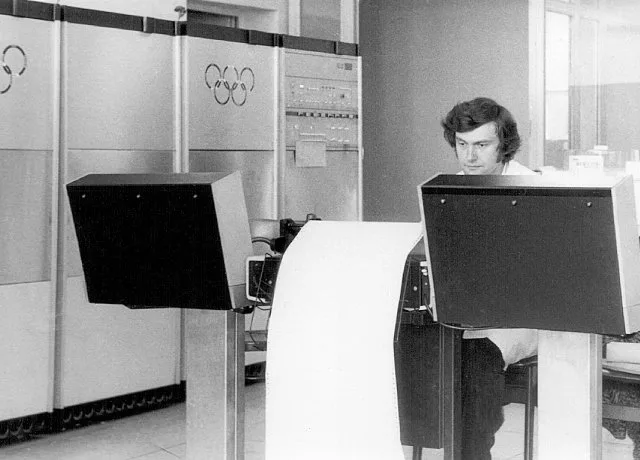
Black and white photograph from 1979: an operator at the console of a FELIX C-256, in front of tall cabinets.
A FELIX C-256 in 1979: the operator’s console and the cabinets of the main unit. Photo: Turbojet, Wikimedia Commons, CC BY-SA 4.0.

0.5 mm

One ferrite ring holds one bit

The internal memory used rings made of ferrite, a magnetic ceramic. In the modules made in Timișoara each ring was 0.5 mm across outside and 0.3 mm inside, threaded by three wires 0.05 mm thick: X, Y and the sense wire.

A ring is magnetised round its hole, one way or the other. One way is 1, the other is 0, and the ring keeps its magnetisation when the current is switched off.

1: one way round0: the other waysense pulse

The core matrix was not part of the licence: the technology for rings this small was military and under a Western embargo, so the first memory blocks were imported ready-made. In Timișoara, where the MECIPT team had already built a core memory, the city’s memory factory then learned to assemble the modules under the microscope.

X and Y

Half a current is not enough

A ring reverses its magnetisation only when the field from the currents through it passes a threshold. The X wire carries half the current needed, the Y wire the other half.

Every other ring on that X row or that Y column gets only half and stays as it was. Only at the crossing do the two fields add up, and that ring reverses. That is how one ring is picked out of tens of thousands without a wire of its own.

950 ns

Reading erases, then writes back

To find out what a ring holds, the memory forces it to 0. If it held a 1, its magnetisation reverses and induces a pulse in the sense wire. If it held a 0, there is no pulse. Reading therefore destroys what was stored, and in the second half of the cycle the memory writes back what it read.

On the IRIS 50 one full cycle, read plus write, took 950 ns and accessed two bytes at a time. No datasheet for the FELIX memory has been found, but at its demonstration in October 1970 the youth daily Scînteia tineretului reported “one million reads or writes per second”. The figures agree:

1 s ÷ 950 ns ≈ 1,052,632 cycles

8 bits + parity

Eight bits for a letter, and one to check them

FELIX worked with 8-bit bytes and 32-bit words. On screen each letter gets eight bits and one more, a parity bit that flags a single bit gone wrong: the contents of the 1974 book on FELIX list the “parity error”.

On screen each bit has its own plane, and an address is the same position in every plane. In the real module, organised as 2½D, wires threaded through the rings formed matrices the size of an A4 sheet, about 72,000 rings each. If each byte had a parity bit, a 16-kilobyte module needed two of them:

16,384 bytes × 9 rings per byte = 147,456 rings
16 modules = 256 KB = 2,359,296 rings

The planes on screen show a 16 by 16 corner, one plane per bit. The sources found do not say whether parity was odd or even; the page uses odd parity.

Your turn

Write your name into memory

Each character becomes one byte of EBCDIC, the character code FELIX used. The memory first reads what was at that address, then writes. On screen one cycle lasts about a second; the page times the real thing with the 950-billionths-of-a-second cycle published for the IRIS 50.

80 columns

Then a punched card

Programs and data went into the machine on cards with 80 columns and 12 rows. A letter is two holes in one column: A is punched in rows 12 and 1, J in 11 and 1, S in 0 and 2, as in the character table printed in Cluj in 1975 for people working on FELIX.

The table has only capitals, the digits 0–9 and punctuation. The page turns lower case into capitals and writes the Romanian letters Ă, Â, Î, Ș and Ț without their marks.

At the 1970 demonstration the card reader read 1,200 cards a minute. Programmers remember its errors too: “Error 18”, a misread card, meant another trip to the card punch.

1,200 lines a minute

And the result, from the printer

Results came out of the line printer: 1,200 lines a minute, according to the party daily Scînteia in 1972, and 132 characters a line. The archaeologist Cătălina Bloșiu proposed a catalogue of finds designed to fit exactly that line width.

Computing centres

From Calea Floreasca to Beijing

Nobody could buy a FELIX privately. The machines sat in the computing centres of state factories, institutes and universities and in regional computing centres, and a generation of Romanian programmers learned the trade on them, often without ever seeing the computer.

  • Bucharest, FEA works, 1970The first FELIX C-256, assembled from CII parts in a ground-floor room facing Calea Floreasca.
  • Bucharest International Fair, October 1970A C-256 in a transparent booth in the central pavilion, presented as the first Romanian third-generation computer.
  • Iași, early 1970sThe regional computing centre had a FELIX C-256. Students wrote FORTRAN programs on coding sheets, which the teaching assistant took to the centre.
  • Galați, 1973The steelworks’ first FELIX C-256 had 128 KB of memory when it was installed. In 1988 a C-256 was still part of the plant’s network.
  • Bucharest, Computer Technology InstituteA C-256 ran “Felix Șah”, a chess program: players entered moves on a teleprinter and the computer’s replies were printed on a paper roll.
  • Cluj, 1975 and 1983The Faculty of Mathematics printed, for internal use, the FELIX C-256 reference booklet the character table comes from. In 1983 the physicists T. A. Beu and R. I. Câmpeanu published a program run on the university computing centre’s C-256.
  • Beijing, 1975–1976The first FELIX C-256 exported to China went to the Institute of Aeronautics. Vasile Baltac and Cornel Maschek taught a course there in French on its structure.

What is missing

What remains uncertain

No FELIX C-256 is known to survive, not even a non-working one. Little of its software is left: a few magnetic tapes, including a backup of the HELIOS operating system, were recovered and put online only recently.

Its speed is hard to pin down. Scînteia tineretului wrote of 200,000 operations a second in 1970, Scînteia of 16,000 “mathematical operations” in 1972, and a 1976 manual gives about three microseconds for most instructions. Nor is the number of C-256s built certain: Vasile Baltac and Horia Gligor put it at “most probably 160”.

The 950 ns cycle is the published figure for the IRIS 50; no datasheet for the FELIX memory has been found, and the sources found do not describe parity per byte. The page does not reproduce the exact wiring of a matrix: the planes are a diagram, one per bit.

Send the link

The link opens the page with your name already filled in.

Sources

The numbers come from documents of the time and from the memories of the people who built the machine. Where the sources disagree, the page says so.

  1. Computers and Automation, December 1968, p. 32: IRIS 50, 950 ns cycle for a 2-byte word, 16,384–262,144 bytes.
  2. Scînteia tineretului, 14 October 1970, p. 3: FELIX C-256 at the Bucharest International Fair, one million reads or writes a second, 1,200 cards a minute, 200,000 operations a second.
  3. Scînteia, 10 December 1972, p. 1: 1,200 lines a minute, 16,000 operations a second.
  4. Dan Bedros, in Un secol de electronică în România (A century of electronics in Romania), Romanian Academy Press, 2020, pp. 356–358: the 16 kB module, 0.5/0.3 mm rings, three 0.05 mm wires, 72,000 rings on an A4 matrix, 2½D organisation.
  5. Memento FELIX C 256, Babeș-Bolyai University, Cluj, 1975: the table of printable characters with EBCDIC and card codes; 9-track magnetic tape.
  6. V. Baltac et al., FELIX C-256. Structura și programarea calculatorului, Editura Tehnică, 1974 (contents): the parity error, interleaved memory blocks, the model 70140 card reader.
  7. Vasile Baltac, Un institut pentru istorie (An institute for history), 2018: the 1968 licence, the first C-256 at FEA, the Beijing course, the first C-256 with 64 KB.
  8. Vasile Baltac, Horia Gligor, Some Key Aspects in the History of Computing in Romania, 2015: the name, 650 FELIX mainframes, 11 to China, most probably 160 C-256s, the embargoed memory.
  9. Viorel Darie, Petre Rău, Amintiri din epoca Felix a calculatoarelor românești, Galați, 2011: Iași, Galați, “Felix Șah”, “Error 18”.
  10. Cătălina Bloșiu, Memoria Antiquitatis IV–V, 1972–1973, p. 18: the catalogue proposed for the 132-character line of the FELIX C-256 printer.
  11. T. Beu, R. Câmpeanu, Computer Physics Communications 30, 1983: a program run on the FELIX C-256 at the university computing centre in Cluj, 32-bit word.
  12. A. D. Corlan, The RASSIRIS project, 2024: no known surviving unit, instructions of about 3 µs.
  13. Z80 România, tapes for FELIX/CORAL/INDEPENDENT: recovered FELIX C-256 tape images, including a HELIOS backup.
  14. V. Melnic, Informatică, p. 12: floor space of about 200 m².
  15. Photos: Turbojet, 1979, Felix C-256 computer 1 and 2, Wikimedia Commons, CC BY-SA 4.0.