Cluj, the 1570s
Can you read Romanian printed 450 years ago?
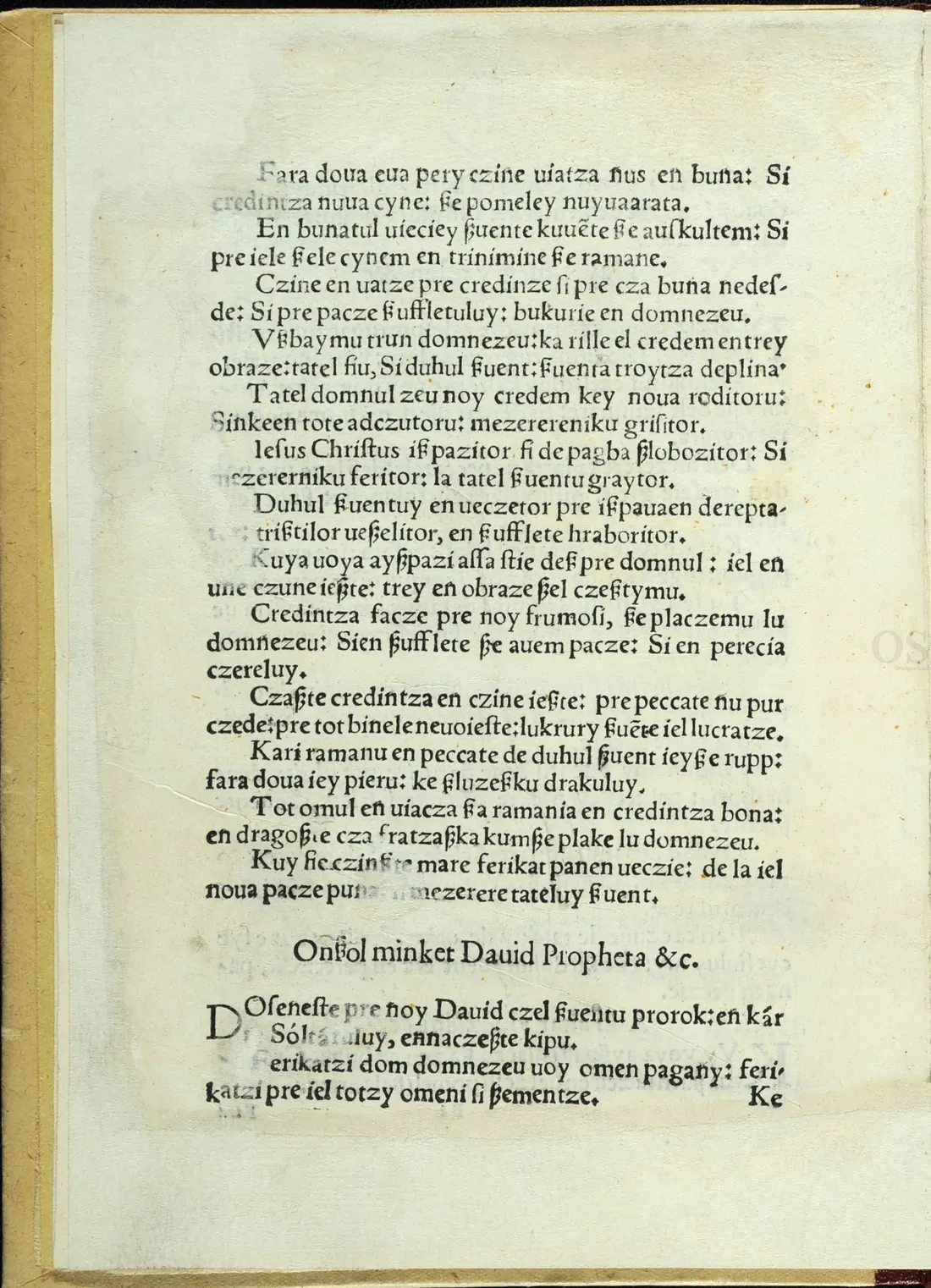
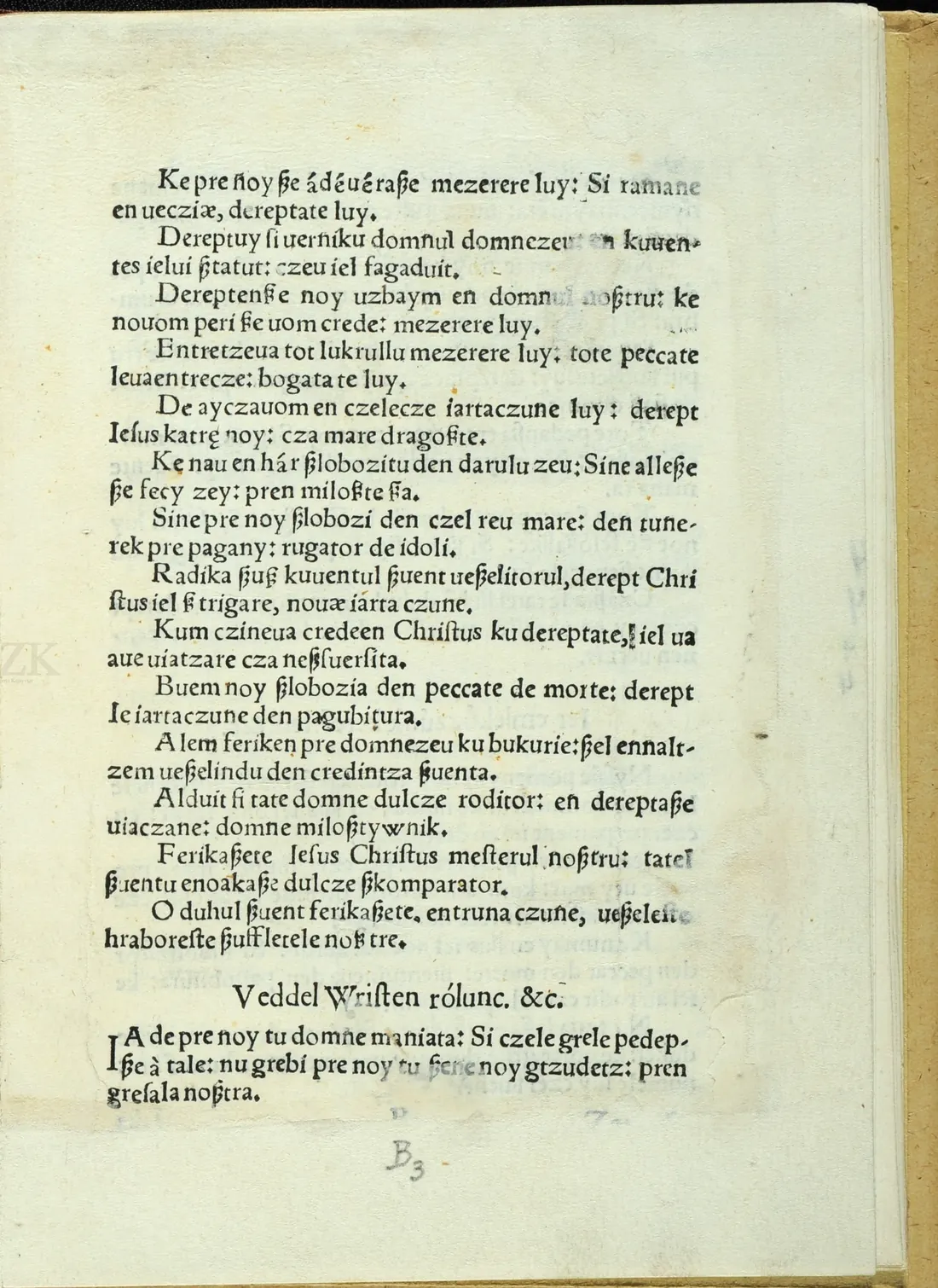
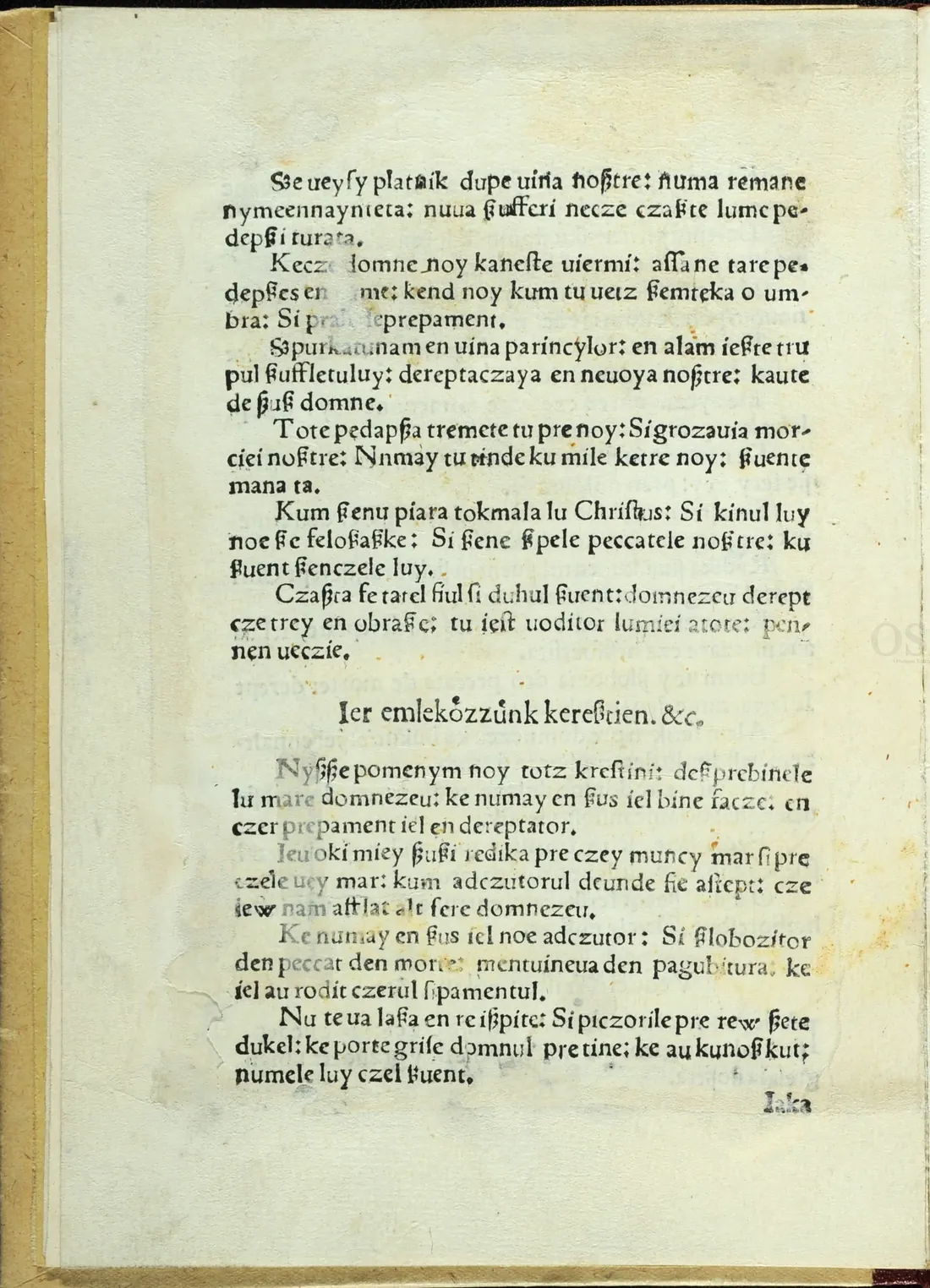
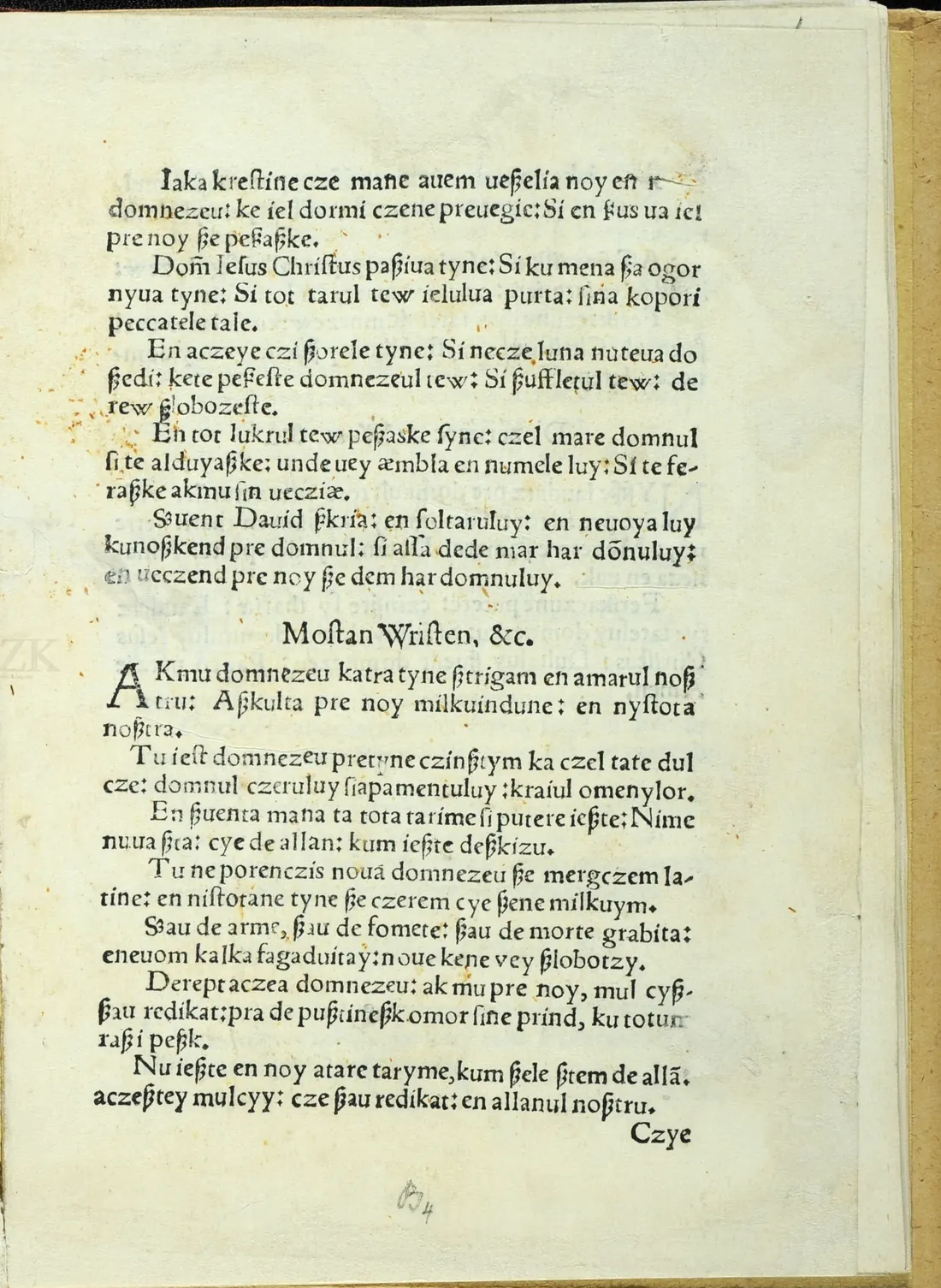
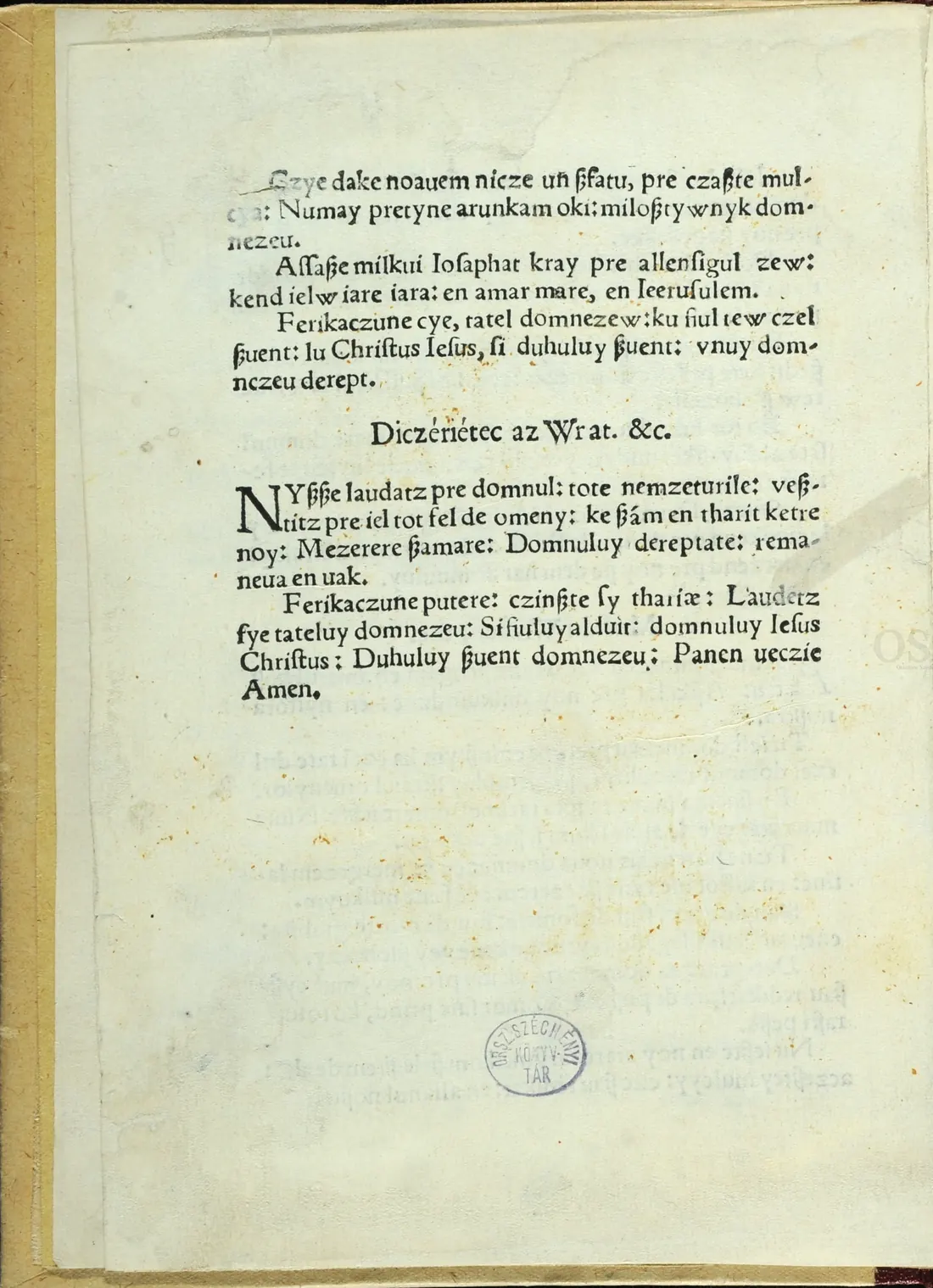
The page pictured here is the oldest surviving piece of Romanian printed in Latin letters. The letters are Latin, but the spelling is Hungarian: k for c, cz for ce, ß for s, y for i. Of the song's 208 words, 34 are spelled as Romanian spells them today. Apply six spelling rules and 176 become readable.
- 4 leaves, 8 pages
- from the second sheet of a small hymnbook
- 10 songs
- translated from Hungarian for the Calvinist Romanians of Banat and Hunedoara
- 1601
- the year the book whose boards held the leaves until 1911 was bound

Six spelling rules make the page readable
Whoever set the type wrote Romanian the way Hungarian was written. Switch the rules on one at a time: each changes only the letters it governs, and colours them. The printed page shows the line you are on.
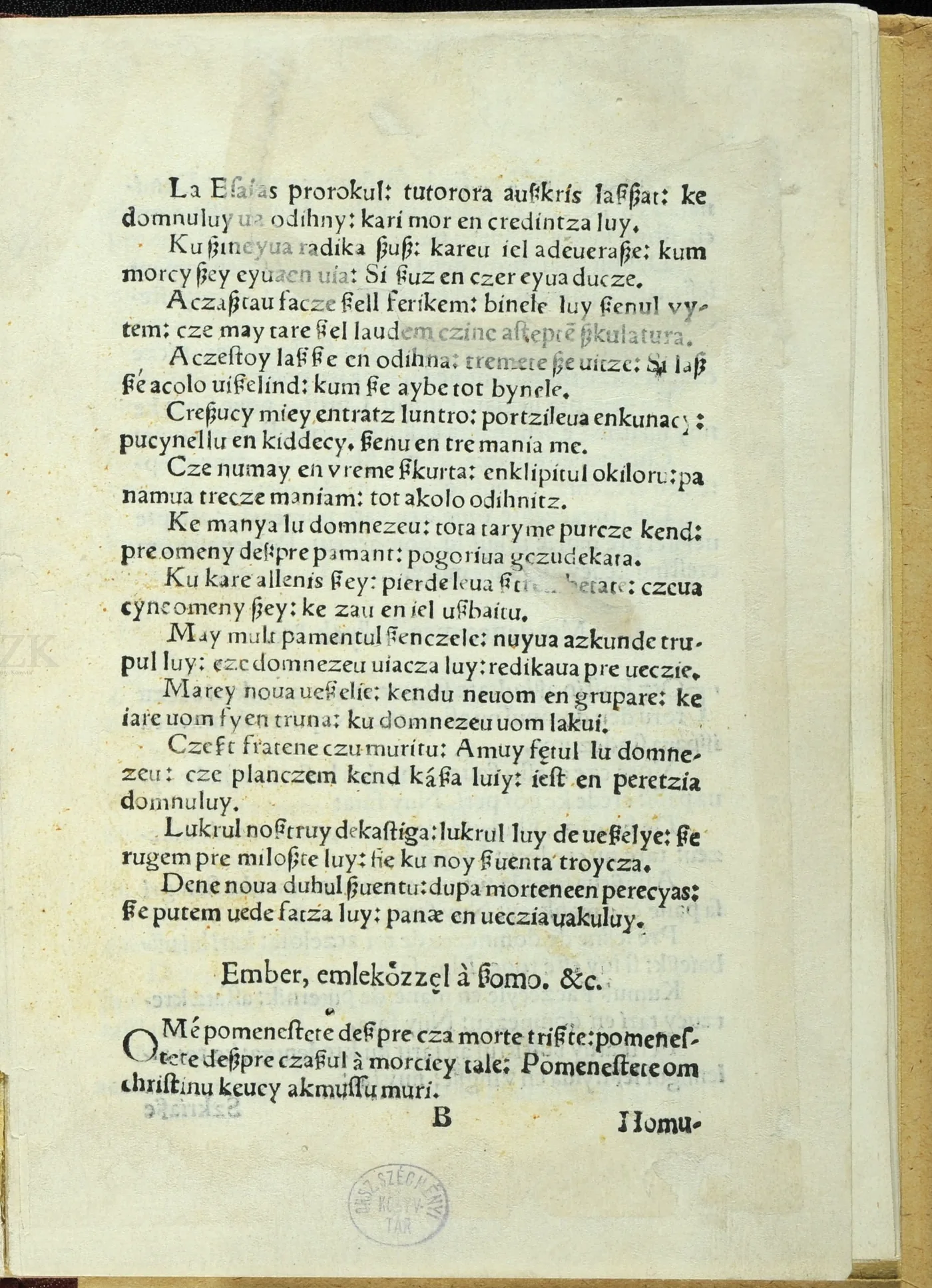
National Széchényi Library, Budapest (RMK I 361); scan published by the Central University Library, Cluj.
34 of 208 words spelled as today
Each line appears twice: first as printed, then in today's Romanian spelling. Under each stanza, its meaning in English.
Tap a line to find it on the page.
La Eſsaias prorokcul:, tutorora au ßskcris laăßßsat: kceă
today's spelling: La Esaias prorocul, tutorora au scris lăsat că
dDomnulu-yi uva odihnyi: kcari mor eîn credintzța lLuyi.
today's spelling: Domnulu-i va odihni cari mor în credința Lui.
The prophet Isaiah left it written for all that the Lord will give rest to those who die in His faith.
KCu ßSine-yi uva raădikca ßsußs: kcare-u iel adeuveraeaßdzeă:, kcum
today's spelling: Cu Sine-i va rădica sus care-u iel adevereadză, cum
morcyții ßseăyi eîyi uva eîn uvia:, Sși ßsuzs eîn czcer eîyi uva duczce.
today's spelling: morții săi îi va învia, și sus în cer îi va duce.
He will raise them to Himself, as He has confirmed: He will raise His dead and take them up to heaven.
Aczcaeaßsta-u faczce ßseăl-l ferikceăm:, binele lLuyi ßseă nu-l vuyi-
today's spelling: Aceasta-u face să-l fericăm, binele Lui să nu-l ui-
teăm:, czce mayi tare ßseă-l laăudeăm czcine aſșteptēăm ßskculaătura.
today's spelling: tăm, ce mai tare să-l lăudăm cine așteptăm sculătura.
So let us glorify Him and not forget His goodness; above all, let us praise Him, we who wait for the resurrection.
Aczceſștoyi laß ßseă eîn odihnaă:, tremete ßseă uvietzdze:, Sși laßs
today's spelling: Aceștoi lasă în odihnă, tremete să viedze, și las
ßeă acolo uvißselind:, kcum ßseă ayibeă tot byinele.
today's spelling: ă acolo viselind, cum să aibă tot binele.
These He leaves to rest; He sends them to their place and leaves them there in peace, to have every good thing.
Creßdzucyții mMieyi, eîntratzți luntro:, portzțile uvaă eînkcunacyți:,
today's spelling: Credzuții Miei, întrați luntro, porțile vă încunați,
pucyținellu eîn kchiddecyți., ßseă nu eîn tre maânia mMe.
today's spelling: puținelu închideți, să nu între mânia Me.
“My faithful, go inside, shut your gates, shut yourselves in a little while, so that My anger does not come in.”
CzCe numayi eîn vreme ßskcurtaă:, eîn kclipitul okchiloru:, paă-
today's spelling: Ce numai în vreme scurtă, în clipitul ochiloru, pă-
naă-m uva treczce maânia-m:, tot akcolo odihnitzți.
today's spelling: nă-m va trece mânia-m, tot acolo odihniți.
“Only for a short time, the blink of an eye, until My anger passes, rest there all the while.”
KCeă maânyia lu dDomnezeu:, tooataă taăryime purczce kgeând:,
today's spelling: Că mânia lu Domnezeu, toată tărime purcegând,
pre ooamenyi deßspre paămaânt:, pogoriî-uva gczgiudekcata.
today's spelling: pre oameni despre pământ, pogorî-va giudecata.
For the anger of God, setting out in all its strength, will bring judgement down on the people of the earth.
KCu kcare allenisșii ßseăyi: pierde-le-uva ßstr[..]âmbeătate:, czce uva
today's spelling: Cu care alenișii săi pierde-le-va strâmbătate, ce va
cyține ooamenyii ßseăyi:, kceă zs-au eîn iel ußzbaăitu.
today's spelling: ține oamenii săi, că s-au în iel uzbăitu.
With it He will destroy His enemies for their wrongdoing, but He will keep His people, who trusted in Him.
Mayi mult paămeântul ßseânczgele: nu-yi uva azskcunde tru-
today's spelling: Mai mult pământul sângele nu-i va ascunde tru-
pul luyi:, czce dDomnezeu uviaczța luyi: reădikca-uva pre uveczcie.
today's spelling: pul lui, ce Domnezeu viața lui rădica-va pre vecie.
The earth will no longer hide the blood and the body of the dead: God will raise his life up for ever.
Mare-yi nouaă uveßselie:, kceându ne uvom eîn grupare:, kceă
today's spelling: Mare-i nouă veselie, cându ne vom îngrupare, că
iareă uvom fyi eîn tr-una:, kcu dDomnezeu uvom laăkcui.
today's spelling: iară vom fi într-una, cu Domnezeu vom lăcui.
Great is our joy when we are buried, for we shall be together again; we shall live with God.
CzCeſst frate-ne cze-u muritu:, Aamu-yi fęătul lu dDomne-
today's spelling: Cest frate-ne ce-u muritu, amu-i fătul lu Domne-
zeu:; czce plaânczgem, kceând kcáaßsa lLuiy: ieſst eîn pereătzția
today's spelling: zeu; ce plângem, când casa Lui iest în perăția
dDomnuluyi.?
today's spelling: Domnului?
This brother of ours who has died is now a child of God. Why do we weep, when his house is in the kingdom of the Lord?
Lukcrul noßstru-yi de kcaăſștigaă:, lukcrul luyi de uveßselyie:; ßseă
today's spelling: Lucrul nostru-i de căștigă, lucrul lui de veselie; să
rugeăm pre miloßste lLuyi:, fie kcu noyi ßSuveânta tTroyiczțaă.
today's spelling: rugăm pre miloste Lui, fie cu noi Svânta Troiță.
Ours is the worry, his is the joy. Let us pray to His mercy: the Holy Trinity be with us.
Deă-ne nouaă dDuhul ßSuveântu:, dupaă mooarte-ne eîn pereăcyțiasș:,
today's spelling: Dă-ne nouă Duhul Svântu, după moarte-ne în perățiaș,
ßseă putem uvede fatzța lLuyi: paănæă eîn uveczcia uvaeakculuyi.
today's spelling: să putem vede fața Lui pănă în vecia veacului.
Give us the Holy Spirit and, after death, Your kingdom, so that we may see His face for ever and ever.
Ember, emlekőzzęl à ßomo. &c.
OMmée, pomeneſște-te deßspre czcaea mooarte trißsteă:, pomeneſș-
today's spelling: Ome, pomenește-te despre cea moarte tristă, pomeneș-
te-te deßspre czcaeaßsul àa morcțieyi tale:. Pomeneſște-te om
today's spelling: te-te despre ceasul a morției tale. Pomenește-te om
chcrieſștinu, kceă uveyi akcmuſſșu muri.
today's spelling: creștinu, că vei acmuș muri.
Where the letters come from
Every value comes from the Hungarian spelling of the time. In Hungarian, sz reads s and s reads sh (Romanian ș); the printer had a single joined letter for sz, ß. In Hungarian books of the period cz also read like the ch in church: the Hungarian heading of the last song, Diczériétec az Wrat, is spelled Dicsérjétek az Urat today.
Where Romanian has sounds Hungarian lacked, the printer improvised. He had no particular letter for the vowels ă, î and â, and wrote them all with e, sometimes a. The sound ț (ts) is spelled three ways, tz, cy and cz, and cz also stands for ce. The letter ß appears almost 300 times on the eight pages.
Words Romanian no longer uses
- credzuții
- the faithful; from credzut, the old form of crezut, believed
- luntro
- inside
- sculătura
- the resurrection; from a se scula, to rise
- tărime
- strength, might
- alenișii
- the enemies; alean comes from Hungarian ellen, “against”
- uzbăi
- to trust; a word of Banat and Transylvania, origin unknown
- căștigă
- worry, care
Meanings from the Romanian dictionaries collected on dexonline (MDA2, DLRLV, Scriban, CADE).
Translated stanza by stanza from a Hungarian hymn
The song on the page translates a Hungarian funeral hymn, Az Istennek jóvoltáról (“Of the goodness of God”), printed in the Reformed hymnbooks of the 1560s. The Romanian stanzas follow the Hungarian ones in the same order. The hymn's first stanza, which also served as its title, stood on the leaf before our page, which is lost.
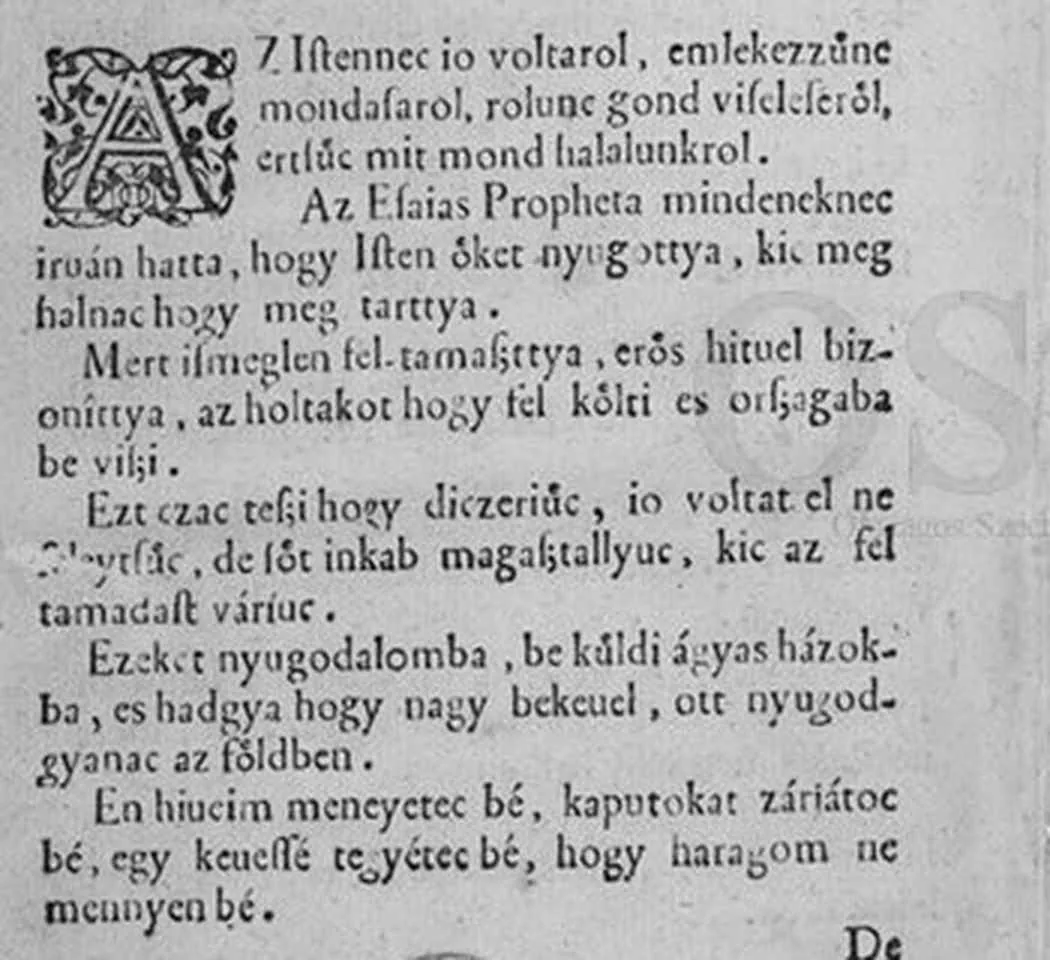
Hungarian, 1574Az Esaias Propheta mindeneknec iruán hatta, hogy Isten őket nyugottya, kic meg halnac hogy meg tarttya.
Romanian, 1570sLa Esaias prorocul, tutorora au scris lăsat că Domnulu-i va odihni cari mor în credința Lui.
- iruán hatta au scris lăsat “left it, writing”: left it in writing
- mindeneknec tutorora to all
- nyugottya va odihni gives them rest
Hungarian, 1574Mert ismeglen fel-tamasztya, erős hituel bizonittya, az holtakot hogy fel kőlti es orszagaba be viszi.
Romanian, 1570sCu Sine-i va rădica sus care-u iel adevereadză, cum morții săi îi va învia, și sus în cer îi va duce.
- bizonittya adevereadză confirms
- fel kőlti va învia raises them
- be viszi îi va duce takes them in
Hungarian, 1574Ezt czac teszi hogy diczeriűc, io voltat el ne feleytsűc, de sőt inkab magasztallyuc, kic az fel tamadast váriuc.
Romanian, 1570sAceasta-u face să-l fericăm, binele Lui să nu-l uităm, ce mai tare să-l lăudăm cine așteptăm sculătura.
- diczeriűc fericăm let us praise him
- el ne feleytsűc să nu-l uităm let us not forget
- az fel tamadast váriuc așteptăm sculătura we wait for the resurrection
Hungarian, 1574Ezeket nyugodalomba, be kűldi ágyas házokba, es hadgya hogy nagy bekeuel, ott nyugodgyanac az főldben.
Romanian, 1570sAceștoi lasă în odihnă, tremete să viedze, și las ă acolo viselind, cum să aibă tot binele.
- nyugodalomba în odihnă into rest
- be kűldi tremete sends them in
- hadgya lasă lets them
Hungarian, 1574En hiueim menyetec bé, kaputokat záriátoc bé, egy keuessé tegyétec bé, hogy haragom ne mennyen bé.
Romanian, 1570sCredzuții Miei, întrați luntro, porțile vă încunați, puținelu închideți, să nu între mânia Me.
- En hiueim Credzuții Miei my faithful
- menyetec bé întrați luntro go in
- kaputokat záriátoc bé porțile vă încunați shut your gates
- hogy haragom ne mennyen bé să nu între mânia Me so that my anger does not come in
Romanian does not say “au scris lăsat”, literally “has written left”. Hungarian says írván hagyta, “left it, writing”, and the translator kept the construction. The fifth stanza is Isaiah 26:20, God's own words in the singer's mouth: “My faithful, go inside”.
Ten songs, each to a Hungarian tune
Above each song stand the first words of a Hungarian hymn, followed by “&c.”, “and so on”. They are not titles: they name the tune to which the Romanian words are sung. The linguist Melich János noticed this in 1911 and used the way these lines are spelled to tie the print to Heltai Gáspár's press in Cluj.
The eight pages
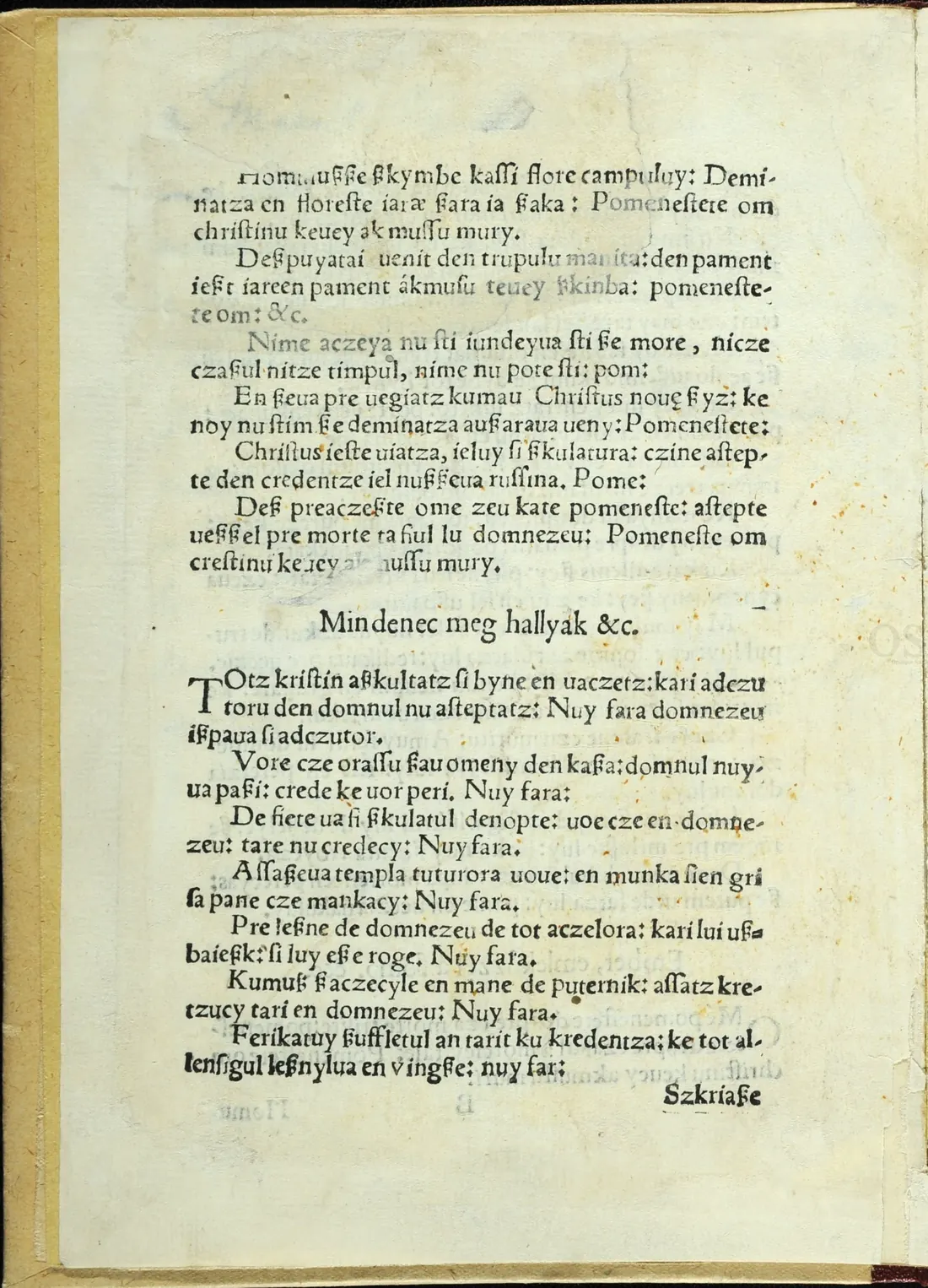
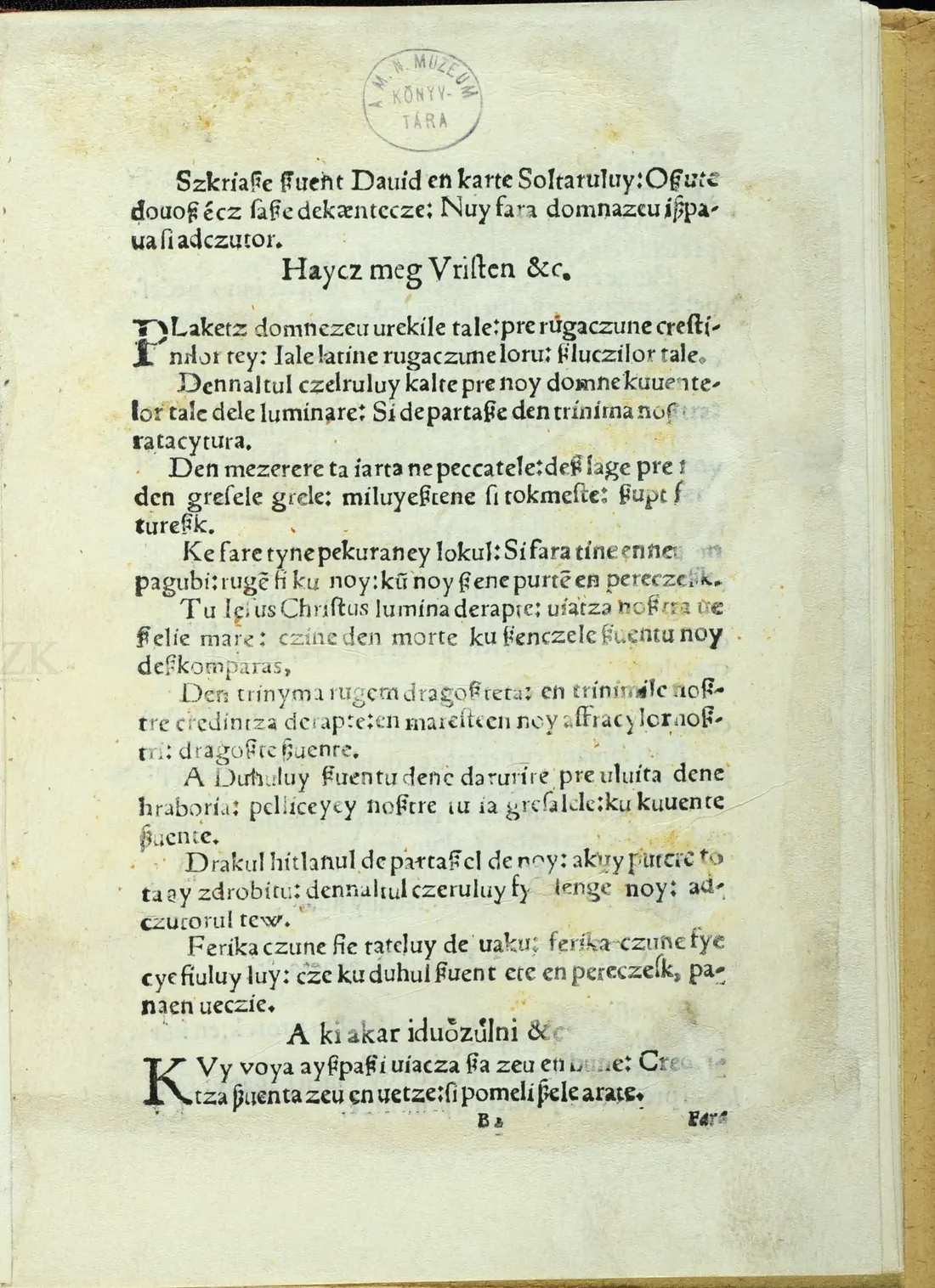
| The tune, as printed | The Hungarian hymn | How the Romanian song begins | What it is | |
|---|---|---|---|---|
| I | lost with the leaf before | Az Istennek jóvoltárólin Hungarian print by 1566 | La Eſaias prorokul: tutorora außkris laßßatLa Esaias prorocul tutorora au scris lăsat | funeral |
| II | Ember, emlekőzzęl à ßomo. &c. | Ember, emlékezzél a szomorú halálrólin Hungarian print by 1569 | OMé pomeneſtete deßpre cza morte trißteOme, pomenește-te despre cea moarte tristă | funeral |
| III | Mindenec meg hallyak &c. | Mindenek meghallják és jól megtanuljákin Hungarian print by 1566 | TOtz kriſtin aßkultatz ſi byneen uaczetzToți creștin ascultați și bine învățați | Psalm 127 |
| IV | Haycz meg Vriſten &c. | Hajtsd meg, Úristen, kegyes füleidetin Hungarian print by 1566 | PLaketz domnezeu urekile talePleacă-ți, Domnezeu, urechile tale | prayer |
| V | A ki akar iduőzűlni &c. | Aki akar üdvözülniin Hungarian print by 1566 | KVy voya ayßpaßi uiacza ßaCui voia a ispăsi viața sa | the creed |
| VI | Onßol minket Dauid Propheta &c. | Unszol minket Dávid prófétain Hungarian print by 1566 | DOſeneſte pre noy Dauid czel ßuentu prorokDojenește pre noi David cel svântu proroc | Psalm 117 |
| VII | Veddel Wriſten rólunc. &c. | Vedd el, Úristen, rólunk haragodatin Hungarian print by 1566 | IA de pre noy tu domne maniataIa de pre noi, tu Doamne, mânia ta | prayer |
| VIII | Ier emlekőzzűnk kereßtien. &c. | Jer, emlékezzünk, keresztyén népekin Hungarian print by 1566 | Nyßße pomenym noy totz kreſtiniNi să pomenim noi toți creștinii | Psalm 121 |
| IX | Moſtan Wriſten, &c. | Mostan, Úristen, hozzád kiáltunkin Hungarian print by 1602 | AKmu domnezeu katra tyne ßtrigamAcmu, Domnezeu, cătră tine strigăm | King Jehoshaphat's prayer |
| X | Diczériétec az Wrat. &c. | Dicsérjétek az Urat, minden nemzetségekin Hungarian print by 1602 | NY ßße laudatz pre domnul: tote nemzeturileNi, să lăudați pre Domnul toate nemzeturile | Psalm 117 |
- Psalm 117 appears twice, in two different translations (VI and X), in the same 16-page booklet.
- Song III names its own source. Its last stanza: “Holy David wrote it in the book of the Psalter, a hundred and twenty-six of songs”: Psalm 126 in the old numbering, 127 in today's.
- The Hungarian models of songs IX and X are known only from books printed after 1600. Nagy Levente thinks the translator worked from a Hungarian book that has not survived.
- Song X adds the Holy Spirit to the closing praise; the Unitarian Hungarian text names only the Father and the Son. For Ion Gheție this shows the translator was a Calvinist.
The Hungarian hymns are identified in the repertory of old Hungarian poetry (RPHA); the year is that of the oldest surviving, securely dated Hungarian book that contains the hymn. National Széchényi Library, Budapest (RMK I 361); scan published by the Central University Library, Cluj.
How four leaves survived: as stuffing in a book cover
1570s
Printed in Cluj
A booklet of two sheets, that is 16 pages. What survives is the second sheet, marked B. Its last page is half empty and has no catchword, the word at the foot that announces the next page, so Ion Gheție thinks the book ended here and the surviving leaves are a proof.
1601
Bound into a cover
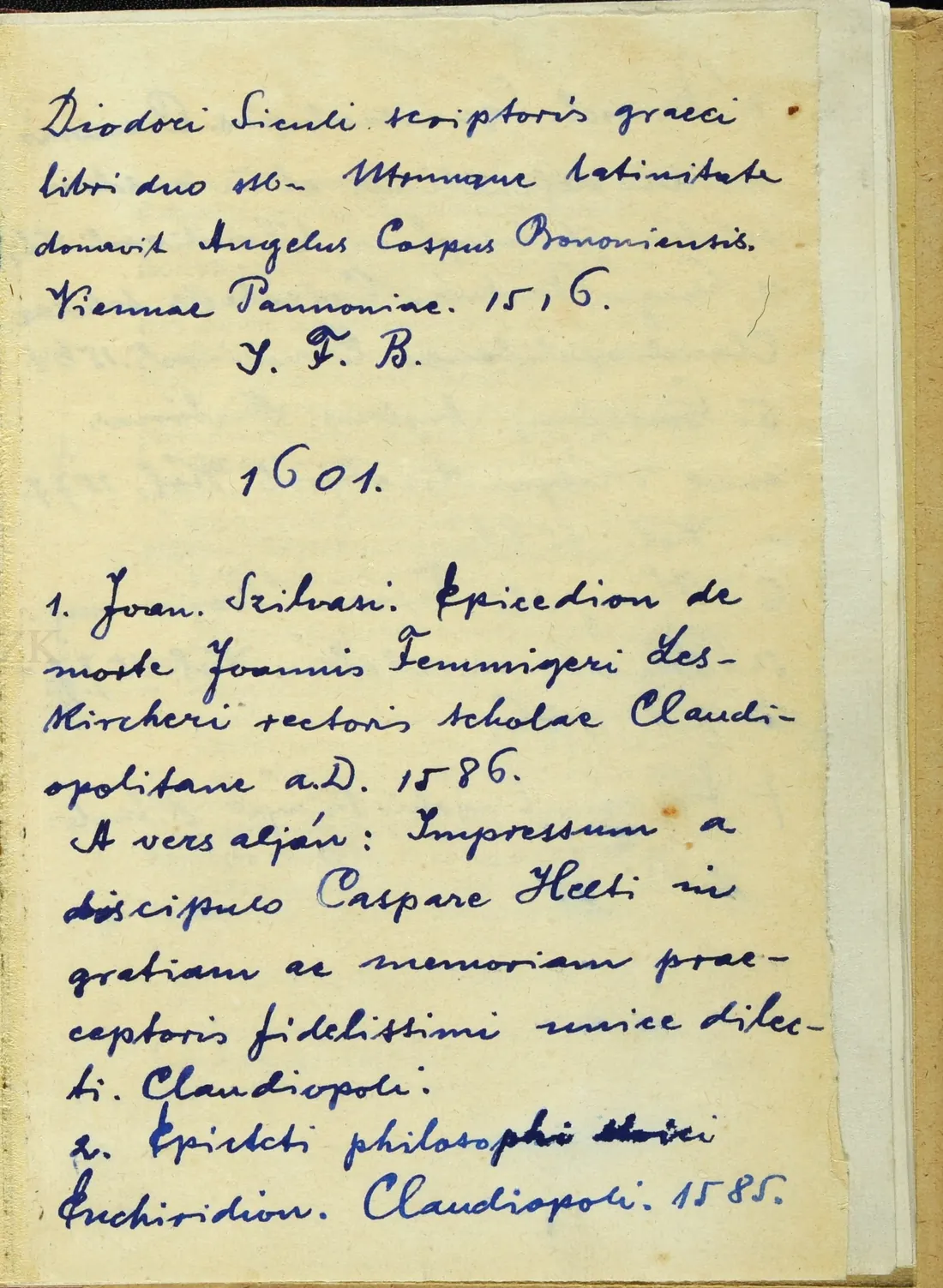
A Cluj binder uses spare printed sheets to stiffen the cowhide boards of a book printed in Vienna in 1516: two books of Diodorus of Sicily on Philip and Alexander. He stamps the year 1601 and the owner's initials, IFB, on the cover. Among the sheets: pieces of six other books printed in Cluj between 1564 and 1586, eight leaves of a German book, and our sheet.
1911
Brought to light in Budapest
The book turns up at a Budapest antiquarian. The ethnographer Sztripszky Hiador notices the fragments in its boards. The book collector Todoreszku Gyula, the son of a Romanian merchant, buys the book from the antiquarian. Todoreszku soaks the boards and lifts out the leaves. Sztripszky names the Romanian fragment after its owner.
1911
The first edition
Sztripszky and the linguist Alexics György publish the text with a facsimile, as “Gergely Szegedi's hymnbook in a 16th-century Romanian translation”. The title was criticised within the year: the songs do not come from a single book.
1920
In the national library
Todoreszku dies in November 1919 without a will. His widow, Horváth Aranka, gives the collection to the National Széchényi Library, where the leaves are today.
When and where, exactly?
The year is uncertain. Ion Gheție dated the print to 1571–1575 because its paper has no watermark, and Heltai's paper mill in Cluj made unwatermarked paper only in those years. He wrote himself that the date is not very secure. Nagy Levente thinks the watermarks were lost when the leaves were soaked and restored, and proposes 1569–1580. The Hungarian catalogue of old prints gives 1564–1586, the span of the other fragments from the same boards.
The place is almost certainly Cluj. In 1911 Melich János tied the spelling to Heltai Gáspár's press; Gheție added the typeface, the same as in books Heltai printed, and the fact that every other fragment in the boards is from Cluj. The first editors thought it was printed in Oradea.
Heltai died in 1574, and his widow ran the press until 1582. If Gheție's date is right, the leaves came either from his last years or from his widow's first.
The Hungarian spelling did not lead to today's alphabet
When the Todorescu fragment was printed, Romanian was written in Cyrillic letters: that is how Neacșu's letter of 1521 was written and how Coresi printed in Brașov. Nor is it the first Romanian noted down in Latin letters: around 1532–1534 the Italian traveller Francesco della Valle recorded how Romanians ask whether you speak their language, “Sti rominest?”. It is the oldest surviving Romanian text printed in Latin letters.
The songs were for the Calvinist Romanian communities of Banat and Hunedoara and are written in their speech, with Hungarian loanwords such as “alenișii” (enemies) and “nemzeturile” (nations). Ion Gheție thinks the translator was a Romanian priest from Caransebeș, Lugoj or Hațeg, where Romanians learned Latin and Hungarian at school; he admits there is no direct evidence. The first editors thought he was Hungarian, perhaps Bishop Tordasi Pál.
This way of writing lived on for another century or so in Calvinist circles in western Transylvania: in 1642 someone copied a hymnbook at Hațeg in which some of the hymns are the same, and in 1648 a priest from Lugoj printed a catechism at Alba Iulia. Today's alphabet comes from elsewhere: from the grammar printed in Vienna in 1780 by Samuil Micu and Gheorghe Șincai, who spelled Romanian after its Latin etymology, and from the United Principalities' decision to replace Cyrillic in 1862.
- 1521 Neacșu's letter, the oldest dated Romanian text
- 1533 “Sti rominest?”, noted by Francesco della Valle (1532 or 1534)
- 1557 Coresi prints in Brașov, in Slavonic from 1557, in Romanian from 1559 (1557–1583)
- 1570s The Todorescu fragment, Cluj, Hungarian spelling (1570s)
- 1594 Luca Stroici's Lord's Prayer, Polish spelling, Kraków
- 1642 Hymnbook copied at Hațeg, with some of the fragment's hymns
- 1648 Calvinist catechism printed at Alba Iulia, Hungarian spelling
- 1703 Istvánházi's psalter, the last Calvinist manuscript of its kind
- 1780 Micu and Șincai's grammar, spelling after Latin, Vienna
- 1862 The United Principalities officially adopt the Latin alphabet
Sources
The letter-by-letter transcription of the eight pages and their reading in today's spelling are by Marius Comper, from the scan, following Ion Gheție's readings. The English renderings of the stanzas are also by Marius Comper; where an old word is uncertain, they follow the sense of the Hungarian hymn.
- Ion Gheție, Fragmentul Todorescu. Text stabilit, studiu filologic, studiu lingvistic și indice, in Texte românești din secolul al XVI-lea, Editura Academiei, 1982, pp. 259–364 (extracts). remusmirceabirtz.wordpress.com/wp-content/uploads/2013/06/ion-gh
- Régi magyarországi nyomtatványok 1473–1600 (RMNy), I, Akadémiai Kiadó, 1971, no. 313. real-eod.mtak.hu/9184/1/RMNy1.pdf
- Melich János, review of Sztripszky–Alexics 1911, Magyar Könyvszemle, 1911, no. 4, pp. 362–364. epa.oszk.hu/00000/00021/00153/pdf/362-364.pdf
- Nagy Levente, A román reformáció és a magyar irodalom (DSc dissertation), 2018, pp. 205–212. real-d.mtak.hu/1095/7/dc_1461_17_doktori_mu.pdf
- Daniele Pantaleoni, Observații asupra textelor românești vechi cu alfabet latin (1570–1703), Philologica Jassyensia, III, 1, 2007. diacronia.ro/ro/indexing/details/A807/pdf
- Electronic corpus of old Romanian texts (CETRV): Fragmentul Todorescu (2021 copy). web.archive.org/web/20210923172013/https://textvechi.ro/fragment
- BCU Cluj Digital Library: Cîntece bisericești, scan of the eight pages. dspace.bcucluj.ro/handle/123456789/26176
- Répertoire de la poésie hongroise ancienne (RPHA), hymns 0065, 0139, 0273, 0340, 0475, 0645, 0968, 1019, 1417, 1469. f-book.com/rpha/v7/rpha.php?r=0139
- Huszár Gál, A keresztyéni gyülekezetben való isteni dicséretek, Komjáti, 1574 (MEK). mek.oszk.hu/08800/08838/
- Szegedi Gergely, Énekeskönyv, Debrecen, c. 1570 (Hungaricana). rmk.hungaricana.hu/hu/view/RMK_I_332/
- Varga Bernadett, Todoreszku Gyula tudományos munkássága, National Széchényi Library blog, 2016. nemzetikonyvtar.blog.hu/2016/09/17/todoreszku_gyula_tudomanyos_m
- National Széchényi Library, exhibition “Kincseit a nemzetnek szánta” (Todoreszku). oszk.hu/kiallitasok/kincseit-nemzetnek-szanta-todoreszku-kiallit
- Ferenczi Zoltán, A kolozsvári nyomdászat története, 1896 (MEK). mek.oszk.hu/07800/07852/07852.htm
- Tipărituri românești vechi: Fragmentul Todorescu, the oldest Romanian text in the Latin alphabet, 2011. tiparituriromanesti.wordpress.com/2011/10/30/fragmentul-todoresc
- dexonline: uzbăi, căștigă, alean, tărime, sculătură. dexonline.ro/definitie/uzb%C4%83i
National Széchényi Library, Budapest (RMK I 361); scan published by the Central University Library, Cluj. National Széchényi Library (RMK I 113a), via the Hungarian Electronic Library (MEK). The 16th-century prints are in the public domain, and faithful scans of them create no new copyright.
Type: EB Garamond and Atkinson Hyperlegible, under the SIL Open Font Licence.