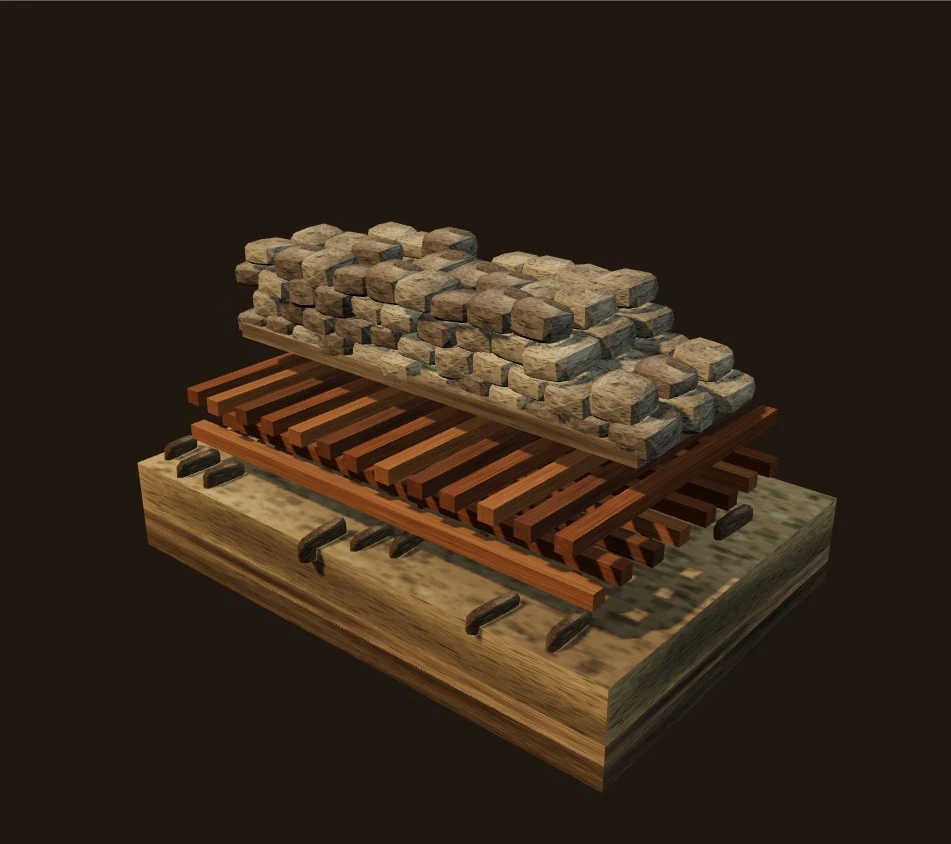
An exploded cross-section with masonry, two layers of crossed timbers and sandy ground.
The masonry and the two layers of timbers

Gâdinți, Neamț

The fortress on timber

At the ruin of the New Fortress near Roman, the first thing you see is stone. Archaeologists found two layers of beams beneath it. Each was laid at right angles to the other. 1 2 3

Pull the wall apart and follow the order in which the builders went from the ground of the Siret floodplain to stone masonry.

Start the story

The ground under the fortress

The trouble with sand beneath a wall

The New Fortress stands on the Siret floodplain, and foundations were examined on sandy ground. A concentrated load can squeeze sand out to the sides, especially when the weight is uneven. 1 2 3

Lower your point of view below the wall. The width over which the weight is spread matters as much as the height of the wall above the ground.

The foundation

Two layers in two directions

Wooden posts were driven into the sand beneath the first layer of beams. The second crosses it and connects several beams at once below the wall. Archaeologists could read that order in the traces left in the foundation. 2 3

Separate the layers and then bring them together. Watch how one beam on top crosses several below it.

Layer separation
40 %

Stone on timber

How the weight of the wall reaches the ground

Beneath the masonry, the beams make up a base. The weight of one part of the wall can spread over more ground than the area it would contact immediately above the timber.

Switch from the materials to the path of the load. The arrows show the general principle without calculating forces for the wall at Gâdinți.

In the section

The ruin at Gâdinți

What remains when the timber disappears

From the surface, the builders’ choice can go unnoticed even where the stone still stands. To learn how the masonry was supported, researchers had to study what lay below the level where the wall began. 2 3

Sources

The section shows the order of materials described in the research. Beam spacing and length, the shape of the masonry and model dimensions are schematic.

  1. Gâdinți municipality, local history

    History of the New Fortress and its location on the Siret floodplain.

  2. Fortifications of Moldavia, archaeological synthesis

    Summary of research on the New Fortress and description of its timber foundation.

  3. Lucian Chițescu, excavations at the New Fortress

    Publication of archaeological research at the New Fortress of Roman.