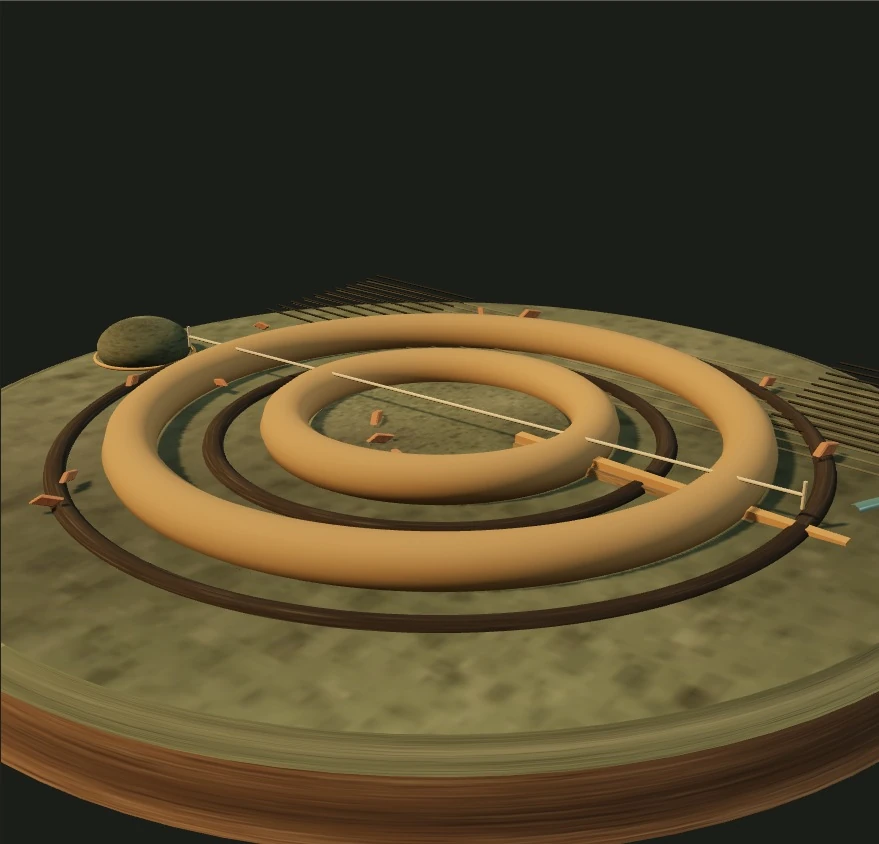
Two concentric ditches and ramparts around a rise, schematically reconstructed beneath a field crop.
Two ramparts and two ditches around a settlement

Galicea Mare · Dolj

A circle hidden in a field

Near the entrance to Galicea Mare is an early Bronze Age circular fortification, linked to the Coțofeni culture in the national record. Its outer ditch measures about 263 metres across. 1

Drag the circle or use the keyboard arrows to follow its shape. In the next chapter, choose whether to look for pottery inside or beyond the enclosure.

Start the story

Ditches and ramparts

Two rings of earth

The record describes a circular fortification with two earth ramparts and two ditches. The 263 metres is the maximum diameter measured across the outer ditch; the occupied area was smaller once the ramparts and ditches are subtracted. 1

In the next chapter, choose inside or outside. The drawn sherds show only the relationship described by the researchers; they do not represent the number or position of any pots.

A surface observation

Fewer sherds inside

Field survey identified less ceramic material inside the enclosure than outside it. The record mentions vessel fragments but does not publish a count for either area. 1

Switch areas. When you look beyond the ditches, more stylised fragments appear than inside; their number is deliberately unspecified.

Area to follow

One possible explanation

A refuge? Still a hypothesis

The difference between inside and outside led the discoverers to suggest that the enclosure may have served as a refuge in danger. They consider brief use or use by a small group; the record presents this as a hypothesis, not a verdict. 1

The comparison remains unusual: pottery is sparser inside. It raises a question, but cannot by itself prove what the fortification was for.

Another mound of the Coțofeni culture

A burial mound on the same rise

The fortification record places it on high ground beside a large mound from the same culture. The Măgură mound record estimates its diameter at about 35 metres and notes Coțofeni pottery fragments on the surface. 1 2

Move closer to the two landforms. The records place them in the same area and connect them to the same culture, but do not describe a more specific relationship between them.

Found in 2017 · record updated in 2024

The plough is smoothing the circle

The fortification was identified in 2017. In its 2024 update, the national record says crops cover the site and cultivation has nearly levelled the ramparts and filled the ditches; they were better preserved in 2017. 1

The record classifies the site as early Bronze Age and attributes it to the Coțofeni culture, but its published calendar span is contradictory. The described form, measurement and question raised by the pottery remain clear. 1

Sources

The circle, ramparts, ditches and sherds are schematic; their widths are not measured. The national record classifies the site as early Bronze Age and links it to the Coțofeni culture, but the published calendar span includes an era marker inconsistent with that classification; this page does not repeat the span.

  1. National Archaeological Repertory · Galicea Mare circular fortification

    Shape, measurement, pottery observation, refuge hypothesis and condition of the site.

  2. National Archaeological Repertory · Galicea Mare–Măgură mound

    Estimated mound diameter and surface pottery fragments.