Cernavodă, seven thousand years ago
The man who has been thinking for seven thousand years
In a grave at Cernavodă, archaeologists found two fired-clay figurines in 1956: a seated man with his chin in his hands, and a seated woman beside him. The people who shaped them left no writing. They left thought itself, baked into clay — and the thought survived.
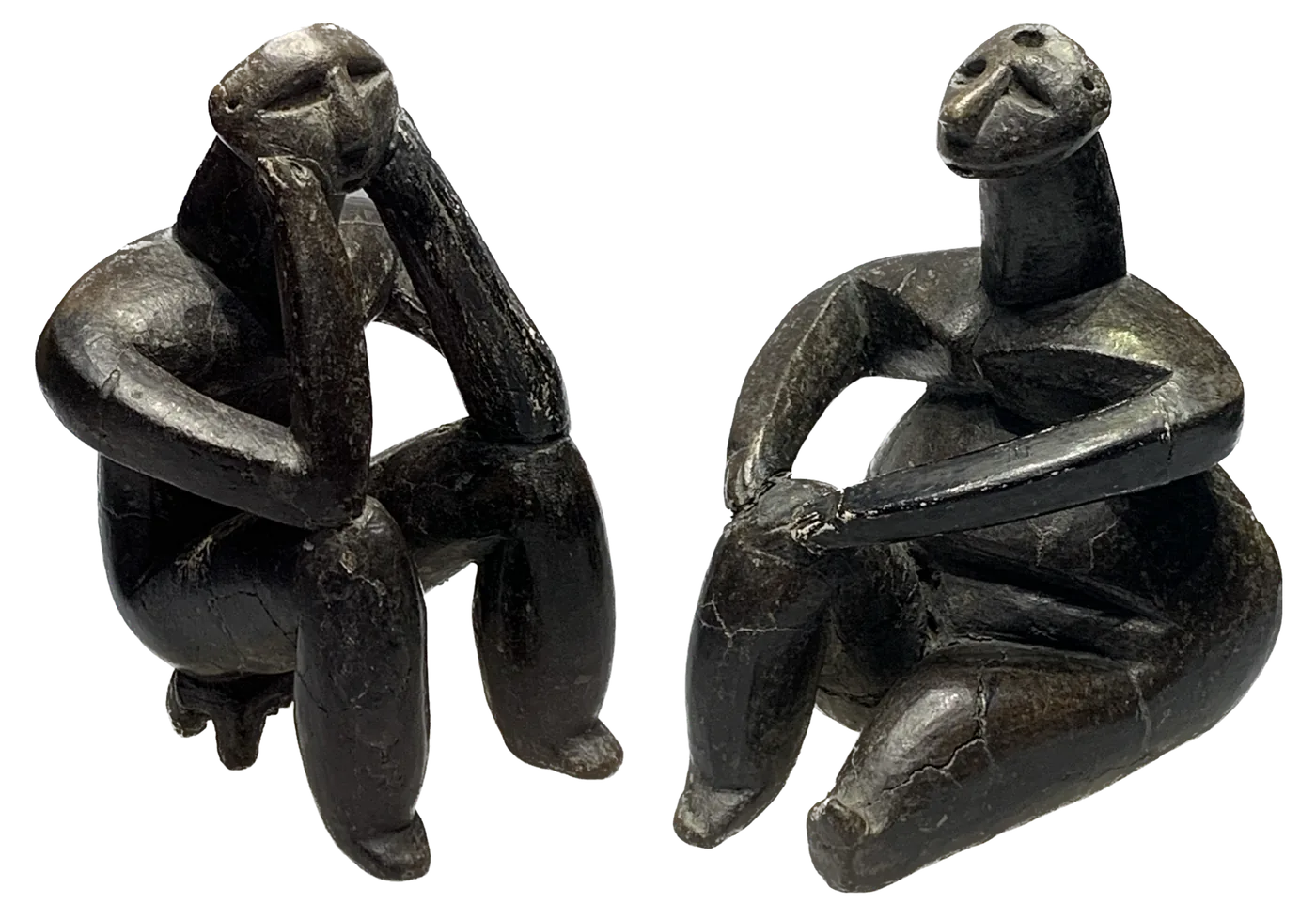
Two clay figurines, palm-high
He sits on a low stool with four legs. His elbows rest on his knees, and his hands hold his head on either side of his face. He is fired clay, dark grey, with a polished surface. His almost oval head has a modelled nose, eyes made of triangular impressions, and a mouth marked by a small hole. A very long neck carries the head. The posture reads as thought — hence the nickname, borrowed from the famous sculpture by Rodin.
She sits straight on the ground, with no chair: one leg stretched forward, the other bent at the knee, her hands on her leg. Her body is modelled with broad hips, her head small, its features barely sketched. Both figurines stand the same height: 11.5 cm. Each fits in a palm.
The name “Thinker” is modern. Rodin conceived his Thinker in 1880, as part of The Gates of Hell; the first monumental bronze was cast in 1904. His stands about 185 cm tall at the Musée Rodin in Paris. The Hamangia one is sixteen times smaller and some seven thousand years older.
How small the Hamangia Thinker is
The bars share one scale. The Neolithic original is 11.5 cm; Rodin’s bronze, at about 185 cm, stands sixteen times taller.
- Where
- National History Museum of Romania, Bucharest; inventory 15906 (him), 15907 (her)
- Material
- Fired clay, shaped by hand
- Size
- Him: 11.5 cm high, 7.5 cm wide; her: 11.5 cm high, 5.4 cm wide
- Age
- Shaped between 5000 and 4600 BC, Hamangia culture, Late Neolithic
- Found
- 1956, in a grave of the Hamangia necropolis at Cernavodă
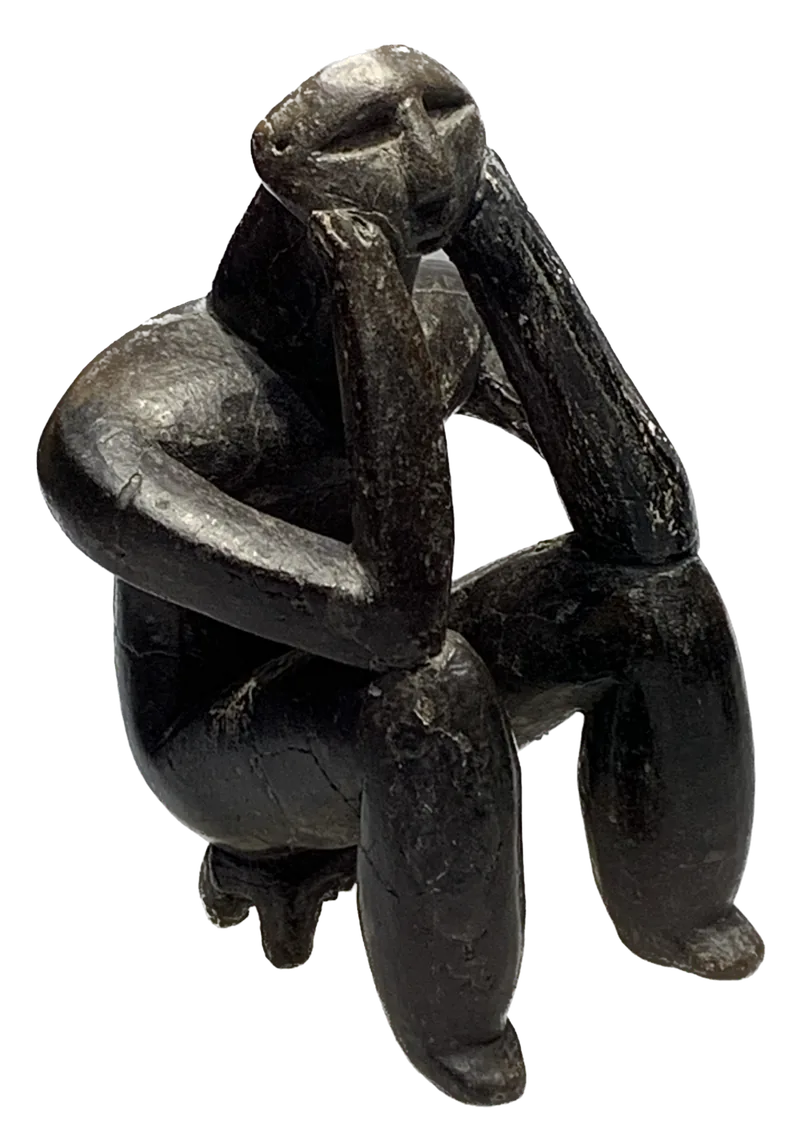

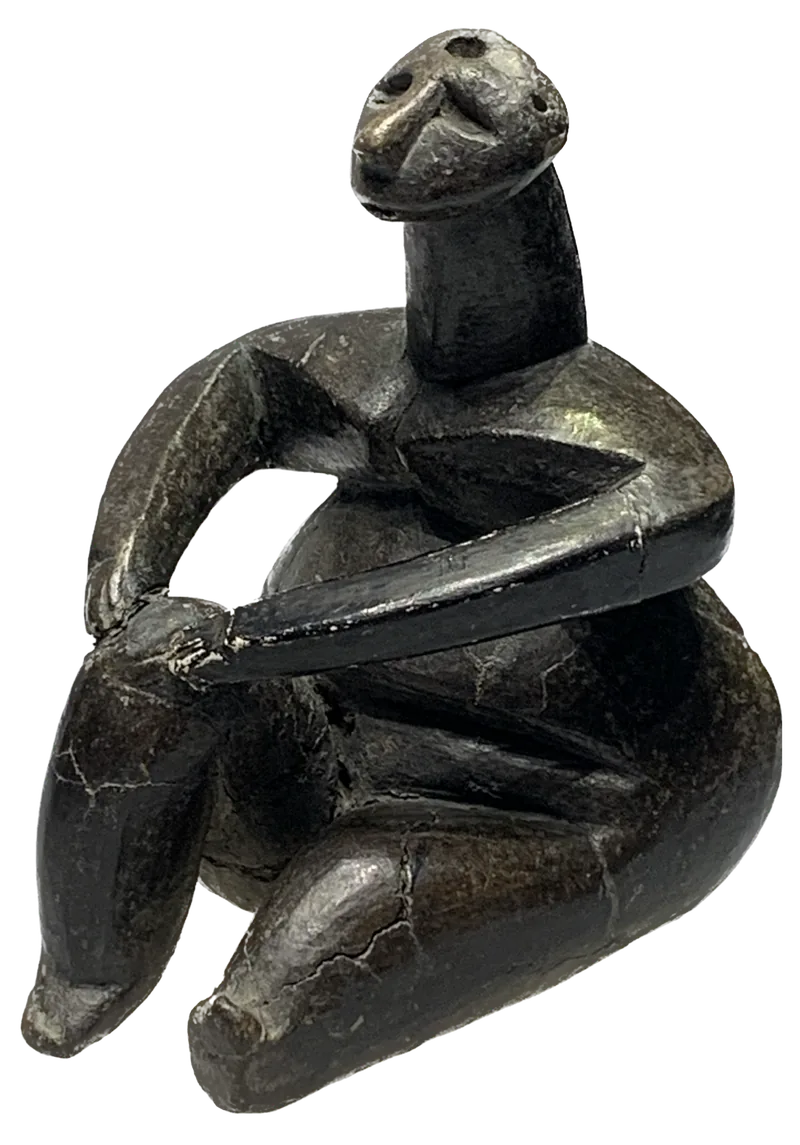

A couple — and why that is rare
In the Neolithic, male figurines were a small minority among the very large corpus of figures found in necropolises and homes. That the Thinker stands beside a female figurine is a rarity, and the rarity points to a direct bond between the two. Both were laid in one grave, beside the buried body, as if to accompany the dead beyond it.
The Cernavodă necropolis where they were found holds more than 400 inhumation graves. Grave goods there include stone axes, pots, bracelets, and human figurines. Of every figurine found so far, the Thinker’s posture sets him apart: a small, roughly shaped figurine in a similar pose is recorded at Trușești, in the Cucuteni area.
His gesture has been read as meditation, and it may equally be mourning. Archaeologists link the thinking pose to reflection on life and death, fitting for a grave. Other readings see a vegetation god, dying to rise again each spring, or a god of death. None can be proven: the Hamangia people left no texts.
Nor is he the only thinker of prehistory. A Neolithic “thinker” was found at Karditsa in Greece, and a Middle Bronze Age one, some four thousand years old, at Yehud in Israel. The pose of a person with their head in their hands seems to have been discovered several times, in different places.
The people by the sea
The Hamangia culture is a Late Neolithic archaeological culture of Dobruja — between the Danube and the Black Sea — and of southern Muntenia. It began around 5250–5200 BC and lasted until around 4550–4500 BC. The name comes from the eponymous settlement of Baia-Hamangia, by Lake Golovița.
Cultural links with Anatolia suggest the Hamangia people were recent settlers from there, unlike the neighbouring cultures, which descend from older Neolithic settlement. They brought black polished pottery and long-necked figurines. They buried their dead in necropolises, crouched or stretched out, with gifts of flint, worked shells, and bone tools. Later the culture was absorbed by the expanding Boian culture, as it shifted toward the Gumelnița culture.
Cernavodă is one of the notable places of this world, through the necropolis that held the Thinker and the Sitting Woman. Other known settlements are Durankulak on its lake, and Baia, the site that gave the culture its name.
What we know, what we guess, what we don’t
Eight statements about the two figurines, each with its evidence. Pick a filter to sort them by strength.
- Known
They were shaped between 5000 and 4600 BC.
The dating in the catalogue of “The Lost World of Old Europe” (New York, 2009–2010), for both pieces, MNIR inventory 15906 and 15907.
- Known
They lay in a grave, beside a buried body.
The funerary context was recorded at discovery in 1956 and confirmed by the European record of the piece, filled in by MNIR specialists.
- Known
Both stand 11.5 cm tall.
The measurements in the New York exhibition catalogue: him 11.5 × 7.5 cm, her 11.5 × 5.4 cm.
- Known
A smaller “thinker” exists at Trușești, in the Cucuteni world.
The parallel is noted in the European record of the piece: a small clay figurine, roughly shaped in a similar pose.
- Guessed
The two share a direct bond — perhaps a couple.
Pairing a man with a woman is rare among Neolithic figurines, and the rarity points to a direct relationship. “Couple” stays an interpretation.
- Guessed
His gesture means meditation or mourning.
The pose suggests thought, and the grave admits the reading of grief. Readings with vegetation or death gods are hypotheses, not evidence.
- Unknown
Who shaped them, and why just so.
No signature, no identified workshop, no text. The hand that shaped the clay stays anonymous.
- Unknown
What the Hamangia people believed about death.
Graves and gifts show care for the dead. What that care meant to the living cannot be read from clay.
The road to the glass case
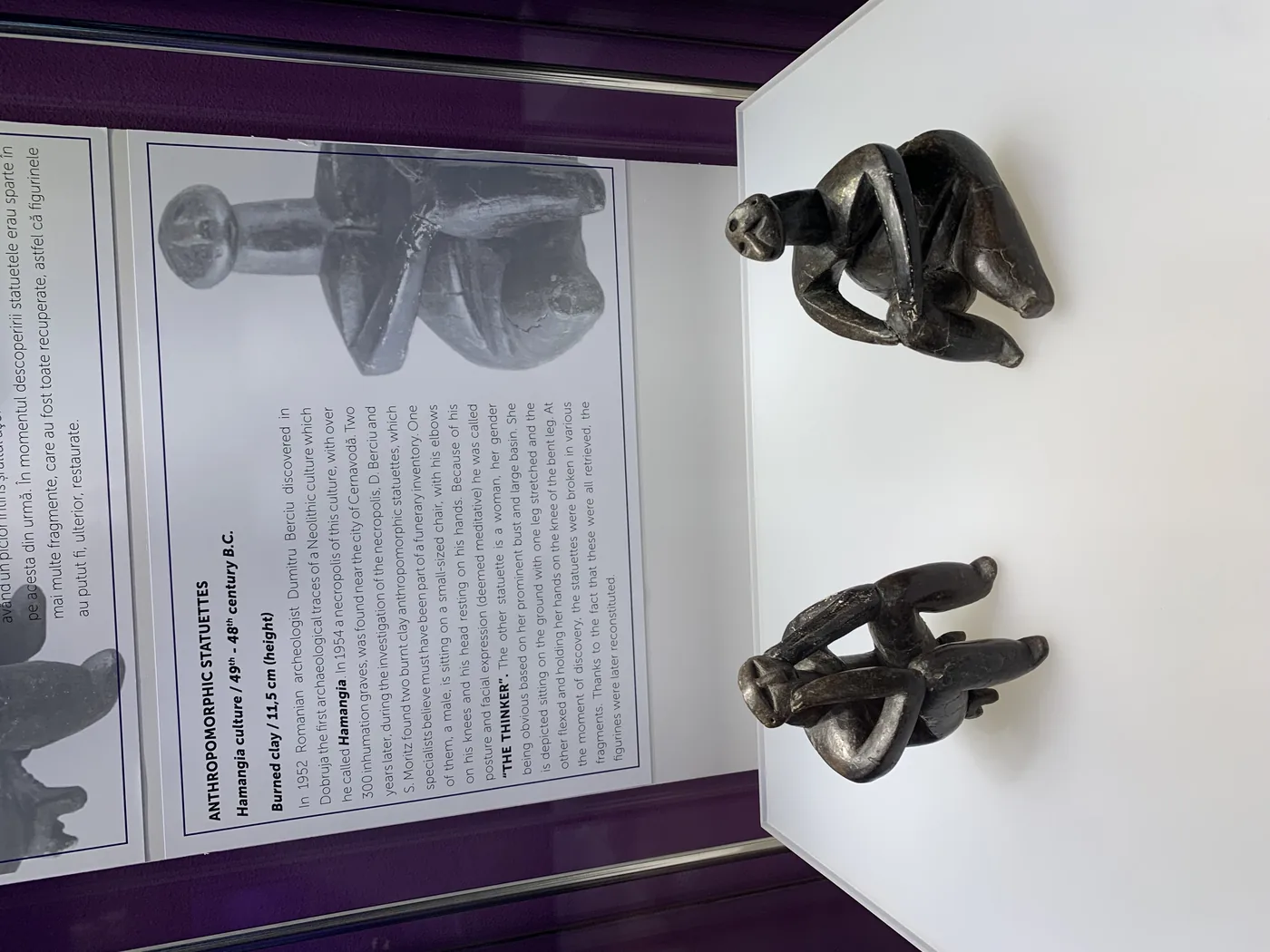
The two figurines were found in 1956, among the grave goods of the Hamangia necropolis at Cernavodă. Today they stand at the National History Museum of Romania in Bucharest, inventory numbers 15906 and 15907.
They have travelled far for objects 11.5 cm tall. From November 2009 to April 2010 they were in New York, in “The Lost World of Old Europe: The Danube Valley, 5000–3500 BC”. In 2019 they reached Liège, at the Grand Curtius, during Europalia Romania, the festival with Romania as guest country.
Since 1 December 2006 the Thinker has also stood on the back of the 200-lei banknote, beside a watermill. The front carries the portrait of Lucian Blaga. Seven thousand years from the Cernavodă clay to the wallet.

- c. 5250–4500 BCThe Hamangia culture, in Dobruja, between the Danube and the Black Sea.
- c. 5000–4600 BCThe two figurines are shaped and fired.
- 1956Found in a grave of the Cernavodă necropolis.
- 2006The Thinker reaches the back of the 200-lei banknote, on 1 December.
- 2009–2010Shown in New York, in “The Lost World of Old Europe”.
- 2019Shown in Liège, at the Grand Curtius, during Europalia Romania.
Sources
Dimensions, inventory numbers, and dating come from the New York exhibition catalogue and the European record of the piece, filled in by MNIR specialists. English translation: Marius Comper.
- Institute for the Study of the Ancient World (New York): “The Lost World of Old Europe” — exhibition narrative (funerary context, rarity of the pairing). isaw.nyu.edu
- ISAW: object checklist — the Thinker (11.5 × 7.5 cm, MNIR 15906) and the female figurine (11.5 × 5.4 cm, MNIR 15907), Hamangia, Cernavodă, 5000–4600 BC. isaw.nyu.edu
- European Virtual Museum: “The Thinker” record (MNIR Bucharest, inventory 15906; height 115 mm, width 75 mm; over 400 graves; the Trușești parallel; interpretations). europeanvirtualmuseum.it
- Wikipedia: “Thinker of Hamangia” (1956 discovery, MNIR, 200-lei banknote, Europalia 2019). en.wikipedia.org/wiki/Thinker_of_Hamangia
- Wikipedia: “Hamangia culture” (5250–4500 BC, Dobruja, Baia-Hamangia, Anatolian links). en.wikipedia.org/wiki/Hamangia_culture
- Wikipedia: “The Thinker” (Rodin: conceived 1880, first monumental bronze 1904, about 185 cm, Musée Rodin). en.wikipedia.org/wiki/The_Thinker
- Wikipedia: “Banknotes of the Romanian leu” (200-lei note, Thinker on the back, issued 1 December 2006). en.wikipedia.org/wiki/Banknotes_of_the_Romanian_leu
- Grand Curtius, Liège: Europalia Romania 2019 (activity booklet). grandcurtius.be (PDF)
- BBC News: the Bronze Age “thinking” figurine, Yehud, Israel (23 November 2016). bbc.com