Chapter 2 · The Earth in spaceLesson 2.1
Earth in the Universe: the Sun–Earth–Moon system at its true scale
If Earth were a bead one centimetre across, how far away would the Moon be? And the Sun?
Before you read: what do you think?
Shrink Earth to a bead 1 cm across. At the same scale, how far from the bead would the Sun be?
See the answer
About 117 m. About 117 m, and the Sun would be a ball 1.09 m across. The Moon would be just 30 cm from the bead. Ordinary drawings bring the bodies closer together so they all fit on one page.
Light takes 8 minutes and 19 seconds to reach Earth from the Sun. From the Moon it takes 1.3 seconds. From Proxima Centauri, the nearest other star, it travels for more than four years.
From a centimetre-wide bead to the Universe
Imagine shrinking Earth to a bead 1 cm across. At the same scale, the Moon is a grain 2.7 mm across, 30 cm from the bead, and the Sun a ball 1.09 m across, about 117 m away. Almost all the space between them is empty.
The Sun is one of at least 100 billion stars in the Milky Way. A galaxy is a vast collection of stars, gas and dust held together by gravity. Distances between stars are measured in light-years: a light-year is the distance light travels in one year, about 9,460 billion kilometres. All galaxies, together with all space, matter and energy, make up the Universe, estimated to be about 13.8 billion years old.
The Sun and all the bodies its gravity holds around it form the Solar System, which arose about 4.6 billion years ago from a cloud of gas and dust.
For the curious
The Milky Way is a spiral disc more than 100,000 light-years across. The Sun lies in one of its arms, about 25,000 light-years from its centre, and takes roughly 230 million years to orbit it once.
One star and eight planets
The Sun is a star: a sphere of hot gas that produces energy inside itself through nuclear fusion and sends it into space as light and heat. Its radius is 695,700 km, 109 times Earth’s, and it contains 99.8% of the mass of the entire Solar System.
Planets are bodies that give off no light of their own. They move in orbits around the Sun and are visible because they reflect its light. The first four, Mercury, Venus, Earth and Mars, are terrestrial planets: small, with solid, rocky surfaces. The next four, Jupiter, Saturn, Uranus and Neptune, are giant planets. Earth is the third planet from the Sun and the largest terrestrial planet, with a diameter at the Equator of 12,756 km.
The average distance between Earth and the Sun, 149.6 million kilometres, is used as a standard for distances in the Solar System and is called an astronomical unit (AU). The Solar System also includes dwarf planets such as Pluto, the planets’ satellites, asteroids and comets.
For the curious
At the Sun’s surface, the temperature is about 5,500 °C.
Neptune, the last planet, is 4.5 billion kilometres from the Sun, or 30 AU.
The Moon, Earth’s natural satellite
The Moon is Earth’s only natural satellite, the only body that moves in an orbit around the planet. Its diameter, 3,475 km, is a little more than a quarter of Earth’s. The average distance to the Moon is 384,400 km.
The Moon has two movements that take the same time: its revolution around Earth and its rotation on its own axis, each lasting 27.3 days. Because the two periods are equal, the same face of the Moon is always visible from Earth.
For the curious
Gravity at the Moon’s surface is six times weaker than on Earth.
The Moon’s orbit is an ellipse, so its distance varies from about 363,300 km at its nearest point, perigee, to 405,500 km at its farthest, apogee.
Moon phases and tides
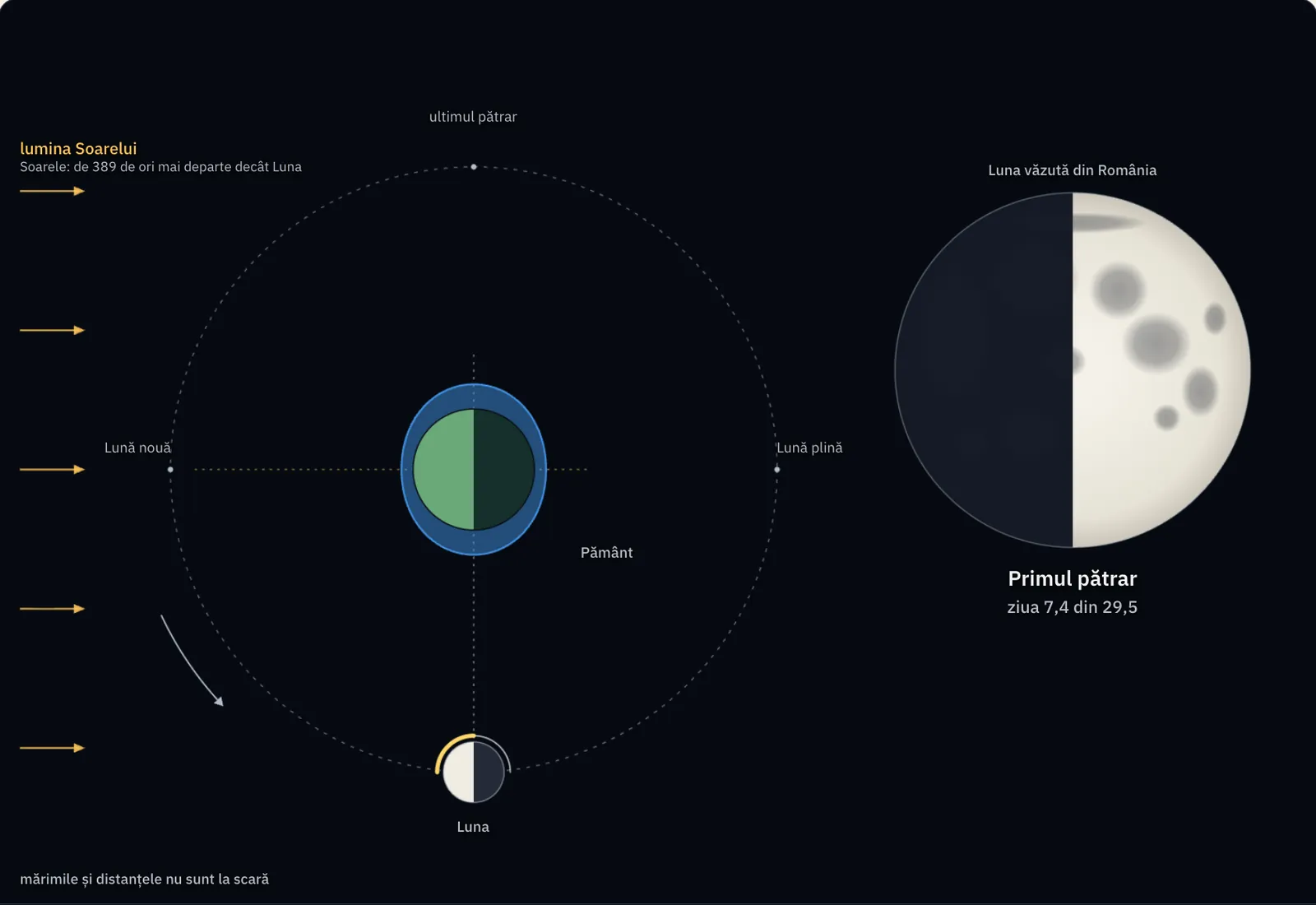
The Sun lights half the Moon at any moment. How much of that half is visible from Earth depends on where the Moon is in its orbit. These successive appearances are called the phases of the Moon. At new Moon, the Moon is between Earth and the Sun, with its unlit face towards Earth. First quarter follows, when half the disc is visible, then full Moon, when Earth is between the Sun and the Moon, and last quarter. The complete cycle takes 29.5 days. It is longer than the 27.3-day revolution because Earth has moved along its orbit in the meantime, and the Moon must travel an extra arc to return to the same position relative to the Sun.
The Moon’s attraction distorts the layer of water around the planet: ocean level rises on the side facing the Moon and on the opposite side. Earth rotates, and each coast passes through the two bulges in turn. These regular rises and falls in sea level are called tides; the rise is the flood tide and the fall the ebb tide. Most coasts have two flood tides and two ebb tides a day.
The Sun also produces tides, though weaker ones. At new Moon and full Moon, when the Sun, Earth and Moon are aligned, the two effects add together and tides are greatest. At first and last quarter they are smallest.
| Phase | Day of the cycle | Lit disc | What is seen from Romania | Tides, compared with the Moon’s alone |
|---|---|---|---|---|
| New Moon | 0.0 | 0% | nothing | 46% higher |
| Waxing crescent | 3.7 | 15% | the right part | 10% higher |
| First quarter | 7.4 | 50% | the right part | 46% lower |
| Waxing gibbous | 11.1 | 85% | the right part | 10% higher |
| Full Moon | 14.8 | 100% | the whole disc | 46% higher |
| Waning gibbous | 18.5 | 85% | the left part | 10% higher |
| Last quarter | 22.1 | 50% | the left part | 46% lower |
| Waning crescent | 25.8 | 15% | the left part | 10% higher |
The cycle of phases lasts 29.5 days. The Sun is 389 times farther away than the Moon and raises 46% of its tide: at New Moon and Full Moon the two add together; at the quarters, the Sun’s share is taken away from the Moon’s.
Calculation and diagram. The shape of the lit part and the percentage are calculated from the Sun–Earth–Moon angle. The day of the cycle is the position within an average cycle of 29.5 days; the Moon moves along its orbit sometimes faster, sometimes slower, so the real day can differ by up to a day. The starting position shows today’s phase; the calculation was compared with the 50 principal phases of 2026 in the tables of the U.S. Naval Observatory, with a deviation of at most an hour. The disc is drawn as it is seen from the northern hemisphere, with the Moon towards the south; its dark patches are a drawing. Sizes and distances are not to scale: with the Earth the size of a 1 cm bead, the Moon would stand 30 cm away and the Sun 117 m. The Moon’s orbit is tilted by 5.1° to the plane of the Earth’s orbit, so at New Moon and Full Moon the three bodies rarely line up exactly, and eclipses are rare. The water raised by the tides is much exaggerated and follows a simplified calculation, with average distances and an ocean that would cover the whole globe; the Sun raises 46% of what the Moon raises. Real coasts receive the tide with a delay and with heights that depend on the shape of the basin: in the north-west of the Black Sea, the main component of the tide has an amplitude of only 2.8–3 cm.
Worked example
The Solar System with Earth as a bead
Shrink Earth to a bead 1 cm in diameter. Its real diameter is 12,756 km, so 1 cm on the model stands for 12,756 km in reality. Divide any real distance by that number.
Moon: 384,400 km ÷ 12,756 km ≈ 30, so the Moon is 30 cm from the bead and 2.7 mm in diameter. Sun: 149,600,000 ÷ 12,756 ≈ 11,730 cm, or about 117 m, and its diameter would be 1.09 m. Neptune would be 3.5 km from the Sun.
A drawing in which the Sun, Earth and Moon fit on one page and all three are clearly visible uses one scale for sizes and another for distances. At a single scale, almost all the space between the three bodies would be empty.
In Romania
Black Sea tides are a few centimetres high
The world’s largest tides occur in the Bay of Fundy on Canada’s Atlantic coast. At Constanța, Mamaia or Vama Veche, on the Romanian coast, the flood and ebb cannot be seen with the naked eye, even though the Moon also crosses Romania’s sky every day.
The shape of the basin explains why. The Black Sea is almost enclosed, and the ocean’s tidal wave does not reach it. What remains is its own tide, produced directly by the pull of the Moon and Sun on the water in the basin. In the north-west of the sea, where the Romanian coast lies, the main tidal component has an amplitude of just 2.8–3 cm. The greatest tidal height in the entire Black Sea has been estimated at 18 cm, at Kherson and Mykolaiv on Ukraine’s coast.
That is why Romanian beaches do not widen and narrow twice a day as they do on ocean coasts.
In brief
- The Universe is about 13.8 billion years old; its matter is grouped in galaxies, and Earth is in the Milky Way.
- The Solar System consists of the Sun, eight planets (four terrestrial: Mercury, Venus, Earth and Mars; four giant: Jupiter, Saturn, Uranus and Neptune), dwarf planets, satellites, asteroids and comets.
- The Sun is a star: it produces energy through nuclear fusion and contains 99.8% of the Solar System’s mass. Earth is the third planet, 149.6 million km from the Sun (one astronomical unit).
- The Moon is Earth’s natural satellite, at an average distance of 384,400 km; its revolution and rotation each take 27.3 days, so the Moon always shows the same face to Earth.
- The phases of the Moon (new Moon, first quarter, full Moon, last quarter) follow one another over 29.5 days and depend on the Moon’s position relative to the Sun and Earth.
- Tides are regular rises and falls in sea level, caused by the pull of the Moon and Sun; they are greatest at new Moon and full Moon.
Common mistakes
WrongThe Moon’s phases occur because Earth’s shadow covers part of the Moon.
RightHalf the Moon is always lit by the Sun; from Earth, a larger or smaller part of it is visible, depending on the Moon’s position in its orbit. Earth’s shadow reaches the Moon only during lunar eclipses.
WrongThe Moon does not rotate on its axis, so the same face is always visible from Earth.
RightThe Moon does rotate, but one rotation takes exactly as long as one revolution around Earth: 27.3 days. If it did not rotate at all, every side would be visible from Earth in turn.
WrongTextbook drawings show how close the Sun, Earth and Moon are.
RightThe drawings enlarge the bodies and shrink the distances. At a scale where Earth is 1 cm across, the Moon is 30 cm away and the Sun 117 m away.
Test yourself
Six questions. For the first five you see the explanation at once, with the paragraph of the lesson that supports it; for the ones with a written answer you compare with a good answer.
Why are different phases of the Moon visible from Earth?
Answer
c) A larger or smaller part of the lit half is visible. The Sun always lights half the Moon. The Moon’s position relative to Earth and the Sun determines how much of that half faces Earth.
Which list contains only terrestrial planets?
Answer
a) Mercury, Venus, Earth, Mars. The terrestrial planets are the first four from the Sun. Jupiter and Saturn are giant planets; the Moon is a satellite.
Why is the same face of the Moon always visible from Earth?
Answer
b) The Moon’s rotation and revolution take the same time. Both movements take 27.3 days, so the Moon turns on its axis just enough to keep the same face towards Earth. The far side is lit by the Sun just as often as the visible side.
On a model, Earth is 2 cm in diameter. How far away, in centimetres, should the Moon be placed if the real distance is 30 times Earth’s diameter?
cmAnswer
60 cm. The Earth–Moon distance is about 30 Earth diameters: 30 × 2 cm = 60 cm.
During which Moon phases are tides greatest?
Answer
c) At new Moon and full Moon. In these two phases the Sun, Earth and Moon are in a line, and the Sun’s pull adds to the Moon’s.
A classmate draws the full Moon between Earth and the Sun. Explain what is wrong and how the three bodies are arranged at full Moon and at new Moon.
A good answer
If the Moon is between Earth and the Sun, its unlit face points towards Earth, so it is new Moon. At full Moon, Earth is between the Sun and the Moon, and the whole lit half is visible from Earth. In both cases the Sun lights half the Moon; only the part visible from Earth changes.
A complete answer places the bodies correctly in both phases and says that half the Moon is lit all the time.
Terms
- galaxy
- A vast collection of stars, gas and dust held together by gravity; Earth’s galaxy is the Milky Way.
- light-year
- The distance light travels in one year, about 9,460 billion kilometres.
- astronomical unit
- The average distance between Earth and the Sun, 149.6 million km, used as a standard in the Solar System.
- planet
- A celestial body with no light of its own that moves in an orbit around a star.
- natural satellite
- A celestial body that moves in an orbit around a planet; Earth’s natural satellite is the Moon.
- phases of the Moon
- The successive appearances of the Moon from Earth over a 29.5-day cycle: new Moon, first quarter, full Moon and last quarter.
- tide
- The regular rise (flood) and fall (ebb) of sea level, caused by the pull of the Moon and Sun.
Sources and link to the programme
- NASA – Planetary Fact Sheet (metric) – diameters of the planets and the Moon (12,756 km, 3,475 km), distances from the Sun (149.6 and 4,515 million km)
- NASA – Moon Fact Sheet – average distance 384,400 km, perigee 363,300 km, apogee 405,500 km, revolution of 27.32 days, synodic period of 29.53 days, gravity 1.62 m/s²
- NASA – Sun Fact Sheet – Sun’s radius 695,700 km (109.2 times Earth’s radius), effective temperature 5,772 K
- NASA Science – Sun: Facts – nuclear fusion in the Sun’s core; the Sun contains 99.8% of the Solar System’s mass
- NASA Science – Solar System: Facts – composition of the Solar System, age of 4.6 billion years, orbit around the galaxy in roughly 230 million years, terrestrial planets
- NASA Imagine the Universe – The Milky Way Galaxy – Milky Way: about 100 billion stars, diameter of roughly 100,000 light-years, Sun about 25,000 light-years from the centre
- NASA Imagine the Universe – The nearest star – light-year (9.461 × 10¹² km) and distance to Proxima Centauri (4.25 light-years)
- NASA Science – Universe: overview – age of the Universe, about 13.8 billion years
- NASA Science – Moon phases – Moon phases, 29.5-day cycle, same face turned towards Earth
- NASA Science – Tides – the two ocean bulges and two flood and ebb tides per day
- NOAA – What are spring and neap tides? – greatest tides at new Moon and full Moon, smallest at the quarters
- NOAA – Where is the highest tide? – world’s highest tides, in the Bay of Fundy (Canada)
- Medvedev, Rabinovich, Kulikov (2016) – Tides in three enclosed basins: the Baltic, Black and Caspian Seas, Frontiers in Marine Science – Black Sea tides: M2 amplitude of 2.8–3 cm in the north-west, estimated maximum height of 18 cm at Kherson and Mykolaiv; tides generated within enclosed seas
From the programme: “Earth in the Universe. The Sun–Earth–Moon system” (common core). Programme competences covered: 1.1, 2.3, 4.5.