Chapter 2 · The Earth as a body in space
Why do day and night, different clock times and opposite seasons exist on one planet?
Clock: a day and a yearScale: 150 million kilometres
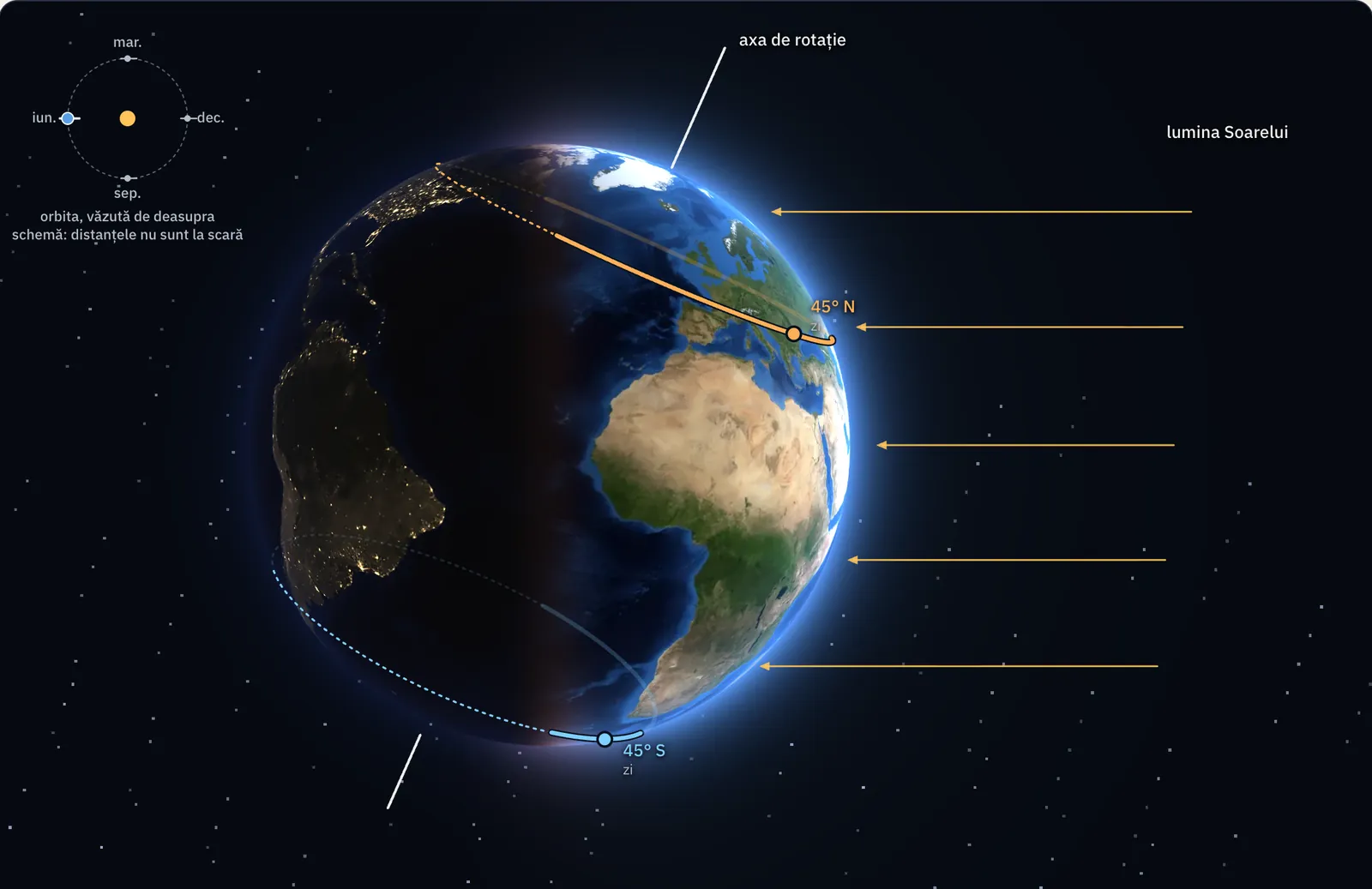
Two places at the same distance from the Equator, one in the north and one in the south, receive very different amounts of light on the same day. The planet beside the text has a surface photographed from satellites, month by month, and its light is calculated for the point of the orbit where it stands.
In June the day is long in the north and short in the south
The orange dot lies at 45° north latitude, on the meridian that crosses Romania. The blue dot lies at 45° south latitude, on the same meridian, in the ocean.
Each circle is the path the dot follows in one rotation of the planet. The thick part of the circle is in sunlight. At the June solstice, the north gets 15 hours and 26 minutes of daylight and the south only 8 hours and 34 minutes.
What do you think causes the difference?
One day is one rotation
The Earth turns from west to east once every 24 hours. A place has day while it is in the lit half of the planet, and night while it is in the other half.
The length of the day therefore depends on how much of a place’s circle falls in the light. At the Equator, the circle is always cut into two equal halves.
The axis is tilted by 23.44°
The dotted line is the perpendicular to the orbital plane, the plane in which the Earth goes round the Sun. The axis of rotation makes an angle of 23.44° with it.
Because of the tilt, the line between day and night does not pass through the poles. In June it leaves the whole region of the North Pole in light and cuts the circles of the northern hemisphere into unequal parts, with the larger part in light.
Where the day is longer, the Sun also climbs higher
At noon in June, the Sun climbs to 68.4° above the horizon at 45° north, and only to 21.6° at 45° south.
The drawings under the day lengths show the same beam of light falling on the ground. When the rays come from high up, the beam lights a narrow strip: at 45° north, a strip 1.08 times the beam’s width. When they arrive at a slant, the same light spreads over 2.72 widths, so each square metre receives less energy.
Summer therefore has two causes working together: more hours of light and rays closer to the vertical.
After six months, the light comes from the other side
The Earth has travelled half of its orbit. The axis points in the same direction as in June; the diagram in the corner shows it pointing the same way in all four positions.
The Sun now lights the planet from the opposite side, and the southern hemisphere leans towards it. The day lengths have swapped: 8 hours and 34 minutes in the north, 15 hours and 26 minutes in the south.
Twice a year, day equals night
In March and September, the Earth passes through the points of its orbit where neither hemisphere leans towards the Sun. The line between day and night runs through both poles and cuts every circle into equal halves.
Everywhere on the globe, the day then lasts almost 12 hours: the geometric calculation gives exactly 12, and a few minutes more pass between sunrise and sunset. At noon the Sun stands vertically above the Equator. These are the equinoxes.
An Earth with a straight axis would have no seasons
The axis is now at 0°, perpendicular to the plane of the orbit. The planet is again in its June position, at the same distance from the Sun as before.
The line between day and night now runs through the poles in every month. The graph of day length over a year has become a straight line at 12 hours, for the north and for the south; the dotted lines show the real year.
One thing changed, the tilt, and the seasons disappeared from the calculation. The distance to the Sun stayed the same.
At another latitude, the same explanation
Move the two points to other latitudes and see how much of their circle stays in light in June.
At the Equator the day lasts 12 hours all year. At the Arctic Circle, the whole circle enters the light at the June solstice: the Sun does not set for 24 hours. Beyond it, the polar day lasts weeks or months, and in the other hemisphere there is polar night.
Now you explain
A classmate says: “Winter is cold because the Earth is farther from the Sun.” How would you show that this explanation does not fit?
Compare with an answer
The seasons are opposite in the two hemispheres: when it is winter in the northern hemisphere, it is summer in the southern one, although the whole planet is at the same distance from the Sun. With a straight axis, the day stays 12 hours long all year and the seasons disappear, with no change in distance. The cause is the tilt of the axis: from one month to the next it changes the height of the Sun at noon and the length of the day.