Chapter 2 · The Earth in spaceLesson 2.3
Earth’s rotation: day and night, local time and time zones
Why does the Sun reach its highest point nearly 38 minutes earlier in Sulina than in Beba Veche, even though their clocks show the same time?
Before you read: what do you think?
You stand still on the 45° parallel, which crosses Romania. How fast does Earth’s rotation carry you?
See the answer
About 1,184 km/h. At 1,184 km/h; at the Equator, the speed reaches 1,674 km/h. Nobody feels it because the ground, buildings and air move together at the same speed.
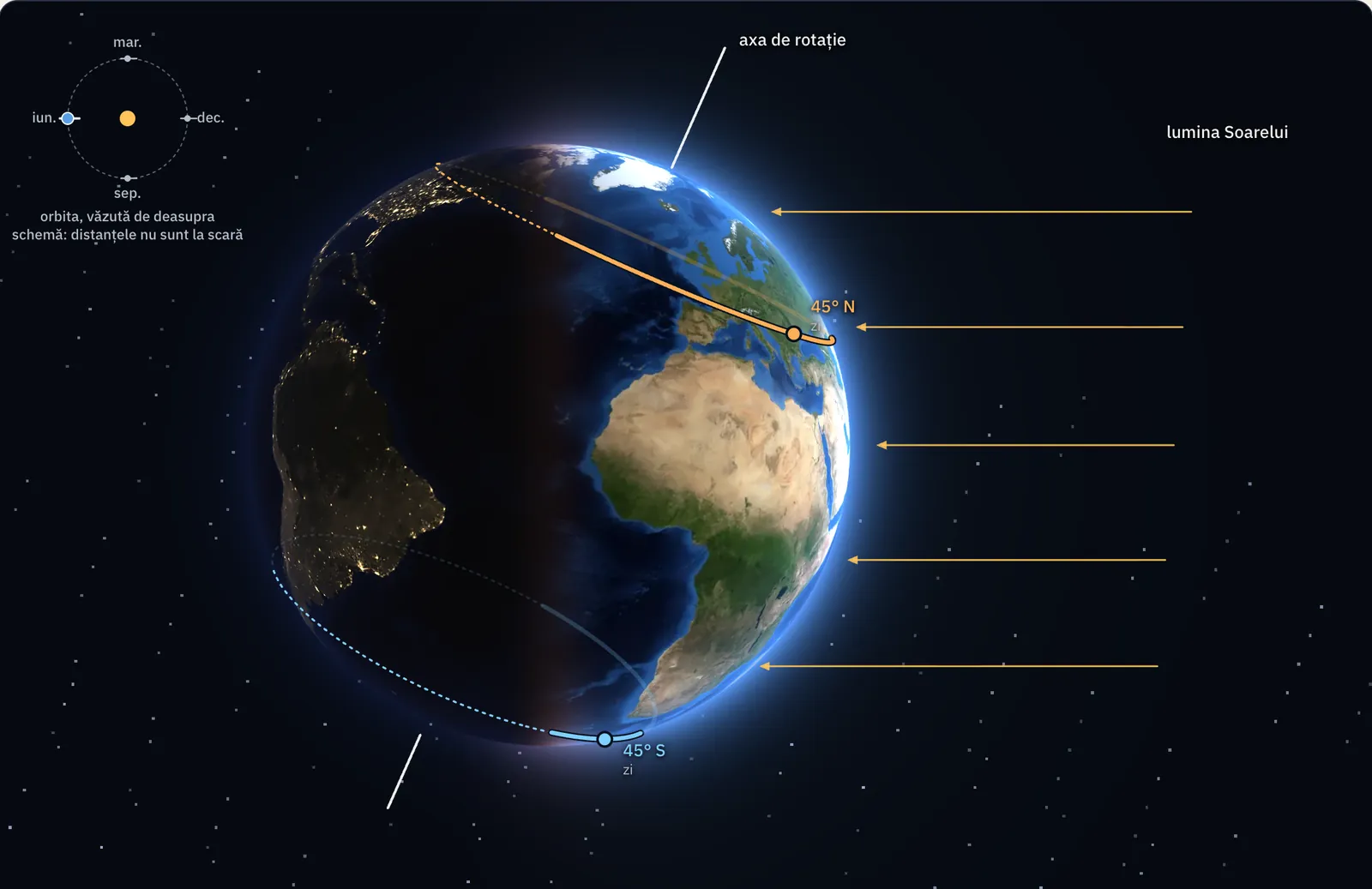
A person standing still at the Equator is carried along by Earth’s rotation at 1,674 km/h. At 45° latitude, on the parallel that crosses Romania, the speed is 1,184 km/h. Nobody feels it because the ground, buildings and air move together at the same speed.
The east sees the Sun first: one rotation takes 23 hours, 56 minutes and 4 seconds
The Sun reaches its highest point nearly 38 minutes earlier in Sulina, Romania’s easternmost town, than in Beba Veche, its westernmost village. Earth spins, bringing each place in turn towards the Sun: the east of the country first, then the west. This spin around the axis, the imaginary line through the two poles, is called rotation. Earth rotates from west to east. That is why the Sun, Moon and stars appear to cross the sky from east to west: their movement is apparent, because the observer is moving.
Relative to the stars, one complete rotation takes 23 hours, 56 minutes and 4 seconds. Clocks follow the solar day, the interval between two successive noons, which lasts 24 hours on average.
Every point on the globe makes a complete circle in the same time, but the circles differ in length. Rotation speed is highest at the Equator, 1,674 km/h, falls towards the poles and is zero at the poles themselves.
For the curious
The difference of nearly four minutes arises because Earth travels onwards along its orbit in that time and must turn a little more than once before the Sun returns to the same position in the sky.
Day and night
At any moment the Sun lights half the globe. Rotation brings each place in turn into the lit half and then the dark half: this is the alternation of day and night.
The alternation sets the daily rhythm of temperature. The ground and air warm by day and cool at night. Because a solar day lasts only 24 hours, neither side of the planet stays in light or darkness for too long.
For the curious
The change from day to night is gradual. The atmosphere scatters light, keeping the sky lit for a while before sunrise and after sunset: these are dawn and dusk.
Local time, time zones and the international date line
Noon is the moment when the Sun crosses a place’s meridian and reaches its highest point in the sky. All places on the same meridian have noon at the same moment, so they have the same local time. Earth turns through 360° in 24 hours: 15° an hour, or 1° every four minutes. A place 1° farther east has noon four minutes earlier.
If each city set its clocks by its own Sun, two neighbouring cities would have different times. So the globe was divided into 24 time zones, strips each 15° of longitude wide. Within a zone, all clocks show the same time, called official time. The zero zone is centred on the Greenwich meridian (0°), and its time is the world reference, Coordinated Universal Time (UTC). Add an hour for each zone eastwards and subtract one for each zone westwards. In practice, time zone boundaries follow national borders.
On the opposite side of the globe from Greenwich, the international date line runs through the Pacific Ocean, roughly along the 180° meridian. It separates two calendar days: cross it westwards and you enter the next day; cross it eastwards and you return to the previous day.
A flattened planet and the deflection of moving bodies
Rotation produces a centrifugal force, greatest at the Equator, where speed is highest. It has made the planet bulge at the Equator and flattened it at the poles: the equatorial radius is 21 km longer than the polar radius.
Another consequence appears in anything travelling long distances: air masses, ocean currents and aircraft. A body travelling north from the Equator keeps the high eastward speed of its starting point. It arrives above places that rotate more slowly and moves ahead of them, towards the east. Seen from the ground, its path curves to the right. This deflection is called the Coriolis effect, and the apparent force producing it is the Coriolis force. In the Northern Hemisphere, moving bodies are deflected to the right of their direction of travel, and in the Southern Hemisphere to the left. The deflection is absent at the Equator and strongest near the poles.
Because of the Coriolis force, winds and ocean currents follow curved paths, and cyclones spin anticlockwise in the Northern Hemisphere and clockwise in the Southern Hemisphere.
For the curious
Rotation explains why day and night occur. The difference between the long days of June and the short days of December is explained by Earth’s second movement, its revolution around the Sun, together with the tilt of its axis.
Worked example
Noon in Sulina and Beba Veche
Romania’s official time is that of the zone centred on the 30° east meridian. On this meridian, the Sun reaches its highest point at 12:00 on average.
Sulina, the country’s easternmost town, lies at 29°41′ E, 19′ west of the 30° meridian. At four minutes per degree, the delay is 19/60 × 4 ≈ 1 minute: noon comes at 12:01 on average. Beba Veche, the westernmost settlement, lies at 20°15′ E, 9°45′ from the 30° meridian. The delay is 9.75 × 4 = 39 minutes: noon comes at 12:39 on average.
A direct check: 29°41′ − 20°15′ = 9°26′, or 9.43° × 4 minutes ≈ 38 minutes. When the Sun has reached its highest point in Sulina, it has another 38 minutes to climb in Beba Veche, even though the clocks show the same time in both places.
In Romania
UTC+2 in winter and UTC+3 in summer
Romania’s official time is Eastern European Time, two hours ahead of Universal Time (UTC+2): when it is 12:00 in Greenwich, it is 14:00 in Bucharest. From the last Sunday in March to the last Sunday in October, summer time applies: UTC+3. Clocks move forward by one hour, on the same dates as in all European Union countries.
The 30° E meridian, which sets winter time, passes east of Sulina, over the Black Sea. The entire country lies west of it, so on average the Sun reaches its highest point after 12:00 on the clock: one minute later in Sulina and 39 minutes later in Beba Veche. From day to day, actual noon varies from this average by up to about 16 minutes. In summer, when clocks have moved forward, solar noon comes at around 13:01 in Sulina and 13:39 in Beba Veche.
The result can be seen in the evening: on the same date, the clock shows a later sunset in Banat than in Dobrogea.
Your place
At what time does the clock show true noon where you live? Choose your place and see the difference from official time.
In brief
- Rotation is Earth’s spin around its axis from west to east in 23 hours, 56 minutes and 4 seconds; the solar day, which clocks follow, lasts 24 hours on average.
- Rotation speed is highest at the Equator (1,674 km/h), falls towards the poles and is zero at the poles; at 45° latitude it is 1,184 km/h.
- Rotation causes the alternation of day and night, the Sun’s apparent movement from east to west, time differences, flattening at the poles and the deflection of moving bodies (the Coriolis force).
- Earth turns 15° an hour, or 1° every four minutes; places on the same meridian have the same local time, while places farther east have a later local time.
- The globe is divided into 24 time zones of 15° each; the reference is the Greenwich meridian (UTC), and the international date line follows the 180° meridian approximately.
- The Coriolis force deflects moving bodies to the right in the Northern Hemisphere and to the left in the Southern Hemisphere. Romania’s official time is UTC+2, with UTC+3 in summer.
Common mistakes
WrongThe Sun moves across the sky from east to west, so it goes around Earth.
RightThe Sun’s movement across the sky is apparent. Earth rotates from west to east, carrying the observer with it.
WrongAt 12:00 the Sun is at its highest point everywhere in Romania.
RightOfficial time is the same across the country, but solar noon depends on longitude: it comes at 12:01 on average in Sulina and 12:39 in Beba Veche, and an hour later on the clock in summer.
WrongThe Coriolis force makes water drain from a sink in one direction in the Northern Hemisphere and the opposite direction in the Southern Hemisphere.
RightThe Coriolis force is observable only in movement over long distances, such as winds, ocean currents and cyclones. In a sink it is too weak; the shape of the basin and the water’s initial movement determine the direction.
Test yourself
Six questions. For the first five you see the explanation at once, with the paragraph of the lesson that supports it; for the ones with a written answer you compare with a good answer.
In which direction does Earth rotate around its axis?
Answer
c) West to east. Earth rotates from west to east, so the Sun appears to move across the sky in the opposite direction, from east to west.
Two places lie on the same parallel, one at 21° E and the other at 27° E. How many minutes earlier does noon come at the eastern place?
minutesAnswer
24 minutes. The longitude difference is 6°, and each degree means four minutes: 6 × 4 = 24 minutes.
Where is the rotation speed of a point on Earth’s surface greatest?
Answer
a) At the Equator. Every point makes a complete circle in the same time, and the Equator is the longest circle. At the poles the speed is zero.
What happens to the calendar date when you cross the international date line westwards, for example from Alaska towards Japan?
Answer
b) You enter the next day. The line separates two calendar days. Travelling west adds a day; travelling east subtracts one.
A wind blows from south to north in the Northern Hemisphere. Which way does the Coriolis force deflect it?
Answer
c) Right, towards the east. In the Northern Hemisphere, deflection is to the right of the direction of travel. For a wind travelling north, right means east.
Madrid lies at approximately 4° west longitude, but Spain uses Central European Time, based on the 15° E meridian. Explain why the Sun reaches its highest point in Madrid well after 12:00 and calculate the average delay in winter.
A good answer
Madrid lies 19° west of the 15° E meridian that sets its clocks. Earth turns 1° every four minutes, so the Sun reaches Madrid’s meridian 19 × 4 = 76 minutes later than the 15° E meridian. Solar noon comes at around 13:16 on average in winter and another hour later in summer, when summer time applies.
A complete answer distinguishes official time from local time, calculates the longitude difference (19°) and converts it to time using four minutes per degree.
Terms
- rotation
- Earth’s spin around its axis from west to east in 23 hours, 56 minutes and 4 seconds.
- solar day
- The interval between two successive noons at the same place, lasting 24 hours on average.
- local time
- Time given by the Sun’s position relative to the local meridian; it is the same at every point on a meridian.
- time zone
- A strip 15° of longitude wide within which the same official time is used; the globe has 24 zones.
- international date line
- A conventional line running roughly along the 180° meridian, separating two calendar days.
- Coriolis force
- The apparent force produced by Earth’s rotation that deflects moving bodies: right in the Northern Hemisphere, left in the Southern Hemisphere.
Sources and link to the programme
- NASA – Earth Fact Sheet – sidereal rotation period (23.9345 hours), length of day (24 hours), equatorial radius (6,378.137 km) and polar radius (6,356.752 km)
- NOAA – What is the international date line? – the international date line, established in 1884, approximately along the 180° meridian through the Pacific
- NOAA Ocean Service – Currents: the Coriolis effect – deflection to the right in the Northern Hemisphere and to the left in the Southern Hemisphere; curved paths of air
- National Geographic Education – Coriolis effect – explanation through different rotation speeds, direction of cyclone rotation, force absent at the Equator and greatest near the poles, water draining from a sink
- EUR-Lex – Directiva 2000/84/CE privind dispozițiile referitoare la orarul de vară – summer time begins on the last Sunday in March and ends on the last Sunday in October in all member states
- timeanddate – Time zone in Bucharest, Romania – Romania’s time: EET (UTC+2) and EEST (UTC+3)
- BZI – România, superlativele geografice – longitudes of the extreme points: Sulina 29°41′ E, Beba Veche 20°15′ E
- NOAA GML – General Solar Position Calculations – equation of time: actual solar noon differs from mean noon
- Wikipedia (en) – Equation of time – actual noon differs from mean noon by up to about 16 minutes (between roughly −14 and +16½ minutes)
From the programme: “The fundamental movements of the Earth and their geographical consequences” (common core). Programme competences covered: 1.3, 2.2, 4.3.