Chapter 2 · The Earth in spaceLesson 2.4
The seasons: why June brings summer to Bucharest and winter to Buenos Aires
If summer came from being closer to the Sun, why is it winter in Buenos Aires precisely when it is summer in Bucharest?
Before you read: what do you think?
At what time of year is Earth closest to the Sun?
See the answer
Early January. Early January, in the middle of Romania’s winter: 147.1 million kilometres, compared with 152.1 million in early July. The seasons come from the tilt of the axis, which changes day length and the Sun’s height.
On 21 June, daylight lasts nearly 15 and a half hours in Bucharest. On the same day in Buenos Aires, it lasts less than ten hours and people wear jackets. The two cities are on the same planet, at the same distance from the Sun.
Distance from the Sun does not explain the seasons
If being closer to the Sun brought summer, January would be the warmest month of the year. In early January the planet passes its closest point to the Sun, perihelion, at 147.1 million kilometres; in early July it passes its farthest point, aphelion, at 152.1 million kilometres. Earth is therefore closest to the Sun in the middle of Romania’s winter.
What is more, the distance is the same for the whole planet, so it cannot bring summer to one hemisphere and winter to the other. The cause of the seasons must be something that distinguishes north from south.
Earth’s journey around the Sun is called revolution and takes one year, or 365 days and nearly six hours. Its path, the orbit, is an ellipse very close to a circle.
The axis is tilted and keeps pointing in the same direction
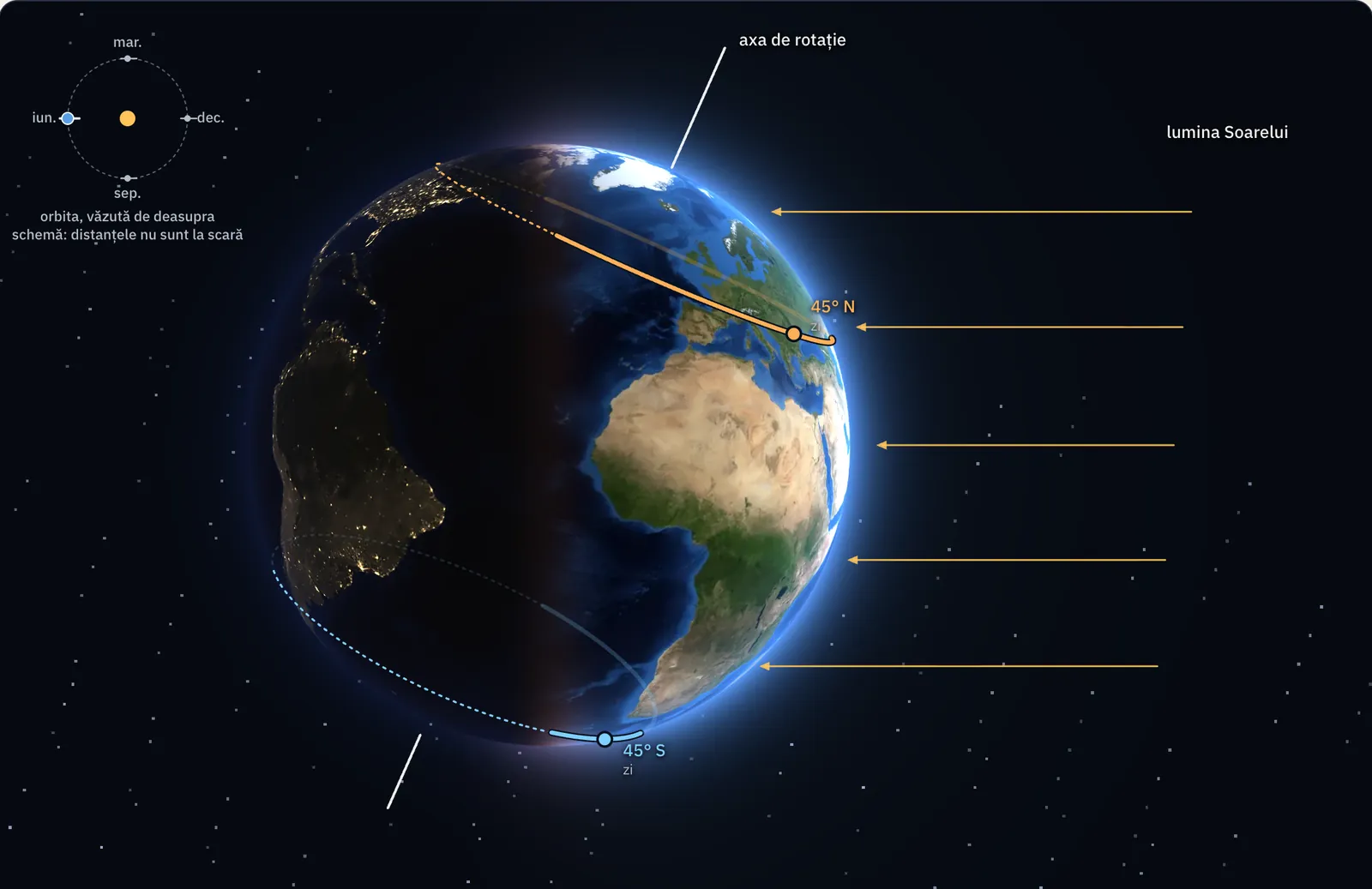
Earth rotates around an axis that passes through the two poles. This axis is tilted by 23.44° (23°26′) from the perpendicular to the plane of the orbit. It points towards the same spot in the sky, near the Pole Star, all year, wherever the planet is on its orbit.
As a result, in June the Northern Hemisphere is tilted towards the Sun; in December, when Earth has reached the other side of its orbit, the Southern Hemisphere is tilted towards the Sun. The axis has not moved; the direction from which the light arrives has changed.
If the axis were perpendicular to the plane of the orbit, every place except the poles would have days of approximately 12 hours and the same path of the Sun across the sky all year. The seasons would disappear.
Tilt changes two things: day length and the Sun’s height
The first effect is on day length. In the hemisphere tilted towards the Sun, every place spends more than half of its 24-hour rotation on the lit side of the planet. In Bucharest, the day of the June solstice is nearly seven hours longer than that of the December solstice.
The second effect is on the height of the Sun above the horizon. At noon on 21 June, the Sun rises to 69° in Bucharest; on 21 December it reaches only 22°. When rays fall almost vertically, their energy is concentrated on a small area. When they fall at an angle, the same energy is spread out: a beam of light one metre wide covers 1.07 m of ground in June and 2.65 m in December.
In summer, a place therefore receives light for more hours and more energy on each square metre. In winter it loses both.
| Position in orbit | Day at 45° north | Day at 45° south | Sun at noon, 45° north |
|---|---|---|---|
| March equinox | 12 h 00 min | 12 h 00 min | 45.0° |
| June solstice | 15 h 26 min | 8 h 34 min | 68.4° |
| September equinox | 12 h 00 min | 12 h 00 min | 45.0° |
| December solstice | 8 h 34 min | 15 h 26 min | 21.6° |
Calculation and photograph. The surface is the NASA Blue Marble mosaic of the month; the light, the day length and the height of the Sun are calculated from the position on the orbit and the tilt of the axis. The size of the Earth and the distance to the Sun are not to scale.
Four dates divide the year
At the summer solstice, around 21 June, the Sun is directly overhead at noon at the Tropic of Cancer (23°26′ north latitude). The Northern Hemisphere has its longest day of the year, and north of the Arctic Circle (66°34′) the Sun does not set: this is polar day. At the winter solstice, around 21 December, the Sun is overhead at the Tropic of Capricorn (23°26′ south latitude), and the situation reverses.
At the two equinoxes, around 20 March and 23 September, the Sun is overhead at noon at the Equator. Day and night then last almost the same length of time across the globe.
The tropics and polar circles divide the planet into five heat zones: the hot zone, between the tropics, where the Sun is directly overhead twice a year; two temperate zones, between the tropics and the polar circles, with four seasons; and two cold zones, beyond the polar circles, with polar day and polar night.
For the curious
The hottest days usually come a few weeks after the solstice, because the ground and especially water warm up slowly. That is why meteorologists count seasons in whole months: meteorological summer in the Northern Hemisphere lasts from 1 June to 31 August.
Worked example
How high the Sun rises in Bucharest
The Sun’s height at noon is calculated with the formula h = 90° − |φ − δ|, where φ is the latitude of the place and δ is the latitude at which the Sun is directly overhead on that day (declination).
Bucharest is at latitude φ = 44.43° north. At the summer solstice, δ = +23.44°, so h = 90° − (44.43° − 23.44°) = 69.01°. At the winter solstice, δ = −23.44°, so h = 90° − (44.43° + 23.44°) = 22.13°. At the equinoxes, δ = 0° and h = 90° − 44.43° = 45.57°.
You can check with a vertical stick one metre tall: at noon on 21 June its shadow measures 38 cm, and at noon on 21 December it measures 2.46 m. The shadow’s length is the height of the stick divided by the tangent of angle h.
In Romania
38 minutes between north and south
The parallel of 45° north latitude, halfway between the Equator and the North Pole, crosses Romania and passes a few kilometres north of Ploiești. The country lies entirely within the northern temperate zone.
Day length also differs within the country. At the summer solstice, a geometric calculation gives 15 hours and 53 minutes at Horodiștea, in Botoșani county, Romania’s northernmost point (48°15′), and 15 hours and 15 minutes at Zimnicea, its southernmost point (43°37′). The north of the country has 38 minutes more daylight. At the winter solstice, the difference reverses: 8 hours and 7 minutes at Horodiștea, 8 hours and 45 minutes at Zimnicea.
The day length given in a calendar is about ten minutes longer than the calculated one, because the atmosphere bends the rays and sunrise and sunset are reckoned by the upper edge of the Sun’s disc. The Sun is therefore visible a little before geometric sunrise and a little after geometric sunset.
Your place
How long does the day last at the solstices where you live, and how high does the Sun climb at noon? Choose your place and the calculation is made for its latitude.
In brief
- The seasons result from two things together: Earth’s revolution around the Sun and the tilt of its axis by 23.44° (23°26′) from the perpendicular to the plane of its orbit.
- The axis keeps pointing in the same direction all year, so in June the Northern Hemisphere is tilted towards the Sun and in December the Southern Hemisphere is; the seasons are opposite in the two hemispheres.
- In summer, the day is longer and the Sun rises higher, so each square metre receives more energy for more hours.
- At the summer solstice (21 June), the Sun is directly overhead at noon at the Tropic of Cancer, and the Northern Hemisphere has its longest day. At the winter solstice (21 December), the Sun is directly overhead at the Tropic of Capricorn.
- At the equinoxes (20 March and 23 September), the Sun is directly overhead at the Equator, and day and night are almost equal across the globe.
- Distance from the Sun does not cause the seasons: Earth is closest to the Sun in early January.
Common mistakes
WrongSummer is warm because Earth moves closer to the Sun.
RightEarth is closest to the Sun in early January. Summer comes from the tilt of the axis: days are longer and rays fall closer to vertical.
WrongEarth’s axis tilts towards the Sun and then away from it.
RightThe axis points towards the same spot in the sky all year. Earth moves along its orbit, and the light comes from a different direction.
WrongThe tilt of 23.44° is measured from the plane of the orbit.
RightIt is measured from the perpendicular to the plane of the orbit. The axis makes an angle of 66.56° with the plane.
Test yourself
Six questions. For the first five you see the explanation at once, with the paragraph of the lesson that supports it; for the ones with a written answer you compare with a good answer.
At what time of year is Earth closest to the Sun?
Answer
b) Early January. Perihelion falls in early January, in the middle of the Northern Hemisphere’s winter. This shows that distance does not cause the seasons.
What would happen to day length in Bucharest if Earth’s axis were perpendicular to the plane of its orbit?
Answer
a) It would be 12 hours all year. Without the tilt, the line between day and night would always pass through the poles and each place would spend half its rotation in light.
Where is the Sun directly overhead at noon on the winter solstice?
Answer
c) At the Tropic of Capricorn. In December the Southern Hemisphere is tilted towards the Sun, and the rays fall vertically at 23°26′ south latitude.
Calculate the Sun’s height at noon at an equinox for a place at 45° north latitude. Give your answer in degrees.
°Answer
45 °. At an equinox δ = 0°, so h = 90° − 45° = 45°.
Why does the ground receive more energy per square metre when the Sun is high in the sky?
Answer
b) Because the rays fall almost vertically and are concentrated on a smaller area. The Sun sends the same energy; the angle at which the rays fall determines the area over which it is spread.
A classmate says, “Winter is cold because the planet moves farther from the Sun.” Which two facts show that this explanation does not fit?
A good answer
First, when it is winter in the Northern Hemisphere, it is summer in the Southern Hemisphere, although the whole planet is at the same distance from the Sun. Second, Earth passes its closest point to the Sun in early January, in winter. The correct explanation is the tilt of the axis, which changes day length and the Sun’s height.
A complete answer names the opposite seasons in the hemispheres and the date of perihelion, then gives the actual cause.
Terms
- revolution
- Earth’s movement around the Sun along its orbit in one year (365 days and nearly six hours).
- perihelion
- The point on Earth’s orbit where it is closest to the Sun (early January, 147.1 million km).
- aphelion
- The point on Earth’s orbit where it is farthest from the Sun (early July, 152.1 million km).
- solstice
- Either of the two moments in the year (around 21 June and 21 December) when the Sun is directly overhead at one of the tropics.
- equinox
- Either of the two moments in the year (around 20 March and 23 September) when the Sun is directly overhead at the Equator and day and night are almost equal.
- polar day
- A period when, beyond a polar circle, the Sun does not set for at least 24 hours.
- heat zones
- The five bands of the planet separated by the tropics and polar circles: one hot, two temperate and two cold.
Sources and link to the programme
- NASA – Earth Fact Sheet – axial tilt (23.44°), perihelion 147.095 and aphelion 152.100 million km
- NASA Space Place – What causes the seasons? – the cause of the seasons and why distance does not explain them
- U.S. Naval Observatory – Earth's seasons: equinoxes, solstices, perihelion and aphelion – dates of the solstices, equinoxes, perihelion and aphelion
- NOAA – Meteorological versus astronomical seasons – meteorological seasons, counted in whole months
- U.S. Naval Observatory – Rise, Set, and Twilight Definitions – sunrise and sunset: upper edge of the disc, centre 50′ below the horizon (refraction 34′ and apparent radius 16′)
From the programme: “The fundamental movements of the Earth and their geographical consequences” (common core). Programme competences covered: 1.3, 2.3, 3.3.