Chapter 5 · Atmosphere and climateLesson 5.1
Earth’s atmosphere: what air is made of and how its layers are arranged
If Earth were the size of a desk globe, how thick would the layer of air where all weather happens be?
Before you read: what do you think?
You climb Vârful Omu, at 2,504 m. The atmosphere stretches hundreds of kilometres above you. How much of all its air is below you?
See the answer
More than a quarter. 26%. At the altitude of Vârful Omu, standard-atmosphere pressure is 746 hPa, compared with 1,013 hPa at sea level, and pressure shows how much air is overhead. Air has weight and is compressed near the ground: half of all the atmosphere lies below 5.6 km.
At sea level, air exerts an average pressure of 1,013 hectopascals (hPa). At 2,504 m, the altitude of Vârful Omu, a summit in the Bucegi mountains, standard-atmosphere pressure is just 746 hPa. More than a quarter of the air is below the summit.
Air is a mixture of gases
On a school globe 30 cm across, all the air where weather happens would form a film two tenths of a millimetre thick. That film is the lower part of the atmosphere, the envelope of air held around Earth by gravity.
Dry air near the ground contains 78.08% nitrogen, 20.95% oxygen and 0.93% argon. The rest, less than 0.05%, consists of carbon dioxide, neon, helium, methane, ozone and other gases. Water vapour is added to this mixture. Its amount varies greatly from place to place, from almost none in desert air to 4% in warm, humid air.
Carbon dioxide takes up little space, about 0.04% of the air, and matters a great deal. Along with methane and water vapour, it absorbs heat emitted by Earth’s surface; these are called greenhouse gases. Nitrogen and oxygen, which together make up 99% of the air, do not retain this heat.
Aerosols also float in the air: tiny solid or liquid particles of dust, sea salt, ash, pollen or smoke. Water vapour condenses around them, so every cloud droplet has such a particle at its centre.
For the curious
At the Mauna Loa observatory in Hawaii, where carbon dioxide concentration has been measured since March 1958, the average for 2025 was 427.35 parts per million (ppm).
A cloud you can see is made of water droplets and ice crystals; water vapour is an invisible gas.
Five layers, distinguished by how temperature changes
The troposphere starts at the ground and reaches 18–20 km above the Equator, 9 km at latitude 50° and 6 km at the poles. It contains most of the air and almost all the water vapour, so clouds, rain and wind form here. In the troposphere, temperature falls with height by an average of about 6.5 °C per 1,000 m: from 15 °C at the ground to −56.5 °C at its upper boundary (at 11 km), called the tropopause, in the standard atmosphere used by meteorologists.
The stratosphere extends from the tropopause to about 50 km. In the stratosphere, temperature rises with height to about −15 °C, because this is where the ozone layer lies. Ozone is concentrated between 15 and 40 km in altitude. It absorbs most of the Sun’s ultraviolet radiation and turns it into heat.
In the mesosphere, between 50 and 85 km, temperature falls again, reaching about −120 °C at the upper boundary. Most meteors burn up here. In the thermosphere, between 85 and 600 km, temperature rises to 2,000 °C; polar auroras appear here. The exosphere, from 600 km to about 10,000 km, is the transition to outer space: atoms and molecules escape from the planet here.
For the curious
Ozone is a gas whose molecules each contain three oxygen atoms. The ultraviolet radiation it blocks would harm skin, eyes and plants.
In the thermosphere, the extremely thin air absorbs X-rays and ultraviolet radiation. The molecules are so few, however, that an object there would not be warmed by them.
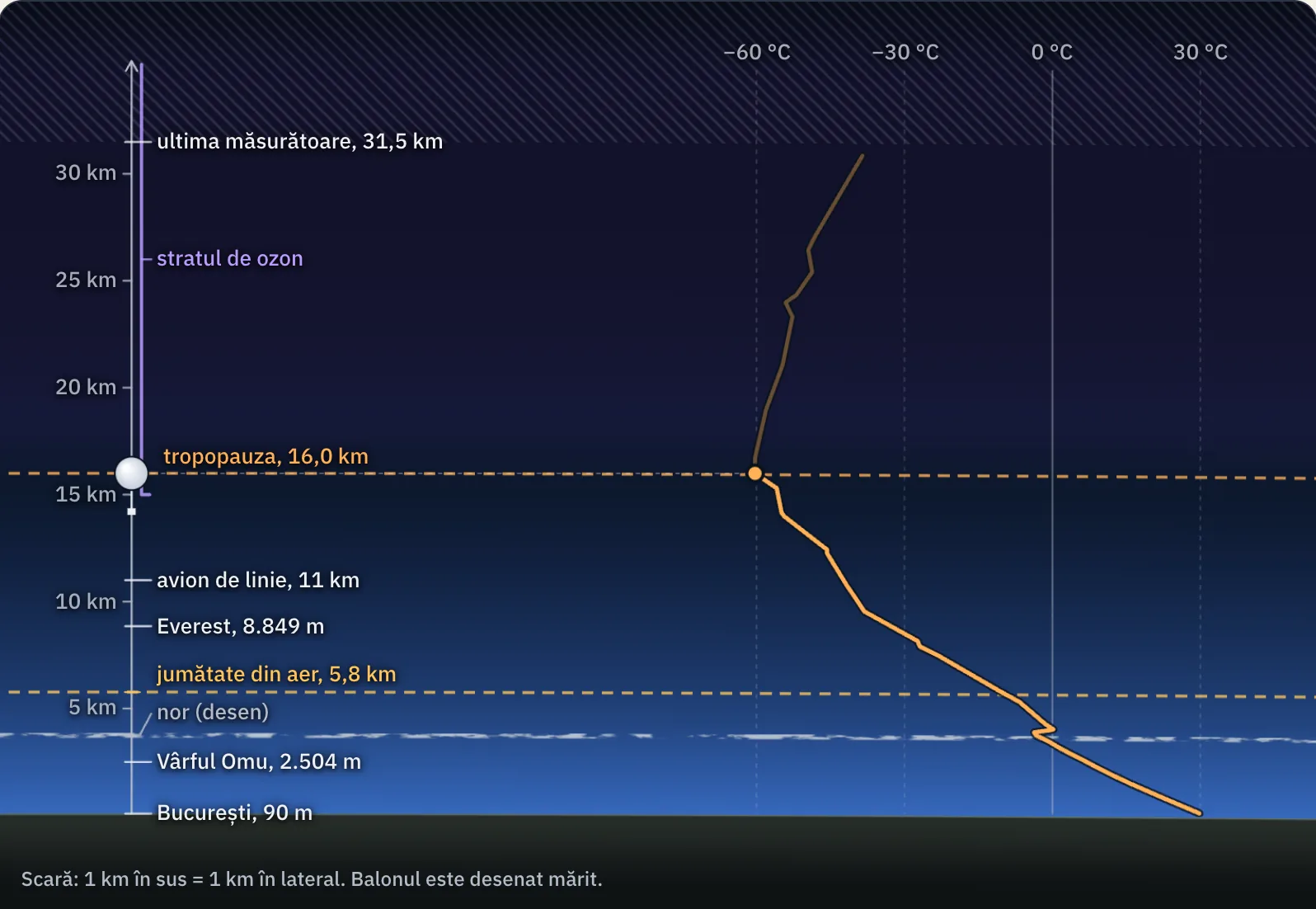
| Level | Height | 2 August 2025, at 14:05 | 20 January 2025, at 13:03 | ||
|---|---|---|---|---|---|
| Ground, Băneasa | 90 m | 29.8 °C | 1,003 hPa | 10.0 °C | 1,018 hPa |
| Vârful Omu weather station | 2,504 m | 6.9 °C | 756 hPa | 2.0 °C | 758 hPa |
| Half the air below | 5.8 km / 5.6 km | −10.3 °C | 502 hPa | −17.6 °C | 509 hPa |
| Height of Everest | 8,849 m | −32.7 °C | 330 hPa | −44.1 °C | 322 hPa |
| Airliner | 11 km | −42.3 °C | 241 hPa | −61.6 °C | 230 hPa |
| Tropopause | 16.0 km / 12.0 km | −60.3 °C | 112 hPa | −66.1 °C | 196 hPa |
| Last measurement | 31.5 km / 31.8 km | −39.3 °C | 10 hPa | −62.3 °C | 8 hPa |
Mean temperature of the planet compared with the 1951–1980 mean (NASA GISTEMP): 1880: −0.18 °C; 1910: −0.43 °C; 1940: +0.12 °C; 1970: +0.03 °C; 2000: +0.39 °C; 2016: +1.01 °C; 2024: +1.28 °C; 2025: +1.19 °C.
Measurements and calculation. Temperature, pressure, humidity and wind are measurements from the radiosondes launched from Bucharest-Băneasa on 2 August 2025 and 20 January 2025 (NOAA’s IGRA archive); between the reported levels, values are interpolated. The heights between standard levels, the tropopause, the brightness of the air (proportional to density) and the diameter of the balloon (starting from 1.5 m at the ground) are calculated from these measurements. The balloon is drawn enlarged, the cloud is a drawing placed where the measured humidity passes 90%, and the ozone layer and the reference heights are those of the lesson. The bars are the yearly departures of global temperature in the NASA GISTEMP series, compared with the 1951–1980 mean.
Pressure falls with altitude
Air has weight. Atmospheric pressure is the force exerted by the column of air above a place. It is measured with a barometer, in hectopascals (hPa) or millibars, two equal units. At sea level, normal pressure is 1,013 hPa.
The higher you climb, the less air remains above you, so pressure falls. Half of all the air in the atmosphere lies below an altitude of 5.6 km. Higher up, the atmosphere gradually thins and has no edge where it ends.
In the mountains, the proportion of oxygen in the air remains 21%, but the air is thinner, so fewer oxygen molecules enter your lungs with each breath. That is why you tire faster on a high ridge than on a plain.
What the atmosphere does for life on Earth
The atmosphere provides oxygen for breathing and carbon dioxide from which plants make their food. The ozone layer absorbs most harmful ultraviolet radiation. Greenhouse gases keep heat near the ground: without the natural greenhouse effect, Earth’s surface would be about 33 °C colder. Moving air carries heat and water vapour from one region to another.
For the curious
Water returns to the land from clouds. Air also slows and burns up most meteors before they reach the ground.
Worked example
The atmosphere on a desk globe
Earth’s mean radius is 6,371 km. A school globe 30 cm across has a radius of 15 cm. Find the thickness of a layer on the globe by proportion: thickness on globe = 15 cm × actual thickness ÷ 6,371 km.
For the 9 km thick troposphere at latitude 50°: 15 cm × 9 ÷ 6,371 = 0.021 cm, or 0.21 mm. All the planet’s weather, with its clouds, rain and storms, would fit into a film two tenths of a millimetre thick.
For the upper boundary of the thermosphere, at 600 km: 15 cm × 600 ÷ 6,371 = 1.41 cm. Half the air, however, would lie in the first 0.13 mm next to the globe, the equivalent of 5.6 km at this scale.
In Romania
From Sulina to Vârful Omu
The weather station at Sulina is 3 m above sea level, on the Black Sea coast. The station on Vârful Omu, in the Bucegi mountains, is at 2,504 m and is the highest in the country. In the standard atmosphere, a model of the average atmosphere used in meteorology and aviation, pressure is 1,013 hPa at Sulina’s altitude and 746 hPa at that of Vârful Omu.
The difference is 267 hPa for a climb of 2,501 m, or about 11 hPa for every 100 m. Pressure is the weight of the air overhead, so the ratio 746 ÷ 1,013 = 0.74 shows that 74% of the air remains above the summit; the other 26% is below it.
Altitude shows up in temperatures too. On Vârful Omu, the long-term average (1961–2024) for February is −10.2 °C, while the average for August, the warmest month, is just 6.4 °C.
In brief
- The atmosphere is Earth’s envelope of air; dry air contains 78% nitrogen, 21% oxygen, nearly 1% argon and small amounts of other gases, including carbon dioxide (about 0.04%).
- The amounts of water vapour and aerosols vary; carbon dioxide, methane and water vapour are greenhouse gases.
- The layers of the atmosphere, from bottom to top, are the troposphere, stratosphere, mesosphere, thermosphere and exosphere.
- The troposphere contains most of the air and is where weather occurs; temperature falls with height up to the tropopause.
- The stratosphere contains the ozone layer, which absorbs ultraviolet radiation; this is why temperature rises with height there.
- Atmospheric pressure is 1,013 hPa at sea level and falls with altitude; half the air lies below 5.6 km.
Common mistakes
WrongCarbon dioxide is only 0.04% of the air, so it cannot affect the planet’s temperature.
RightA gas’s effect depends both on its amount and on what its molecules do. Carbon dioxide absorbs heat emitted by the ground, whereas nitrogen and oxygen, which make up 99% of the air, do not retain it.
WrongIn the mountains, air contains a smaller percentage of oxygen.
RightThe percentage remains 21%. The air is thinner, so the same volume contains fewer molecules of every gas, including oxygen.
WrongThe hole in the ozone layer causes global warming.
RightThese are two different problems. The ozone layer absorbs ultraviolet radiation; global warming comes from the increase in greenhouse gases, chiefly carbon dioxide.
Test yourself
Six questions. For the first five you see the explanation at once, with the paragraph of the lesson that supports it; for the ones with a written answer you compare with a good answer.
Which gas makes up most of dry air?
Answer
b) Nitrogen. Nitrogen makes up 78% of dry air, oxygen 21% and argon nearly 1%.
In which layer of the atmosphere does temperature rise with height because ozone absorbs ultraviolet radiation?
Answer
c) The stratosphere. The ozone layer lies in the stratosphere, between 15 and 40 km, and turns ultraviolet radiation into heat.
Why do you tire faster when climbing a 2,500 m summit?
Answer
a) The air is thinner, so each breath brings in less oxygen. The composition of the air remains the same; pressure and the number of molecules in a volume of air fall.
Where do clouds, rain and wind form?
Answer
d) In the troposphere. The troposphere contains most of the air and almost all the water vapour.
On a globe with a radius of 20 cm, how thick would the 9 km troposphere be? Earth’s radius is 6,371 km. Give your answer in millimetres.
mmAnswer
0.28 mm. 20 cm × 9 ÷ 6,371 = 0.028 cm, or 0.28 mm.
A classmate says, “If nitrogen and oxygen make up 99% of the air, the other gases do not matter.” Give two examples that show otherwise.
A good answer
Carbon dioxide makes up about 0.04% of the air, yet it absorbs heat emitted by the ground; together with the other greenhouse gases it keeps Earth’s surface about 33 °C warmer. There is even less ozone, yet the ozone layer in the stratosphere blocks most ultraviolet radiation. A gas’s role depends both on its amount and on what its molecules do.
A complete answer names two gases present in small amounts (carbon dioxide, ozone, water vapour or methane) and states the role of each.
Terms
- atmosphere
- The envelope of air held around Earth by gravity.
- troposphere
- The lowest layer of the atmosphere, 6–20 km thick, in which temperature falls with height and weather occurs.
- tropopause
- The upper boundary of the troposphere, where temperature stops falling with height.
- stratosphere
- The layer between the tropopause and about 50 km, in which temperature rises with height.
- ozone layer
- The part of the stratosphere between 15 and 40 km where ozone is concentrated; it absorbs the Sun’s ultraviolet radiation.
- atmospheric pressure
- The force exerted by the column of air above a place; measured in hectopascals (hPa), it falls with altitude.
- greenhouse gases
- Gases that absorb heat emitted by Earth’s surface: water vapour, carbon dioxide and methane.
Sources and link to the programme
- NOAA JetStream – The Atmosphere – dry air composition (nitrogen 78.084%, oxygen 20.946%, argon 0.934%) and water vapour, up to 4%
- NOAA JetStream – Layers of the Atmosphere – boundaries of the five layers and temperatures of the stratosphere, mesosphere and thermosphere; meteors burning up in the mesosphere
- NOAA JetStream – Air Pressure – normal sea-level pressure (1,013.2 mb) and half the air below 5.6 km
- NOAA Global Monitoring Laboratory – Mauna Loa CO2 annual mean data – annual average carbon dioxide in 2025: 427.35 ppm; measurements since March 1958
- US EPA – Basic ozone layer science – the ozone layer, at about 15–40 km, and absorption of ultraviolet radiation
- UCAR Center for Science Education – Layers of Earth's atmosphere – ozone turns ultraviolet radiation into heat; auroras appear in the thermosphere
- NOAA JetStream – How clouds form – water vapour condenses around airborne particles (condensation nuclei)
- NASA – What is the greenhouse effect? – greenhouse gases; about 33 °C due to the natural greenhouse effect
- NASA – Earth Fact Sheet – Earth’s mean radius, 6,371 km
- NASA Glenn Research Center – Earth Atmosphere Model – standard atmosphere: temperature falls by 6.49 °C per 1,000 m, from 15 °C at the ground to −56.5 °C at 11 km; pressure formula, giving 1,013 hPa at 3 m and 746 hPa at 2,504 m
- NOAA NCEI – GHCN-Daily, lista stațiilor – altitudes of Sulina (3 m) and Vârful Omu (2,504 m) stations
- PressOne – Omu de pe Omu – the station on Vârful Omu, the highest year-round occupied building in Romania
- ANM – Caracterizare climatologică multianuală 1961–2024, februarie – February average on Vârful Omu, −10.2 °C
- ANM – Caracterizare climatologică multianuală 1961–2024, august – August average on Vârful Omu, 6.4 °C
From the programme: “Earth’s atmosphere: composition and structure” (common core). Programme competences covered: 1.3, 2.3, 3.3.