Chapter 4 · LandformsLesson 4.2
Landform processes: weathering, erosion and landslides
Why does a slope that has stood still for decades begin to move downhill?
Before you read: what do you think?
In December 1996, at Pârcovaci, near Hârlău, a slope began to move downhill. How much land do you think moved in a single landslide?
See the answer
About 100 hectares. About 100 hectares, of which 70 hectares were farmland. The earth tore apart 2.5 km of local road and two bridges and reached the Bahlui riverbed. The slope gave way because a great deal of water had collected in the soil.
In December 1996, at Pârcovaci, near Hârlău, the right-hand slope of the Bahlui valley began to move across about 100 hectares. The earth tore apart 2.5 km of local road and two bridges and reached the riverbed. Water that had collected in the soil was the cause.
A slope gives way: gradient, clay and water
A slope like the one at Pârcovaci can stay still for decades, then move when a great deal of water collects in the soil. Most landslides begin where three conditions meet: a slope, clay-rich rocks and plenty of water in the soil, from prolonged rain or melting snow. Deforestation, digging at the foot of the slope, the weight of buildings and earthquakes hasten the movement.
Landslides are movements of a mass of earth, most often over a layer of waterlogged clay that becomes slippery. A landslide leaves a scarp at the top and, below it, the body of the slide, with ridges and steps of earth.
A landslide is a gravitational process: material moves down a slope under its own weight, without being carried by water or wind. Gravity also causes falls, sudden drops of rock or banks on steep slopes.
For the curious
In loose rocks such as loess, the ground can sink in place; this process is called subsidence.
Two kinds of force shape landforms
Gravity is just one of the forces that shape landforms. They fall into two groups. Internal agents draw their energy from inside the Earth: tectonic plate movements, volcanism and earthquakes. They create the great features of the crust, including mountain chains, uplifted plateaux and ocean basins.
External agents act at the surface: rainwater, rivers, the sea, glaciers, wind, temperature changes, living things and people. Their energy comes from the Sun and gravity. They wear down high ground and deposit material in low places. The landforms you see are the result of both kinds of force working at the same time.
Rock breaks down in place: physical and chemical weathering
Weathering covers all the changes that rock undergoes in place under the action of air, water and temperature. It has two forms.
Physical weathering breaks rock into pieces without changing its composition. Freezing and thawing are the most common causes. Water enters cracks, freezes, expands and widens the crack; after many repetitions, a piece breaks away. In mountains, angular fragments collect at the foot of rock faces to form scree.
Chemical weathering turns minerals in rock into other substances. Rainwater contains dissolved carbon dioxide and is slightly acidic, so it dissolves limestone; oxygen rusts minerals containing iron. The layer of broken and altered rock produced by weathering is called the weathering mantle; soil forms on it.
For the curious
Rock also breaks under large differences between daytime and night-time temperatures and the pressure of roots.
Chemical weathering is faster in a warm, wet climate.
Material moves away: erosion, transport and deposition
Erosion is the removal of material by an external agent: running water, a glacier, wind or waves. Transport follows, and when the agent loses force, deposition takes place: material is laid down. The same river erodes in the mountains, where the gradient is steep, and deposits material on the plain, where it flows slowly.
Rainwater also acts before it reaches a river. A torrent, a short, steep valley in which water flows only after rain or when snow melts, has three parts: the catchment basin, where water collects, the channel and the alluvial fan, where the material carried down is deposited.
For the curious
Raindrops and water flowing across the whole surface of a slope wash away soil. As it gathers into streams, the water cuts increasingly deep channels: rills, then larger channels and gullies.
Worked example
What set the Pârcovaci slope in motion
Step 1, the slope. The village of Pârcovaci lies in the Bahlui valley on the Moldavian Plateau, and the landslide covered the right-hand slope of the valley.
Step 2, the material. The slope consisted of earth from an older landslide that had stopped, yet could easily be set in motion again.
Step 3, the water. Geographers who studied the site found that the main cause was the heavy wetting of the upper slope: groundwater was emerging at the surface in large quantities, and snow was melting.
The conclusion. The three conditions came together in December 1996 and set about 100 hectares of land in motion, including 70 hectares of farmland. Ordinary rain or snow would not have been enough on a slope with different rock or a gentler gradient.
In Romania
The Subcarpathians and Moldavian Plateau, where landslides are most common
Landslides are most frequent in the Subcarpathians and the Moldavian Plateau, where clay and marl, suitable slopes and deforested land occur together. In the Curvature Subcarpathians, earthquakes from Vrancea add to the risk.
The earthquake of 4 March 1977 set old landslides in motion again and triggered others. The displaced earth dammed streams such as the Zăbala, forming temporary lakes. Dozens of houses were destroyed, including at Colți, in Buzău county.
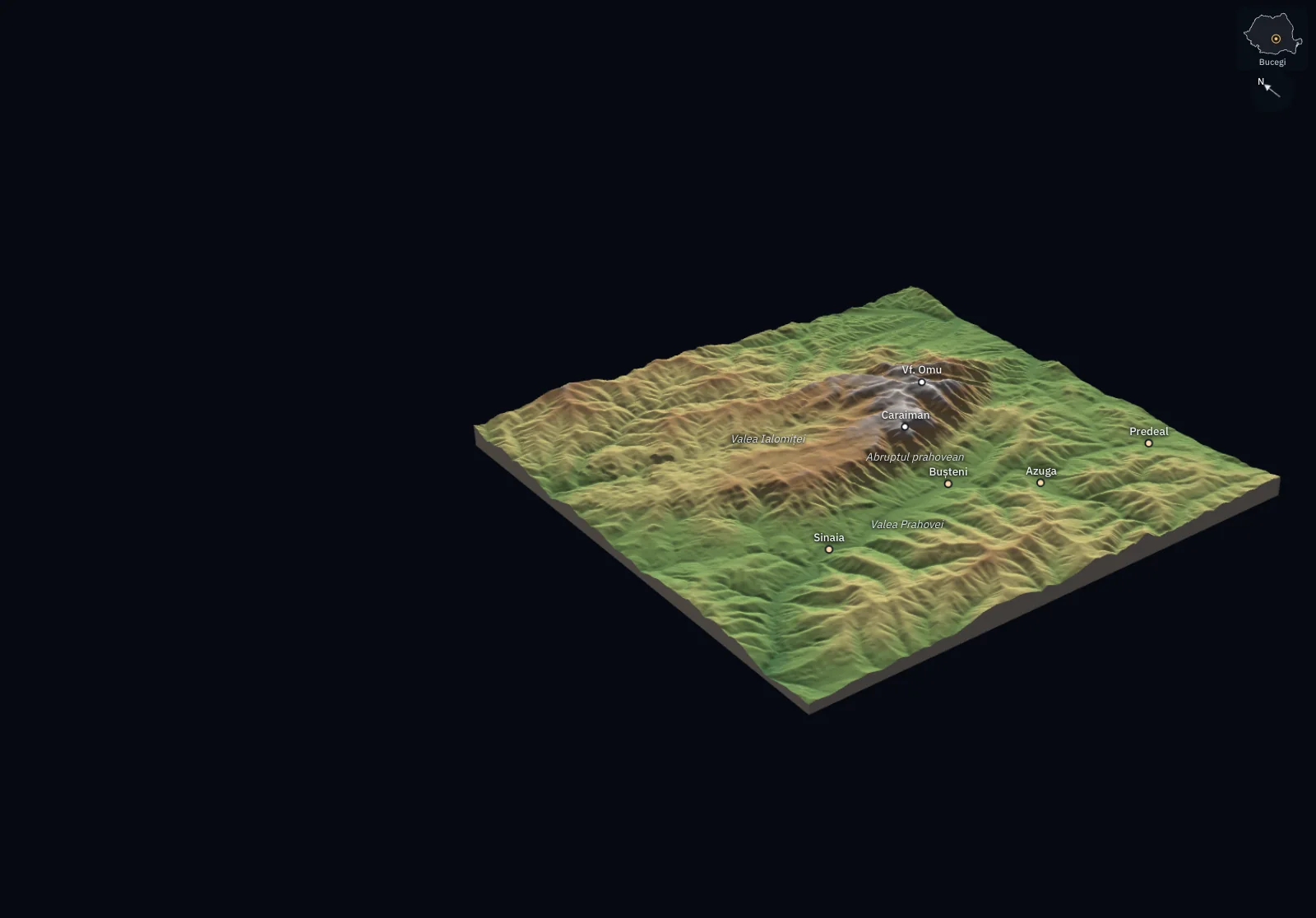
Gravity also created Lacul Roșu, a lake in the Eastern Carpathians: a slope gave way in 1837 or 1838 (sources give different years), damming the Bicaz stream. The lake behind the natural dam lies at an altitude of 983 m.
In brief
- Internal agents (plate movements, volcanism and earthquakes) create the great features of the crust; external agents (water, glaciers, wind, temperature, living things and people) shape them.
- Weathering transforms rock in place: physical weathering breaks it without changing its composition (freezing and thawing, scree), while chemical weathering changes its minerals (dissolution, oxidation).
- Erosion removes material, transport moves it, and deposition lays it down where the agent loses force.
- A torrent has a catchment basin, a channel and an alluvial fan.
- Gravitational processes move material down a slope under its own weight: falls on steep slopes and landslides, especially on waterlogged clay.
- In Romania, landslides are most frequent in the Subcarpathians and the Moldavian Plateau; at Pârcovaci, about 100 hectares slipped in December 1996.
Common mistakes
WrongChemical weathering, physical weathering and erosion are the same thing: rock breaks down.
RightPhysical weathering breaks rock in place, chemical weathering changes its minerals in place, and erosion removes material and carries it elsewhere.
WrongAny hill will slide after heavy rain.
RightRain triggers landslides mainly where there is a slope and clay-rich rock. An equally steep limestone or sandstone hill slides much less often.
WrongExternal agents only destroy landforms.
RightThey build landforms too: eroded material forms alluvial fans, floodplains, deltas, beaches and dunes.
Test yourself
Six questions. For the first five you see the explanation at once, with the paragraph of the lesson that supports it; for the ones with a written answer you compare with a good answer.
In winter, on a rock face in the Bucegi mountains, water in cracks freezes at night and thaws by day. After a few years, angular boulders have collected at the foot of the face. What process broke them away?
Answer
b) Physical weathering. Freezing and thawing break rock without changing its composition: this is physical weathering. The boulders collected below form scree.
In which part of a torrent is the material carried by water deposited?
Answer
d) On the alluvial fan. At the end of the channel the gradient decreases, the water loses force and leaves material in a fan shape: the alluvial fan.
Which situation describes erosion?
Answer
a) A mountain river picks up gravel from its banks and carries it downhill. Erosion involves removal. The statue and rock change in place (chemical and physical weathering), while the sand left on the floodplain is deposition.
What three conditions occur together in most landslides?
Answer
c) A slope, clay-rich rocks and plenty of water in the soil. Waterlogged clay becomes slippery, and the slope allows the mass of earth to move.
What triggered landslides in the Curvature Subcarpathians in 1977?
Answer
b) An earthquake with its epicentre in Vrancea. The shaking set in motion slopes that already had a gradient and clay-rich rocks.
A local council in the Subcarpathians wants to widen a road by digging at the foot of a clay hill that was deforested ten years ago. The spring has been rainy. What risk arises, and what two measures would reduce it?
A good answer
The risk is a landslide: the hill has a slope and clay, the soil is full of water, and the excavation removes support at its base. The risk falls if water is removed from the slope through ditches and drains, and if the slope is supported by a wall and replanted with trees. The work should be postponed until the ground dries.
A complete answer names the process, identifies the three conditions (slope, clay, water) and human intervention, and suggests measures that address water or support for the slope.
Terms
- internal agents
- Forces that draw energy from inside the Earth (tectonic movements, volcanism and earthquakes) and create the great features of the crust.
- external agents
- Forces that act on the surface of the crust (water, glaciers, wind, temperature, living things and people) and shape landforms.
- weathering
- The transformation of rock in place through physical and chemical weathering.
- physical weathering
- The breaking of rock into pieces without changing its composition.
- chemical weathering
- The chemical transformation of minerals in rock under the action of water and air.
- erosion
- The removal of material by water, ice, wind or waves.
- landslide
- The movement of a mass of earth down a slope, usually over a layer of waterlogged clay.
Sources and link to the programme
- British Geological Survey – Weathering – physical weathering by freezing and thawing; chemical weathering: rainwater with dissolved carbon dioxide is slightly acidic
- British Geological Survey – Erosion – erosion, transport, deposition
- British Geological Survey – Landslides – types of slope movement and their causes
- Analele Universității „Ștefan cel Mare” Suceava, Geografie, 2000 – C. Brânduș, Gh. Burican, Fenomene de risc geomorfologic în bazinul superior al Bahluiului – the Pârcovaci landslide in December 1996: about 100 ha, the right-hand slope of the Bahlui, 2.5 km of local road, two bridges, 70 ha of farmland, the cause (groundwater and snowmelt on an old landslide)
- INFP, proiectul ROEDUSEIS – Fișa IV.2, Alunecarea de teren – the earthquake of 4 March 1977: reactivated and newly triggered landslides, dammed streams (Zăbala), temporary lakes, dozens of houses destroyed (Colți, Buzău)
- Wikipedia – Lacul Roșu – natural dam lake formed in 1837 or 1838, altitude 983 m
From the programme: “Processes shaping the surface of the Earth’s crust” (common core). Programme competences covered: 1.3, 3.2.